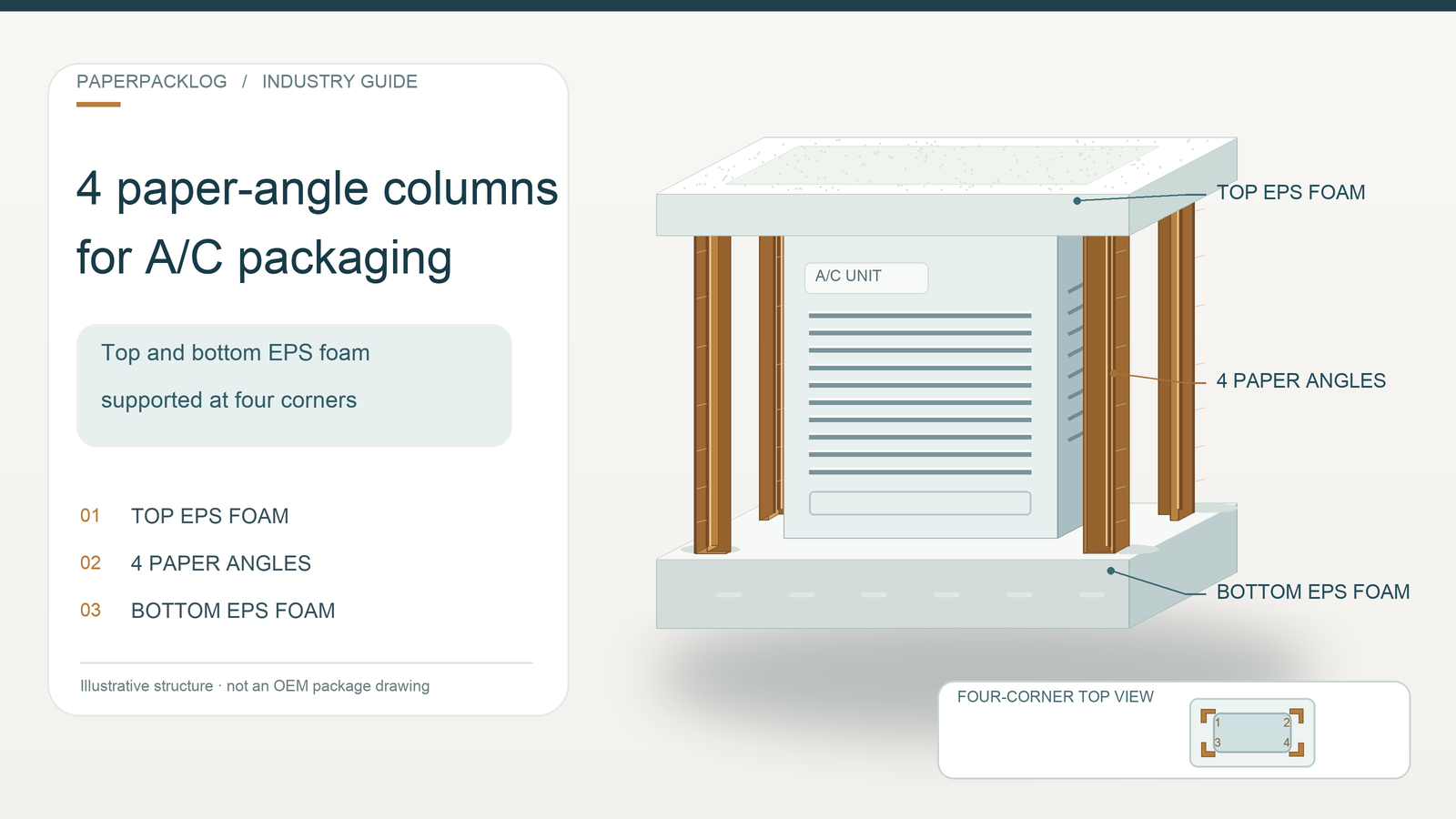
When someone says a paper angle board “goes into an air conditioner,” this guide means its shipping or storage package. It does not propose replacing an operating component or an installed metal bracket with paper. The illustration shows an A/C unit protected by top and bottom EPS foam pieces, with four paper angle boards standing at the corners like columns between them to support the upper foam. It is not a confirmed manufacturer’s package drawing or a verified load rating.
Our general angle-board guide covers the material and common uses. This article instead asks what the team must check before approving an air-conditioner package.
Trace the load path through four columns
The four illustrated columns run between corner support areas of the lower and upper EPS pieces. Check whether each end bears on its intended surface, whether loads are distributed among the four, and whether length variation, crushing or buckling tilts the upper foam toward the appliance. These columns join the two EPS protectors; they do not replace the EPS cushioning around the product.
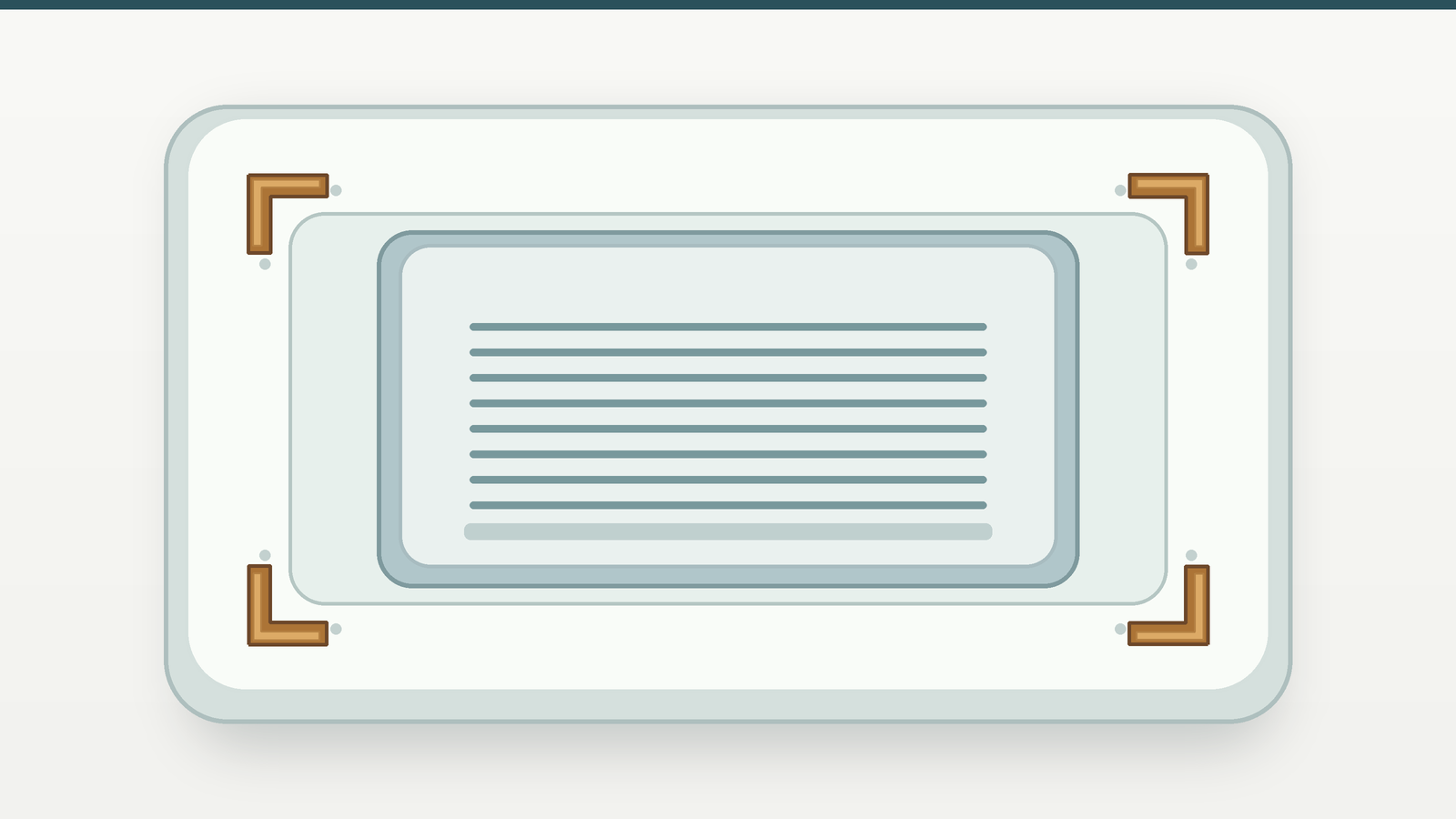
Example plan arrangement of four columns. Confirm the appliance and foam geometry from the actual model drawing.
Between the columns and the A/C unit, maintain clearances and cushioning appropriate to the model. Avoid pressing a column against vulnerable features such as the appearance panel or air outlet of an indoor unit or the pipe connections and coil fins of an outdoor unit. The outer carton is omitted from this schematic; the real carton, foam, boards and appliance must be evaluated as a complete package.
Strap protection on an outer carton or pallet edge is a separate application. It has different load paths and contact surfaces from the four-column arrangement shown here. Do not transfer specifications or test results between them merely because both use paper angle boards.
Ask for these inputs before choosing a thickness
YOONSUNG’s product page lists customizable wing widths, thicknesses and lengths. Those ranges describe manufacturing capability; they are not an approved specification or guaranteed performance for any air-conditioner model. A model-specific request for quotation should include:
- Packaged product and placement drawing: Is this an indoor or outdoor unit? Show the shape of both EPS protectors, the positions of all four columns, and their end contact surfaces. Include any outer-carton strapping positions.
- Product and carton geometry: Record mass and center of gravity, carton and EPS dimensions, wing width, board thickness and length, and clearances around the product and pipe connections. Set numerical values from the actual drawing and measurements.
- Loads: Determine the stack load transmitted through the top EPS into the four columns, the support area and length variation of each column, pallet orientation, number of stacking tiers and storage duration. Do not convert an angle-board-only strength figure into a whole-package rating.
- Material and environment: Agree on paper construction, lamination and adhesive quality, coating if any, and foreseeable humidity exposure. A “moisture-resistant” label alone proves neither wet strength nor recyclability.
- Acceptance criteria: Product engineering, quality and logistics teams should agree in advance on permissible surface marks, angle-board movement and carton damage.
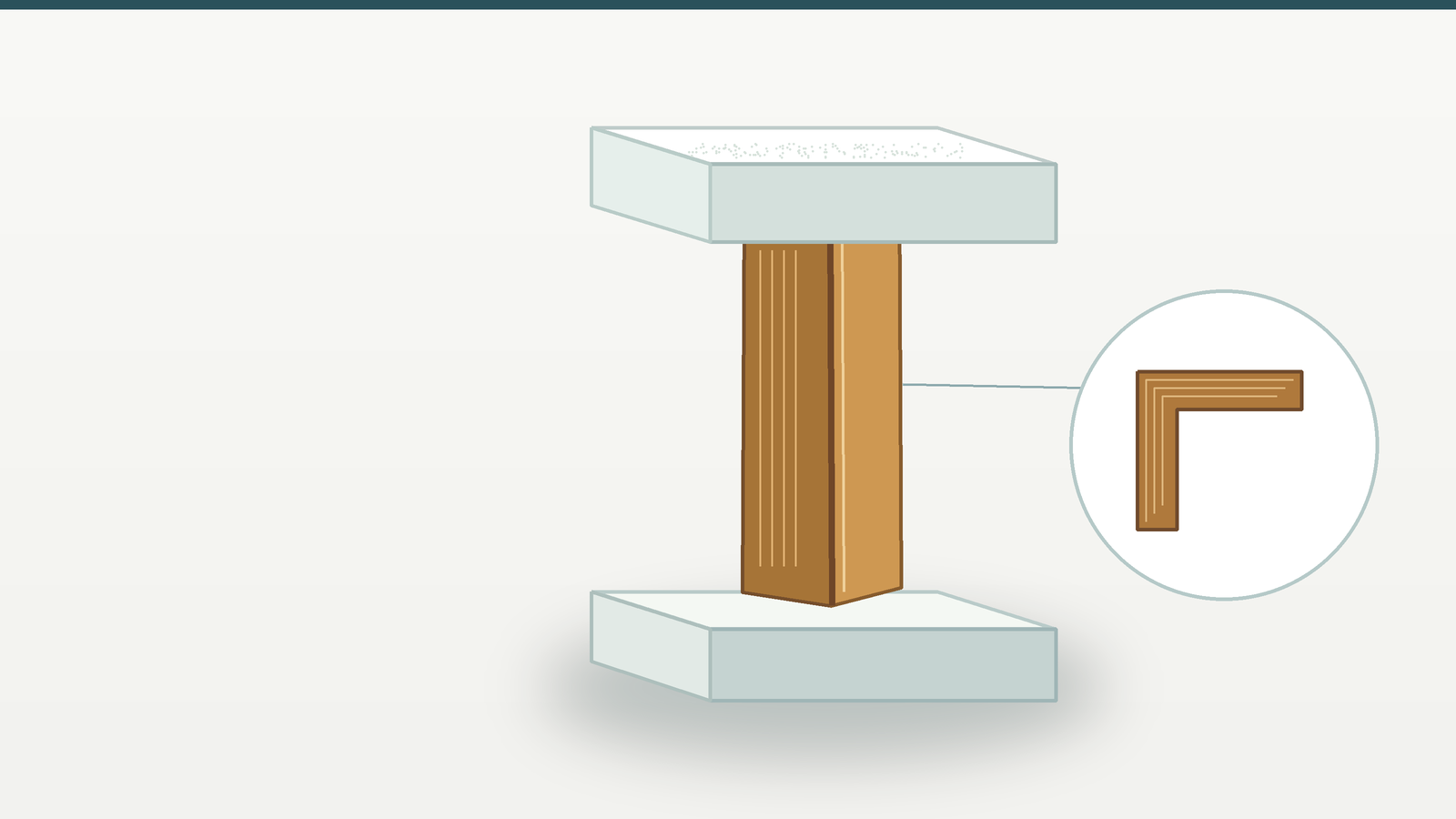
Enlarged end contact at one corner. The complete package uses all four columns; this drawing alone establishes no allowable load or cushioning rating.
Test the angle board and the finished package separately
For the angle board alone, inspect dimensions, thickness, cut edges, warping and delamination. If compression is specified, record specimen length, loading direction, fixture, temperature and humidity, units, and individual results so that supplier data are comparable.
For the finished package, test the actual A/C model with top and bottom EPS, all four paper angle columns and the outer carton together. After stacking, inspect tilt of the upper foam and crushing, buckling or movement of each column. After agreed handling, vibration and impact tests, unpack and inspect the product surface, pipe connections and fin-protection areas for contact marks. Where humidity is a credible hazard, agree on the exposure condition and compare before-and-after performance.
ISTA distinguishes early-design screening tests from tests that more broadly simulate distribution hazards. “ISTA tested” is therefore incomplete as an approval statement: the team must choose a procedure matched to the package type and distribution route, then specify what constitutes product damage. This guide assigns no universal ISTA procedure number or pass threshold to an air conditioner.
Records to retain for approval
- Supplier: drawing revision, angle-board dimensions, paper/adhesive construction, lot, individual measurements and tolerances.
- Appliance engineering and quality: areas that must not touch the reinforcement for each unit type, inspection points for appearance and function, and pass/reject criteria for the finished package.
- Logistics: actual palletization, strapping, handling and humidity conditions, damage photographs and reproducible failure locations.
- Change control: which supplier, paper, thickness, adhesive, coating or placement changes trigger a new test.
In short: this arrangement uses four paper angle columns between top and bottom EPS pieces, with sufficient clearance from the A/C unit and verification of the entire finished package. Define board-to-foam end contact, load on each column, stacking, humidity and distribution conditions, then approve the design from test evidence. Do not describe the boards as installed A/C parts or as replacements for the full EPS cushioning system.
About the Author
PackingMaster: PaperPackLog editor, covering packaging materials, market developments and practical technical guidance for the paper-converting industry.