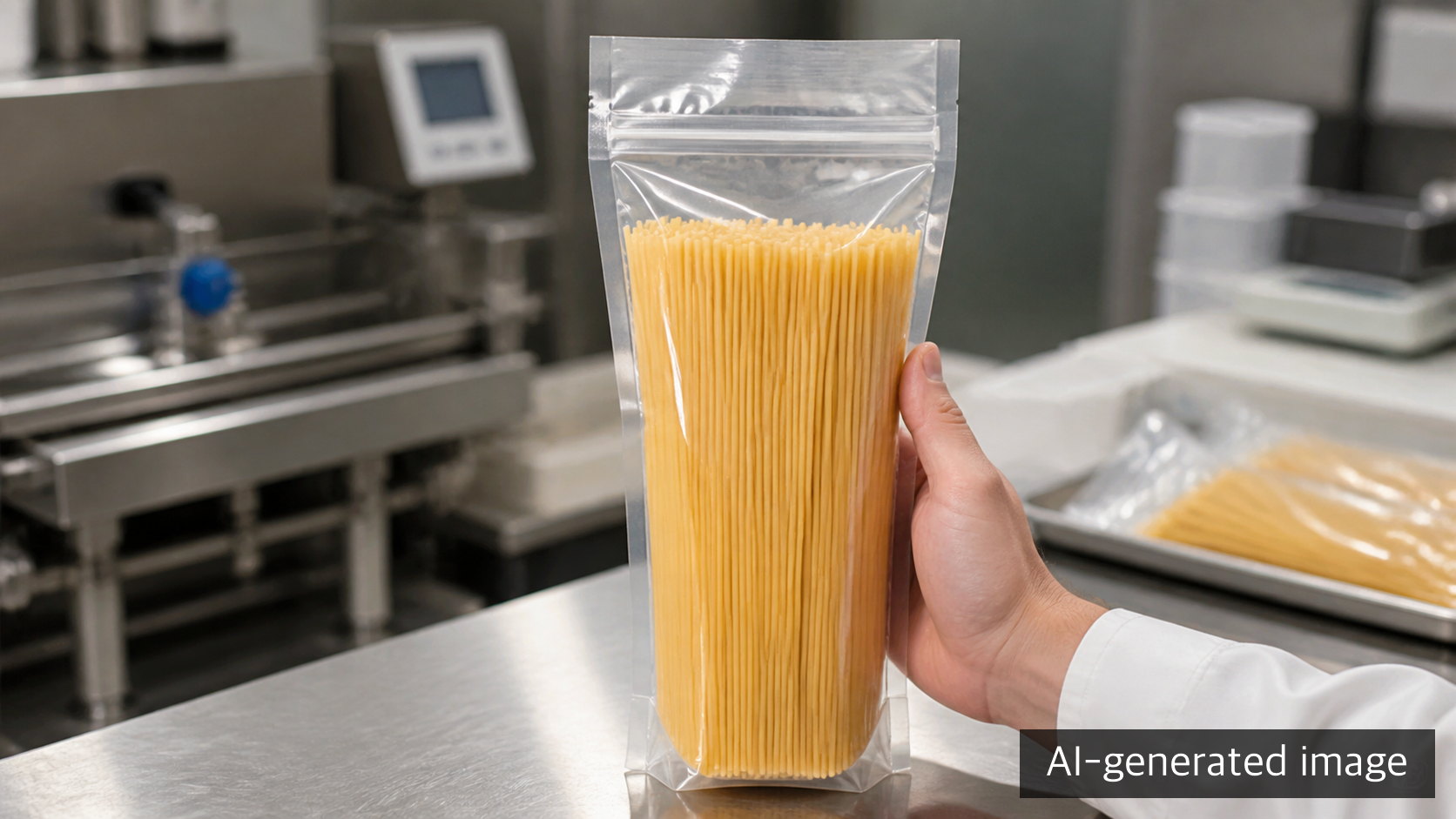
Italian packaging-machinery company Altopack introduced a transverse resealable zipper format for long pasta in August 2026. The consumer benefit is easy to understand: remove the required amount and close the pack again. For a manufacturer, however, the decision must begin with zipper feeding, seal conditions, product contamination, effective line speed and repeated-open-close quality, not convenience claims alone.
What the published sources say
Altopack’s announcement and coverage by Food & Drink Technology describe the following elements:
- A transverse resealable zipper is added to a long-pasta format positioned as an alternative to the conventional pillow bag.
- The zipper is intended to let consumers remove the desired amount and close the package again.
- A configuration with spaghetti divided into 100-gram bundles is also presented.
- Altopack identifies its Easy Lock and Future 250 and 400 equipment families as part of the solution.
- The company states a capacity of up to 300 packs per minute, depending on format and the number of bundles.
- Altopack says it has secured orders from customers in the United Kingdom and Europe.
The 300-packs-per-minute figure is a supplier claim at the upper end of the stated range. It should not be treated as a guaranteed production rate for every film, zipper and product configuration. Good-output speed will depend on pack dimensions, bundle count, zipper feeding, seal cooling, inspection and discharge conditions.
How the zipper changes the consumer experience
Long pasta is often used over several meals. A conventional pillow pack may require a clip or a separate container after opening, and an uneven torn edge can be awkward to store. A resealable zipper is intended to let the consumer take the required amount and organise the remainder in the original package.
The 100-gram bundle concept adds portioning convenience. Pre-grouped servings allow cooking quantity to be selected without a scale. If the bundle uses a band or another packaging component, however, its material, separation route and total packaging weight should also be reviewed. Added convenience does not automatically establish an environmental benefit.
On the line, a zipper is a new process
A zipper may look like one small added component, but it introduces feeding, tension control, registration, cutting, insertion, heat sealing, cooling and inspection. A small position error can reduce usability or interfere with the top seal and opening feature. Insufficient sealing can cause leakage; excessive heat can distort the web or damage the zipper profile.
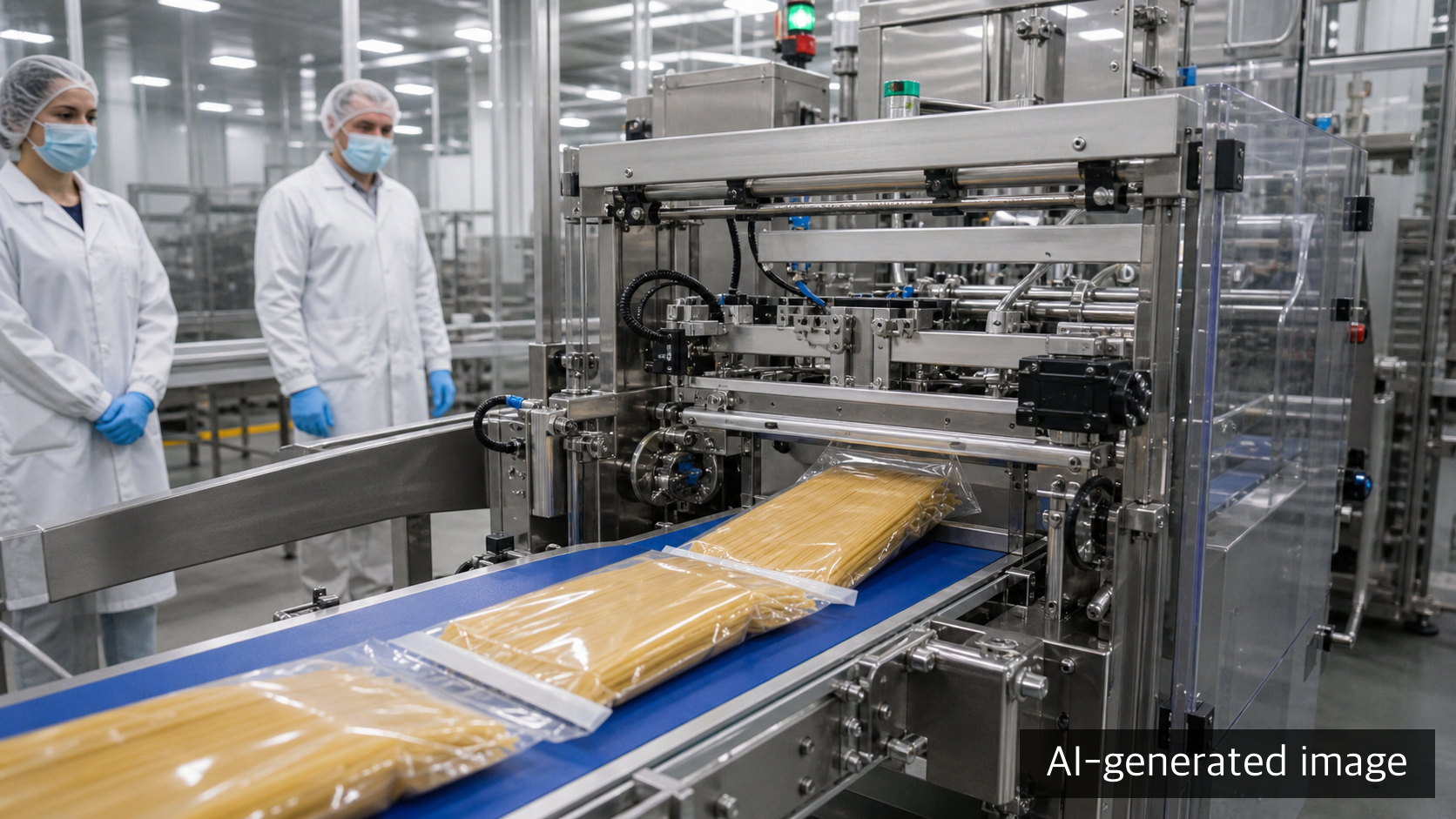
At minimum, the line review should cover these interfaces:
- Zipper-reel feeding and tension control
- Synchronisation between print registration, zipper cut and pouch length
- Seal temperature, pressure and dwell time between zipper flange and film
- Distance between top seal, tear feature and zipper
- Product-drop timing that keeps fragments and dust out of the seal area
- Cooling and discharge conditions that prevent deformation immediately after sealing
- Sensors or vision systems that detect missing, displaced or inadequately sealed zipper sections
Before assuming that a zipper module can simply be added to an existing machine, inspect the web path, available frame space, servo and PLC capacity, guarding and cleaning access.
Quality risks specific to long pasta
Spaghetti is long and rigid, but brittle under impact. Fragments and dust created during filling can enter the zipper profile or heat-seal area, affecting reclosure and leak performance. During conveying and case packing, stiff pasta ends can also create concentrated loads against the film.
A validation plan therefore needs more than the standard checks used for powders or snack pouches:
- Product-length distribution and breakage rate
- Reclosure after dust or broken pasta contaminates the zipper
- Tensile or peel strength of top, side and bottom seals
- Zipper engagement after repeated opening and closing
- Pinhole and seal damage after face, edge and end drops
- Film puncture by pasta ends after distribution vibration
- Web and seal dimensional stability under temperature and humidity exposure
- Ease of gripping and opening without tools or gloves
A practical pre-production test matrix

A pilot should not test only one run at top speed. Build a matrix with controlled variables and predefined acceptance criteria.
| Test | Variables | Main acceptance criteria |
|---|---|---|
| Zipper attachment | Temperature, pressure, dwell | Peel strength, web shrinkage, profile distortion |
| Registration | Low, rated and maximum speed | Offset between zipper centre and tear/opening features |
| Contamination tolerance | Clean, dust and broken pieces | Reclosure, leakage and visual condition |
| Repeated opening | Initial, 5, 10 and 20 cycles | Engagement feel, profile separation and leakage |
| Drop | Face, edge and pasta-end orientations | Pinhole, seal rupture and product breakage |
| Distribution vibration | Time and amplitude levels | Film abrasion and puncture by pasta ends |
| Productivity | Bundle count, pack size and speed | Good packs per hour, stops and scrap rate |
| Storage | Temperature, humidity and time | Seal retention, dimensional change and odour |
Acceptance criteria should use numbers and sample sizes rather than vague language such as “does not open”. Zipper-position tolerance, minimum peel strength, reclosure cycles, allowed leaks and drop height should be included in the product specification.
How to interpret “up to 300 packs per minute”
The more useful KPI is good packs per hour. Even if a machine briefly reaches 300 packs per minute, effective output will be lower if zipper-reel changes, web splicing, product jams, cleaning and quality stops are frequent.
During production trials, record these separately:
- Time at continuous stable operation
- Planned and unplanned downtime
- Frequency and mean recovery time of zipper-related microstops
- Film and zipper scrap during start and stop
- Packs that pass appearance, seal and weight criteria together
- Time from format change to the first acceptable pack
The product-feeding system must also support pack rate multiplied by bundle count. If several 100-gram bundles are loaded into each pack, bundle formation, alignment and missing-bundle inspection may become the real bottleneck.
Questions to ask before purchase and implementation
Film and zipper
- Which film structures and thickness ranges have been validated?
- How are the zipper material and the film sealant layer matched?
- What requalification is required if the zipper supplier changes?
- What are the positional tolerances between print mark, tear feature and zipper?
Equipment and controls
- What FAT and SAT good-output rate is guaranteed for each product, rather than the nominal speed?
- Which sensors detect a missing zipper and inadequate attachment?
- How are rejects discharged, and how is reject confirmation monitored?
- What is the measured downtime for zipper-reel changes and web splicing?
- In what format are recipe changes, alarm history and quality data stored?
Maintenance and hygiene
- How often must the zipper-insertion area and sealing jaws be cleaned and inspected?
- Are there product-dust traps or inaccessible hygiene zones?
- What is the replacement time for wear parts, and how are local spare parts supported?
- Can the zipper module be bypassed when producing a conventional pack?
Sustainability statements require separate evidence
The published coverage says reclosure can help maintain freshness and reduce waste. The accessible sources, however, do not quantify food-waste reduction, total film weight, the effect of the added zipper on material complexity, recyclability or carbon emissions.
Before making a marketing claim, confirm the full packaging structure and weight and test its compatibility with collection, sorting and recycling systems in the target market. It is also safer to verify whether the resealable feature changes real storage behaviour through user testing or market data.
Conclusion
Altopack’s transverse zipper brings a familiar convenience feature to a relatively traditional long-pasta package. In production, success will depend less on the concept itself than on whether the line can attach the zipper consistently without product contamination, preserve reclosure quality and maintain the target good-output rate.
A proper adoption programme should connect consumer evaluation, film-and-zipper compatibility, seal window, contamination tolerance, drop and vibration performance, line speed and scrap in one pilot plan. A convenience idea becomes a packaging innovation only after it has been converted into a stable and measurable production condition.
About the Author
PackingMaster: Editor of PaperPackLog, covering packaging materials, equipment, product developments and production-validation practice.
References
- Altopack, We launch our new resealable zip packaging for spaghetti, 3 August 2026.
- Food & Drink Technology, Resealable zip pack elevates long-pasta convenience, 4 August 2026.
Sources checked on 6 August 2026. Published speed and performance figures are supplier claims and require product-, material- and equipment-specific validation before adoption.