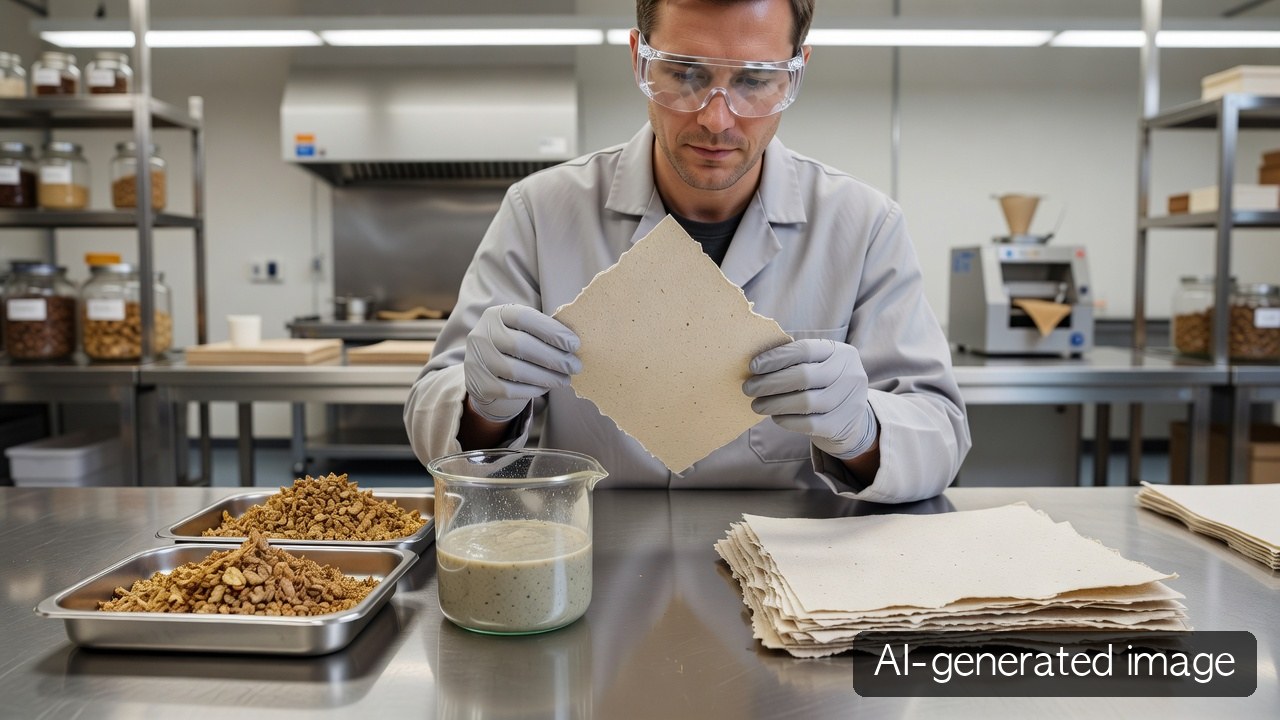
A strength headline about paper made with apple pomace can quickly invite ideas for food containers or shipping cases. Paper and packaging R&D, quality and production teams have a more immediate question: can pomace-lot variation be controlled, can the result be reproduced at matched basis weight, density and sheet-making conditions, and can water, grease and converting requirements be met? This article keeps the early laboratory result at its stated scale and turns the next unknowns into a pilot approval table.
Evidence scope—checked September 9, 2026: On September 3, Massey University described a student project and related work in which supplementing conventional wood pulp with 20% apple pomace reportedly increased both tensile strength and tensile stiffness by approximately 50% versus wood-pulp paper alone. The release identifies a laboratory-scale handsheet system, preliminary findings, proof-of-concept status and future barrier and commercial-feasibility work. It does not disclose whether the 20% is on a dry basis, nor the basis weight, density, refining, wet pressing, drying, test methods, replicate count, raw data or variability. A September 8 Farmers Weekly article repeats the university account and is therefore not independent replication.
Difference from earlier coverage: The oat-hull pulp article discussed the general packaging potential of agricultural by-products, while the alternative-fiber article covered the broader supply, strength, converting and recycling data package. This article locks the scope of one specific
20% blend / approximately 50% in two mechanical propertiesresult and focuses on staged approval through barrier and scale-up work.
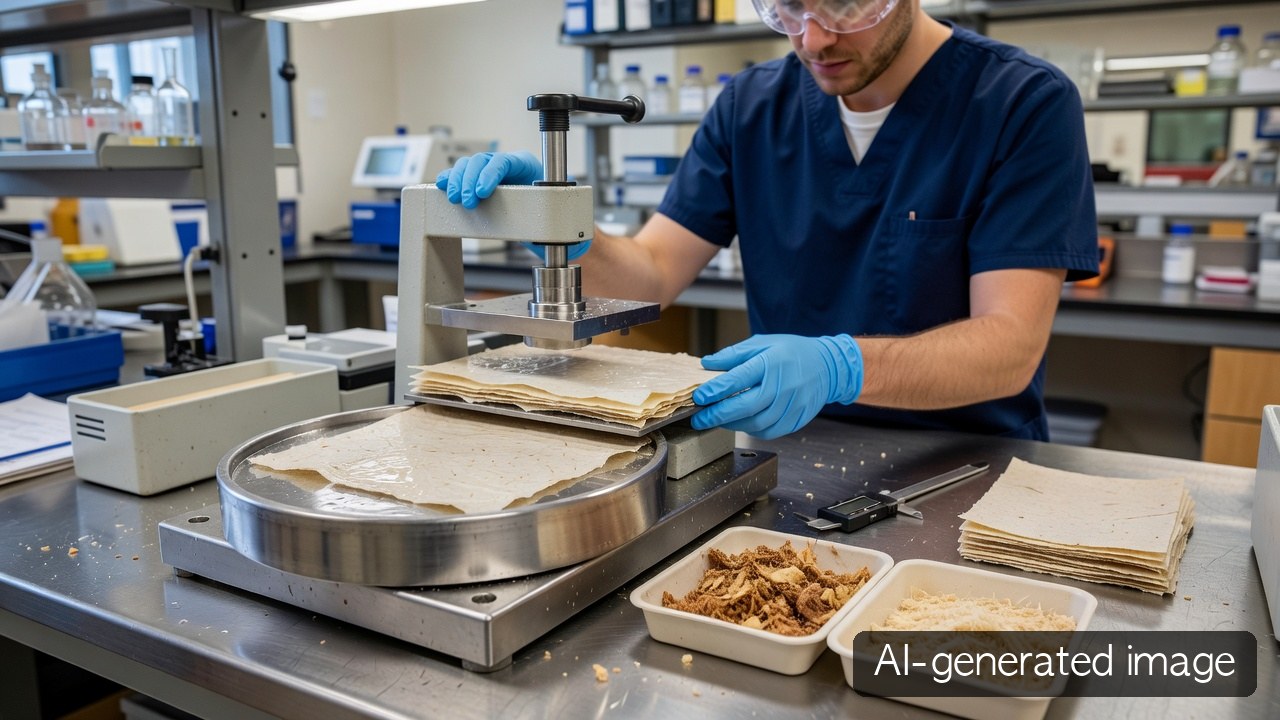
What the 20% and Approximately 50% Figures Actually Cover
| Public wording | Confirmed scope | Condition not disclosed | Plant interpretation |
|---|---|---|---|
| 20% apple-pomace supplementation | Research condition blending pomace with wood pulp | Dry-basis definition, pretreatment yield, particle and fiber fractions | Do not copy into a recipe until the material and calculation basis are known |
| Approximately 50% increase in tensile strength | Preliminary comparison with wood-pulp-only handsheets | Basis weight, density, specimen direction, method, replicates, raw data | Do not call it a production-scale strength improvement before matched-condition reproduction |
| Approximately 50% increase in tensile stiffness | Mechanical property reported separately from strength | Stiffness definition, conditioning and statistical variation | Do not collapse into “50% stronger overall” |
| Barrier improvement work | Water and oil resistance identified as the next technical focus | Water-vapor, oxygen or grease data; coating composition and coat weight | Barrier performance is unresolved |
| Food-service potential | Takeaway containers and other food-service formats mentioned as possible applications | Jurisdiction, migration, sensory, hygiene and shelf-life evidence | Not a food-contact approval |
| Commercial feasibility | Described as future work | Supply, cost, yield, energy, line speed and defect data | Commercial readiness not established |
Tensile strength and tensile stiffness are different properties. Reducing two reported improvements to “the packaging is 50% stronger” can imply that burst, tear, compression, fold, impact and wet performance also improved. Define the target structure—case, tray, cushioning component or coating base—then test the loads that structure actually experiences.
A. Feedstock-to-Handsheet Reproduction Table
First reproduce the result under known feedstock and process conditions. Leave undisclosed values as questions for the researchers, supplier or internal measurement rather than inventing them.
| Input or observation | Wood-pulp control | Apple-pomace blend | Status and next action |
|---|---|---|---|
| Feedstock lot | [species/pulp type/production date] | [apple variety/processor/collection date/lot] | Hold testing when origin and lot cannot be traced |
| Moisture and solids | [method/value] | [as received and after drying, method/value] | Do not compare a 20% blend without a dry-basis conversion |
| Pretreatment | [refining/washing condition] | [washing/drying/milling/screening/storage] | Record controls for residual sugar, oil, foreign material and microbial risk |
| Actual blend | [dry mass] | [wood-pulp and pomace dry mass with calculation] | Do not equate input mass with retention in the sheet |
| Fiber and particle distribution | [length/fines] | [distribution/fines/non-fiber fraction] | Redesign blending or screening when lot variation is material |
| Handsheet process | [forming/pressing/drying/conditioning] | [matched condition] | Do not compare mechanical properties across different process conditions |
| Basis weight, thickness and density | [individual values/mean/variation] | [same format] | Match or separately account for basis-weight and density effects |
| Yield and drainage | [drainage time/white-water solids] | [same format] | Reassess yield and drying load if drainage slows or fines are lost |
Apple pomace contains skins, pulp and seeds left after fruit processing. Variety and season matter, but so do juicing, washing and storage. The project participant’s statement that apples are processed nearly year-round in Hawke’s Bay is a useful signal of regional availability; it is not evidence of contracted monthly volume or storage stability.
B. Performance-to-Packaging Approval Table
| Test package | Condition to hold constant | Result to record | Approval basis or hold condition |
|---|---|---|---|
| Tensile strength and stiffness | Same basis weight, density, conditioning, direction and method | Individual values, mean, variation and failure mode | Compare with the incumbent and customer specification; do not use the public 50% as a pass limit |
| Burst, tear and fold | Target structure and converting direction | Initial and repeated-use change | Do not substitute tensile data for these properties |
| Compression or forming | Case, tray or cushioning geometry and humidity | Load, deformation, recovery and cracking | Hold expansion until the prototype meets the internal requirement |
| Water barrier | Substrate, coating, coat weight, temperature, humidity and test side | Absorption, transmission, edge penetration and time response | Separate uncoated sheet from the finished structure and judge against distribution conditions |
| Grease barrier | Test oil, temperature, contact time and fold area | Penetration, staining and coating cracks | A flat coupon does not approve formed corners or folds |
| Odor, foreign matter and hygiene | Feedstock lot, storage, drying and heat history | Sensory, contamination and hygiene-control results | For food-near or food-contact uses, hold until the applicable documents and tests are complete |
| Printing, bonding and forming | Ink, adhesive, die, speed and drying conditions | Feeding, dust, print spread, fold, bond and defects | A laboratory handsheet still requires an actual converting trial |
| Recyclability | Finished pack with coating, adhesive and print | Repulping, screening, residue and sticky impact | Do not make a recyclability claim from the fiber name alone |
| Scale-up and total cost | Input, yield, water, energy, cleaning, speed and rejects | Material, energy, waste and time per good unit | Do not infer economics from laboratory strength alone |
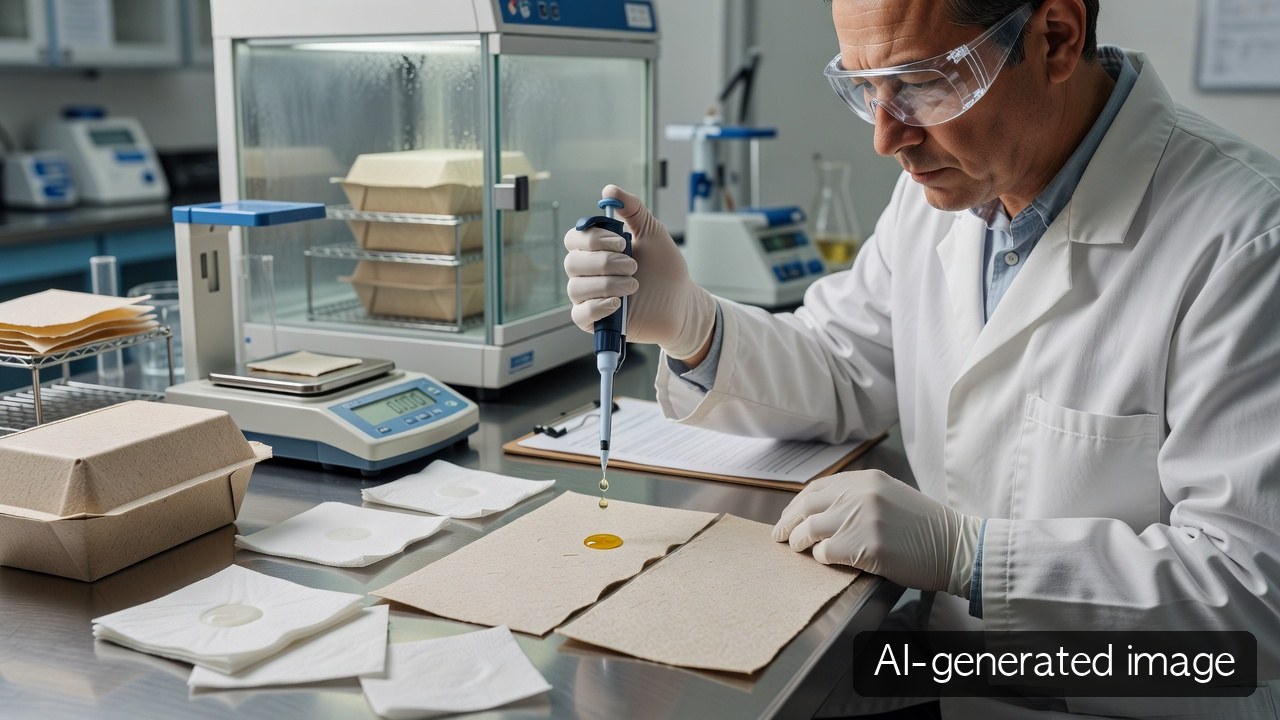
G0–G6 Pilot Approval Sequence
G0. Lock the Public Claims and Missing Data
Record 20%, approximately 50%, proof of concept, laboratory handsheets, barrier work in progress and future commercial-feasibility assessment exactly as disclosed. Record the missing test method, raw data, variation and recipe in the same status map.
G1. Create an Apple-Pomace Feedstock Specification
Define processor, apple variety and process, collection time, moisture, residual sugar and oil, foreign material, storage temperature and duration, washing, drying, milling and lot-change control. Test variation across different dates and lots rather than relying on one sample.
G2. Reproduce the Handsheet Result at Matched Conditions
Match basis weight, thickness, density, refining, forming, pressing, drying and conditioning between the wood-pulp control and the blend. Record individual tensile-strength and tensile-stiffness results with variation, and confirm the equation and denominator behind the approximate 50% figures.
G3. Verify Barrier Performance in the Finished Structure
Start with the water and grease resistance that the public release identifies as the main technical hurdle. If a plant-based coating is used, record solids, coat weight, drying or curing, pinholes, fold cracking and edge absorption. Add oxygen, aroma or gas testing only where the intended product requires it.
G4. Move to the Actual Pack and Converting Line
For a takeaway container, test forming, nesting, lid fit, leakage, stacking and use temperature. For a case or board, test printing, die cutting, bonding, compression and humidity exposure. Flat handsheet tensile data do not replace finished-pack performance.
G5. Complete Food-Contact and Recyclability Evidence
Review the applicable food-contact documents and tests for the final structure, including feedstock, pretreatment, coating, additives, ink and adhesive. Evaluate recyclability on that finished pack as well; apple-pomace fiber alone does not determine coating, adhesive or print behavior in a recovery process.
G6. Decide Repeatability and Commercial Feasibility
Across multiple feedstock lots and production dates, compare yield, drainage and drying load, speed, cleaning, odor, rejects and cost per good unit. Expand only after customer specifications, supply terms and change control are also in place.
Hold Approval Immediately When
- The 20% is used without knowing whether it is wet or dry mass.
- The two approximately 50% increases are collapsed into “all packaging performance improved by 50%.”
- Sheets with different basis weight, density, refining, pressing, drying or conditioning are compared directly.
- The announcement is described as an independently verified paper or commercial-line result.
- Food-container use is approved without water and grease data and test conditions.
- Food-contact suitability or recyclability is declared simply because the input is plant-based.
- One seasonal sample is used to establish year-round supply and quality stability.
- Only feedstock price per kilogram is compared while yield, drainage, drying, cleaning and rejects are omitted.
The early apple-pomace result shows that a processing by-product may supplement part of the wood fiber while improving selected handsheet mechanical properties. What the public material currently establishes, however, is a laboratory proof of concept and a list of next research steps. Development must reproduce the feedstock, process and test conditions; quality must approve barrier, food-contact and recycling evidence; and production must approve drainage, drying, converting and repeatability. Only when those blanks contain plant data does an interesting research result become a scale-up decision.
About the Author
PackingMaster: Editor of Paper Pack Log. We collect and organize market trends, product information, and technical insights for the paper packaging industry.
References
- Massey University, “Turning apple leftovers into tomorrow’s food packaging innovation” (September 3, 2026; university project description and preliminary findings)
- Background: Farmers Weekly, “Apple waste shows promise for food packaging” (September 8, 2026; a report derived from the university account, not an independent replication)