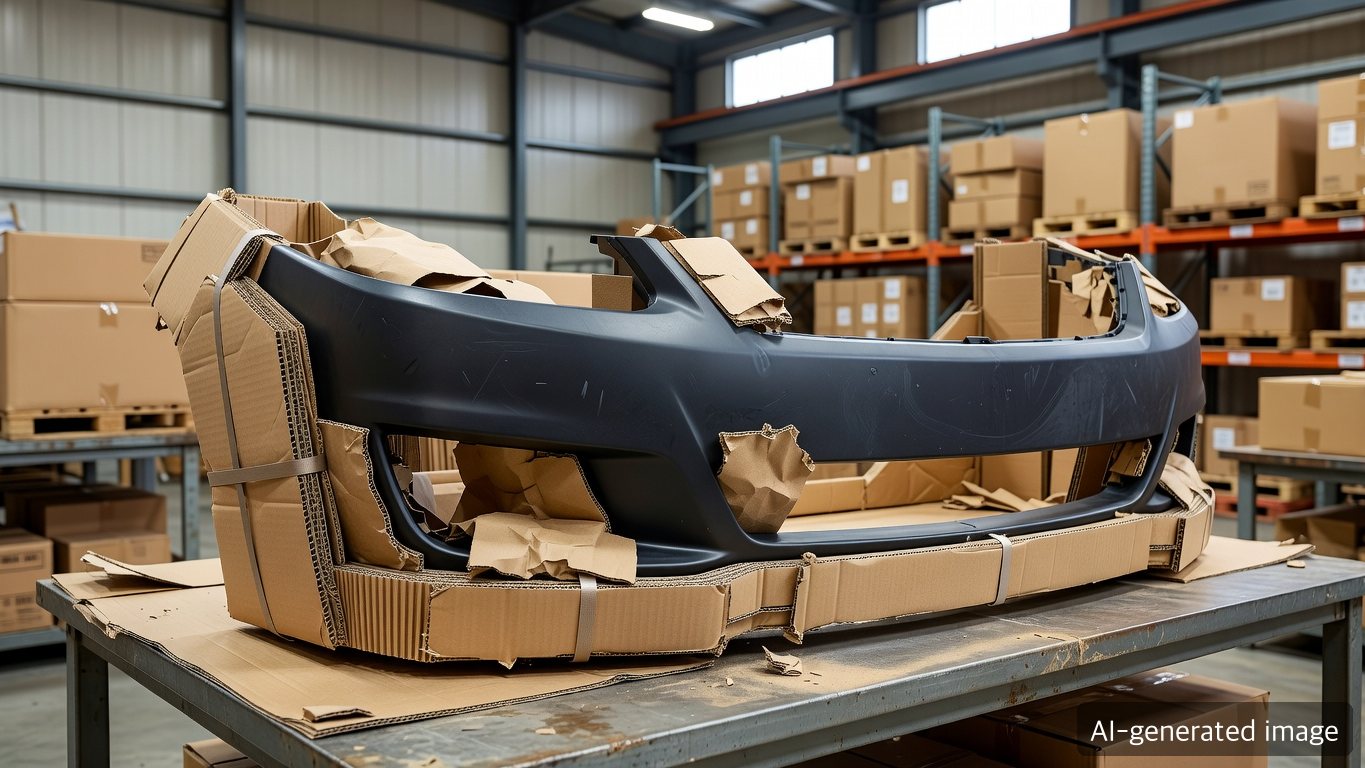
In automotive parts e-commerce, small brackets and sensors are rarely the hardest items to pack. The bigger challenge is often large, long, surface-sensitive parts such as bumpers, door panels, trims, and mouldings. Even when the product is not extremely heavy, it is bulky, awkward to handle, vulnerable at the edges, and exposed to drops, compression, vibration, and abrasion across parcel hubs, warehouses, and last-mile delivery.
That is why many teams first think of wooden crates, plastic cushioning, or excessive wrapping. The recent Mondi and Ovoko bumper packaging case shows another route: large automotive parts can sometimes move to geometry-matched heavy-duty corrugated packaging while improving both cost and protection. According to the published case, the project reduced empty space and optimized material use around the bumper shape, cutting unit packaging costs by up to 42%. The solution was tested under real-life shipping conditions, and the first trial order was delivered within two weeks.
This article is not a general introduction to corrugated box design. It focuses on the structural, protection, cost, e-commerce, and returns questions that matter when shipping large automotive parts.
Why Car Bumper Packaging Is Difficult
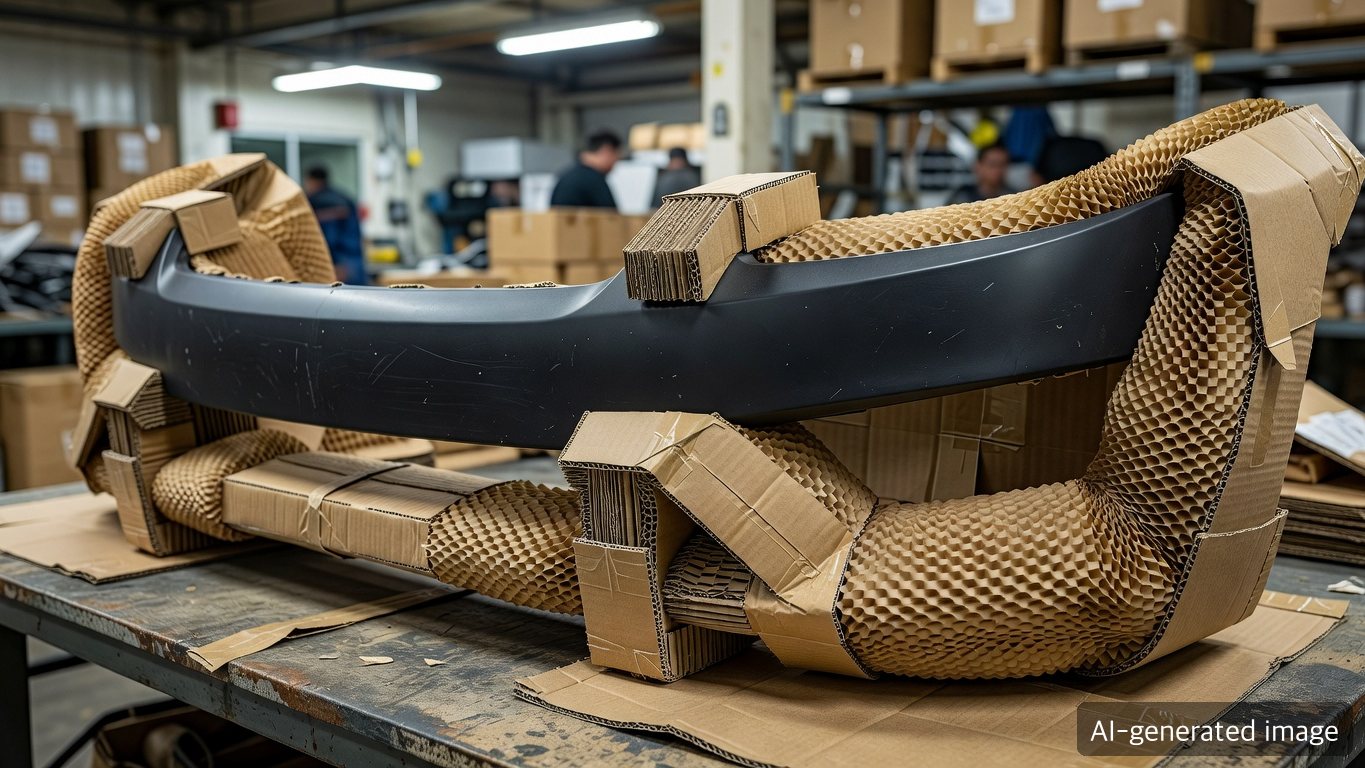
Bumper packaging is not simply a matter of choosing a larger box. Bumpers are long and curved, so a standard rectangular box often creates excessive void space around both ends and the center. That empty space increases box size, freight cost, and internal movement.
The main risks include:
- Surface scratches: painted, coated, or decorative areas can be damaged by abrasion.
- End damage: bumper ends and mounting areas concentrate impact during drops.
- Box deformation: long packages can bend, buckle, or collapse in the middle.
- Oversized packaging cost: a box larger than the product increases board use, void fill, and dimensional weight.
- Returns logistics: customers or repair shops may need to repack the product, so complex or single-use structures can increase return damage.
For automotive parts, corrugated packaging cannot be specified only by outer dimensions. The weak directions of the product, claim-sensitive surfaces, assembly steps, and repeatability for warehouse operators all matter.
What the Mondi-Ovoko Case Shows
According to Mondi’s announcement and Packaging Insights’ report, Ovoko had been dealing with costly packaging that did not provide enough protection. Mondi adapted a heavy-duty solution from its automotive packaging portfolio for e-commerce logistics and shaped the package around the actual bumper geometry.
Three lessons stand out.
1. Reducing empty space can improve both protection and cost
In large-part packaging, empty space is not just waste. It allows the product to move, requires additional cushioning, increases shipping volume, and can make the box more vulnerable to compression. A corrugated structure shaped around the bumper can hold the product in the right places and reduce unnecessary material.
2. Heavy-duty corrugated is structural design, not just a thicker box
For automotive parts, simply increasing board strength is rarely enough. Crease lines, reinforcing ribs, double-wall areas, edge supports, internal locking tabs, and pad locations must work together. The design should separate impact zones from compression zones so that protection is maintained without adding excessive material.
3. Real logistics testing becomes the approval standard
The published case notes that the solution was tested under real-life shipping conditions before approval. For automotive e-commerce, physical testing matters more than theoretical strength. Long and irregular products can fail in unexpected ways depending on drop orientation, conveyor impacts, stacking pressure, and vehicle vibration.
Cost Points When Replacing Wood or Plastic
The reason to consider corrugated for large parts is not only the sustainability message. For procurement and operations teams, the bigger question is total cost.
Key cost items include:
- Packaging material cost: box, internal pads, reinforcements, tape, and protective paper.
- Assembly time: how long one operator needs to pack one product.
- Storage volume: whether the structure stores flat and reduces warehouse space versus wood or molded plastic.
- Shipping volume: whether a shape-matched design lowers dimensional weight or oversize charges.
- Damage and returns cost: reshipment, customer support, inventory loss, and disposal.
- Return usability: whether the customer can close and reuse the same structure for return shipment.
The “up to 42% reduction in unit packaging cost” in the Mondi-Ovoko case should not be read as “corrugated is always cheaper.” It is better understood as the result of combining void-space reduction, material optimization, operational efficiency, and improved protection.
Design Checklist: Where Should Large Parts Be Supported?
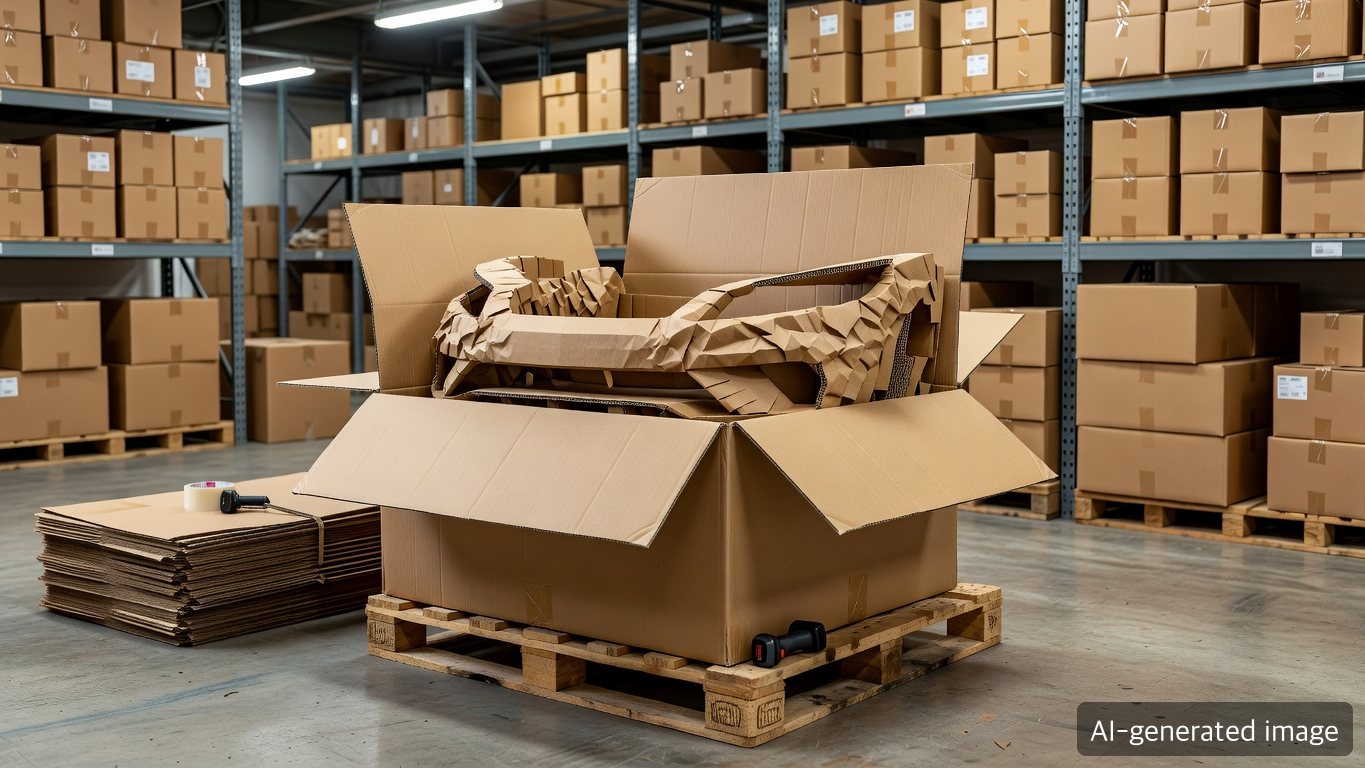
For long, thin parts such as bumpers, side skirts, and door trims, the goal is not to fill every millimeter of the box. The goal is to hold the vulnerable points correctly.
Practical checkpoints include:
- End protection: use folded pads, double layers, or reinforced zones where drop energy concentrates.
- Center support: long parts can sag or force the box to bend if the middle is unsupported.
- Surface separation: prevent painted surfaces from rubbing directly against corrugated board; use paper wraps, sleeves, or spacing features where needed.
- Movement control: limit movement in all directions without compressing or deforming the product.
- Assembly error prevention: folding sequence and locking points should be intuitive for warehouse staff.
- Opening and return handling: reduce knife use and consider closures that can be reused for returns.
- Label placement: long boxes need a flat area where shipping labels will not bend around corners.
When these points are addressed, the package becomes more than an outer box. It becomes a combined product-holding fixture and transport container.
What E-Commerce and Returns Add to the Problem
B2B industrial shipments are often packed by trained staff and move through relatively predictable logistics routes. Automotive parts e-commerce is different: product sizes vary by order, customers and repair shops may handle the package, and returns are possible.
Additional factors include:
- Multi-SKU coverage: decide whether one structure can cover several bumper or moulding lengths, or whether size families are needed.
- Fast packing workflow: folding, inserting, and taping steps must be few enough to protect fulfillment speed.
- Unboxing experience: the customer should not scratch the painted surface while removing the product.
- Return instructions: simple markings for replacing internal supports can reduce return damage.
- Carrier handling: long packages may face both automated equipment limits and manual handling risks.
For categories with frequent returns, the question is not only whether the package protects the first outbound shipment. It should also provide reasonable protection when used again.
When Corrugated May Not Be Enough
Heavy-duty corrugated is not the right answer for every automotive part. Wood, plastic, foam, metal racks, or hybrid packaging may still be needed in cases such as:
- very heavy metal parts with concentrated point loads;
- oily, wet, sharp-edged products that can quickly damage paper-based materials;
- long outdoor storage or extreme humidity exposure;
- established returnable rack systems already in place;
- premium surfaces requiring separate non-abrasive inner protection;
- export shipments with special corrosion prevention, hazardous goods, or regulatory requirements.
The goal is not to convert every component to paper. It is to identify where corrugated can reduce total cost and damage risk, and where additional surface protection or structural reinforcement is still necessary.
Questions to Ask Before Redesigning the Package
Before specifying heavy-duty corrugated for automotive parts, clarify the following:
- What are the actual weight, length, and weakest areas of the product?
- Are claims mainly caused by scratches, breakage, deformation, or missing parts?
- How much empty space and cushioning does the current package use?
- How many minutes does one operator need to pack one unit today?
- Can a customer reuse the same structure for a return shipment?
- Which validation is required: drop, vibration, compression, or real parcel shipment testing?
- How do storage volume and disposal cost compare with wood or plastic alternatives?
- Do carrier size rules, long-item surcharges, or dimensional weight thresholds change the economics?
These questions move the discussion from “Can corrugated work?” to the more useful question: “What structure would make corrugated work?”
Conclusion
The Mondi-Ovoko bumper packaging case shows that corrugated can be more than a secondary packaging material for large automotive parts. With the right structure, it can replace or complement wood- and plastic-heavy approaches while reducing empty space, supporting vulnerable points, and improving operational efficiency.
The key is not to choose a thicker box. The key is to design around the product geometry, fix the damage-critical points, simplify packing, consider returns, and validate the result under real logistics conditions. As automotive parts e-commerce grows, packaging will increasingly affect not only product protection but also fulfillment speed, freight cost, return quality, and customer trust.
About the Author
PackingMaster: Editor of Paper Pack Log, curating market trends, product information, and technical insights for the paper packaging industry.
References
- Mondi, “Ovoko cuts eCommerce packaging costs for car bumpers by up to 42% with Mondi,” 2026, https://www.mondigroup.com/news-and-insight/2026/ovoko-cuts-ecommerce-packaging-costs-for-car-bumpers-by-up-to-42-with-mondi/
- Packaging Insights, “Mondi and Ovoko collaborate on e-commerce car parts packaging,” 2026, https://www.packaginginsights.com/news/mondi-ovoko-car-parts-packaging.html