
A store may hold several bundles of visually identical paper chicken boxes while a recall notice identifies only a product name and manufacturing date. Discarding every similar box without tracing it is uncontrolled; continuing to use stock because it looks normal is worse. Procurement, quality and operations should first connect the recalled product, manufacturing date, internal item code, received lot and point of use in one isolation table.
A Korean recall publicized in August 2026 provides a useful case for reading “total migration” without exaggeration and for building a release process around evidence rather than appearance.
What the public sources confirm
The KCCI hazardous-product blocking system, which displays linked MFDS inspection information, and reports dated 7 and 10 August support the following scope:
Paper food container_acrylic resin coating, manufactured by Packstar, was subject to a stop-sale and recall for a non-compliant total-migration result.- The blocking-system record identifies the government inspection body as
Ministry of Food and Drug Safety — Food, document number3000232278, and report type asnon-compliant self-quality inspection. - Its non-compliance result field states
4% acetic acid: 85 mg/L; the specification field is blank. - The action was reported as starting on 7 August 2026, and the record names Namyangju City in Gyeonggi Province as the issuing authority.
- The manufacturing date is 23 July 2026.
- The pictured container was described as carrying a BHC-related QR mark.
The accessible record and reports do not disclose the applicable specification value, extraction temperature and time, contact area, number of specimens, recall class, root cause or results for other manufacturing dates. The public 85 mg/L field is not a complete test report, and missing fields must not be invented. Obtain the official report and the supplier’s recall plan.
Total migration is not the name of a specific toxicant
Total migration measures the overall non-volatile residue transferred from a food-contact article into a food simulant under specified conditions. A non-compliant total-migration result does not, by itself, identify which substance migrated, quantify a health effect, prove that every acrylic coating is unsafe or settle whether the package is environmentally preferable.
Separate three questions:
- Legal recall scope: Does the stock match the official product and manufacturing date?
- Root-cause scope: Do adjacent lots share the same coating batch, paper lot, machine conditions or shift?
- Use suitability: Does the evidence match the real food’s oil, moisture, temperature and contact time?
The first question defines immediate isolation. The second and third define investigation and requalification. Do not narrow the official scope, but do not extend the incident to every manufacturing date or every paper container without evidence.
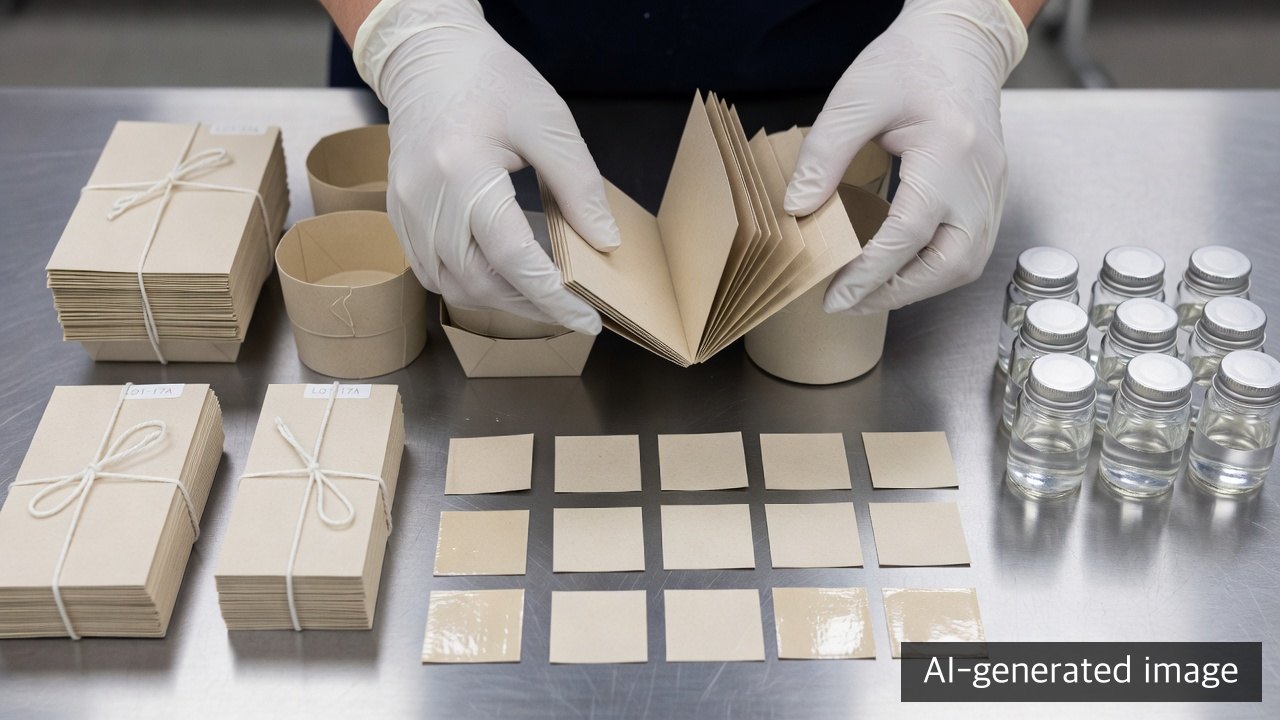
Copyable product-and-lot isolation table
An official product name alone may not locate stock across plants, warehouses and stores. Map it to internal purchasing and issue records.
| Check | Value to enter | Status | Immediate action |
|---|---|---|---|
| Official recall item | Product, manufacturer, manufacturing date | Match / no match / unknown | Stop use and shipment for matches and unknowns |
| Internal item mapping | Item code, drawing, print or QR version | Linked / not linked | Recheck PO and supplier delivery documents if not linked |
| Supplier lot | Production lot, coating batch, paper lot | Complete / partial / unknown | Move unidentified bundles to a separate hold area |
| Stock location | Plant, DC, store and quantity | Reconciled / discrepancy | Investigate differences between physical and system stock |
| Use status | Unused, in process, distributed, consumed | Quantity by stage | Trace destination and recovered quantity separately |
| Test evidence | Lot-specific report and test conditions | Pass / fail / missing | No release while evidence is missing |
| Replacement | Supplier, coating, date and report | Approved / testing / unapproved | Do not mix with existing stock before approval |
A “no match” decision cannot be based on colour or shape. It should mean that product name, manufacturer, manufacturing date, internal code and supplier lot are connected by records and exclude the item from the recall.
Five evidence blocks to review in the test report
1. Specimen identity
Product, material classification, manufacturing date, production lot and print version must match the received article. A generic certificate for a representative sample cannot establish lot traceability for a different coating batch.
2. Test conditions
Verify food simulant, contact area, temperature, duration and replication. A room-temperature dry-use report should not automatically represent a hot, oily fried-food application.
3. Result and limit
The measured total-migration result, applicable limit and disposition should appear together. The public system shows 4% acetic acid: 85 mg/L, but its specification field is blank. Do not treat that one line as the complete report or invent the missing limit and conditions.
4. Change history
Review paper, coating chemistry, formulation, coat weight, drying, machine, subcontractor and supplier changes. If a change occurred near the affected date, use it to define the adjacent-lot investigation.
5. Corrective action and revalidation
A root-cause statement is not release evidence. Require test results for a newly produced lot under the corrected conditions, first-article receiving checks and a traceability record.
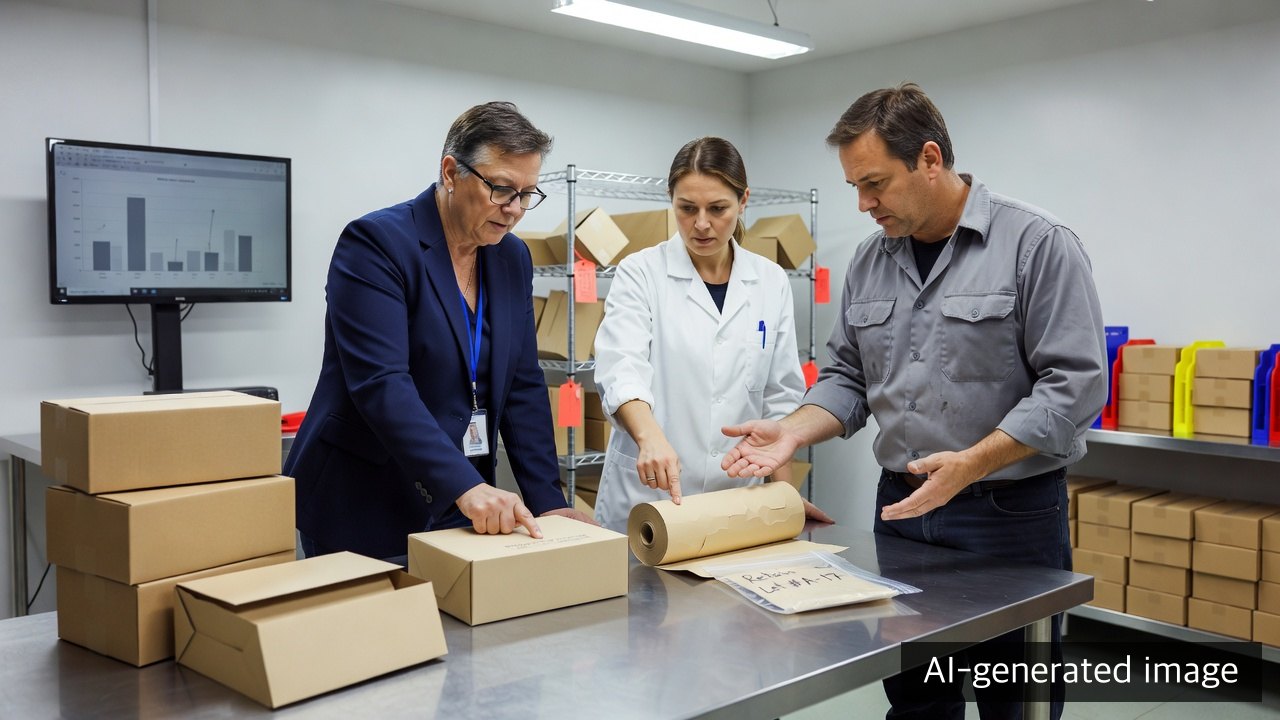
Immediate actions by role
Procurement
- Request the official recall plan, manufacturing dates and lots, quantity by consignee and test report in writing.
- Split internal items where one commercial name covers several coating or print versions.
- Compare replacement materials on composition, coating, food-contact evidence and change-approval requirements, not lead time alone.
Quality
- Compare retained samples and physical stock against manufacturing date and lot, and record the verifier.
- Record the public
4% acetic acid: 85 mg/Lresult separately from the undisclosed specification value and detailed test conditions. - Design adjacent-lot testing from coating batch, paper lot, machine changes and production time rather than an arbitrary date window.
Production and logistics
- Apply both physical quarantine and system hold so unknown or recalled stock cannot be issued.
- Keep consumed, unused, recovered, returned and destroyed quantities separate.
- Segregate the first replacement lot and check forming, sealing, grease resistance and deformation in actual use.
Conditions that block reuse or replacement release
Hold release if any of the following remains unresolved:
- The official product and manufacturing date are not mapped to the internal item.
- Supplier lot, coating batch or paper lot cannot be identified.
- The complete lot-specific report, applicable specification value and detailed test conditions are unavailable.
- The single public 85 mg/L field is used to assert a chemical identity or health effect.
- A later manufacturing date is assumed safe without a root-cause investigation.
- Replacement food-contact evidence and actual-use validation are incomplete.
- Shipped, used, recovered, returned and disposed quantities do not reconcile.
Documents to check today
- KCCI hazardous-product blocking-system record and competent-authority notice
- Supplier recall plan and affected quantity by consignee
- Internal item code, purchase order, delivery record and receiving lot
- Lot-specific test report and test conditions
- Paper, coating, application, drying and machine change history
- Replacement specification, food-contact evidence and first-lot approval
- Stock-use-recovery-return-disposal reconciliation
The confirmed event is a total-migration non-compliance and recall for a specific manufacturer’s product and manufacturing date. The operational objective is not to amplify fear or judge an environmental claim. It is to isolate every affected unit and release only new stock supported by traceable lots and relevant test conditions.
About the Author
PackingMaster: Editor of Paper Pack Log. We collect and organize market trends, product information, and technical insights for the paper packaging industry.
References
- KCCI Hazardous Product Sales Blocking System, Inspection record for
Paper food container_acrylic resin coating, document 3000232278, received 7 August 2026. - FoodToday, ‘Eco-friendly’ BHC chicken paper container fails safety specification; MFDS recall, 7 August 2026.
- SafeTimes, Packstar-manufactured BHC chicken paper container exceeds total-migration specification, 10 August 2026.