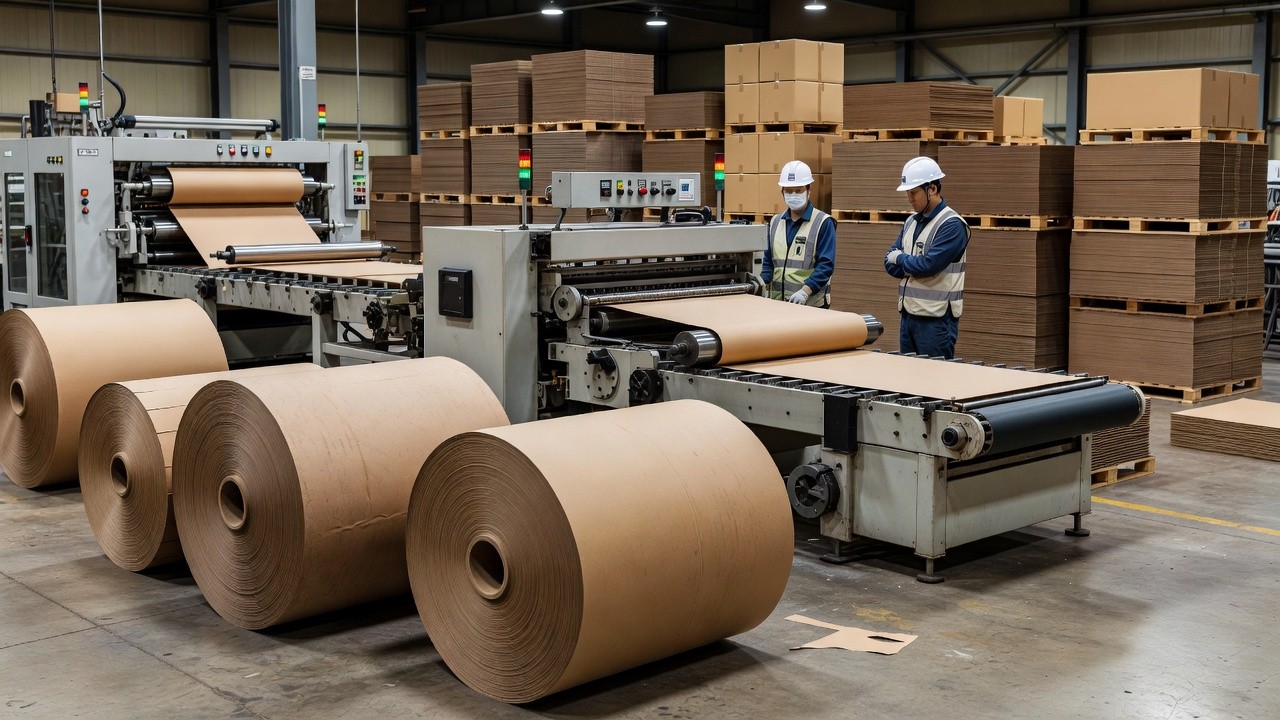
Blue Industrial Development’s first-half 2026 filing reports average utilization of 88.0% for the parent company’s Pyeongtaek paper machine 3 and 90.2% for subsidiary Blue Package’s Cheongju corrugator. The filing also shows a return to consolidated operating profit for the half year. Those facts deserve attention, but they do not by themselves prove that a shortage or price increase is imminent.
Utilization shows how long a particular line operated during a stated period. It is a useful starting point for questions about capacity buffers, product mix, maintenance and lead-time risk. It is not direct evidence of backlog, inventory, quality or pricing.
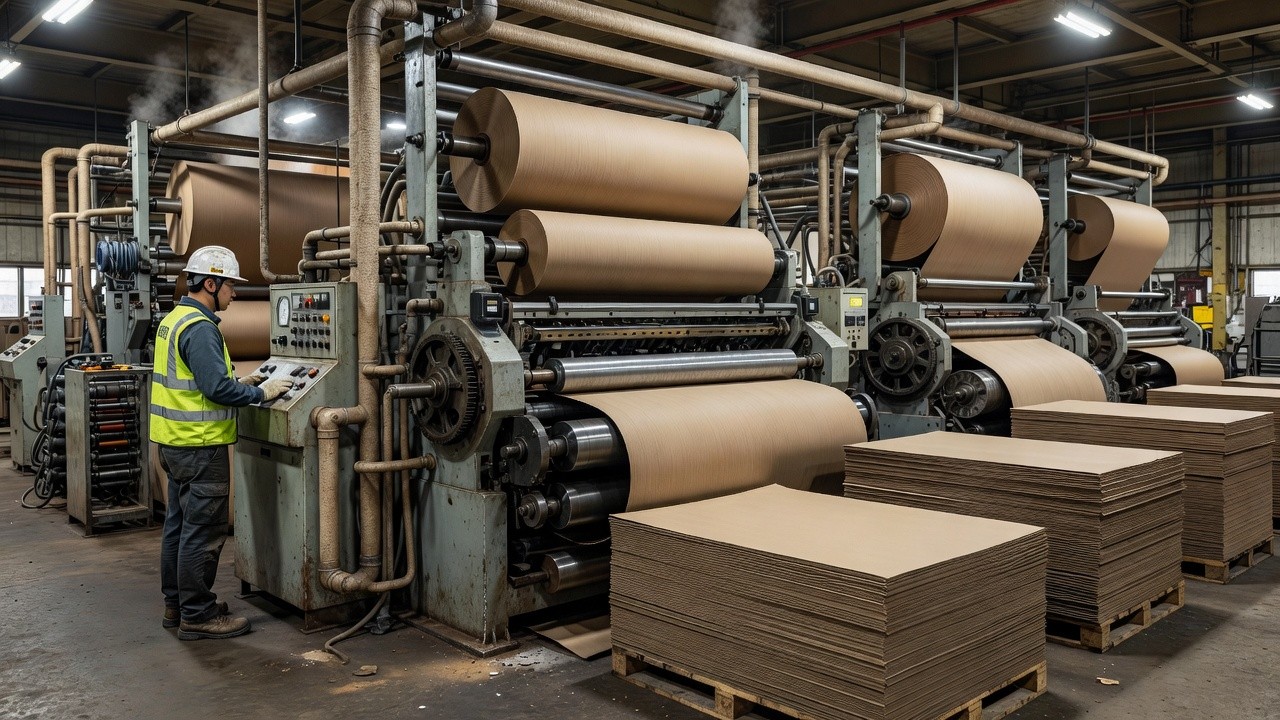
Three Lines Disclosed in the Filing
The utilization table is based on operating time rather than tonnage.
| Site and line | Time-based operating status |
|---|---|
| Pyeongtaek paper machine 2 (paper) | 4,344 hours available · 3,314 actual · 76.3% |
| Pyeongtaek paper machine 3 (paper) | 4,344 hours available · 3,824 actual · 88.0% |
| Blue Package Cheongju corrugator (corrugated board) | 833 hours available · 751 actual · 90.2% |
The disclosed ratios are 76.3% for Pyeongtaek paper machine 2, 88.0% for machine 3 and 90.2% for the Blue Package Cheongju corrugator, each measured against that line’s disclosed available hours. The filing’s capacity assumptions use 24 operating hours per day for Pyeongtaek paper production but seven hours per day for the Cheongju corrugator. The percentages therefore should not be compared as equivalent measures of absolute physical saturation. In particular, Cheongju’s 90.2% means 751 operating hours out of 833 disclosed available hours; it is not 90.2% of all half-year calendar hours or of tonnage-based capacity.
The filing also does not divide non-operating time into scheduled maintenance, breakdowns, changeovers, cleaning or insufficient orders. For procurement, that reason code can matter more than the headline percentage.
A Profit Turnaround Is Not the Same as Supply Reliability
The filing reports first-half 2026 consolidated revenue of KRW 52.69 billion and operating profit of KRW 0.26 billion, reversing a KRW 6.55 billion operating loss in the prior-year period. Separate-company revenue and operating profit were KRW 48.25 billion and KRW 0.88 billion. Bloter also reported the operating-profit turnaround, but its KRW 44.1 billion revenue figure does not match the filing’s current-period consolidated revenue; this article therefore uses the filing for the financial amounts. These results and the utilization figures do not establish that:
- utilization alone caused the earnings improvement;
- capacity is at an absolute limit;
- every customer’s lead time will extend; or
- prices for a particular flute or paper combination will rise immediately.
Raw-material costs, selling prices, mix, fixed-cost absorption, inventory valuation and subsidiary results can all change at the same time. The operating-profit turnaround is one measure of operating performance, not a complete supplier-health assessment. The same filing reports a consolidated first-half net loss of KRW 2.97 billion. Supplier financial health should therefore be assessed using operating cash flow, net income, liquidity, debt maturities and working capital, while delivery, quality and alternate-production capability require separate operational evidence.
Procurement Signals Behind 88% and 90%
1. Maintenance and Rush-Order Flexibility
If a high time-based utilization ratio persists across multiple periods, schedule flexibility for planned maintenance, paper-grade or basis-weight changes on paper machines, flute, width or paper-combination changes on the corrugator, setup and rush orders may decline. A single half-year ratio cannot establish that condition; monthly ratios and downtime by reason should be reviewed together.
2. SKU Bottlenecks Can Differ from the Average
Corrugator productivity can vary with flute, width, paper combination and order sequence. Printing and die-cutting are separate converting stages, so their load and queue time should be checked separately rather than treated as part of corrugator utilization. Buyers should ask which line and shift actually run their specification.
3. Connecting Paper and Corrugated Operations
The filing states that the parent’s Pyeongtaek mill produces coreboard and linerboard, while subsidiary Blue Package produces corrugated board and boxes. It does not disclose the grade allocation of Pyeongtaek machines 2 and 3, the volume supplied to Cheongju or the captive-sourcing share. Pyeongtaek paper machine 3’s 88.0% rate therefore cannot be read directly as liner availability for a particular corrugated specification. Buyers should separately verify the approved paper BOM and producing machine, internal versus external sourcing, and backup sources during maintenance.
4. Operating Time Is Not Shipping Capacity
A running machine does not guarantee on-time shipment. Work in process, quality holds, palletizing, warehouse congestion and vehicle scheduling can become downstream bottlenecks. For buyers, on-time delivery, overdue orders, finished-goods dwell time and remake lead time are often more actionable than utilization alone.
Buyer Verification Checklist
- Which line runs our SKU?
- Evidence: SKU-to-line and shift mapping
- Decision: identify the actual bottleneck rather than relying on the plant average.
- What are normal and rush lead times?
- Evidence: order receipt date, confirmed due date, actual shipment date, quantity and order class for each order over the last three months
- Decision: separate order-to-ship lead time from confirmed-date adherence.
- Can maintenance work move to another line?
- Evidence: preventive-maintenance plan and alternate-line approval
- Decision: include size, print and quality approval on the backup line.
- Which paper substitutions are approved?
- Evidence: approved paper combinations and customer-change process
- Decision: check strength, color, print and price effects.
- Is quality stable in months with higher time-based utilization?
- Evidence: monthly utilization, output, first-pass yield, defect and rework rates, and claims ppm for the same periods
- Decision: separate time utilization, output and quality.
- Is a shipping buffer actually available for our SKU?
- Evidence: available, allocated and quality-hold inventory by SKU, work in process, days of cover and warehouse occupancy
- Decision: separate sellable buffer from congested or reserved stock.
Five Questions for the Supplier Meeting
- “How much did monthly utilization vary at Pyeongtaek paper machine 3 and Blue Package’s Cheongju corrugator?”
- “For the disclosed 88.0% and 90.2% figures, how was non-operating time split among maintenance, changeovers and breakdowns?”
- “Which line runs our specification, and what alternate line is already approved?”
- “Can you separate actual normal-order and rush-order lead times for the last three months?”
- “How did defects, rework and on-time delivery change during the higher-utilization periods?”
Conclusion
The two ratios show actual operating hours as a share of each line’s disclosed available hours. The return to operating profit demonstrates an earnings improvement, but the filing provides neither prior-year-period line utilization nor delivery and quality data. It therefore does not establish that operating conditions or supply reliability improved year over year, nor does it directly establish company-wide capacity saturation or price direction.
The practical use of the figures is to prioritize questions. Mapping the buyer’s SKU to its actual line, confirming maintenance and alternate capacity, locking paper substitutions, and reviewing delivery and quality history turns a public utilization figure into a usable procurement risk check.
About the Author
PackingMaster: Editor of PaperPackLog. We collect and organize market trends, product information, and technical insights for the paper-packaging industry.