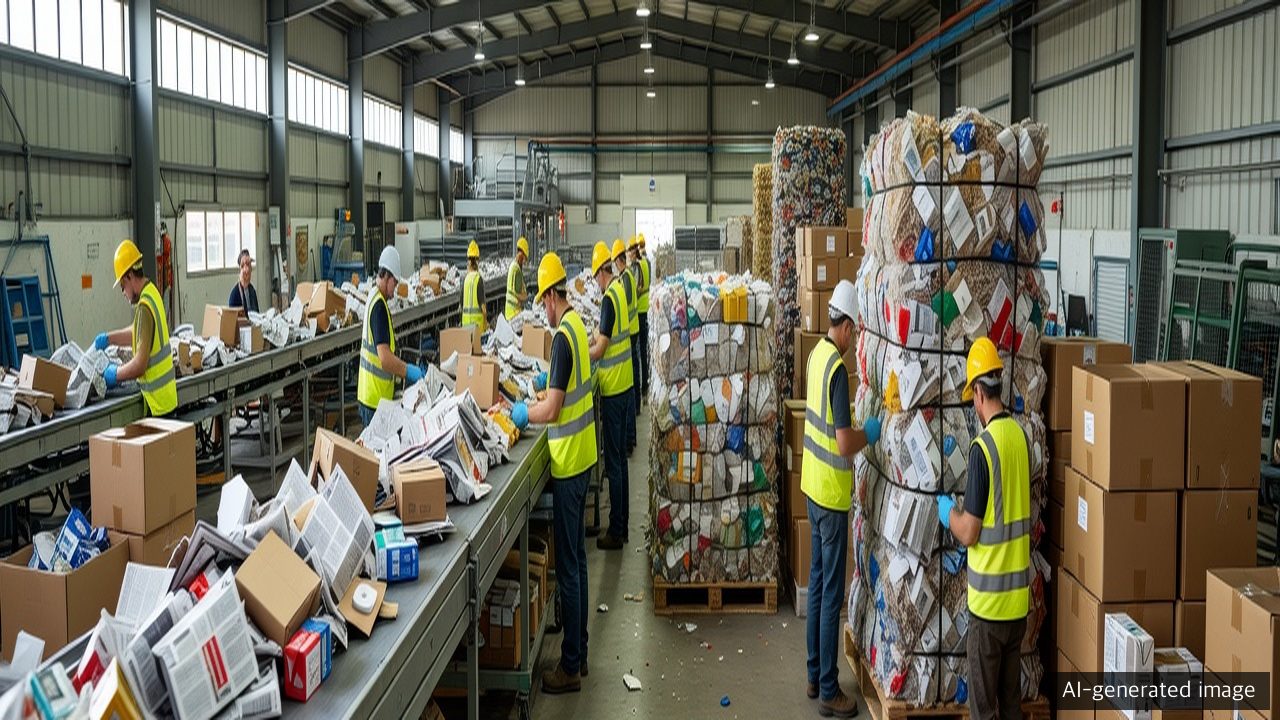
A California-bound carton package can reach final artwork approval and then stop when someone asks, “Where is the evidence that this format is actually sorted in that market?” The responsible reader is not only the designer, but also purchasing, packaging development, legal, and sales. The decision table below gives those teams a copy-ready way to judge carton and composite paper-packaging recycling claims by collection access, MRF sortation data, recovery path, and legal hold conditions, not by material name alone.
On June 24, 2026, CalRecycle updated Table 2 of the SB 343 Final Findings Report. The update added three large-volume transfer or processing facilities that sort non-CRV cartons into PSI Grade 52 bales, and it showed non-CRV gable-top cartons and aseptic containers at 21 counties served, or 62% of surveyed counties. CalRecycle also stated that the update is not a recyclability determination for any specific product and is not a recycling-rate determination.
On July 15, 2026, reporting also showed that a federal court had granted a preliminary injunction blocking enforcement of SB 343 while litigation continues. That does not mean packaging teams should stop preparing evidence. It means the decision file should separate legal enforcement status from the practical evidence behind the claim.

Why Material Name Is Not Enough
A carton may look paper-based, but recyclability claims are more complicated than that. Gable-top cartons, aseptic containers, coated paper, composite paper packaging, and food-contact formats can behave differently in collection, sortation, and recovery.
The practical lesson from the California SB 343 materials is clear. The question is not simply whether the package appears to be paper. The question is whether that format is accepted in collection, sorted into a defined stream at large facilities, connected to a recovery path, and compatible with design requirements.
CalRecycle’s 2025 Final Findings describe recyclability-related criteria across collection access, defined sortation streams, reclamation, and composition or design requirements. The report itself does not deliver a final product-level answer. Packaging teams therefore need an internal decision file that connects official tables to the actual SKU, package structure, and label wording.
California Carton Recycling-Label Decision Table
This is not a simple checklist. It is a decision table for approval meetings, with input fields, observed values, source criteria, status, role owner, action verb, target, and trigger in one place.
| Input field | Observed value | Source criteria | Status | Role owner | Action verb | Target | Trigger |
|---|---|---|---|---|---|---|---|
| Package format | Classify as gable-top carton, aseptic container, or another composite paper format | Product specification, CalRecycle MT&F code | Not confirmed | Packaging development | Classify | SKU package structure | New SKU, structure change, supplier change |
| Collection access | Confirm whether the format is accepted by California residential programs | CalRecycle Final Findings Table 1 | Not confirmed | Legal and sales | Compare | California-bound SKU | California sale or customer label request |
| MRF sortation | Confirm whether the current Table 2 value for non-CRV gable-top cartons and aseptic containers is 21 counties and 62% | CalRecycle June 24 2026 Update Letter and Attachment 1 | Conditional | Packaging development | Record | Decision file | Official Table 2 update or customer audit |
| Recovery path | Confirm which bale stream or recovery route receives sorted cartons | Supplier documents, customer requirement, public evidence | Hold if missing | Purchasing | Request | Packaging supplier and recovery evidence | Before artwork release or customer review |
| Label wording | Capture the exact recycling claim, symbol, and disposal guidance | Artwork file, legal review memo | Not confirmed | Legal and sales | Approve | Printed artwork and digital copy | Before artwork lock |
| Legal status | Check SB 343 enforcement timing, preliminary injunction status, and customer-specific rules | Current official, legal, and industry sources | Monitor | Legal | Update | Label approval memo | Publication date, print order, shipment review |
The table is meant to prevent overconfident claims. It shows whether a package can proceed, must be held, or needs narrower customer-facing wording. In July 2026, when enforcement timing is affected by litigation, the legal-status row is especially important.
What Each Role Should Do
Purchasing should request the carton structure, coating, adhesive, barrier layer, cap or closure details, and recovery-path evidence from the supplier. If the supplier says the package is recyclable because it is a carton, do not copy that wording into the claim file. Ask whether the statement is connected to California collection and sortation evidence.
Packaging development should classify each SKU by material type and form, then attach samples and artwork to the same decision file. Do not manage gable-top cartons and aseptic containers as one generic paper category. Separate CRV and non-CRV status before label placement is approved.
Legal and sales should align printed packaging, customer proposals, web copy, and sales decks. A cautious package label paired with stronger sales wording can still create audit risk. When a preliminary injunction or other legal update appears, explain the difference between enforcement status and evidence readiness.

When to Hold the Claim
Hold the recycling label decision if any of the following conditions apply.
| Hold condition | Why it matters | Next action |
|---|---|---|
| Final package structure is not confirmed | Coatings, adhesives, barrier layers, caps, or closures can change the decision | Recheck after final BOM and samples are available |
| Sales territory is unclear | Collection access and customer requirements may differ | Confirm territory and customer label criteria |
| Current Table 2 and legal status have not been checked | Official data and enforcement status can change | Check official pages and current legal reporting before print release |
| Recovery path is not documented | Sortation alone may not support the full claim | Request supplier, customer, or recovery-network evidence |
| Label wording is too broad | A broad recyclable claim can exceed the evidence | Narrow the wording to the actual market and conditions |
A hold is not a failure. In recycling-label work, the larger risk is a process that cannot pause. If the evidence is incomplete, stop the print release, update the file, and reopen approval when the evidence is available.
The Main Issue Is Evidence Structure, Not One Number
The 62% figure is important, but it does not automatically make every carton package eligible for a California recycling claim. CalRecycle’s June 2026 update says the publication is not a product-level recyclability determination and is not a recycling-rate determination.
The internal file should therefore connect several pieces of evidence.
- Which MT&F category applies to the SKU
- Which table supports collection access
- Which update supports sortation status
- Who confirmed recovery path and design compatibility
- When legal status and customer requirements were checked
With that structure, a team can respond whether enforcement proceeds, pauses, or customer review arrives first. Without it, a statement such as “cartons are recyclable” becomes fragile the moment a buyer asks about sortation infrastructure or recovery route.

Conclusion: A Label Is an Evidence File
The expansion of carton sortation in California does not end the labeling question. It shows that recyclability claims are moving from material-name shorthand toward regional infrastructure, sortation data, recovery-path evidence, and legal status.
Teams selling carton or composite paper packaging should build the decision table before finalizing label wording. Classify the package, attach collection and sortation evidence, document recovery-path questions, and list hold conditions. A recycling label should be treated as the output of an evidence file, not as decorative packaging copy.
FAQ
Q: Does the 62% sortation figure mean a carton can immediately use a recycling label?
No. The 62% figure is a June 2026 sortation-data point for specific carton formats across surveyed counties. Product structure, collection access, recovery path, design requirements, and legal status still need review.
Q: Does the preliminary injunction mean teams can stop preparing?
No. Enforcement may be paused, but customers and retailers can still ask for evidence behind recycling claims. The practical move is to mark legal status separately and keep the evidence file current.
Q: Do overseas packaging suppliers need this table?
Yes, if products may be sold in California or supplied to customers with California distribution. Even indirect suppliers may be asked to support claims with the same evidence logic.
About the Author
PackingMaster: Editor of Paper Pack Log. We collect and organize market trends, product information, and technical insights for the paper packaging industry.
References
- CalRecycle, Accurate Recycling Labels
- CalRecycle, June 24 2026 SB 343 update letter
- CalRecycle, Table 2 addendum 062426
- CalRecycle, SB 343 Final Findings Report
- Packaging Dive, More California MRFs are sorting cartons, easing recent recycling concerns
- Packaging Dive, California blocked from enforcing upcoming ’truth in labeling’ law