
For Korea’s 2026 Chuseok gift sets, reducing empty space in the outer carton and making different components separable at end of use are two related but distinct design tasks. In a September 25 retail field report, NewsPenguin observed individually plastic-wrapped items in some paper cartons and noted that EPS foam and cooling packs can be needed for delivery. The report does not say all these components were observed together in a single inspected set, establish a violation by any named brand, or survey every Korean gift set.
A paper outer carton does not make the entire package single-material. Equally, the mere presence of plastic or EPS does not prove illegality or that paper inserts would always perform better. Breakage, leakage, temperature control and what happens after opening all matter.
Packaging-volume compliance is not an end-of-life verdict
Under Korea’s current Rules on Standards for Packaging Materials and Methods, Article 4 calls for less packaging material and fewer packaging stages to curb unnecessary packaging, with product-specific methods in Annex 1. Article 3(1) calls on manufacturers, importers and sellers to endeavour to use packaging that is easy to recycle, among other matters. It would be incorrect to turn those provisions into “a paper carton automatically passes all standards” or “an inseparable insert is necessarily a violation of the overpackaging rule.” Product classification, purpose, geometry, measurements and applicable exceptions require case-by-case review.
NewsPenguin reported that some cartons had less excessive empty space than in past years. It also quoted expert concerns that individual wrapping may be missed by some overpackaging checks, and that EPS bonded to another material could hinder separation if it is hard to take apart. This was a conditional concern, not a finding that the inspected EPS insert was a bonded composite. Measuring empty packaging volume addresses one part of carton design; making the components readily separable addresses a different end-of-life question. One score does not replace the other.

Illustration only. These are not the products photographed by NewsPenguin or samples that underwent a statutory packaging test.
Check the carton and the retention materials separately
When opening a prototype, set out the outer carton, individual wrap, retainers, coolant package and closures as separate components. For example, removable corrugated dividers may be candidates for a paper collection stream along with the carton. Thin coatings, adhesives, contamination or metal components can change the actual sorting outcome. Do not treat EPS and film as paper; verify whether they can be removed and what local collection instructions apply.
Being removable is not the same as being proven recyclable. Check whether a consumer can separate each part without tools, whether material labels are accurate, whether leaks soil the paper, and whether the local recovery system actually accepts the material. Substituting paper for another insert also calls for finished-package checks of impact protection, fit, moisture and chilled-distribution conditions. Do not announce an environmental improvement based solely on a material swap while changing protection and load paths without testing.
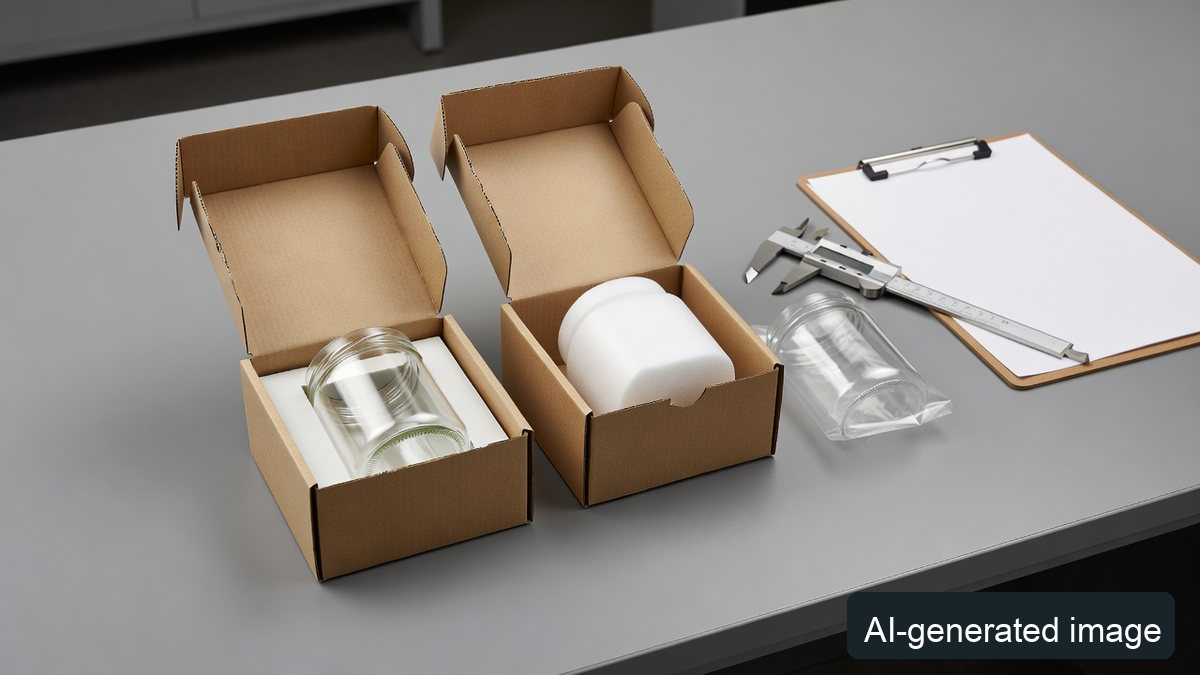
Illustration only. It establishes neither suitability nor legal compliance for any particular gift set.
Pre-launch sample review — an editorial framework
- Outer carton and void: Record the actual dimensions with the product and cushion installed, product category, and the applicable statutory measurement method. If uncertain, classify the item and any exceptions before remeasuring.
- Individual wraps: Record the protective, hygiene or leak-control function and count potentially duplicated film or boxes; redesign only where the function can be maintained.
- Inserts: Record paper, EPS or plastic components, adhesive or interlocking joints, and whether the consumer can remove them by hand. Test separation and the route for rejected material.
- Distribution and temperature: Test the actual shipping package for handling, vibration, impact or stacking as relevant; examine condensation, leakage and fibre soiling in chilled service.
- Consumer instructions: Check the separation order, material declarations and local disposal route; remove an inaccurate “all paper” claim.
This is editorial guidance, not a list of statutory duties or an accredited test standard. Transport-only packaging and a retail gift package may be treated differently under the rules; do not apply a single legal limit to both without checking the scope and conditions.
Bottom line: Once a carton has less empty space, the next question is whether the inner materials can actually be separated. Do not combine the report’s different paper-carton, individual-wrapping and EPS examples into a claim that one product or company violated the rules. Review each component’s material, protective function, opening sequence and local collection route on an actual prototype.
About the Author
PackingMaster: PaperPackLog editor, covering packaging materials, market developments and practical technical guidance for the paper-converting industry.