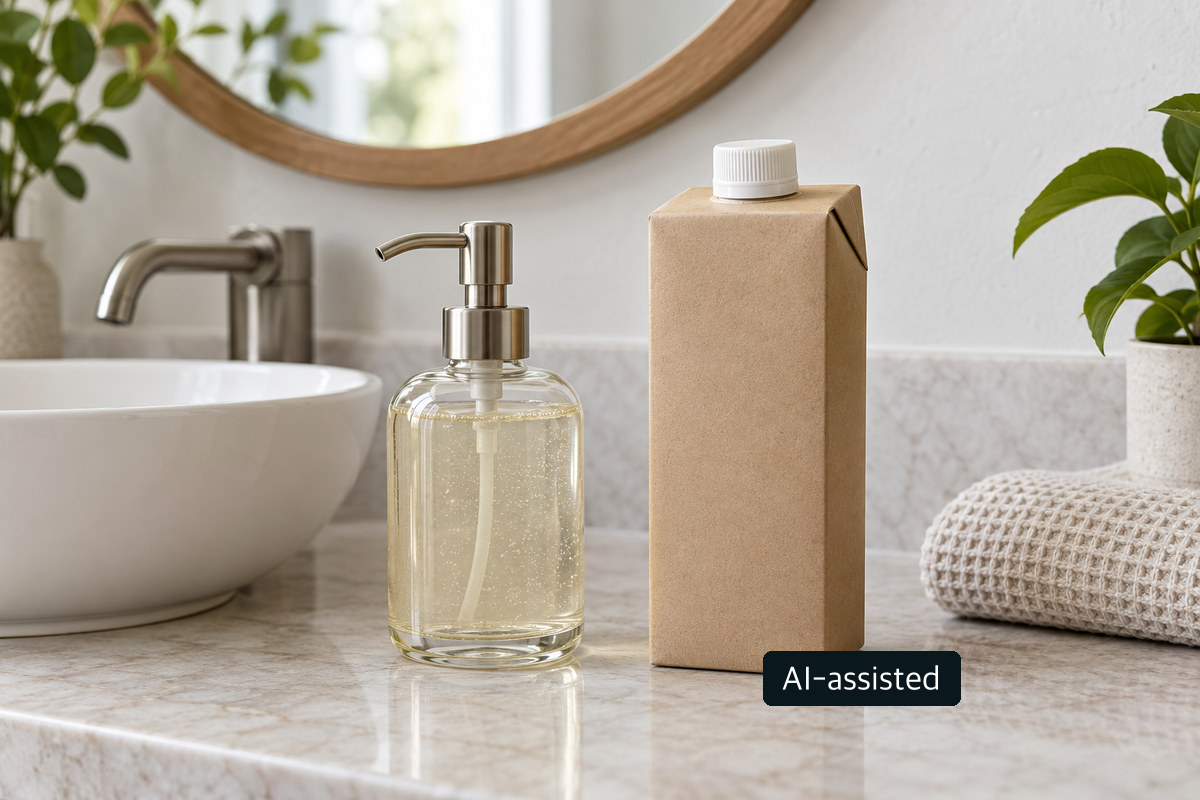
US household-products brand Cleancult sells Pure Castile Soap in a 32 fl oz (approximately 946 mL) paper-based carton and suggests pouring it into a bottle the buyer keeps. Its product page describes an olive- and coconut-oil soap and claims the carton uses 90% less plastic by weight than a standard 32 fl oz HDPE bottle. The asterisk matters: that is the brand’s packaging-plastic-weight comparison against a specified bottle, not a 90% reduction in total packaging mass or life-cycle greenhouse gases.
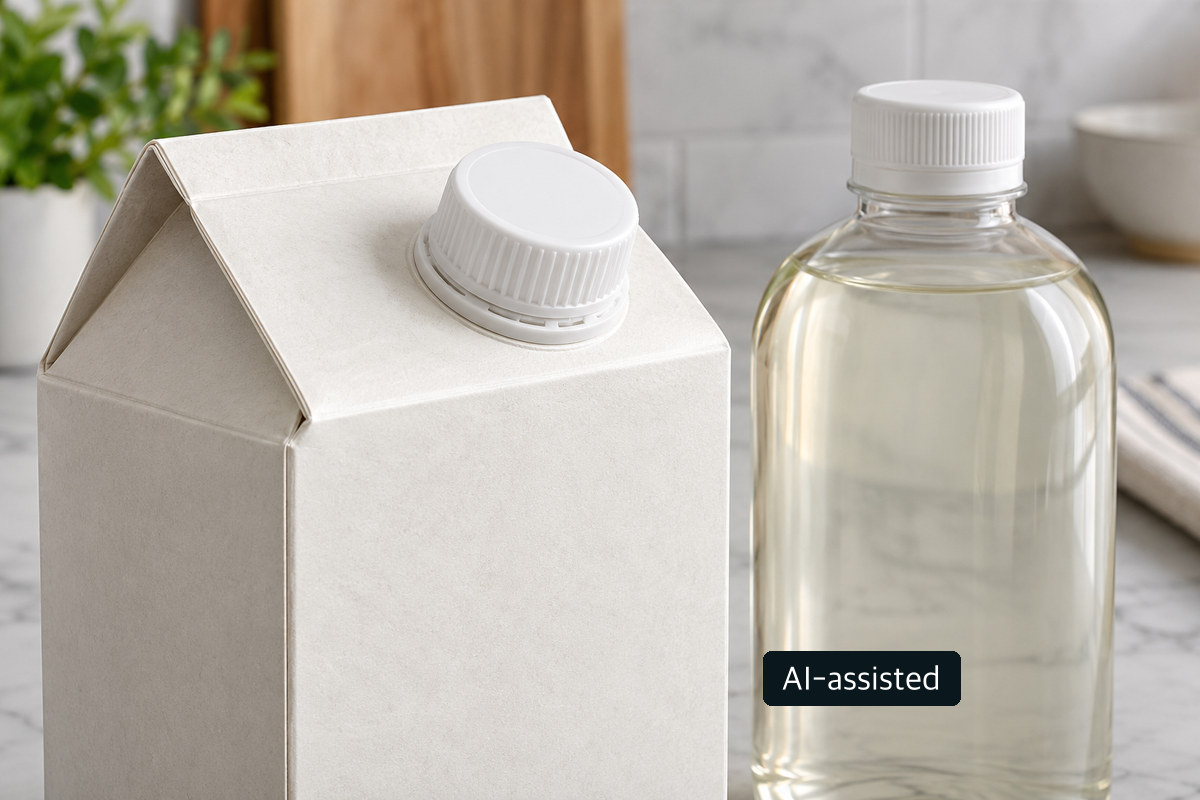
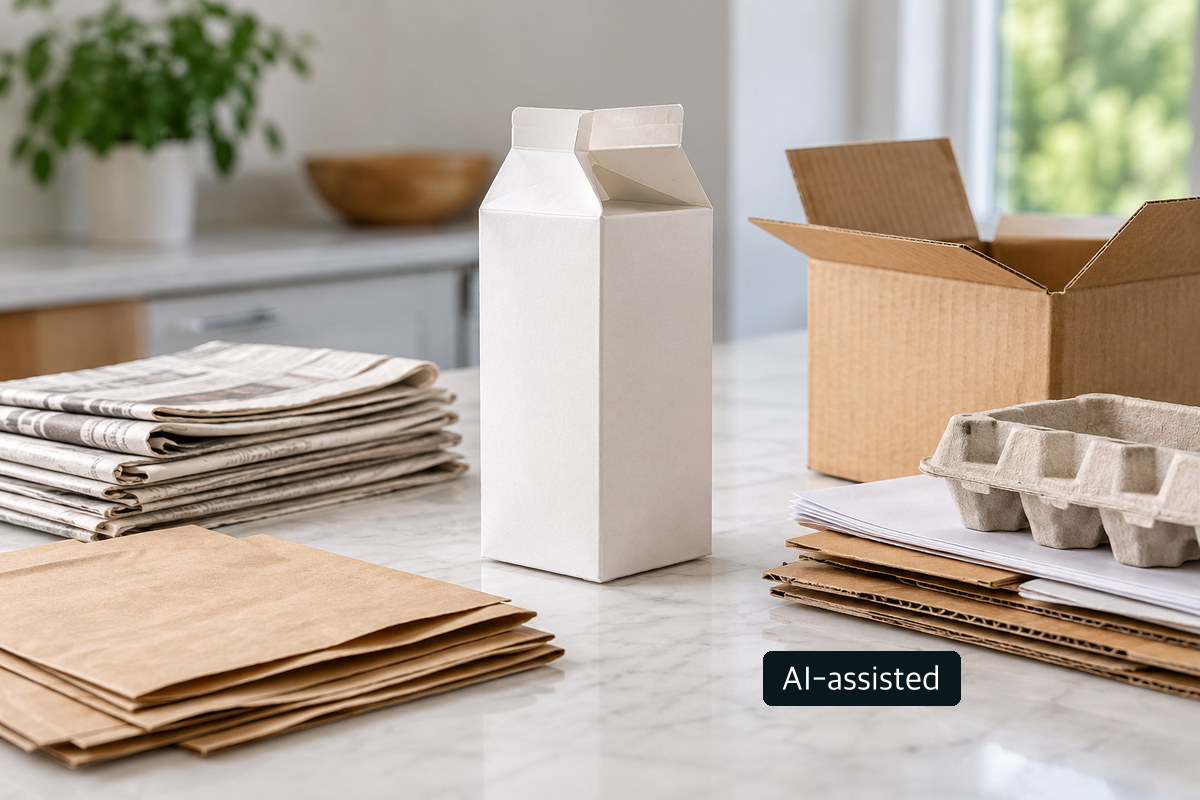
The photographs below are unbranded conceptual scenes, not photographs or replicas of Cleancult’s marketed carton. Its actual opening and material layers require a physical sample and specification.
Keep three packaging boundaries distinct
| Brand wording | Supported scope | Unsupported shortcut |
|---|---|---|
| Paper-based carton | Paper fibre is described as the main packaging material | 100% paper, plastic-free or single-material pack |
| 90% less plastic | Brand comparison of plastic packaging weight with a standard 32 fl oz HDPE bottle | 90% less total waste, carbon or water use |
| Recycle the carton | Brand asks users to check local guidelines after emptying it | Universal acceptance or verified downstream recycling |
| Refill a bottle | A proposed user behaviour | Every buyer repeatedly refills an existing bottle |
A carton for liquid products may need layers, closures and a pour feature beyond paper fibre. The product page does not establish this SKU’s layer composition, material weights, cap design or recovery rate. We should not transfer the construction of another beverage or soap carton to this one as a fact.
Carton collection is address-dependent
Cleancult tells users to recycle an empty carton subject to local instructions. The Carton Council maintains consumer guidance for checking whether cartons are collected in a locality. Even where a municipal program accepts cartons, that does not independently certify this particular soap package, guarantee current collection at a given address, or prove recovery into new fibre after sorting.
An evidence trail runs from (1) the local accepted-material list, through (2) instructions for emptying, rinsing and handling the closure, (3) the package’s actual materials and sortability, to (4) the local processor’s downstream outlet. If cartons are not accepted in a buyer’s area, “paper-based” alone does not establish a recycling benefit.
Test the refill proposition on the same functional unit
Concentrated-use directions are a separate part of the product proposition. Dilution, dose, how long the reused bottle lasts, shipment distance and the carton’s actual end-of-life all influence any comparison. The product page’s “about four gallons of all-purpose spray from one carton” is a brand calculation under its usage directions, not an observed outcome in every household.
To assess the design, request a pack material bill, the definition of the plastic-weight comparator, collection information for the sales address and a realistic count of bottle reuses. Without those inputs, a narrow claim about reduced plastic packaging weight should not be inflated into proof of recyclability or overall environmental superiority.
References
- Cleancult, Pure Castile Soap—Fresh Peppermint product page (accessed 24 October 2026): brand statements about size, ingredients, carton, plastic-weight comparison and local disposal guidance.
- Carton Council, consumer carton recycling guidance (accessed 24 October 2026): a starting point for checking local collection, not a guarantee for a specific Cleancult pack.
About the Author
PackingMaster examines paper packaging, liquid cartons and converting operations. We separate a brand’s published claims from the additional checks needed at a specific collection address.