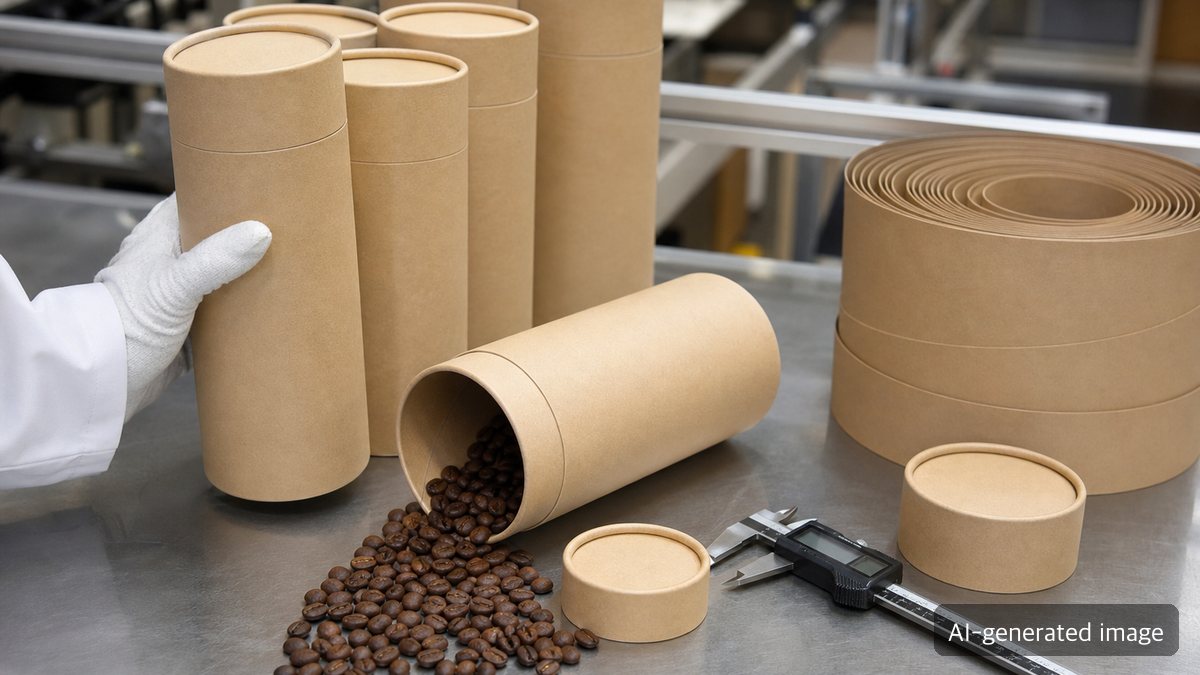
Specialty coffee brands are showing more interest in paper tubes, cylindrical packs, and spiral-wound paperboard packaging. The format stands out on the shelf, works well for gift positioning, and gives a more paper-based impression than rigid plastic containers.
But for coffee, the key question is not whether the pack can be described as plastic-free. Roasted coffee is sensitive to oxygen, moisture, aroma loss, and degassing. A paper tube may look like a simple cylinder, but the real specification sits in the tube structure, inner liner, cap, sealing method, and recyclability claim.
What Role Does a Paper Tube Play in Coffee Packaging?
Coffee paper-tube packaging usually uses a spiral-wound paperboard tube as the outer structure. That structure keeps the product upright, maintains shape during display, and gives the brand a printable surface and tactile paper feel.
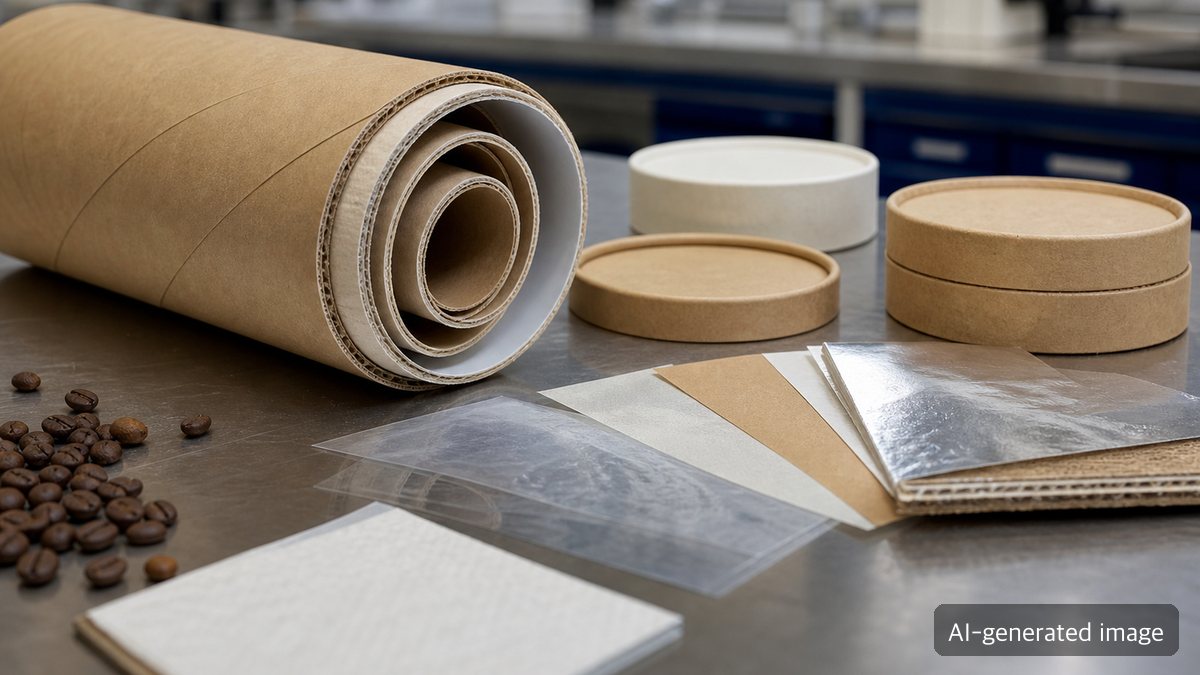
However, the tube itself does not solve every packaging function. A coffee paper tube is normally a system made from several parts:
- Outer paperboard tube
- Inner liner or primary pouch
- Top and bottom caps or lids
- Pre-opening seal
- Label, sleeve, or printed surface
- Degassing valve or separate pouch if required
That means buyers should not treat it as just “one paper tube.” A thick, premium-looking tube can still fail if the inner barrier is weak. A good-looking cap can still let in moisture and oxygen if the fit is loose.
Criterion 1: The Food-Contact Structure
The first split in food packaging is the direct-contact surface. The review scope changes depending on whether the coffee touches the inside of the paper tube directly, or whether the coffee is packed in a separate pouch and the tube works as secondary packaging.
If the coffee contacts the tube or inner liner directly, the food-contact suitability of the liner, odor transfer, ink and adhesive safety, and contamination control all matter. If the coffee sits inside a separate pouch, the tube can be assessed more around structure, appearance, recyclability, and logistics performance.
In practice, start with these questions:
| Question | Why it matters |
|---|---|
| Does the coffee directly touch the tube interior? | Defines food-contact material and hygiene requirements |
| Is there a separate pouch? | Shows whether barrier performance sits in the pouch |
| Is the product whole bean or ground coffee? | Changes aroma-loss and oxidation sensitivity |
| Is reclosure needed after opening? | Affects lid fit and user experience |
| Is the pack used for ambient, chilled, retail, or e-commerce channels? | Changes moisture, impact, and stacking conditions |
Criterion 2: Oxygen Barrier, Moisture Barrier, and Degassing
Coffee packaging should not treat barrier performance as a secondary issue just because the pack looks paper-based. Roasted coffee changes quickly when exposed to oxygen and moisture. Freshly roasted beans also release carbon dioxide, so the pack design may need a degassing valve or a defined resting period before packing.
When designing a coffee paper tube, barrier performance can be split into three layers:
- Primary pack: aluminum laminate, high-barrier film, paper-based barrier pouch, or similar structure
- Tube interior: food-contact liner, moisture barrier coating, odor-transfer control layer
- Opening and closure: seal, cap, tamper evidence, and reclosable lid
If a pack is marketed as paper-based while relying on a complex inner pouch and a plastic cap, the consumer-facing message may not match the real disposal structure. On the other hand, replacing every component with paper can compromise barrier performance. The practical goal is not a slogan; it is to define the minimum structure needed to protect the coffee and communicate that structure clearly.
Criterion 3: Lid and Bottom-Cap Design
The lid strongly shapes the user experience of a paper tube. For gift coffee, the opening feel, sound, and fit become part of the brand experience. For e-commerce, the lid must not loosen during transport. For retail display, the pack should keep its shape even after repeated handling.
Typical options include:
- Paperboard cap
- Metal cap
- Plastic cap
- Paper-plus-film composite lid
- Inner seal combined with an outer cap
Each option has trade-offs. A paperboard cap improves material consistency but can be more sensitive to humidity and repeated use. A metal cap gives a premium feel and stronger fit, but needs clear disposal guidance. A plastic cap may perform well in use but can conflict with a plastic-free positioning.
Criterion 4: Recyclability Claims and Disposal Guidance
Recyclability claims are the risky part of coffee paper-tube packaging. A paper-looking exterior does not automatically mean the whole pack fits a paper recycling stream. Inner coatings, film liners, adhesives, metal or plastic caps, and label materials can all change sorting and recycling behavior.
Buying and marketing teams should verify:
- Whether the tube body and cap use the same material
- Whether consumers can separate components by hand
- Whether the inner liner disrupts paper recycling
- Whether label and adhesive choices affect recycling
- Whether disposal guidance is consistent across target markets
- Whether claims such as “plastic-free,” “recyclable,” or “compostable” have supporting documentation
For export coffee, country-by-country labeling rules and EPR data requirements may differ. If recyclability is decided only from how paper-like the package appears, later buyer reviews or regulatory checks can become expensive.
Documents to Request Before Quoting
When reviewing a new paper tube for coffee, request the following from the supplier:
- Tube outer diameter, inner diameter, height, wall thickness, and tolerance
- Base paper specification, basis weight, winding method, and adhesive system
- Inner liner or coating construction
- Food-contact compliance documentation
- Oxygen and moisture barrier data, or the compatible primary-pack specification
- Cap material, fit method, and repeated opening test information
- Drop, compression, stacking, and e-commerce shipping test conditions
- Recyclability and disposal-claim documentation
- Printing method, inks, finishing, and odor-transfer control
- Minimum order quantity, tooling or jig cost, and lead time
These documents move the review beyond a nice-looking sample and into a real commercialization decision. Coffee quality is directly tied to aroma and freshness, so packaging design and preservation performance must be checked together.
Wrapping Up
Paper tube packaging can be an attractive format for coffee: strong shelf presence, gift value, and a natural paper feel. But it is risky to decide only from a plastic-free claim or a kraft-paper appearance. In coffee packaging, the outer tube, inner barrier, lid, seal, degassing path, and recyclability guidance have to work as one system.
Coffee brands and packaging buyers should therefore ask not just “can we switch to a paper tube?” but “which component is responsible for each function?” The exterior can deliver the paper-based brand feel, but product protection should be backed by test data, and recyclability claims should match component separation and supporting evidence. That is how a package can look good to consumers while also managing quality and regulatory risk.
About the Author
PackingMaster: Editor of Paper Pack Log. We collect and organize market trends, product information, and technical insights for the paper packaging industry.
References
- Earthy Cores, “Why More Specialty Coffee Brands Are Switching to Paper Tube Packaging”, https://www.earthycores.com/Blog-view.aspx?cid=120&t=34
- MTPak Coffee, “Paper tube cylinder packaging for roasted coffee”, https://mtpak.coffee/2023/06/paper-tube-cylinder-packaging-roasted-coffee/