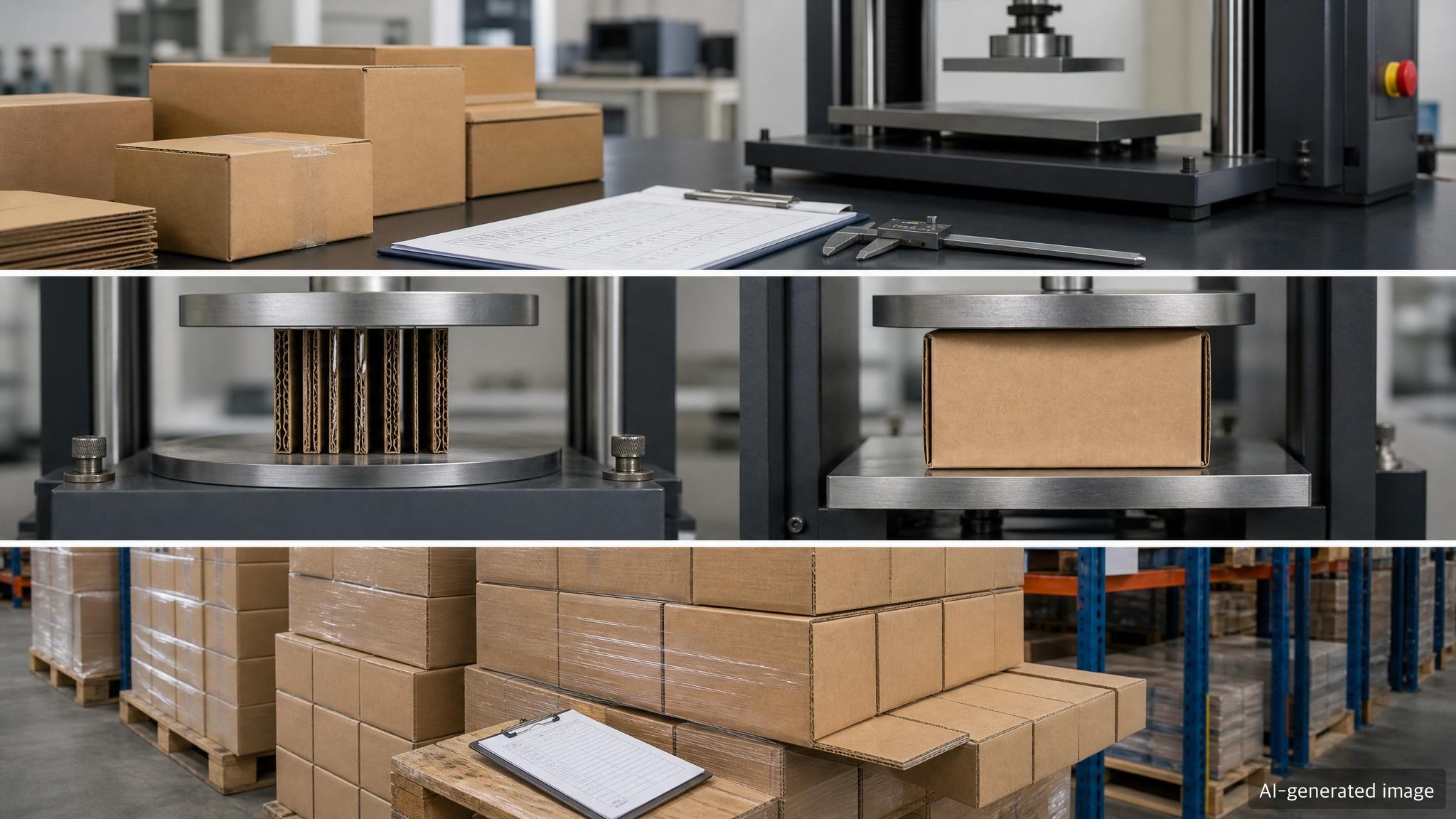
The most common question when requesting a corrugated box quote is deceptively simple: “How much weight can this box hold?” The problem is that the answer is anything but simple. Even with the same base paper and the same flute type, the actual load a box can sustain depends on its dimensions, height, stacking method, humidity, storage duration, and pallet condition.
That is why packaging professionals look at ECT, BCT, the McKee formula, and safety factors together. ECT is the edge crush strength of the corrugated board material; BCT is the compression strength of the finished box; and the McKee formula is a calculation that estimates BCT from ECT and box dimensions. This article organizes the compression strength calculation workflow so that purchasing, sales, and quality professionals can speak in numbers rather than vague terms like “strong enough” when evaluating box specifications at the quoting stage.
Where earlier articles covered the fundamentals of flute types, base paper, and compression strength, the focus here is calculation. That said, these formulas produce estimates for initial screening at the quoting stage. Critical shipments, heavy products, long-term storage, and export packaging must be verified through actual BCT testing and distribution testing.
The Roles of ECT, BCT, and the McKee Formula
The first step is to separate the three terms.
| Term | Meaning | How it is used at the quoting stage |
|---|---|---|
| ECT | Edge Crush Test. The force a corrugated board sample can withstand when compressed along its edge. | Board strength benchmark. Typically expressed in lb/in. |
| BCT | Box Compression Test. The maximum compressive load a finished box can sustain when loaded top to bottom. | Most directly tied to actual stacking stability. |
| McKee formula | An empirical formula that estimates BCT from ECT, board caliper, and box perimeter. | Used for quote comparison and specification screening before testing. |
A higher ECT generally correlates with better box compression strength. However, ECT alone does not determine BCT. Even with the same 44 ECT board, the finished box strength will vary with box footprint, perimeter, height-to-perimeter ratio, joint quality, handle cutouts, print coverage, and flute direction.
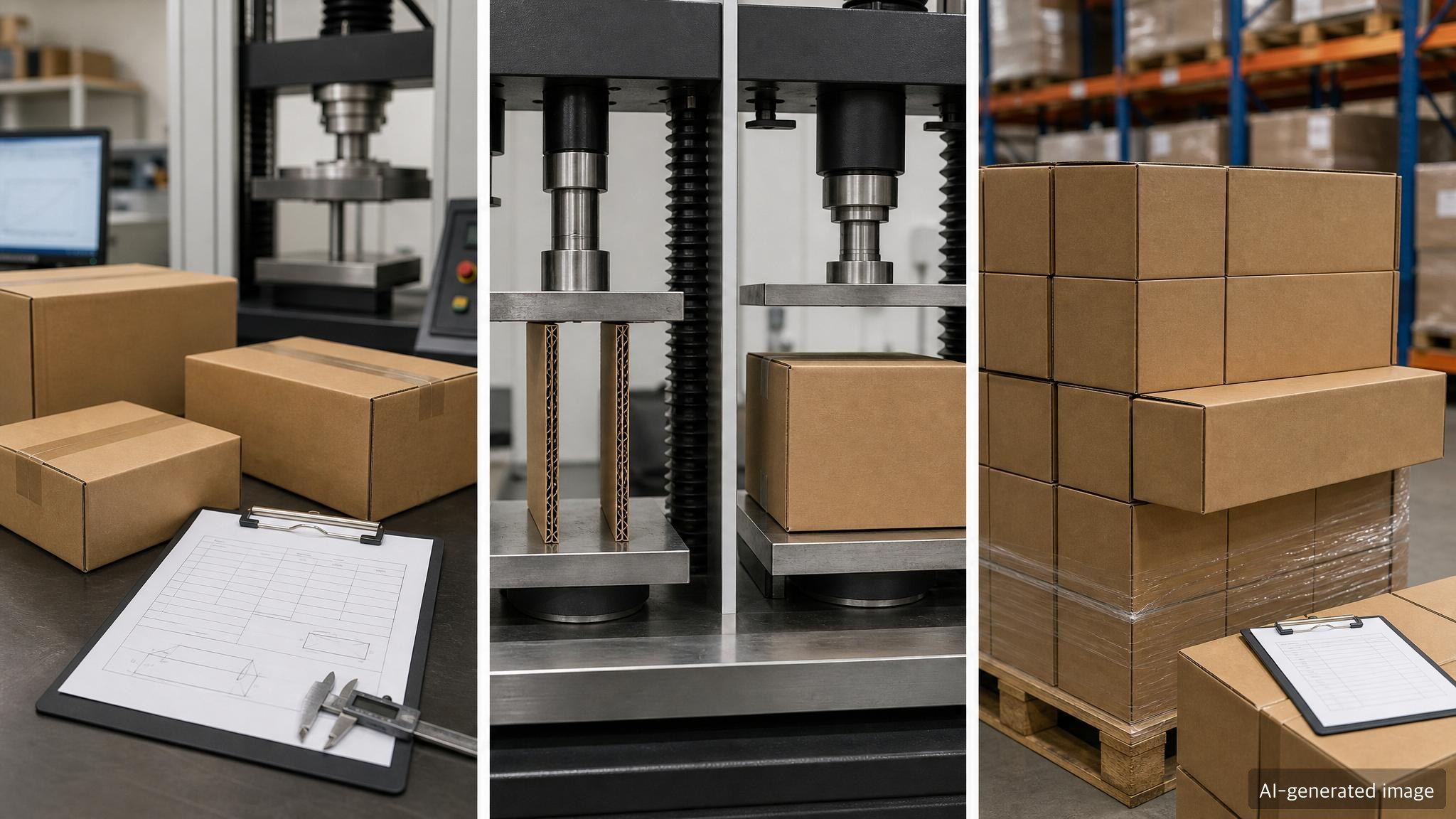
BCT, being a finished-box test, is the more operationally relevant measure. The challenge is that running a BCT test for every quote candidate is not practical. The McKee formula fills this gap by providing a first estimate of “roughly what range this specification falls into” before any samples are made.
What the McKee Simplified Formula Calculates
The simplified McKee formula used in practice takes this form:
Estimated BCT = 5.87 × ECT × sqrt(P × t)
Each variable is defined as follows:
| Variable | Meaning | Example unit |
|---|---|---|
| BCT | Estimated box compression strength | lbf |
| ECT | Board edge crush strength | lb/in |
| P | Box perimeter: 2 × (length + width) | inch |
| t | Corrugated board caliper (thickness) | inch |
| 5.87 | Empirical constant for RSC boxes | Based on US customary units |
Some references use Z for perimeter and h for caliper. The most important thing to watch here is not to confuse h with box height. The value that goes into the caliper term of the simplified McKee formula is the thickness of the corrugated board itself — not the box height. Box height does influence actual compression strength, but it is not the variable that belongs in this term.
Units are equally critical. The formula above is written for ECT in lb/in, perimeter and caliper in inches. Mixing in millimetres or kgf will produce incorrect results. If your quoting workflow uses mm and kg, convert units carefully before and after the calculation.
Calculation Example: Estimating BCT for a 44 ECT Box
Consider a standard RSC (Regular Slotted Container) with the following parameters:
| Parameter | Value |
|---|---|
| Box outer dimensions | 16 × 12 × 10 in |
| Perimeter P | 2 × (16 + 12) = 56 in |
| Board caliper t | 0.14 in |
| ECT | 44 lb/in |
Inserting into the simplified McKee formula:
BCT = 5.87 × 44 × sqrt(56 × 0.14)
    = 5.87 × 44 × sqrt(7.84)
    = 5.87 × 44 × 2.8
    ≈ 723 lbf
The estimated laboratory compression strength for this box is approximately 720 lbf, or roughly 327 kgf. However, quoting that figure as “can hold up to 327 kg” is dangerous. In real logistics, humidity, storage duration, vibration, eccentric pallet loading, misaligned stacking, and handling impacts all degrade the effective strength.
Applying a Safety Factor to Arrive at a Working Load
In practice, BCT is not used directly as the maximum allowable stacking load. It is divided by a safety factor.
Working load = BCT ÷ safety factor
For the example above, with an estimated BCT of approximately 720 lbf and a safety factor of 3:
720 lbf ÷ 3 = 240 lbf
240 lbf is approximately 109 kgf. In other words, even though the estimated laboratory strength looks like 327 kgf, a working load of roughly 109 kgf is a more realistic figure for operational use.
The safety factor is not a single fixed number. It can be set lower when storage duration is short, warehouse humidity is stable, and boxes are column-stacked precisely. It must be set higher for long-term storage, high-humidity environments, refrigerated or frozen conditions, ocean freight, mixed loads, or pallets with overhang.
| Condition | Indicative safety factor direction |
|---|---|
| Short-term storage under one week, indoor warehouse, column stacking | Start from around 2.0 |
| Storage up to one month, standard freight | Around 2.5–3.0 |
| Storage over one month, high humidity, export, refrigerated, mixed loads | 4.0 or above, or conduct dedicated testing |
The figures in the table are starting points for quoting. Where the risk of product damage is high or customer claim costs are significant, apply a more conservative approach.
Calculating the Load on the Bottom Box
A step that is frequently missed in compression strength analysis is determining the actual load acting on the bottom box in a stack. Looking only at a single box weight is not enough. The bottom box carries the weight of every box above it.
The basic calculation is:
Load on bottom box = total box weight × (total stack count − 1)
For example, if a single packed box weighs 18 kg and six boxes are stacked on a pallet, the bottom box supports five boxes above it:
18 kg × (6 − 1) = 90 kg
The actual load on the bottom box is at least 90 kg. Adding in creep during storage, humidity effects, vibration, pallet deck gaps, and stacking misalignment raises the required BCT further.
Required BCT = actual upper load × safety factor
Applying a safety factor of 3:
90 kg × 3 = 270 kgf or more
Under these conditions, a box with a laboratory BCT of at least 270 kgf is required. When converting between kgf and lbf, note that 1 kgf ≈ 2.205 lbf.
What to Check on a Test Report
When reviewing a test report, looking only at a single “BCT: X kg” line is insufficient. The same numerical result can mean very different things depending on test conditions.
| Item to check | Why it matters |
|---|---|
| Test method | Confirm the compression test standard used: TAPPI T804, ASTM D642, or another |
| Conditioning | Verify the temperature and relative humidity before testing. Standard lab conditions may differ from actual warehouse conditions. |
| Specimen specification | Confirm the specimen matches the actual delivery box in dimensions, paper grade, flute type, and joint method. |
| Compression direction | Confirm that top-to-bottom compression is the test orientation. |
| Failure mode | Identify the cause: corner buckling, side-wall collapse, joint failure, etc. |
| Average vs. minimum | Do not look only at the average; check the spread and the minimum value. |
Humidity conditions deserve particular attention. Corrugated board is a fibre-based material and loses strength as it absorbs moisture. Environments above 80% relative humidity, refrigerated warehouses, ocean freight, and extended storage through rainy seasons can all produce real-world performance below laboratory figures.
When the McKee Formula Does Not Apply
The simplified McKee formula is useful, but it cannot be applied universally. Its original purpose is to quickly estimate the compression strength of a standard corrugated RSC box. Actual testing should take priority in the following situations:
- Boxes with handles, windows, large cutouts, or tear perforations
- Boxes with heavy print coverage, coating, or lamination
- Double-wall, triple-wall, or special flute-combination boards
- Unusually long, flat, or otherwise non-standard box geometries
- Boxes where interior partitions, reinforcements, or cushioning contribute to load-bearing
- Packaging subject to significant environmental exposure: refrigerated, frozen, high humidity, or ocean freight
- Heavy products, fragile goods, or applications with high claim risk
In these cases, treat the McKee estimate as an initial candidate specification only. Produce samples and conduct BCT testing and actual stacking trials before finalising.
Pallet Loading Conditions Checklist
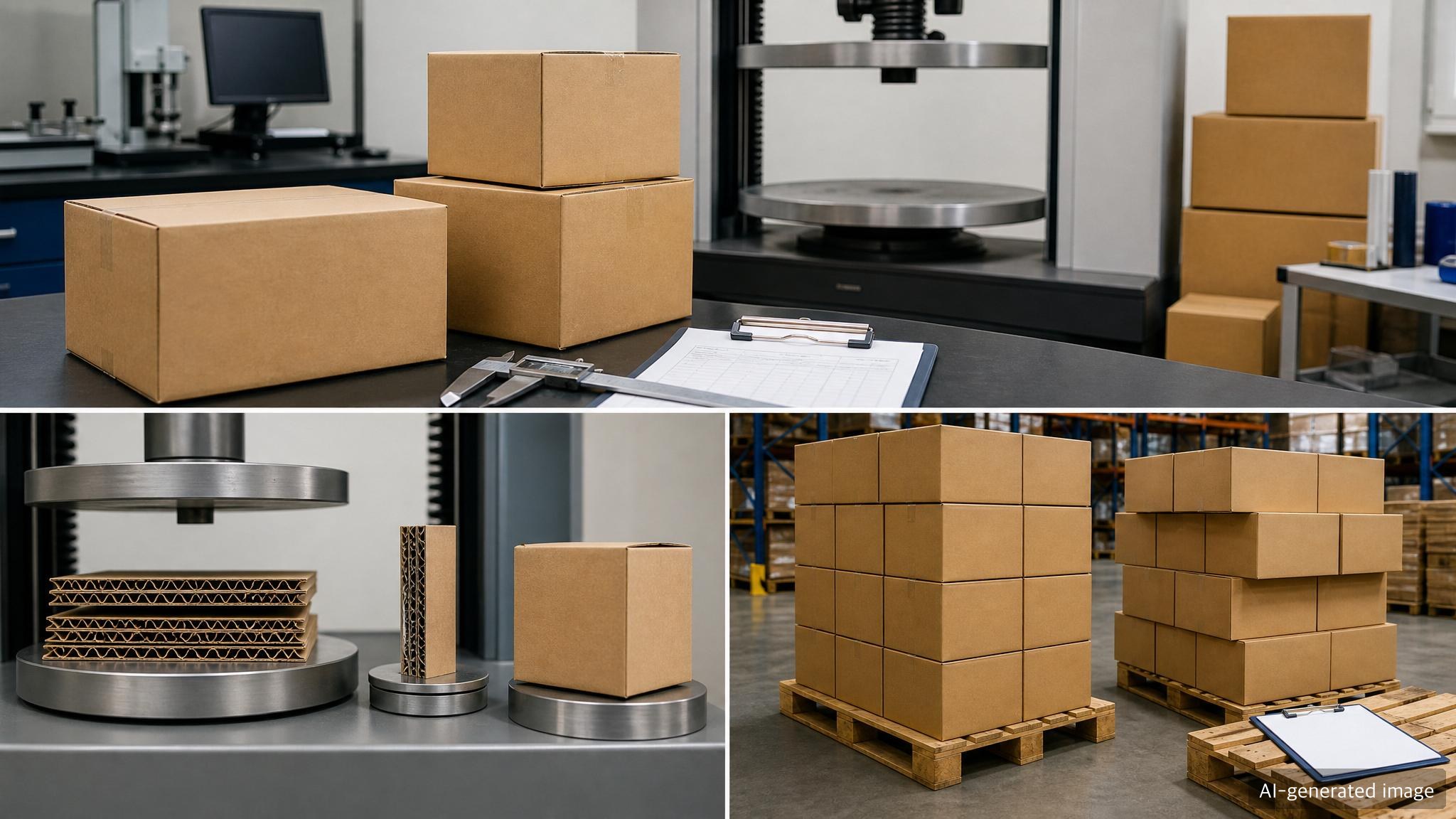
Compression strength is not a single-box question. How boxes are stacked on a pallet determines what strength is actually required. Clarifying the following conditions before submitting a quote request leads to a much more precise conversation with the packaging supplier.
| Item | Question to answer |
|---|---|
| Stack height | How many layers are stacked on the pallet? |
| Total box weight | What is the gross weight per box, including product, inner packaging, and cushioning? |
| Stacking pattern | Column stack, interlock stack, or a combination? |
| Pallet overhang | Do boxes extend beyond the pallet edge? |
| Stretch-wrap tension | Does stretch film pressure deform the box side walls? |
| Warehouse environment | What is the relative humidity? Is refrigeration involved? What is the storage duration? |
| Transit mode | Parcel delivery, LTL freight, container, or ocean shipment? |
| Customer requirements | Are specific tests required — BCT, drop, vibration, ISTA, ASTM D4169? |
Pallet overhang and interlock stacking are the two conditions most often overlooked in practice. Column stacking, where box corners align directly above those of the box below, is structurally the most favourable for compression. Interlock stacking and pallet overhang can cause boxes that appear to have sufficient BCT on paper to fail in the field.
Language to Include in a Quote Request
To enable a meaningful compression strength comparison, a quote request should state conditions in numerical terms.
Example:
Total packed box weight: 18 kg
Outer box dimensions: 480 × 320 × 260 mm
Pallet stacking: 6 layers, column stack
Storage conditions: ambient warehouse, up to 30 days; high humidity possible during rainy season
Transit mode: domestic freight; possible parcel conversion for partial shipments
Request: recommended ECT/BCT specification based on estimated bottom-box load and safety factor
Testing: BCT test report on pre-production sample required before mass production
Even this level of detail will produce significantly better quotes than a request that simply states “X-gsm kraft liner, please.” With this information, a packaging supplier can justify their choice of paper combination, flute type, box construction, and reinforcement method — and a purchasing team can evaluate why prices differ.
Practical Takeaways
Corrugated box compression strength should not be set by intuition. The correct process is to calculate the load on the bottom box first, then back-calculate the required BCT using a safety factor. ECT and the McKee formula are tools for narrowing down candidate specifications quickly within that process.
Calculated values, however, cannot account for every gap between the laboratory and the field. Humidity, storage duration, pallet overhang, interlock stacking, cutouts, and joint quality all materially affect real-world strength. For any important shipment, do not stop at the calculation: verify with sample BCT testing, actual stacking trials, and where warranted, ISTA or ASTM distribution testing.
The one line to keep in mind at the quoting stage:
“ECT is the strength of the board; BCT is the strength of the box; the McKee formula is the estimation tool that bridges the two.”
Getting that distinction right makes corrugated box specification discussions considerably less ambiguous.
FAQ
Q. Does a higher ECT always mean a better box?
A higher ECT indicates greater edge crush strength in the board material. However, the performance of a finished box is determined jointly by box dimensions, board caliper, joint quality, cutouts, stacking method, and humidity — not by ECT alone. ECT cannot be used to predict final box performance on its own.
Q. Can I use the BCT value from the McKee formula directly as the maximum stacking weight?
No — doing so is unsafe. The McKee formula produces an estimated laboratory BCT. The actual working load must be derived by dividing that figure by a safety factor, and should be set more conservatively for long-term storage or high-humidity environments.
Q. Why isn’t box height in the McKee formula?
The t (or h in some notations) in the simplified McKee formula refers to the corrugated board caliper, not the box height. Box height and aspect ratio do influence real compression strength, but they are not the variable in the caliper term of the simplified formula. Substituting box height into that term will produce a significantly incorrect result.
Q. When is actual BCT testing strictly necessary?
Actual BCT testing is strongly recommended for heavy products, export packaging, long-term storage, refrigerated or high-humidity environments, boxes with handle cutouts, and any application where product damage or claim costs are significant. The formula is a tool for selecting candidate specifications; final validation requires physical testing.
About the Author
PackingMaster is an editor at PaperPackLog, covering market trends, product information, and technical insights across the paper packaging industry.