
When a corrugated-box hand hole tears, the first response is often to enlarge the opening or add a reinforcement patch. Actual failure is produced by several connected factors: finger contact, end radius, flute direction, board moisture, gross package mass, load shift and repeated handling. Design and quality teams need a test plan that connects geometry, material, finished box, environment, handling cycle and failure mode, not a checkbox that says a hand hole is present.
Standards boundary — checked September 4, 2026: The official title of
ISO/TS 18617:2025is Hand hole design principles and test methods for handheld packages. It is the broader technical specification for hand-hole design principles and test methods for handheld packages.ASTM D6804-24A, Standard Guide for Hand Hole Design in Corrugated Boxes, specifically covers pre-cut apertures used as hand holes for manual handling of corrugated boxes. ASTM’s public scope says the guide supports package development and subsequent performance testing but is not intended to supply a specific hand-hole design. Do not collapse both documents into onecorrugated test standard: use ISO for the broader design-and-test principles and ASTM as the corrugated-box guide.
A Different Question from the Weight-and-Handling Standard
A box weight and handle work standard first decides whether a package should be handled by one or two people and how the task must be marked and performed. This article begins after that decision and asks whether the hand hole itself survives the actual distribution condition. It does not replace an ergonomic mass assessment. Adding hand holes to a heavy box does not automatically make single-person handling safe.
Connect Geometry, Material and Use to One Drawing Revision
Identify every hand-hole test specimen with at least the following inputs.
| Group | Required record | Often-missed connection |
|---|---|---|
| Box | Box style, internal and external dimensions, joint and opening orientation | Position of the product centre relative to the hand-hole centre |
| Hand-hole geometry | Width, height, end radius, flap, finger-contact surface and cut quality | Micro-notches, crush and burr at each end |
| Location | Distance to bottom, top, vertical and horizontal scores; alignment of both sides | Overlap with score, print or die-cut stress concentrations |
| Corrugated board | Liner and medium combination, flute, flute direction and approved strength specification | Different liner tensile, moisture and flute damage at the same ECT |
| Reinforcement | Patch material, size, direction, bond area and adhesive application | A new tear starting at the reinforcement edge |
| Contents | Actual gross mass, count, restraint, centre and potential load shift | Local pressure at an internal box edge and asymmetric load |
| Production | Print, die-cutter, gluer, knife, production date, shift and lot | Difference between a sample cut and a production die-cut edge |
Place tolerances and measurement locations on the drawing, not only nominal dimensions. Photograph the inner finger-contact edge, end radius, flute damage and reinforcement bond boundary with coordinates.
Copy-Ready Hand-Hole Test Plan
1. Lock Purpose, Specimens and Acceptance Before Testing
| Item | Entry example | Approval rule |
|---|---|---|
| Product | [item code / drawing revision / customer / use] | Treat a changed drawing, board or reinforcement as a separate group |
| Specimen groups | [control / geometry A or B / reinforcement A or B] | Sample across production lot and position |
| Sample size | [quantity per group / rationale] | Predefine enough samples to expose variation and failure mode |
| Gross mass | [nominal / upper limit / product distribution] | Include maximum shipping mass and adverse load shift |
| Conditioning | [temperature / relative humidity / time / state] | Lock to the target distribution environment and customer specification |
| Handling route | [lift / distance / height / rotation / set-down] | Condense the real route without deleting critical motions |
| Acceptance | [crack / deformation / load / repetitions / product safety] | Do not rewrite after the result is known |
| Stop condition | [rapid tear / drop risk / fixture abnormality] | Prioritize operator safety and record the stop point as a result |
A standard’s name does not automatically determine sample size or a product pass limit. Approve these before testing based on product risk, gross mass, customer requirement and the internal quality level.
2. Test-Condition Matrix
| Axis | Minimum comparison | Values to record | Representative failure mode |
|---|---|---|---|
| Static lift | Actual maximum mass and simultaneous two-side lifting | Time-load trace, displacement and initial crack location | End tear, liner tensile break or reinforcement peel |
| Repeated handling | Planned lift-carry-set cycle | Cycle count, deformation each cycle and residual deformation | Fatigue crack, hole elongation or flute crush |
| Asymmetric load | Product shift, side-height difference and one side leading | Left-right load ratio, tilt and crack timing | Sudden one-end failure or joint-side distortion |
| Vertical and turning motion | Actual floor, pallet and shelf heights with turns | Path, speed, box contact and impact | Lower-edge hand-hole tear or corner buckling |
| Environment | Standard condition plus target high humidity, low temperature or wet risk | Temperature, RH, conditioning time and board state | Wet-strength loss, bond peel or creep |
| Production variation | Knife early and late life, cross-machine position and lot | Dimensions, cut edge, flute damage and failure distribution | Burr or notch initiation and location variation |
ASTM’s public information says hand holes are not intended for pushing or pulling and emphasizes package weight, size, handling frequency and distance. If users in the actual operation pull a package horizontally by its opening, document that instead of hiding it. Treat it as a separate foreseeable-misuse or hazard scenario and connect the result to a change in work method or package structure.
3. Separate Mechanical Fixtures from Human Handling
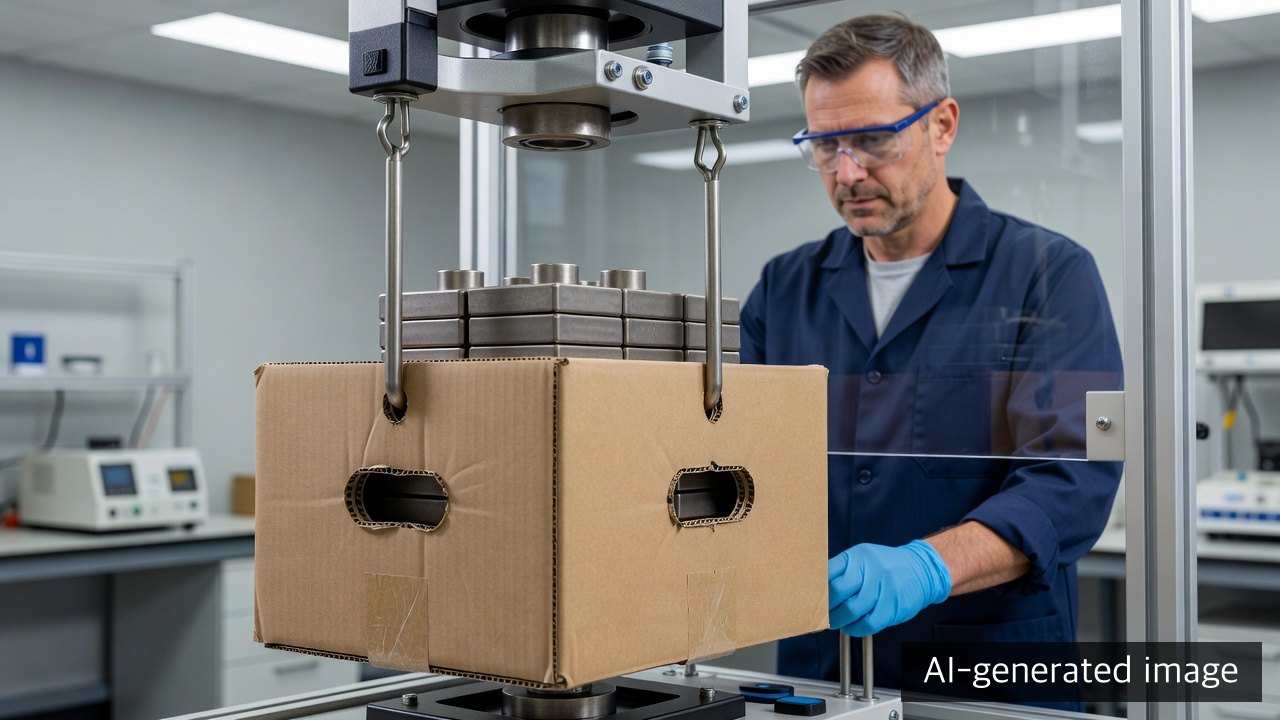
A mechanical fixture test makes left and right loads, lift speed, hold time and displacement repeatable. The fixture’s contact width, curvature and insertion depth can distort results if they do not reasonably represent finger contact, so include the fixture drawing and calibration status in the report.
A human handling trial checks hand entry, sharp edges, finger pressure, wrist posture, visibility and the movement route. Do not approve a design that passes the machine test but is hard to grip or presents a sharp cut edge. Keep ergonomic mass and two-person handling decisions as a separate safety assessment.
4. Do Not Record Every Failure as Tear
| Code | Failure mode | Photograph and data location | Design feedback |
|---|---|---|---|
| T1 | Liner tensile tear from a hand-hole end | Crack origin, flute direction and peak load | Review end radius, location and liner combination |
| T2 | Compression or buckling below the opening followed by tearing | Displacement, flute crush and product contact | Review hole height, bottom distance and internal support |
| T3 | Reinforcement bond peel | Bond boundary, peel surface and environment | Review adhesive, application and patch size |
| T4 | New stress-concentration tear at reinforcement edge | Distance between patch edge and crack | Review patch orientation, tapered edge and area |
| T5 | Burr, incomplete cut or flute damage initiates break | Magnified edge photo, knife and production lot | Review knife, anvil or mat, pressure and production control |
| T6 | Joint, score or corner distortion occurs first | Whole-box displacement and product shift | Redesign the box system, not only the hand hole |

Execution Gates
G0. Define the Use Scenario
Observe who lifts the box, how many people are involved, what mass is moved, between which locations and how many times. Record pulling or pushing, glove use and potential wet exposure.
G1. Lock the Drawing and Material Baseline
Place box, hand-hole and reinforcement dimensions and tolerances in the drawing revision. Link liner, medium, flute, flute direction and bond to the material specification.
G2. Verify the Fixture and Pre-Test Safety
Confirm that contact geometry represents actual handling and synchronize load, displacement and video time. Use a lower-risk specimen first to verify stop conditions and drop protection.
G3. Run Environment, Repetition and Asymmetry
Do not stop after one lift at room condition. Repeat by target distribution environment and product shift, collecting left-right load and crack-initiation location.
G4. Confirm Production Reproducibility
Sample from the actual print, die-cut and gluing lot rather than development-room cuts. Cover cross-machine position and knife-life windows. Approval includes the production variation of the chosen design.
G5. Control Change and Feed Back Field Evidence
Define retest scope when paper combination, supplier, flute direction, die or knife, reinforcement or adhesive, product mass or logistics route changes. Link a field-claim photograph back to drawing revision and production lot.
Conditions That Require an Approval Hold
- Describing ISO/TS 18617 and ASTM D6804 as corrugated-box standards with identical scope
- Citing a standard without verifying the edition, purchased text and applicable procedure
- Choosing the sample size or pass criterion after seeing the results
- Testing an empty box or centre-aligned weight while omitting actual product shift
- Approving high humidity, repeated handling and production variation from one room-temperature lift
- Comparing hole dimensions while omitting board, flute direction, reinforcement and cut edge
- Using a fixture contact geometry that differs materially from the human hand
- Treating added hand holes as a replacement for ergonomic or two-person handling assessment
The fastest way to reduce hand-hole tears is not always to enlarge the reinforcement. It is to find where and by which mode failure starts in a repeatable test. Standards provide principles and guidance; they do not prescribe the correct geometry for a particular box. Combine actual gross mass, environment, use motion and production variation in one plan so that a box with an opening becomes a package that can actually be gripped and moved.
About the Author
PackingMaster: Editor of Paper Pack Log. We collect and organize market trends, product information, and technical insights for the paper packaging industry.