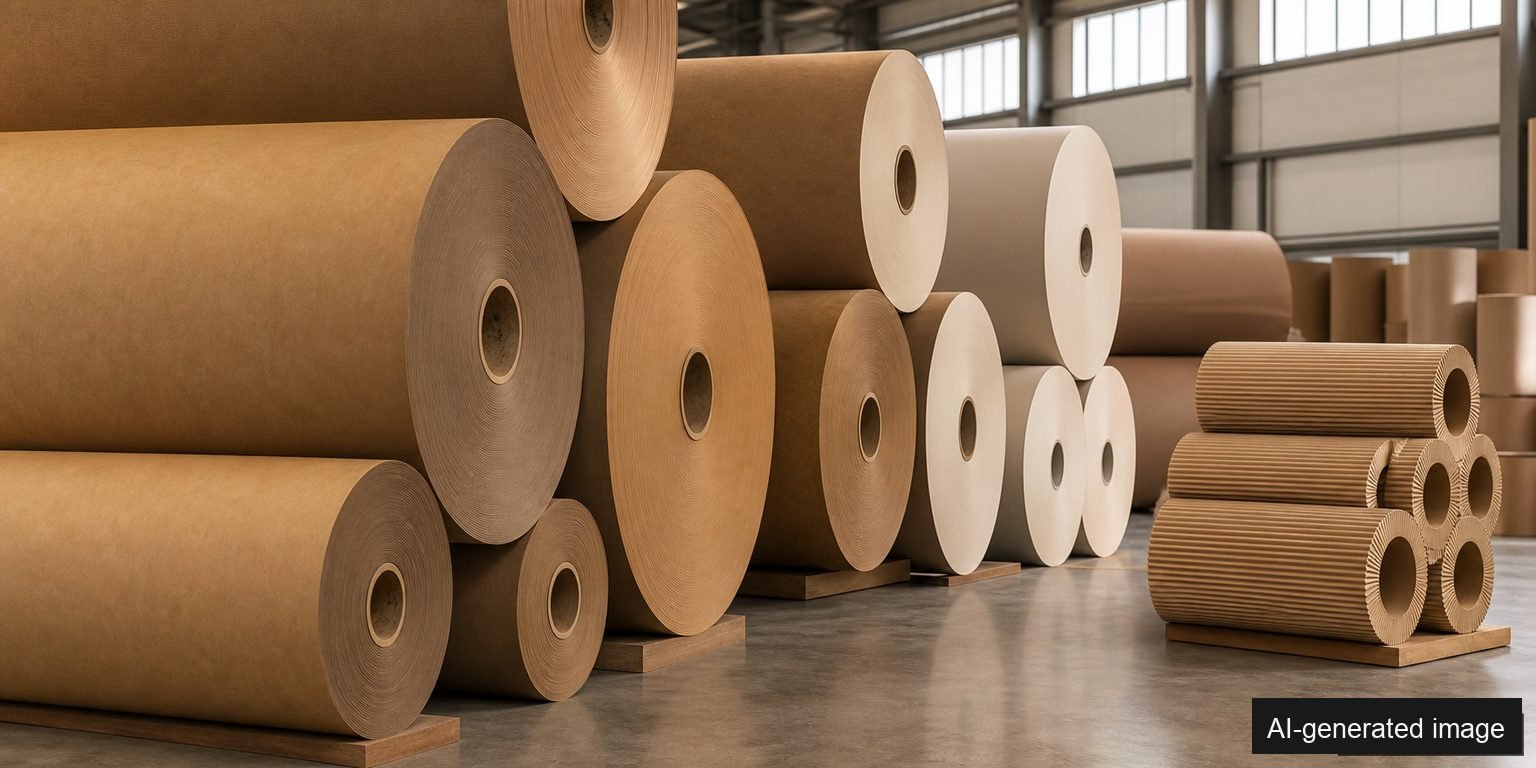
When asking for a corrugated box quotation, “please make it strong” is not enough. The packaging supplier needs to know the product weight, box size, stacking height, transportation route, and storage environment before choosing the flute and board combination. If purchasing or sales teams cannot organize those conditions, the result is often either over-specification that raises cost, or under-specification that causes damage claims.
A packaging academy course on corrugated packaging and design is scheduled by Allpackaging in June 2026, and that demand points to the same issue. Corrugated packaging is not just a box. It is a design task that converts product and logistics conditions into measurable requirements. This article summarizes the basic checks non-specialists should prepare before discussing flute, board grade, and compression strength.
Five details to define first
Packaging design does not start by choosing a board grade. It starts with the product and logistics conditions.
| Item to check | Impact on packaging design | Example to share with supplier |
|---|---|---|
| Unit weight | Box load, burst and compression strength | 8 kg per product, 4 units per box |
| Product size and shape | Internal box size, clearance, movement | 320 mm × 210 mm × 120 mm |
| Stacking height | BCT, flute, board grammage | 5 layers per pallet, 2-pallet-high warehouse storage |
| Transport method | Drop, vibration, and crush risk | Parcel, freight, container export, refrigerated truck |
| Storage environment | Moisture, temperature, long-term compression | 30 days at room temperature, 7 days chilled, 30 days ocean freight |
Without these five details, it is difficult to decide whether A-flute or B-flute is appropriate, or whether KLB or TLB is enough. Even for the same 10 kg product, the required strength changes depending on whether it is shipped as a single parcel or transported long distance on a pallet.
Flute selection: start with the use case, not just thickness
The flute is the wave-shaped layer inside corrugated board. In general, A-flute is thicker and provides cushioning, B-flute offers good printability and dimensional stability, and E-flute is thin and suitable for small packaging. But “thicker is always stronger” is the wrong way to think about it. Box structure, board grade, bonding quality, and stacking conditions all work together.
A-flute
A-flute is relatively high and can be useful for cushioning and vertical compression. It is considered for glass bottles, large household goods, and bulky products that need impact absorption. However, it takes more storage and transport space and may be less suitable for detailed printing.
B-flute
B-flute is a practical and widely used choice for many cartons. It is thinner than A-flute but offers good dimensional stability and printability, making it suitable for general parcel boxes, food packaging, household goods, and components. For the same box dimensions, B-flute can be more space-efficient and easier to process.
E-flute
E-flute is thin and has a relatively flat surface, so it is often used for small boxes, printed retail packaging, internal dividers, and display boxes. It is more common as inner packaging or for light products than as a stand-alone outer shipping box.
Double-wall corrugated board
For heavy goods or export packaging, double-wall structures such as A+B flute or B+C flute may be considered. They increase cost and thickness, but can improve stability for long-term stacking, container shipment, and moisture exposure. Still, over-specification raises not only material cost but also logistics and storage cost, so the decision should be based on actual loading conditions.
Board grade selection: separate liners and medium
Corrugated board is usually considered in two parts: liners and medium. Liners form the outer and inner surfaces of the board, while the medium forms the fluted structure that contributes to compression strength and cushioning.
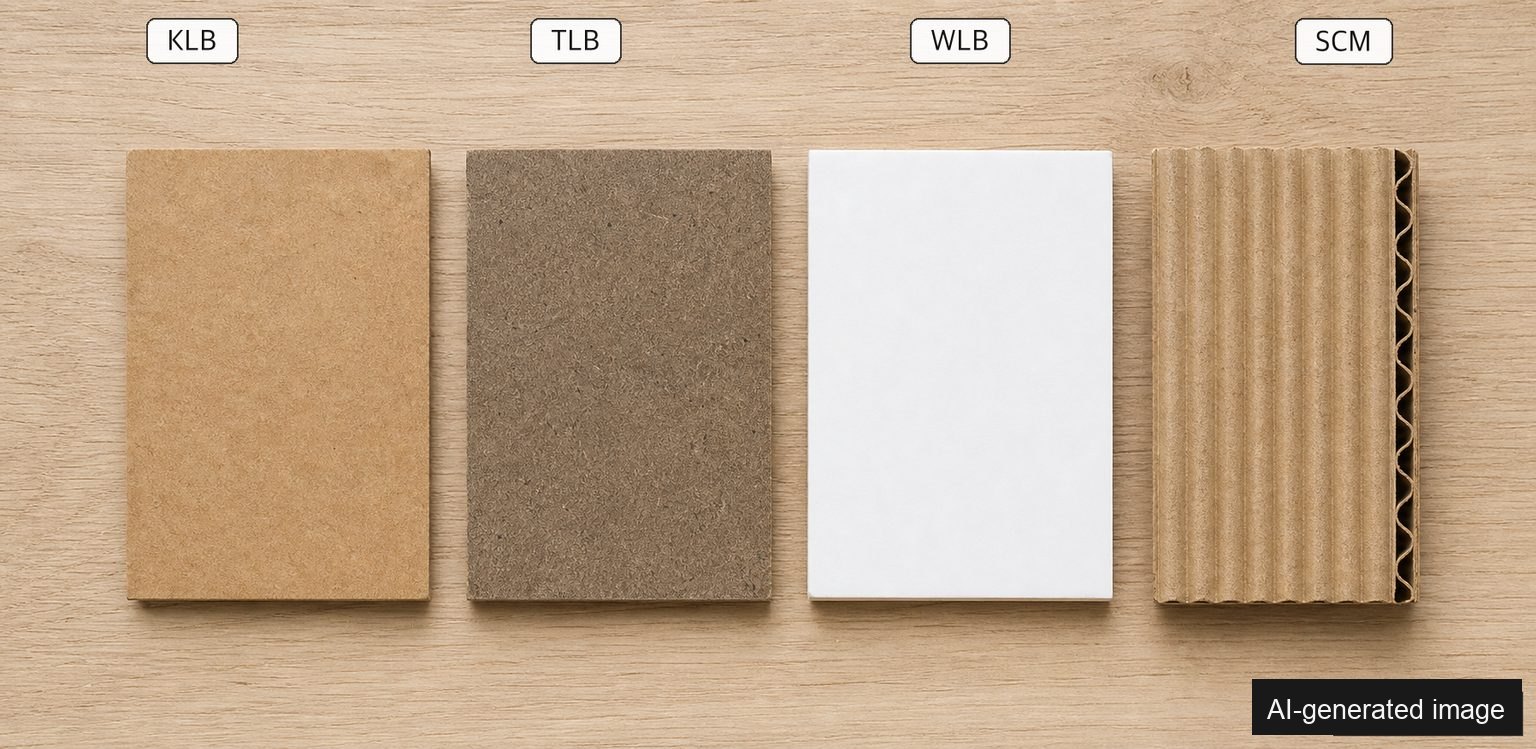
If a previous article explained grades such as KLB, TLB, WLB, and SCM, the design-stage questions should be reframed like this:
- How much external impact and stacking load will the box face?
- Is print quality more important, or is strength more important?
- Will the package face moisture, chilled, or frozen conditions?
- Is recycled-fiber-based liner sufficient, or is a stronger liner needed?
- Is general medium enough, or is higher-strength medium required?
For example, a lightweight household product shipped by parcel may work with TLB-type liners and general medium. A beverage, metal component, or export heavy item may require KLB-type liners and a stronger medium. The key is not memorizing grade names, but connecting product load and logistics conditions to the board combination.
Compression strength: the ability to survive stacking
One of the most common corrugated box failures is collapse during stacking. That is why BCT and ECT are frequently discussed.
- BCT (Box Compression Test): Measures how much top-to-bottom compression a finished box can withstand. It is directly related to stacking stability.
- ECT (Edge Crush Test): Measures the edgewise compression strength of corrugated board. It helps estimate how the board structure contributes to box compression strength.
- Burst strength: Measures resistance to puncture or rupture. It is also relevant when the package faces rough handling or parcel delivery shock.
In daily work, every product cannot always be tested in a lab. At the quotation stage, the practical step is to calculate the expected stacking load and share it with the packaging supplier.
A simple sequence is:
- Check the gross weight of one packed box.
- Check how many layers will be stacked on a pallet or in storage.
- Calculate the load carried by the bottom box.
- Add a safety margin for vibration, moisture, long-term storage, and handling impact.
- Choose the required flute, board grade, and box structure.
For example, if one box weighs 12 kg and the pallet is stacked five layers high, the bottom box carries four boxes above it, or roughly 48 kg of load for an extended period. Transport vibration, pallet imbalance, moisture-related strength loss, and handling impact mean the required safety margin should be higher than the simple static load.

Checklist before requesting a quotation
When designing new corrugated packaging or changing an existing specification, sharing the following information improves quotation quality.
1. Product information
- Product name or product group
- Unit weight
- Quantity per box
- Product dimensions
- Sensitivity to breakage, dents, pressure marks, or moisture
2. Box structure
- Regular slotted carton, lid-type box, sleeve, tray, or another structure
- Need for handles, holes, dividers, or cushioning
- Print color and print location
- Whether an automatic packing machine will be used
3. Logistics conditions
- Parcel, freight, in-house delivery, or container export
- Pallet stacking height
- Warehouse storage period
- Chilled, frozen, or high-moisture environment
- Past claims involving drops, vibration, or crushing
4. Quality criteria
- Compression strength or drop-test requirements
- Existing specification and problem history
- Whether the goal is cost reduction or damage reduction
- Environmental, recycling, or certification requirements
With this information prepared, a packaging supplier can explain why a certain specification is needed rather than simply quoting a unit price. Purchasing teams can also distinguish between over-specification and under-specification more easily.
Four common mistakes
1. Asking only for the same thickness as the existing box
Even if box thickness is the same, performance can differ depending on liner grammage and medium strength. Instead of asking for the same thickness, share the existing specification, box weight, board combination, and actual claim history.
2. Checking product weight but ignoring stacking conditions
A lightweight product can still require compression strength if it is stored for a long time or stacked high. Conversely, a heavier product may not require an expensive double-wall specification if it is shipped in a single layer.
3. Mentioning moisture conditions too late
Corrugated board is sensitive to moisture. For chilled, frozen, seafood, agricultural, or ocean-shipping applications, water resistance, liner grade, and storage practices should be reviewed together.
4. Lowering board grade based only on unit price
Lowering the board grade may reduce box unit cost, but damage, returns, repacking, and delivery delays can cost more. Specification changes should ideally be tested with samples or actual stacking trials.
Practical conclusion
Corrugated packaging design starts not with a flute name or board grade, but with product and logistics conditions. Product weight, stacking height, transport method, and storage environment should be defined first. Then the flute, board combination, and compression strength can be selected properly. This allows the packaging supplier to recommend an appropriate specification and helps purchasing teams make a rational decision between cost and quality.
Before requesting a quotation, complete this one sentence:
“How many kilograms does one packed box weigh, how many layers will it be stacked, and what transport and storage environment will it face?”
If that question can be answered, half of the corrugated packaging design work is already organized.
About the Author
PackingMaster is the editor of Paper Pack Log, curating market trends, product information, and technical insights for the paper packaging industry.
References
- Allpackaging, Packaging Academy course announcement for
Corrugated Packaging and Design: https://www.allpackaging.co.kr/77/?bmode=view&idx=171159296 - FEFCO, Testing methods for testing the corrugated industry: https://www.fefco.org/technical-information/fefco-testing-methods-recommendations
- Georgia Tech Renewable Bioproducts Institute,
Predicting Box Compression Strength: https://research.gatech.edu/sites/default/files/rbi/pdfs/Predicting%20Box%20Compression%20Strength_3.pdf - Edge Crush Test overview: https://en.wikipedia.org/wiki/Edge_crush_test