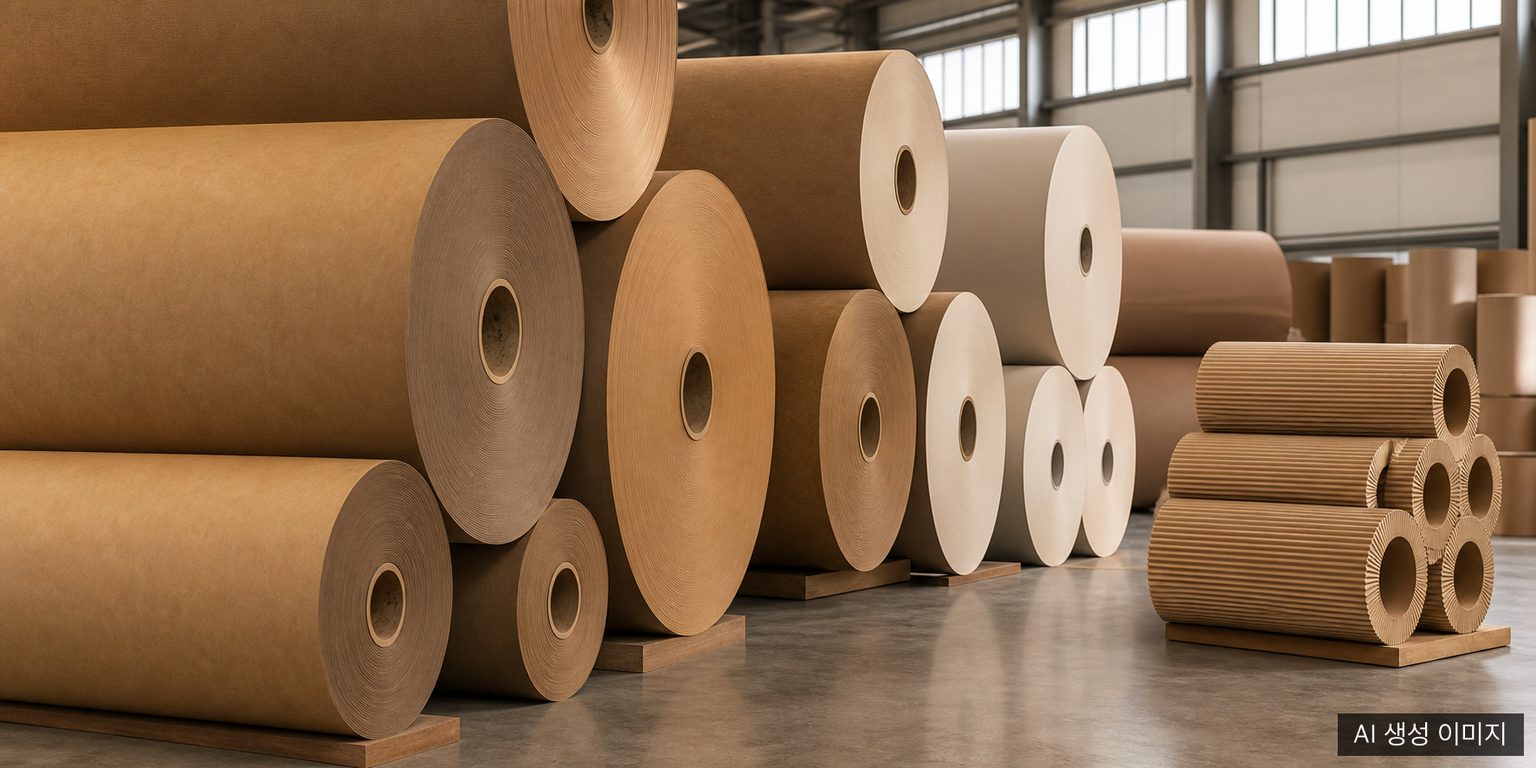
A box is made by combining outer and inner liners with a corrugating medium in between. If the grade is too weak, boxes can fail during stacking. If the grade is excessive, costs rise unnecessarily. With Korean corrugated base paper prices up by 12 to 18 percent in 2026, grade selection has become even more important. This article summarizes the base paper grades box makers and purchasing teams should understand before quotation and ordering, based on Korean Industrial Standard KS T 1004 classifications.
Four Major Categories of Corrugated Base Paper under KS Standards
Under KS classification, corrugated box base paper is divided into four broad groups.
- Liner: KLB, TLB, KS, and TL. Used for outer and inner box facings. Typical basis weight: 110 to 280 g/m².
- Corrugating medium: SCM and MM. Used for the fluted middle layer. Typical basis weight: 110 to 200 g/m².
- White board: WLB and WLC. Used for color-printed boxes. Typical basis weight: 200 to 500 g/m².
- Reinforced and specialty grades: KFB, water-resistant paper, and anti-rust paper. Used for heavy-duty, export, and moisture-resistant boxes. Typical basis weight: 175 to 280 g/m².
The liner determines appearance and strength, while the corrugating medium largely controls compression strength when boxes are stacked. Food, cosmetics, and electronics boxes that require color printing often use white board as the outer facing.
1. Liner Grades: KLB and TLB
KLB: Kraft Liner Board with Higher Strength
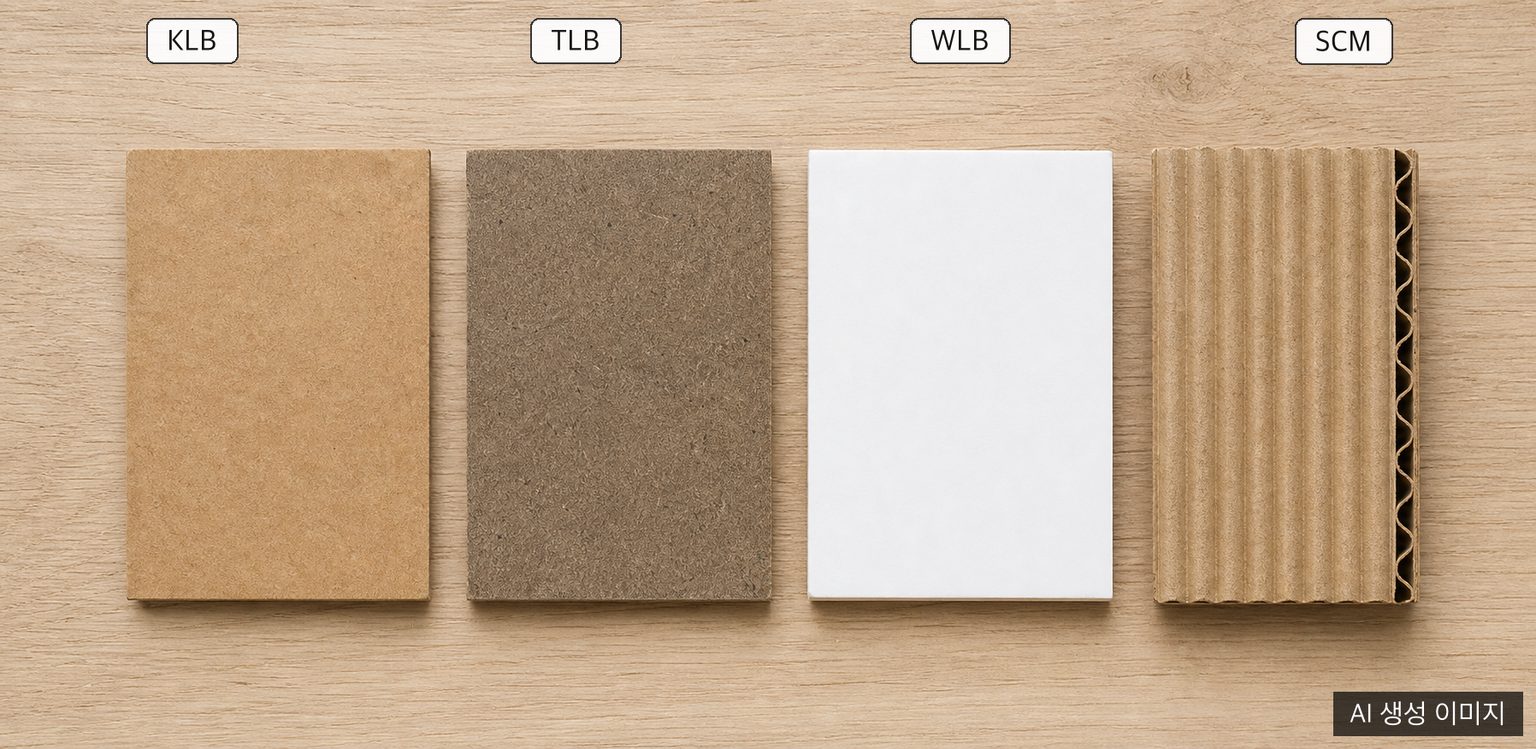
KLB is the benchmark high-strength outer liner for Korean corrugated boxes. It contains a defined share of virgin kraft pulp and provides strong tensile and burst strength. Common basis weights are 110, 125, 175, 225, and 280 g/m². Because it meets KS T 1004 strength grades while remaining cost-effective, it is widely used as an outer liner for beverage, food, and export boxes.
In U.S. and European terminology, the same concept is often called KA, Kraft, or kraftliner. Liners shown in quotations as K-grade paper or kraft grade also belong to the KLB family. Premium 100 percent virgin pulp grades may be listed separately as K grade or Kraft 100 percent to distinguish them from recycled-fiber liners.
TLB: Test Liner Board Based on Recovered Paper
TLB is an outer liner made primarily from recovered paper such as OCC. It looks similar to KLB, but average strength is about 15 to 25 percent lower, and price is usually lower by a similar range. It is often used instead of KLB for general parcel and household-goods boxes when box thickness, contents, and stacking requirements are not demanding. In Korean quotations it may appear as TLB, B-grade liner, or test liner.
KS, TL, and IB Variant Liners
- KS (Kraftliner Surface): a KLB surface grade with white coating.
- TL (Top Liner): a white liner with enhanced print quality.
- IB (Improved Board): a modified board with reinforced KLB strength.
When some color printing is needed but full white board is too costly, KS and TL can be practical compromises.
2. Corrugating Medium: The Core of Box Compression Strength
The corrugating medium is the fluted layer between two liners. Box compression strength, or BCT, is largely determined by the medium.
- MM (Medium): a general medium based on recovered paper and OCC. Recommended for ordinary parcel and household-goods boxes.
- SCM (Semi-Chemical Medium): a semi-chemical pulp-based medium with higher strength. Recommended for beverages, food, and heavy goods.
Flute type also matters. A, B, C, E, and F flutes should be selected together with the medium grade. A flute is taller and stronger, while E and F flutes are thinner and used for printing and display applications.
3. White Board for Color-Printed Boxes
- WLC (White Lined Chipboard): white top side with gray back side; common in cosmetics and food cartons.
- WLB (White Lined Board): white on both sides for premium color boxes.
- Premium cosmetics and electronics boxes: often use WLB with surface coating or lamination.
White board prioritizes print quality, so its strength is lower than KLB. When additional strength is needed, it is common to use white board as the outer facing and laminate KLB as the inner facing.
4. Reinforced and Specialty Grades for Heavy, Export, and Moisture-Resistant Boxes
- KFB (Kraft Fluting Board): a reinforced medium variant used for heavy export boxes.
- Water-resistant paper and T-grade paper: liners treated for water resistance or cold resistance, used for seafood, livestock products, and export environments with moisture exposure.
- Anti-rust paper: corrosion-resistant paper for automotive parts and metal products.
Major Korean Corrugated Base Paper Manufacturers
At the quotation and ordering stage, knowing who makes each grade matters for supplier diversification and supply-chain risk management. Based on Korea Paper Association member information and industry reporting, the main domestic suppliers by grade are as follows. Product lineups can change through mergers and line adjustments, so confirm directly before ordering.
Liner Producers for KLB and TLB
The major Korean liner suppliers include Tailim Paper, Asia Paper, Shindaeyang Paper, Korea Export Packaging Industrial, and Koryo Paper. These companies supply most of the domestic liner volume. Tailim Paper and Shindaeyang Paper are vertically integrated into corrugated board and box production, while Asia Paper supplies through group box subsidiaries. In July 2024, the three leading liner makers announced price increases of about KRW 70,000 to 80,000 per ton, roughly 20 percent.
Corrugating Medium Producers for SCM and MM
Corrugating medium is often produced by liner manufacturers as well. The major liner producers supply general MM and reinforced SCM grades based on semi-chemical pulp, while some smaller specialty paper makers supply specific SCM basis weights. For SCM grades of 175 g/m² or higher used in beverages, food, and heavy goods, specification and basis-weight variation are critical checks.
White Board Producers for WLB and WLC
Major Korean white board suppliers include Hansol Paper, Hanchang Paper, KleanNara, Hankuk Paper, and Seha. As of the third quarter of 2024, Hansol Paper, Hanchang Paper, and KleanNara accounted for about 85.4 percent of the domestic white board market. In January 2026, the three companies raised prices by roughly KRW 120,000 per ton, affecting quotations for color-printed boxes.
Note: The mapping above is based on Korea Paper Association information and industry reports from 2024 to 2026. Lineups, mergers, and certifications can change. For exact specifications, check the or contact each manufacturer directly.
Four Ordering Criteria
When preparing a box purchase order, four variables are especially important.
1. Weight: Load Weight and Box Size
Select liner basis weight based on contents weight and stacking height. General guidelines are:
- General parcel boxes under 5 kg: TLB 175 g/m² plus MM 125 g/m².
- Food and beverage boxes from 5 to 15 kg: KLB 225 g/m² plus SCM 175 g/m².
- Export and heavy goods above 15 kg: KLB 280 g/m² plus reinforced SCM.
- Color cosmetics and electronics boxes: WLC outer facing plus KLB inner facing.
2. Strength: Compression, Burst, and Bonding
- Compression strength (BCT): determined by medium grade and flute type.
- Burst strength: determined by liner basis weight and pulp content.
- Bonding strength: determined by adhesive quality between liner and medium.
The grade combination changes depending on which strength is most important. Long stacking periods or high stacking levels require compression strength; frequent transport shocks require burst strength.
3. Printing and Appearance
- Single-color or logo printing: KLB or TLB is usually enough.
- Two or more color printing: WLC or KS is recommended.
- Premium design boxes: WLB with surface coating.
- Eco-friendly unprinted boxes: TLB alone with minimal ink use.
4. Environment and Certification
- FSC or PEFC certification: certified base paper, increasingly required for EU export.
- Recycled content: TLB has a high recovered-paper share; KLB contains more pulp, which affects ESG reporting.
- EU PPWR readiness: as recyclable packaging becomes mandatory by 2030, the share of recyclable grades should increase.
Grade Price Trends in Q1 2026
Based on Background: January 2026 Korea Paper Association data and industry interviews, estimated grade prices are as follows. These are not official market prices and should be used only as negotiation references.
- KLB 175 g/m²: about KRW 600,000 to 700,000 per ton, up 12 to 18 percent year over year.
- KLB 225 g/m²: about KRW 650,000 to 750,000 per ton, up 12 to 18 percent.
- TLB 175 g/m²: about KRW 500,000 to 600,000 per ton, up 10 to 15 percent.
- General WLC: about KRW 800,000 to 1,000,000 per ton, with separate pressure from printing-paper antitrust penalties.
- MM 125 g/m²: about KRW 500,000 to 600,000 per ton, up 10 to 15 percent.
- SCM 175 g/m²: about KRW 600,000 to 700,000 per ton, up 12 to 18 percent.
Because supply shortages caused by fires and accidents continued into May, prices may still fluctuate. When negotiating orders, check Korea Paper Association monthly supply-demand data together with your own purchasing data.
Practical Checklist for Box Makers
- Specify liner grade, basis weight, medium grade, and flute type in the RFQ.
- Before placing an order with a new supplier, receive a one-ton pilot lot and run internal BCT and burst tests.
- If customers require FSC or PEFC certification, discuss liner certification in advance.
- For imported liners, such as Chinese KLB or TLB, separately check KS compliance and basis-weight variation.
- Include allowable basis-weight tolerance, such as plus or minus 5 percent, and remedies for strength shortfalls in the contract.
Frequently Asked Questions
Q: Is the strength gap between KLB and TLB proportional to the price gap?
KLB contains more virgin kraft pulp, so tensile and burst strength are on average 15 to 25 percent higher than TLB. However, for ordinary parcel and household-goods boxes, TLB 175 g/m² is often sufficient. KLB is usually more cost-effective when limited to beverages, food, export, heavy goods, or moisture-sensitive conditions.
Q: How is corrugating medium grade selected?
MM and SCM are the most common. SCM has higher compression strength. General parcel boxes often work with MM 125 g/m², while beverages, food, and heavy goods are better suited to SCM 175 g/m² or higher. When stacking exceeds five levels, SCM adoption becomes more common.
Q: Can WLC boxes be replaced with KLB?
Not if print quality is central. KLB has a brown surface, so color printing appears darker, and ink absorption differences reduce print quality. For color boxes, the standard approach is to use WLC as the outer facing and laminate KLB inside if more strength is needed.
Q: What should I watch when ordering imported base paper?
Chinese KLB and TLB are common alternatives, but check KS compliance, basis-weight variation, ocean freight volatility, and arrival lead time of three to six weeks. Prices may be 5 to 10 percent lower than domestic grades, but import share is often kept below 30 percent to manage supply-chain risk.
Q: How much more expensive is FSC-certified liner than general KLB?
Certification typically adds 5 to 10 percent. EU export customers are increasingly requiring it, and large domestic food and household-goods companies are adopting it for ESG reasons. Certified liners may have separate lot requirements, so small orders can become more expensive.
About the Author
PackingMaster: Editor of PaperPackLog. Covers market trends, product insights, and technology in the paper packaging industry.
References
- Background: Korea Paper Association, monthly domestic paper industry supply and demand
- Background: Tailim Paper vertical integration report
- Fire and fatal accident shock Korean corrugated base paper market: H1 2026 supply crisis
- Forty days after fires and accidents: Korean corrugated base paper market recovery status