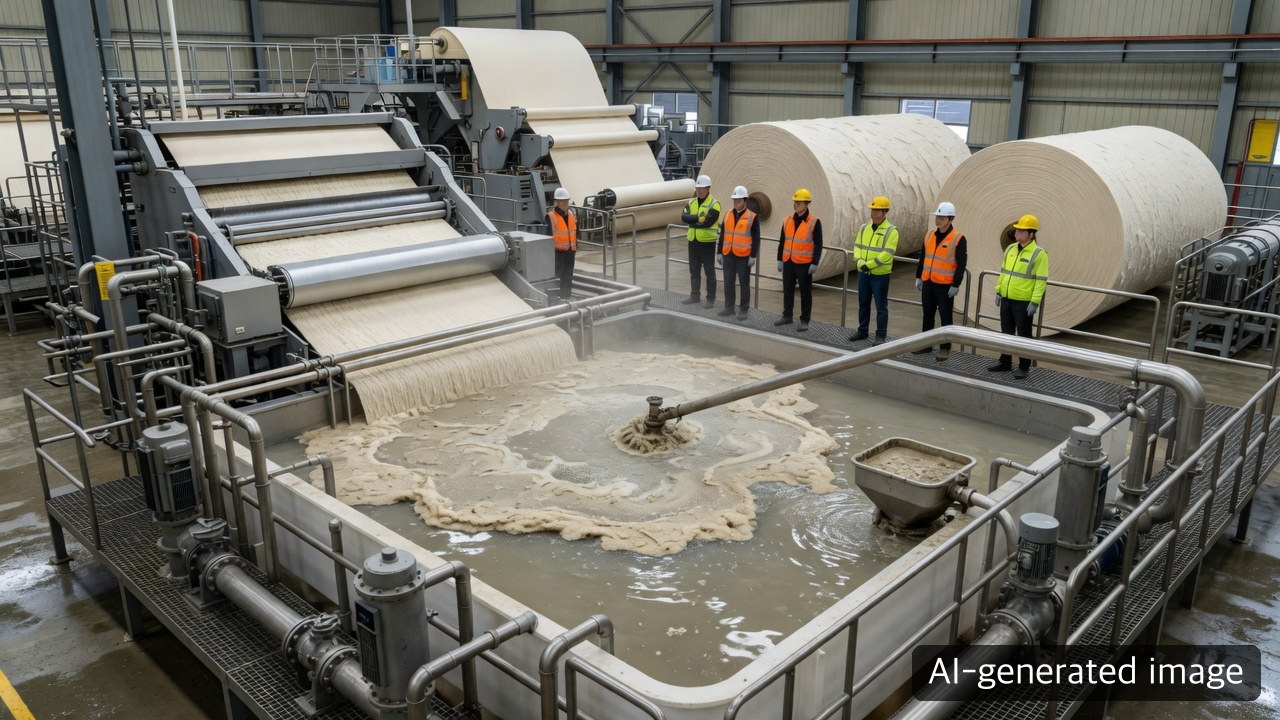
White-water solids from corrugating-medium and testliner production are not one uniform waste stream. Fibre fines, fillers and additives vary by recovery point, and that difference changes nanofibrillation energy, retention, drainage and final strength. Turning those solids back into a strengthening resource must therefore begin by fixing the recovery point and characterising the solids, not by buying a grinder.
A 2026 master’s thesis from Seoul National University used grinder-based nanofibrillation to convert white-water solids from corrugating-medium production into white water-originated cellulose nanofibrils (WCNF). It evaluated WCNF as an internally added strengthening agent and as an additive in oxidised-starch surface sizing. A conference paper from the same research group examined handsheets prepared from Korean old corrugated container (KOCC) furnish under retention-aid conditions.
The research demonstrates potential, but it is not a ready-made mill recipe. The reported results come from handsheets and research formulations. A mill trial must also control white-water lot, furnish, retention chemistry, drainage and size-press runnability. This article separates the published findings from the operating recommendations needed for a plant pilot.
What the research establishes—and what it does not
| Research area | Finding reported in the public sources | Why it cannot be copied directly |
|---|---|---|
| Recovery point | In samples from one domestic corrugating-medium mill, DAF-recovered solids had higher organic and lower inorganic content than silo white-water solids and were relatively more suitable for nanofibrillation | Furnish, filler, DAF chemistry and recovery operation differ by mill |
| Grinding | Viscosity reached a plateau at approximately 25 passes, while SEM confirmed sufficient nanofibrillation | Twenty-five passes is a result for the study’s feedstock and equipment, not a plant setpoint |
| Internal addition without retention aid | WCNF produced at 10 and 20 passes improved strength more than 30-pass WCNF; the study linked this to more effective retention of relatively larger fibrils | More nanofibrillation can deliver less value if the material does not remain in the sheet |
| Internal addition with retention aid | In KOCC handsheets with retention aid and 5–7 wt% WCNF, the highest improvements across different mechanical properties fell in an approximately 19–26% range, as summarised in the thesis abstract | This is not a single 19–26% “overall strength” gain; property-specific test tables are required |
| Lightweight handsheets | At 1 wt% WCNF produced with 5 or 10 passes, handsheets at 91–97 g/m² retained mechanical strength comparable to the base paper; a literature-based cost model estimated about 5% lower manufacturing cost per unit area | This is a handsheet result and model estimate, not a guaranteed machine or mill saving |
| Surface sizing | In the oxidised-starch-based formulation, 5 wt% WCNF gave the strongest improvement | Starch solids, viscosity, pickup, drying load and paper surface will differ in production |
| Utilisation efficiency | After normalising the thesis-selected best laboratory condition for each route by WCNF mass, the strengthening-efficiency indices differed by approximately 22.7 times | The calculation uses compression for internal addition and MD tensile for surface sizing; it is not a productivity or total-cost ratio |
All quantitative results in this table come from samples taken at one domestic corrugating-medium mill and tested under specified research-equipment, handsheet and formulation conditions. They are not performance demonstrated on a continuous paper machine or at mill scale.
The useful question is not simply how much a property improved. It is which feedstock, retention and application conditions produced the improvement. Nanofibrillation and retention, dosage and drainage, and surface-sizing concentration and runnability must be optimised together.
Stage 1: Fix the source and mass balance
A sample labelled only “DAF” is not reproducible. Record at least:
- furnish and KOCC share, major fillers, starch and retention chemistry;
- sampling point, time, machine state and grade in production;
- white-water flow, total solids, recovered solids and disposal quantity;
- ash, organic fraction, fibre fraction and moisture of recovered solids;
- pH, conductivity, temperature and recent chemical changes; and
- separate identities for DAF float, silo white water and any other recovery point.
Even within one mill, a grade or chemistry change can alter the suitability of white-water solids for nanofibrillation. Build the pilot around lots representing major production conditions, not one daily average sample.
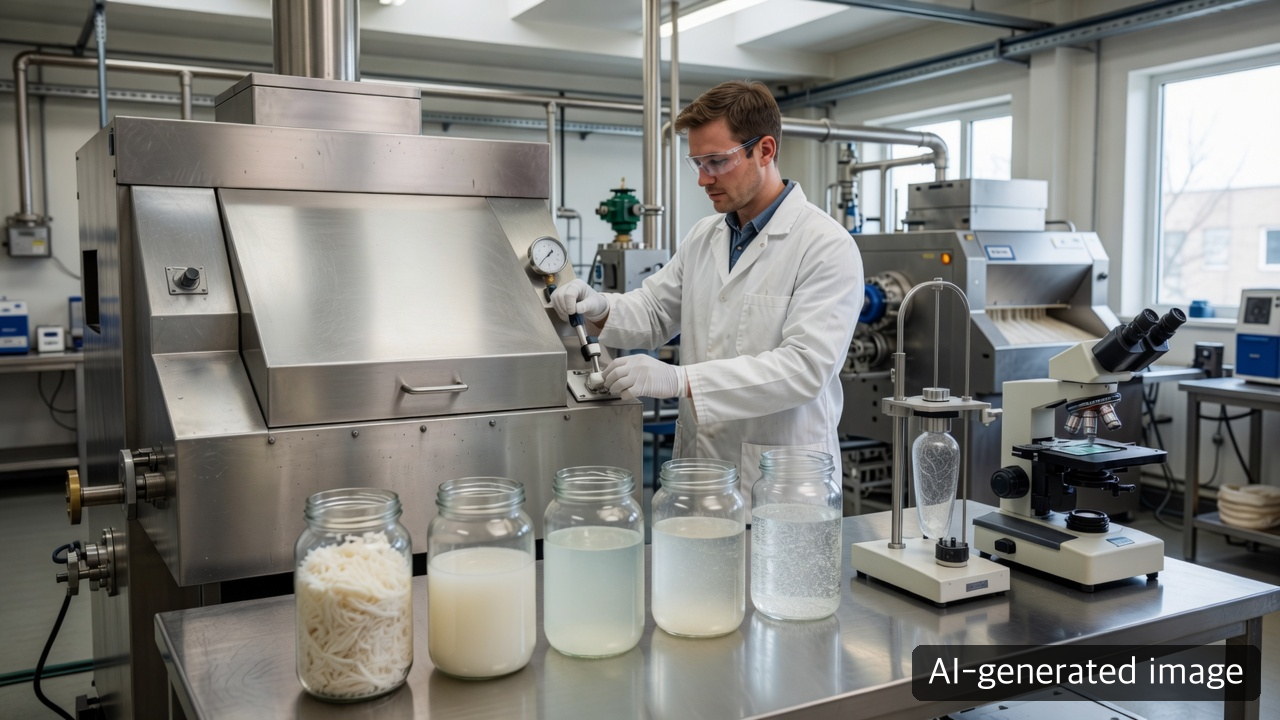
Stage 2: Build a nanofibrillation curve, not a pass-count target
Pass count alone is difficult to transfer between grinder sizes. At each pass level, link:
- pass count and throughput;
- electrical energy and time, preferably per unit of dry solids;
- solids concentration and temperature;
- viscosity and whether the increase has plateaued;
- fibril morphology and remaining coarse material;
- pumping, pipe or filter restriction and cleaning; and
- actual performance in internal-addition or surface-sizing trials.
Under the study’s 5% suspension and specified grinder conditions, low-shear viscosity began to plateau at approximately 25 passes. This is a useful starting reference, not an acceptance limit. If viscosity no longer increases while energy and temperature continue to rise—or drainage, pumping or cleaning deteriorates—the earlier operating range should be considered as the pilot ceiling.
Stage 3: Test internal addition, retention and drainage as one experiment
A strength-only trial omits runnability. Compare at least a no-addition control, WCNF without retention aid, WCNF with the current retention program, and WCNF with a deliberately adjusted retention condition using the same furnish.
| Trial input and measurement | Decision / hold-or-stop condition |
|---|---|
| WCNF dosage and nanofibrillation stage / site-relevant tensile, compression, burst or other strength properties | Does the target property improve at the reference basis weight? / Hold if the gain is not repeatable |
| Retention-aid type and addition order / total and ash retention, white-water solids or turbidity | Do WCNF and fines remain in the sheet? / Stop if white-water solids rise or become unstable |
| Stock consistency, charge and conductivity / chemical demand and floc condition | Does WCNF conflict with the wet-end program? / Stop for overflocculation, formation loss or a sharp chemical increase |
| Forming and vacuum conditions / drainage time, vacuum load and press solids | Can production rate be maintained? / Hold for drainage delay or higher press load |
| Drying conditions / steam demand, drying load and moisture profile | Is strength value greater than added energy demand? / Stop if drying load or moisture variation exceeds the mill limit |
The study’s retention-aid effect does not mean that a mill should simply add more aid. Addition order, charge, conductivity and ash can change the response of the same chemical. Link strength, white-water solids, drainage and formation to the same trial identifier.
Stage 4: Separate equal-basis-weight and equal-strength comparisons
A lightweighting trial needs two controls:
- equal basis weight, to identify the property effect of WCNF; and
- equal target strength, to determine how far basis weight can be reduced.
Mixing the two obscures the difference between “higher strength” and “less fibre.” The reported 91–97 g/m², base-paper-equivalent strength and about 5% cost-reduction potential are results for the study’s handsheet conditions. A mill calculation must include grinder power, recovery and dewatering, chemicals, cleaning, drying, rejects and production speed—not fibre cost alone.
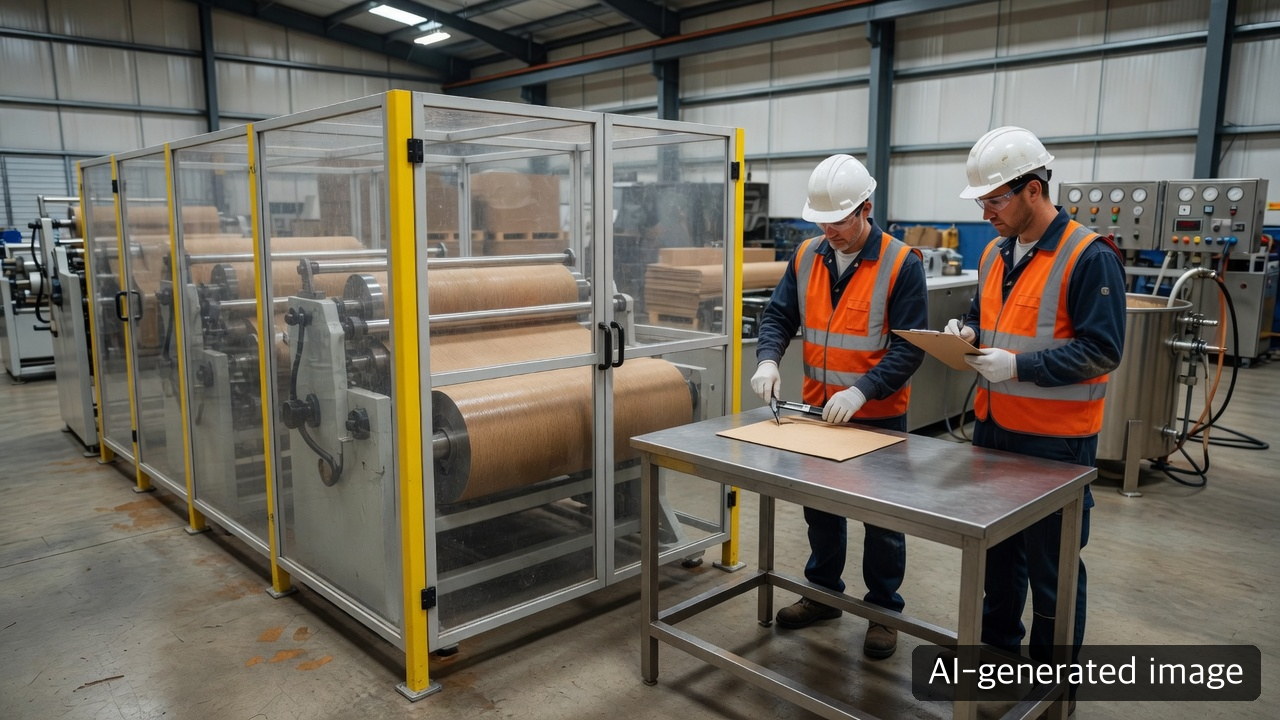
Stage 5: Evaluate surface-sizing efficiency and runnability together
Surface sizing can reduce the challenge of retaining WCNF inside the sheet, but it introduces viscosity, filtration, pickup, foaming and contamination risks at the size press.
Track:
- oxidised-starch solids and temperature, with viscosity before and after WCNF;
- WCNF dispersion order and mixing time;
- filter, nozzle and pipe restriction, foaming and circulation stability;
- pickup on each side and cross-direction variation;
- roll contamination, doctoring and cleaning time;
- final moisture, curl, surface strength, printability and bonding suitability; and
- property improvement and total operating cost per unit of WCNF.
The approximately 22.7-times figure does not mean surface sizing is that much more economical as a complete process. It compares WCNF-mass-normalised strengthening-efficiency indices built from compression at the selected internal-addition condition and MD tensile at the selected surface-sizing condition. A mill must repeat the comparison using the same property and control, then include the simplicity of internal addition, whether a size press exists, target properties, cleaning time and downtime cost.
Stage 6: Plant pilot matrix
This is not a numeric recipe. It is a framework to populate with mill conditions.
| Gate and inputs | Required record / release condition |
|---|---|
| G0. Recovery-source qualification / recovery point, grade, chemicals and lot | Solids, ash, organics, moisture and recovery mass / representative-lot range and exclusions approved |
| G1. Nanofibrillation / equipment, passes, throughput and consistency | Energy, temperature, viscosity curve, morphology and cleanability / runnable range fixed before the effect plateau |
| G2. Internal addition / WCNF, retention program and addition order | Strength, retention, white water, drainage and formation / property benefit and wet-end stability pass together |
| G3. Lightweighting / basis-weight steps, forming and drying | Target strength, speed, steam, rejects and cost / total-cost advantage confirmed at equal strength |
| G4. Surface sizing / starch, WCNF, viscosity and pickup | Strength, variation, blockage, foam, cleaning and drying / continuous operation and quality remain within mill limits |
| G5. Scale-up / representative grades, shifts and furnish lots | Repeatability, workability, maintenance, waste and carbon data / joint quality, production, maintenance and cost approval |
No department should release these gates alone. Production records speed, drainage and drying; quality records strength and repeatability; maintenance and energy record throughput, power and cleaning; purchasing and cost control record chemicals, fibre and total cost. All records must use the same trial identifier.
Signals to stop before increasing dosage
Pause and isolate the cause when any of the following occurs:
- ash, organic fraction or moisture of recovered solids moves outside the representative-lot range;
- viscosity improvement stops while energy per dry solid and temperature continue to increase;
- retention gain is outweighed by worse drainage, formation or white-water instability;
- size-solution viscosity, foam, filter blockage or roll contamination interrupts continuous operation;
- strength improvement appears only for one lot or one operator; or
- grinder, chemical, drying, cleaning and reject costs exceed the fibre saving.
Conclusion
The central task in turning white-water solids into WCNF is not grinding them as finely as possible. It is connecting what is recovered, where it is recovered, how far it is nanofibrillated, and under which retention, drainage and sizing conditions it remains useful in the sheet.
The Seoul National University work provides a valuable starting chain—from DAF source selection and nanofibrillation plateau to retention, lightweight handsheets and surface-sizing efficiency. The next plant action is not to copy its numbers as specifications. It is to populate the G0–G5 matrix with the mill’s own lots, energy, properties, runnability and total cost.
About the Author
PackingMaster: Editor of PaperPackLog. Covers market trends, product information and manufacturing technology in the paper-packaging industry.
References
- Seoul National University S-Space, Seungwook Park, “Study on the Nanofibrillation of White Water Solids from Corrugating Medium Production for Advanced Utilization,” master’s thesis, 2026, https://s-space.snu.ac.kr/handle/10371/233546
- Korea Technical Association of the Pulp and Paper Industry conference proceedings, Seungwook Park, Hakmyeong Lee, Geonhee Lee and Hyejung Youn, “Evaluation of the Physical Properties of KOCC Handsheets with White Water-Originated Cellulose Nanofibrils (WCNF) with Retention Aid Addition,” 2025 Autumn Conference, https://www.dbpia.co.kr/journal/articleDetail?nodeId=NODE12432881
Sources checked on 18 August 2026. The two publications belong to the same research stream and are not treated here as independent plant-replication evidence. Published figures apply to the study’s feedstock, handsheets, equipment and formulations. The G0–G5 gates and stop conditions are operating recommendations designed to prevent those figures from being copied directly into a mill specification.