
Cosmetics export packaging compliance is no longer a matter of checking the EU and the United Kingdom separately. For K-beauty ODM/OEM manufacturers and brands, the buyer question is usually simpler: for each product, what are the container, label, folding carton, insert, cushioning, and shipping box made of, how much do they weigh, and how do they affect recyclability evidence and EPR cost?
Recent Korean cosmetics-industry coverage has discussed EU PPWR and UK pEPR together for a practical reason. The EU is moving packaging rules toward recyclability, packaging minimisation, restricted substances, recycled content, and labelling. The UK is using packaging EPR to connect packaging weight and material category with cost. With the UK publishing 2025 pEPR base fees, packaging data has become not only a sustainability file but also a cost and margin variable.
This article focuses on practical preparation rather than policy theory. It is written for brands, ODM/OEM suppliers, packaging development teams, purchasing teams, and export sales teams supplying cosmetics into Europe and the UK.
Why PPWR and UK pEPR should be handled together now
The EU and UK systems are different, but the source data companies need to prepare is largely the same.
- Export SKUs and market-by-market sales routes
- Material, weight, and component structure of primary containers
- Paper grade, coating, window film, adhesive, and finish details for folding cartons and inserts
- Material, weight, and reusability of cushioning and shipping boxes
- Supplier specifications, test reports, certificates, and change history
- Data templates requested by importers, distributors, or local EPR-responsible parties
If a company builds separate folders for PPWR and UK pEPR, duplicate work grows quickly. A better approach is to create one product-level packaging BOM and reuse it for EU conformity review, UK fee exposure, and buyer documentation.
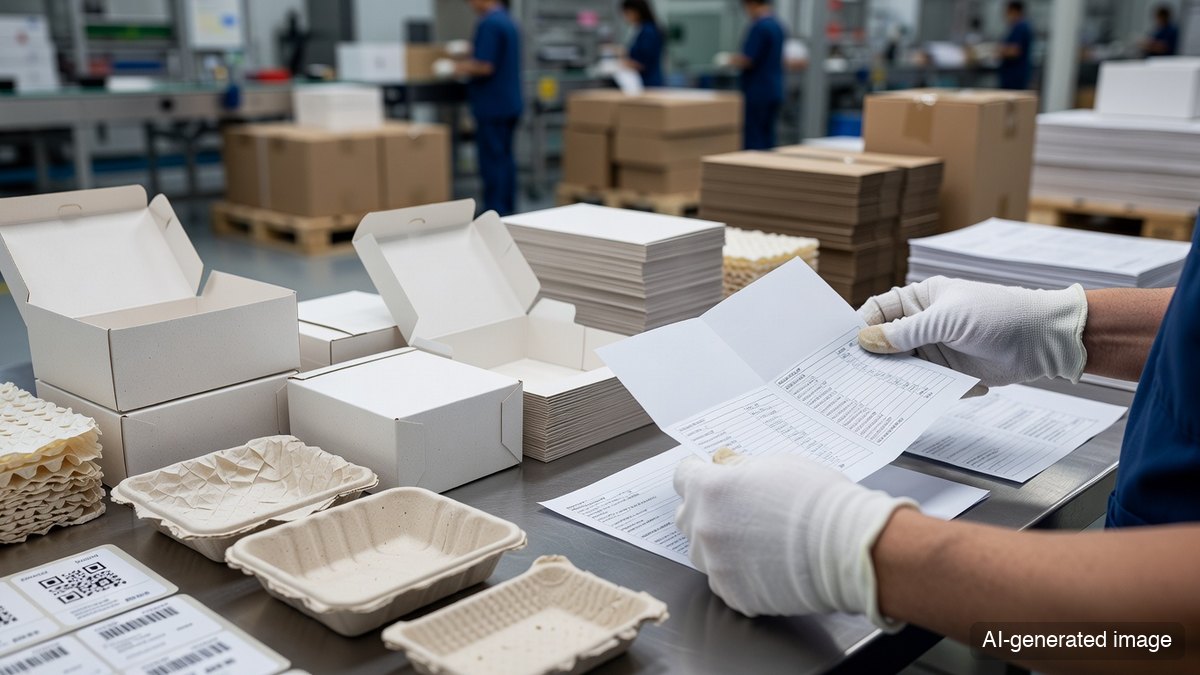
Cosmetics packaging is not only the primary container
When a packaging regulation request arrives, many cosmetics companies start with the bottle, tube, pump, cap, or jar. That is necessary, but it is not enough. Buyers and importers often look at the full packaging system.
Primary packaging includes bottles, tubes, pouches, jars, pumps, caps, inner caps, labels, seals, and components that contain or directly support the product. Material classification can become complex when plastics, glass, aluminium, silicone, metal springs, and multiple resins are combined.
Secondary packaging includes folding cartons, sleeves, set boxes, inserts, leaflets, and sealing labels. Even paper-based cartons need more review when they include coatings, lamination, foil stamping, window film, magnets, foam inserts, or plastic trays.
Cushioning and transport packaging includes corrugated shippers, moulded pulp, paper cushioning, bubble wrap, foam, pallets, bands, and stretch film. These materials may not be visible to consumers, but they still affect EPR reporting quantities and logistics performance.
UK pEPR base fees turn packaging design into a price signal
The UK’s 2025 pEPR base fees show disposal fee levels by material category. In the official 2025 base-fee publication, plastic is listed at £423 per tonne, paper and card at £196 per tonne, glass at £192 per tonne, and fibre-based composite at £461 per tonne. The actual cost exposure for a business depends on the responsible party, data quality, modulation, and commercial structure, but the direction is clear.
For cosmetics packaging, these numbers affect design decisions such as:
- Whether plastic blister trays or inserts can be replaced with paper-based inserts
- Whether a carton with window film can be treated simply as paper and card, or needs composite-material review
- How much premium rigid cartons and gift sets increase declared packaging weight
- Whether sample kits, promotional bundles, and e-commerce delivery packs create separate reporting quantities
- Whether the brand, UK importer, distributor, or marketplace carries the pEPR cost contractually
The practical question is not simply “Can we switch to a greener material?” The better question is whether material change, weight reduction, damage risk, consumer experience, and EPR fee exposure improve together.
ODM/OEM suppliers need to define packaging data ownership
In K-beauty export supply chains, brands, ODM/OEM manufacturers, packaging suppliers, filling sites, and logistics partners often hold different pieces of the packaging data. In that structure, data ownership and permission to submit evidence become critical.
ODM/OEM suppliers should clarify these points early in the contract or project setup.
- Who approves the final packaging specification: the brand or the manufacturer?
- Who selects and purchases folding cartons, inserts, cushioning, and shipping materials?
- Who is responsible for providing material and weight data by packaging component?
- Is buyer approval required before supplier or specification changes?
- Who prepares EU EPR, UK pEPR, or buyer data templates?
- Are test reports and certificates limited to a specific brand, SKU, or supplier scope?
From the brand side, asking an ODM/OEM partner “Are you PPWR-ready?” is too broad. Asking for an SKU-level packaging data sheet is more useful.
Practical packaging data sheet fields
For each product, the following fields make it easier to answer both EU and UK requests.
- Product data: SKU, product name, capacity, destination country, buyer, sales channel
- Packaging level: primary, secondary, transport, and e-commerce packaging
- Components: container, cap, pump, label, folding carton, insert, leaflet, cushioning, shipper
- Material: main material, secondary materials, coating, lamination, film, adhesive, and finish
- Weight: grams by component and total packaging weight per sales unit
- Dimensions: outer dimensions and inner dimensions needed for empty-space review
- Supplier data: packaging supplier, specification number, and revision history
- Evidence: test reports, certificates, supplier declarations, recyclability review notes
- Responsible party: EU EPR, UK pEPR, labelling, and export-document owner
This single sheet supports buyer responses, cost estimation, packaging redesign, and testing-lab consultation with the same data language.

Containers: check material combinations and separability
Cosmetics containers often use complex structures for appearance and performance. Pumps, sprays, and airless containers may combine plastic housings with metal springs, silicone parts, and multiple resin components. For PPWR and EPR purposes, a broad “main material” description may not be enough.
Useful questions include:
- Can consumers easily separate caps, pumps, labels, and sleeves?
- Does a glass container include a plastic pump or metal spring assembly?
- Could label adhesives or inks affect recycling processes?
- Are refill pouches or replacement cartridges documented separately from the main pack?
- If PCR plastic is used, are content level, supplier evidence, and certification linked to the SKU?
Folding cartons: paper-based does not automatically mean low-risk
Folding cartons are central to the K-beauty brand experience. But in recyclability and EPR review, detailed structure matters.
Check the following.
- Coated paper, lamination, metallic foil, UV coating, and special finishes
- Window film material and whether it can be separated by the consumer
- Whether the inner tray is paper, plastic, moulded pulp, or composite
- Whether FSC, PEFC, recycled-paper, or similar claims match the actual packaging scope
- Whether premium set boxes include magnets, ribbons, foam, or plastic trays that can be separated
Even when the main carton is paper, non-paper components can create extra explanation for UK pEPR material classification and EU recyclability review.
Cushioning and shipping: the invisible cost area
Cosmetics are sensitive to breakage, leakage, scratches, and claims. For that reason, cushioning is often over-designed. Under European and UK packaging data requirements, cushioning also becomes reportable packaging.
A practical review should ask:
- Can bubble wrap or foam be replaced with moulded pulp, paper cushioning, or corrugated inserts?
- After replacement, does the pack still pass drop, compression, vibration, and temperature/humidity conditions?
- Does cushioning weight reduction lower freight cost and pEPR reporting quantities at the same time?
- Are e-commerce delivery boxes and export master cartons managed separately?
- For return-heavy channels, has a reusable or return-ready pack been considered?
Packaging reduction is both a compliance action and a logistics cost opportunity. But if damage rates increase, returns and waste can rise, so redesign must be validated with transport testing.
A 30-day action sequence
- Update the EU and UK export SKU list.
- Split each SKU’s packaging into primary, secondary, transport, and e-commerce levels.
- Collect material, weight, supplier, and specification numbers for every component.
- Flag coatings, windows, foil, magnets, inserts, and mixed-material structures in cartons and set boxes.
- Ask the UK importer or distributor who carries pEPR responsibility and which data template is used.
- Ask EU buyers what PPWR-related documents they expect from suppliers.
- Compare packaging-change options by cost, quality, recyclability, lead time, and fee exposure.
- Archive before/after samples, photos, test results, approvals, and specification revisions.
Closing view
EU PPWR and UK pEPR are different frameworks, but they require the same internal capability from cosmetics exporters: separate packaging by level, manage material and weight numerically, and document responsibility in contracts and files.
K-beauty ODM/OEM suppliers and brands should start by combining container, folding-carton, cushioning, and shipping-pack data into one packaging BOM. Then buyer questions can be handled through data, cost, and quality review rather than starting from regulation interpretation each time.
About the Author
PackingMaster: Editor of Paper Pack Log, covering paper packaging markets, product information, and technical insights from a practical B2B perspective.
References
- European Commission, Packaging and Packaging Waste Regulation, https://environment.ec.europa.eu/topics/waste-and-recycling/packaging-waste/packaging-packaging-waste-regulation_en
- GOV.UK, Extended Producer Responsibility for Packaging: 2025 base fees, https://www.gov.uk/government/publications/extended-producer-responsibility-for-packaging-2025-base-fees/extended-producer-responsibility-for-packaging-2025-base-fees