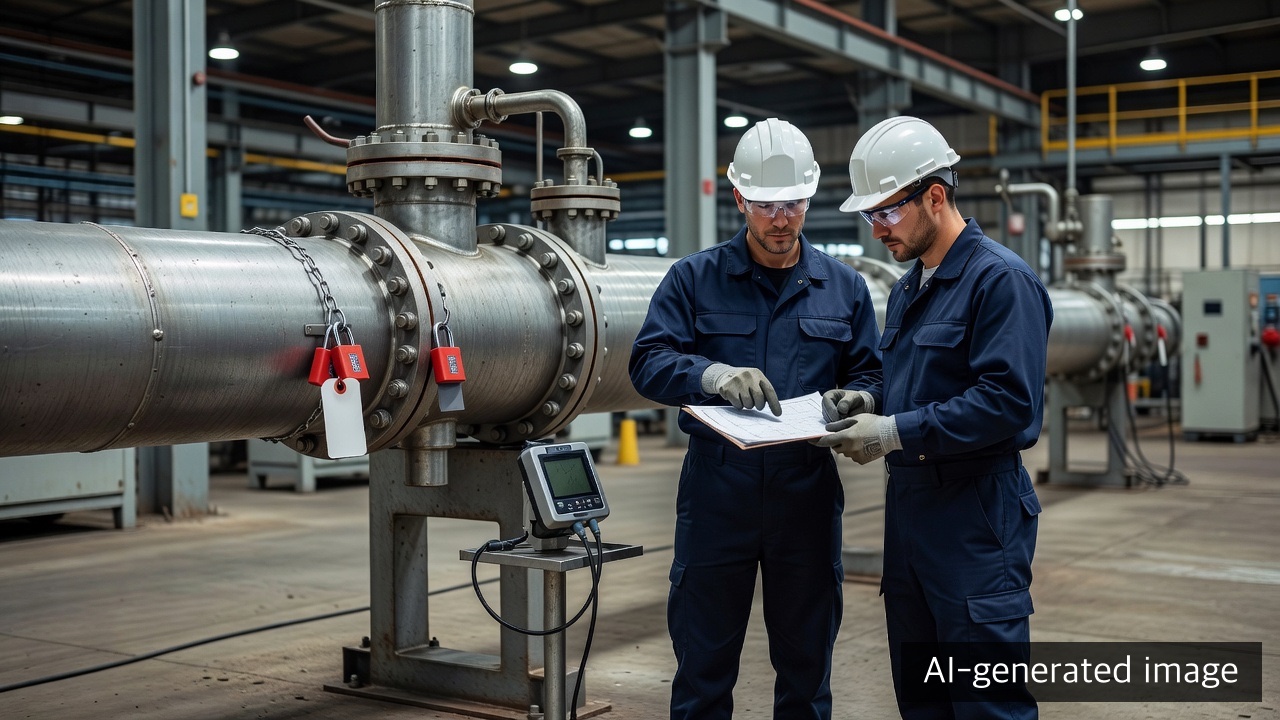
On September 18, 2026, Daio Paper announced that the company and one of its personnel, together with consolidated subsidiary Daio Engineering and one of that company’s personnel, had been referred to prosecutors on suspicion of violating Japan’s Industrial Safety and Health Act in connection with a carbon-monoxide accident at the Kani mill. It is a legal follow-up to the March accident.
For paper and packaging companies, the useful question is not only what the case is called. The practical controls are what was isolated before opening the line, what hazard information moved in writing from the owner to every contractor tier, who verified the atmosphere with which instrument, and what evidence justified releasing the work to proceed. Buyers with Kani exposure should also verify supply status by product, line, and purchase order rather than relying on a mill-wide statement.
What changed on September 18
Daio Paper’s notice and Sankei Shimbun’s reporting establish the following public record.
- On September 17, 2026, the Tajimi Labour Standards Inspection Office referred Daio Paper, one Daio Paper employee, consolidated subsidiary Daio Engineering, and one Daio Engineering employee—a total of two corporate entities and two individuals—to the Mitake Branch of the Gifu District Public Prosecutors Office.
- Sankei reported that Daio Paper and its manager were suspected of failing to provide the subcontractor, in writing, with the hazards and precautions when assigning the valve-removal/installation work on piping carrying combustible gas containing CO. Daio Engineering and its manager were suspected of failing to inform the performing contractor that it had to verify, by measurement or another method, that there was no risk of CO-related harm to health.
- Daio Paper said it had implemented safety measures and recurrence-prevention actions after the accident. Its September 18 notice does not list the detailed control changes, validation evidence, or current line-by-line operating status.
A referral to prosecutors is not a conviction or a final judicial finding. The allegations and the final disposition must be kept separate.
What the March company report confirms
Daio Paper’s second report, published on March 17, provides the following facts.
- Time: About 9:45 a.m. on March 10, 2026. Operating check: Identify the exact turnaround task and shift.
- Location: Building for the No. 1 kiln equipment at the Kani mill. Operating check: Verify the physical line, valve, and isolation boundary—not only the process name.
- Work: Removal and installation of a valve on piping that carried combustible generated gas containing CO. Operating check: Treat the job as line breaking with residual and connected energy hazards.
- Cause stated by the company: Gas leaked because a valve that should have been closed was not properly closed. Operating check: A valve-position indication does not prove isolation.
- People affected: Five contractor employees and one group employee were taken by ambulance. Two temporarily lost consciousness, four were discharged after hospital treatment, and two had minor injuries that did not require admission. Operating check: Rescue planning must prevent unprotected co-worker entry.
- Production: The company said the planned turnaround was completed and production was unaffected. Operating check: This March production statement does not establish product-level inventory or delivery status.
The company said maintenance resumed after approval by the relevant authorities and that the scheduled turnaround was completed. It also reported no off-site environmental impact and no property damage.
Why “the valve was closed” is not enough
Opening a line or replacing a valve is different from a routine visual inspection. When workers separate a flange or remove a valve, they must control not only residual gas and pressure but also the potential for material to re-enter from upstream, downstream, bypass, recovery, or interconnected equipment.
The isolation method must follow the applicable law, process-hazard assessment, piping and instrumentation diagram (P&ID), equipment instructions, and approved site procedure. Whether valve closure is sufficient—or whether double block and bleed, a blind, or physical disconnection is required—depends on the material, pressure, temperature, toxicity, and piping configuration. The list below is therefore a permit-review template, not a universal engineering prescription or legal standard. This is an editorial checklist for general piping maintenance, not a list of measures reported as implemented at the Kani mill.
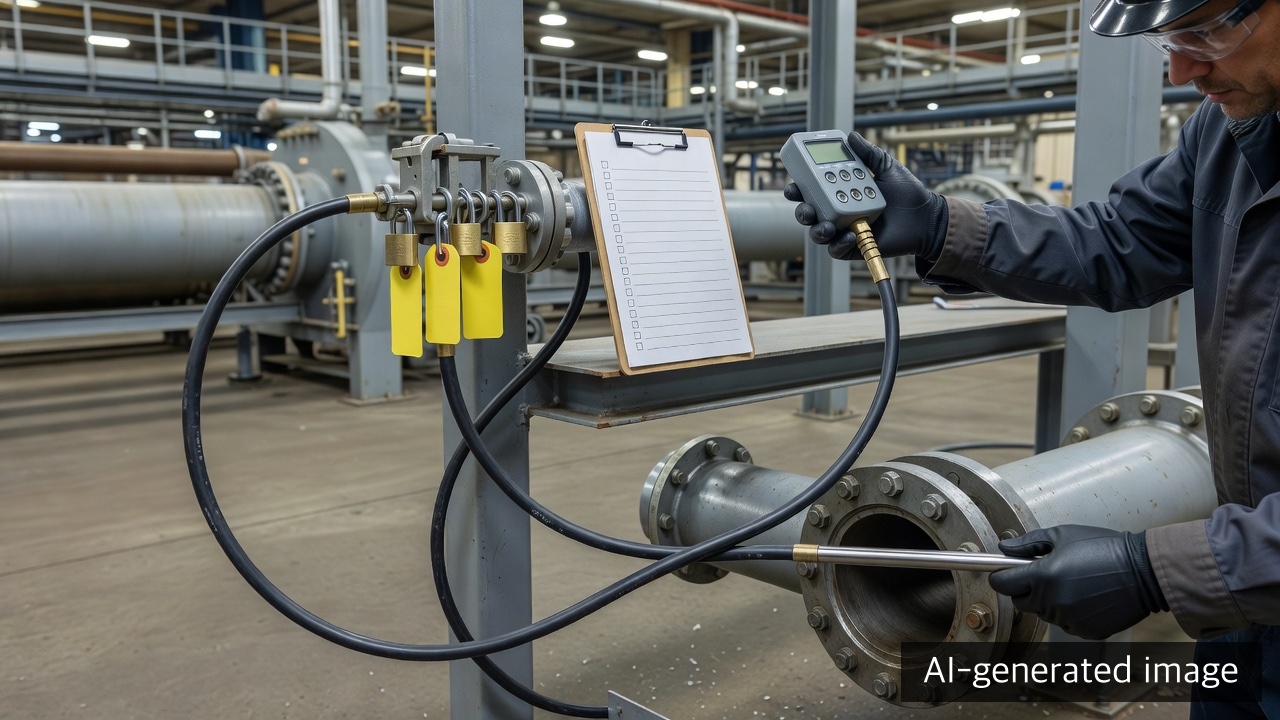
Copy-ready piping-maintenance permit checklist
Use equipment ID, line number, service, work location and time, owner department, maintenance contractor, performing contractor, job supervisor, permit issuer, gas tester, instrument ID, calibration and function-check status, and emergency contacts as common header fields.
- Scope and boundary — Before release, match the item being removed or installed, adjacent lines, upstream and downstream connections, bypasses, and recovery lines against the drawing and field condition. Stop and reissue the permit if scope changes. Keep the marked P&ID, field photos, and change record as closure evidence.
- Energy and material isolation — Identify every source, valve position, lock and tag, backpressure and re-entry path, drain, purge, and depressurization state. Do not remove isolation devices without authorization; hand over status at shift change. Retain the isolation list, lock IDs, zero-state verification, and release approval.
- Hazard transfer — State the material, CO, flammability, oxygen-deficiency, heat and pressure hazards, prohibited actions, PPE, and emergency response. Repeat the briefing for new workers and lower-tier contractors. Keep owner–prime–performing-contractor signatures and the toolbox-talk record.
- Atmospheric test — Define gases, points and depths, time, instrument range, calibration and function check, and the source of acceptance and alarm criteria. Retest continuously or at the approved interval when conditions can change. Record raw readings, time, location, tester, and instrument ID.
- Permit hold points — Require completion of isolation, draining and depressurization, atmospheric testing, ventilation, PPE, attendant, and rescue plan before flange break. Stop for an alarm, odor or symptom, pressure, process change, damaged isolation, or changed scope. Record release, stop, and restart times with the approver.
- Emergency response — Define the alarm, escape route, muster point, first aid, rescue equipment, and external contacts. Allow no unprotected co-worker rescue entry. Keep the drill or briefing record, communication test, and rescue-lead confirmation.
- Restoration and handover — Remove tools, blinds, and temporary hoses; reassemble the valve; restore guards and labels; and define the leak test and commissioning sequence. Assign commissioning conditions and a monitoring owner. Keep the leak-test and commissioning result, lock removal, and production acceptance.
A gas-test field should not contain only “safe” or “no issue.” It needs what was measured, where, when, with which instrument, and what the raw result was. A zero display is weak evidence if instrument range, sensor condition, sample point, and function check are missing.
Close the owner–contractor information gap
The reported allegations make the owner-to-performing-contractor interface especially important. A contract clause saying “comply with safety rules” does not identify the hazards of a specific process line.
Everyone at the joint pre-job meeting should give the same answer to five questions.
- What did the line contain? Confirm the service and CO, flammability, oxygen-deficiency, pressure, and temperature hazards.
- Where is the isolation boundary? Walk down the drawing valve IDs and physical lock locations with the people who will perform the work.
- Who verified the atmosphere? Share the tester’s qualification, instrument ID, point, time, and raw readings.
- What stops the job? State alarm, process change, damaged isolation, symptoms, and loss of communication as stop-work conditions.
- Did the information reach the last contractor tier? Keep the owner–prime–performing-contractor briefing and signatures in one record set.
Do not reduce supply risk to “the mill is operating”
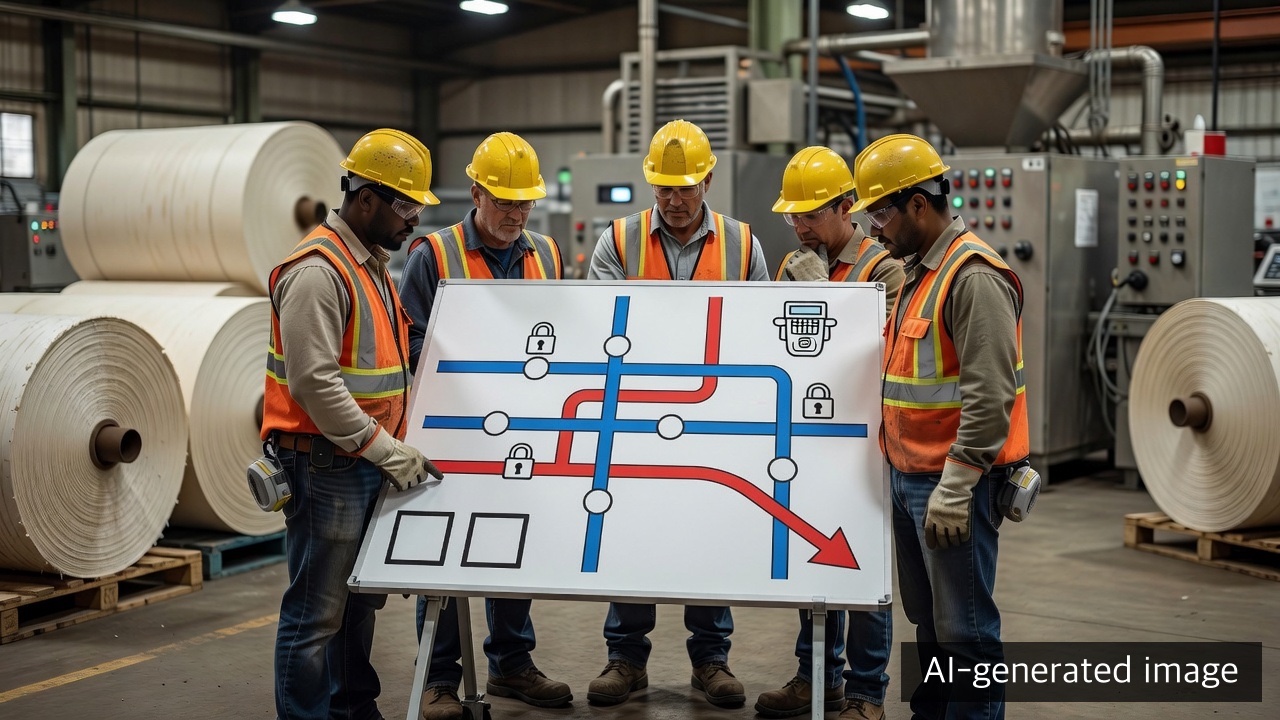
Daio Paper said on March 17 that it had completed the planned turnaround and that production was unaffected. The notice did not disclose product-level inventory, shipment, or delivery status, so it should not be extended to every September order. In a separate matter, the company announced on September 11 that part of the Kani mill’s wastewater-treatment equipment had been damaged. It said production continued with some treatment-capacity restriction and that it would consult customers individually if product-supply concerns arose.
The two events must not be treated as having the same cause or impact. The separate September notice does, however, reinforce the need to verify current order-level status.
- Product exposure — Ask, “Is our grade produced, converted, or shipped from Kani?” Record the item code, specification, mill, and alternate mill.
- Line status — Ask, “Is the relevant line running normally, or subject to a maintenance or operating restriction?” Record the confirmation date, respondent, and validity period.
- Inventory and logistics — Ask, “What stock can ship, what is the confirmed shipment date, and is there a transport or customs delay?” Record the PO quantity, ETA, and evidence source.
- Alternative source — Ask, “Can another mill, grade, width, or pack unit meet the approved specification?” Record the quality approval, sample, and conversion lead time.
- Change notice — Ask, “Who will notify whom, by which channel, if operations or delivery changes?” Record the owner, contact route, and next review date.
Build the exposure register as one row per item code–supplying mill–production line–open PO–available stock–alternate source–next review date. If the supplier has not confirmed an item, mark it unconfirmed rather than “normal,” then assign an owner and due date.
Conditions that require stop work
Do not begin line opening or valve removal if any of the following remains unresolved.
- The drawing and field condition do not agree on the isolation boundary or lock points.
- Backpressure, residual pressure, or a re-entry path has not been eliminated or verified.
- The performing worker has not received the material hazard information in writing.
- Instrument calibration or function check, sample location, time, or raw readings cannot be verified.
- There is no alarm response, escape route, attendant, or rescue plan.
- The work scope or process condition no longer matches the permit.
The practical conclusion is straightforward: verified isolation instead of a valve-position assumption; traceable hazard transfer instead of verbal shorthand; raw measurements instead of “no issue”; and order-level supply confirmation instead of a mill-wide label. Four records can be checked today: the piping-isolation list, raw gas-test log, owner-to-contractor pre-job briefing, and open-PO supply-status register.
About the Author
PackingMaster: Editor of Paper Pack Log. We collect and organize market trends, product information, and technical insights for the paper packaging industry.
References
- Daio Paper, Notice concerning referral on suspicion of violating the Industrial Safety and Health Act
- Daio Paper, Notice concerning the accident, second report (PDF)
- Sankei Shimbun, Daio Paper and others referred over the Kani mill CO-poisoning case
- Daio Paper, Partial damage to wastewater-treatment equipment at the Kani mill (PDF)