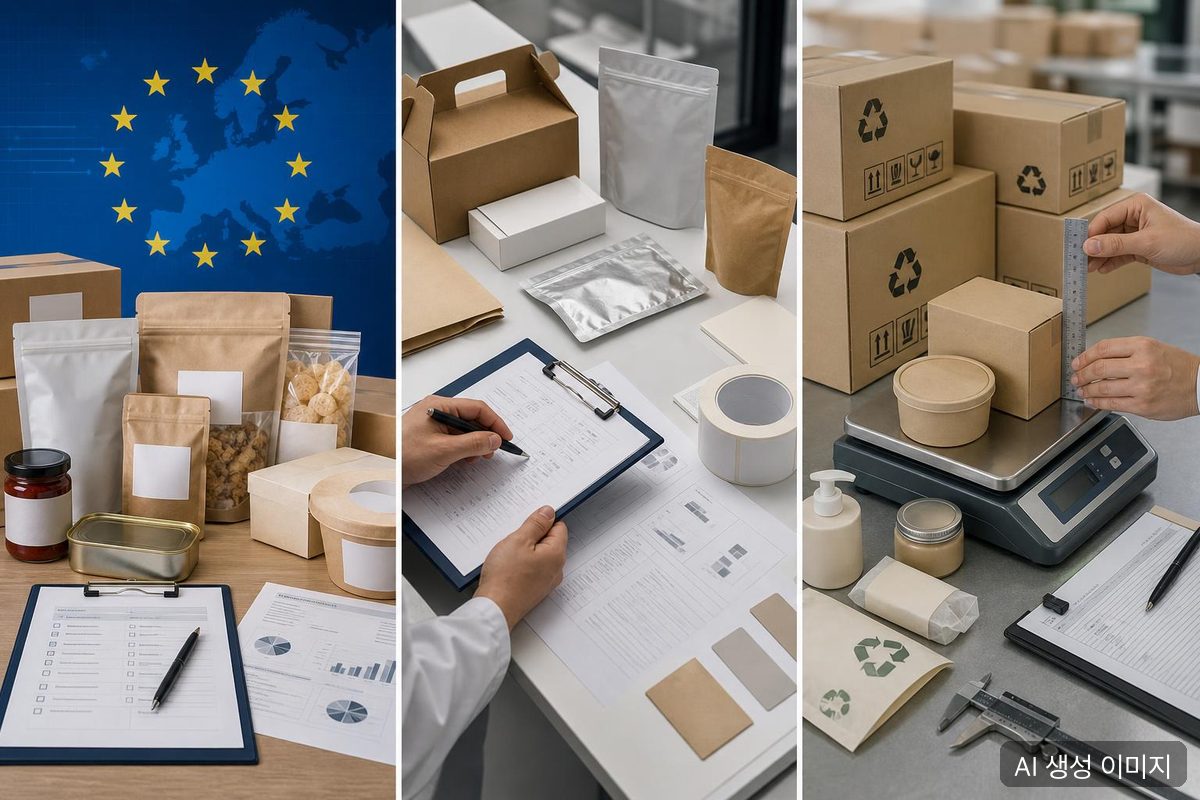
On 12 August 2026, the EU Packaging and Packaging Waste Regulation, or PPWR, begins general application. For Korean food and cosmetics exporters, the issue is not as simple as using eco-friendly packaging. Companies must check packaging materials, hazardous substances, recyclability, labeling, recycled content, food-contact safety, and documentary evidence for each product.
A Korean electronics industry newspaper reported on 6 May that K-food exporters are facing confusion over PPWR interpretation, testing-agency requests, and material conversion preparations. Food industry media also reported that relevant government ministries plan a joint briefing on PPWR and strengthened EU rules for food-contact plastic packaging.
This article focuses not on a general overview of the regulation, but on the practical checklist exporters need when reviewing actual food and cosmetics packaging.
Dates to Check First
EU PPWR entered into force on 11 February 2025 and, according to European Commission materials, generally applies from 12 August 2026. According to Korean food industry reporting, EU 2025/351, which strengthens safety standards for plastic containers that contact food, is scheduled to apply in September 2026.
For exporters, the important point is that production schedules move earlier than legal application dates. Even if products enter the EU after August, packaging orders, printing, filling, and shipping happen before then. As reported, shipments from June onward may already need packaging prepared for regulatory compliance.
Three actions should start now.
- Build a packaging-material list by EU export SKU.
- Check material composition and evidence for each packaging component.
- Link test reports and supplier documents before buyers request them.
1. Redefine the Scope of Packaging
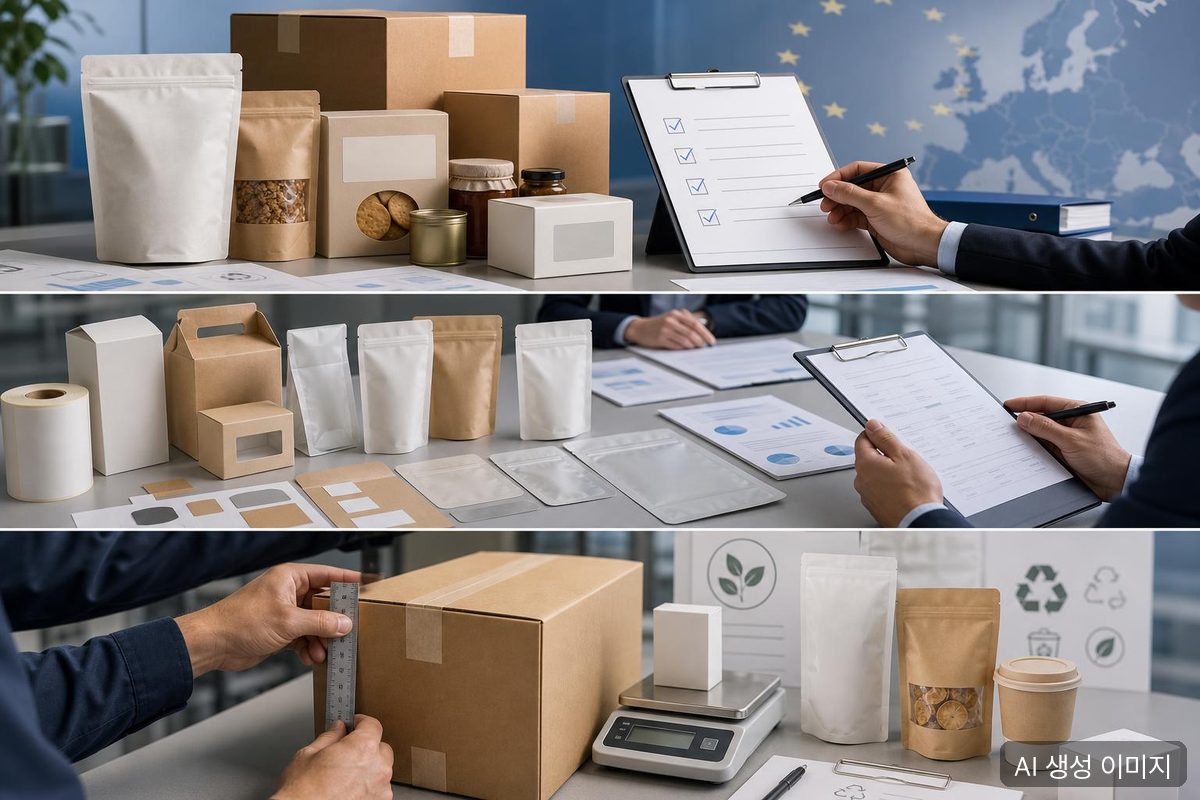
PPWR covers packaging as a whole. Food exporters should not look only at the packaging that directly wraps the product. Primary, secondary, and transport packaging must all be separated.
- Primary packaging: pouches, cups, trays, bottles, caps, and labels. Check food-contact safety, material, ink, adhesive, and hazardous substances.
- Secondary packaging: individual cartons, bundle packaging, and paper sleeves. Check recyclability, overpackaging, and label information.
- Transport packaging: corrugated boxes, cushioning, pallets, and stretch film. Check empty space, weight, recyclability, and export packaging documents.
K-food exporters should pay close attention to pouches, instant-noodle cups, small sauce packs, frozen-food trays, cosmetics cartons, and cushioning materials. When an EU buyer asks for product packaging data, the request usually covers the entire packaging structure, not just one component.
2. Check Material Composition Separately from Food-Contact Safety
Food and cosmetics packaging is not evaluated by sustainability alone. Food-contact safety and recyclability are different checklist items.
For example, conversion to mono-material packaging can help recyclability, but shelf-life protection, oxygen barrier, moisture barrier, and migration safety must be reviewed at the same time. Reports that a major noodle producer is researching a switch from multilayer composite film to mono-material powder-soup packaging belong to this same context.
Exporters should request the following data from packaging suppliers:
- Main materials: composition ratios of PP, PE, PET, paper, aluminum, coating layers, and other materials.
- Food-contact status: food-contact layer material, migration testing status, and regulatory conformity.
- Hazardous-substance restrictions: confirmations or test reports for restricted substances such as heavy metals and PFAS.
- Printing and adhesives: food-contact suitability of inks, adhesives, and coatings.
- Preservation performance: oxygen barrier, moisture barrier, and chilled or frozen suitability.
The key is not the phrase eco-friendly material. The key is knowing which material is used in which layer and which test or document proves it.
3. Do Not Assume Recyclability by Product Type
PPWR aims to ensure that packaging can be recycled in an economically viable way. The European Commission has set a goal that all packaging on the EU market should be recyclable by 2030.
The problem is that even paper packaging can be judged differently depending on coatings, film labels, window films, foil stamping, adhesives, and composite materials.
Check these items by product:
- Can paper and plastic be easily separated?
- Are there components that can be replaced with mono-material alternatives?
- Do labels and adhesives interfere with recycling processes?
- Is there black plastic, metalized film, or aluminum composite layers?
- Are cushioning and outer boxes managed under the same criteria?
Export managers should not simply ask suppliers for a recyclable claim. They should request the basis used to make that judgment.
4. Manage Overpackaging and Empty Space with Numbers
Empty space is an easy item to miss in EU packaging compliance. Even if the material is eco-friendly, excessive packaging relative to contents can become an issue.
Food and cosmetics need cushioning space to prevent breakage, leakage, and deformation. But to explain that need, numbers are required.
Record the following:
- Product dimensions: width, depth, and height of the finished product.
- Primary packaging dimensions: pouches, containers, bottles, tubes, and similar components.
- Folding carton dimensions: separate inner and outer dimensions.
- Transport box dimensions: inner dimensions, outer dimensions, flute type, and packing quantity.
- Cushioning specification: material, weight, position, and reason for use.
- Empty-space ratio: quantify the difference between content and packaging space.
This data supports not only regulatory compliance but also logistics cost reduction. Reducing packaging can improve container loading efficiency and shipping cost at the same time.
5. Prepare Labeling and Documentation Together
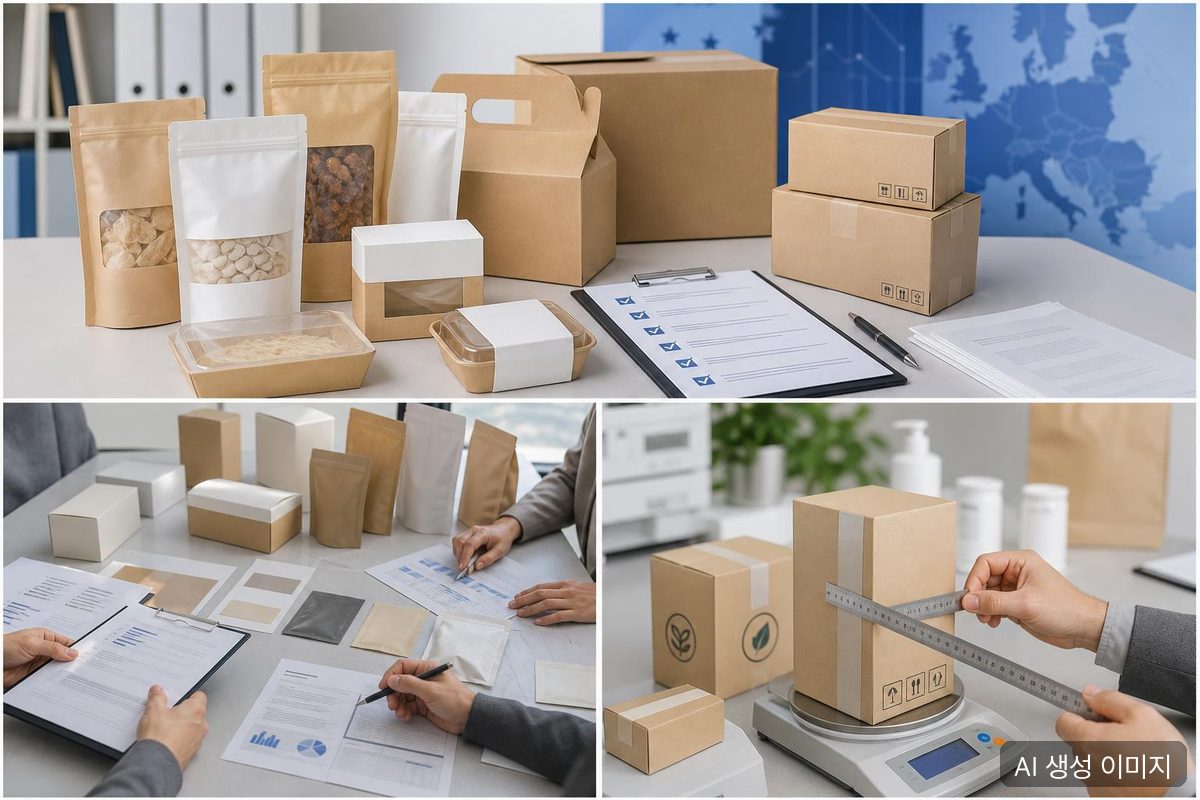
It is important that joint government briefings cover PPWR requirements and documents needed for compliance. In practice, the bottleneck is often not whether packaging meets the rule, but how that fact can be shown in documents.
Exporters and packaging suppliers should prepare:
- Packaging specifications
- Material composition tables
- Supplier declarations
- Test reports
- Food-contact conformity data
- If FSC, PEFC, or other certificates exist, documents confirming the certified scope
- Recyclability evaluation data or internal review sheets
- Packaging dimension and weight records
- Review history for labels and marking text
Collecting document names is not enough. Each document must be linked to product code, packaging-material code, applicable country, and application period. Then, when a buyer asks for a specific SKU, the file can be submitted immediately.
Practical Checklist for K-Food Exporters
Start with these items to set response priorities.
- EU export SKU: Is the list of products exported to the EU up to date?
- Packaging structure: Have primary, secondary, and transport packaging all been separated?
- Material data: Have materials and composition ratios been obtained for each packaging component?
- Food-contact safety: Has conformity of the food-contact layer been checked?
- Hazardous substances: Are there documents for restricted substances such as heavy metals and PFAS?
- Recyclability: Have mono-material conversion options and interfering elements been reviewed?
- Empty space: Can dimensions and cushioning reasons be explained numerically?
- Labeling: Has the need to change labels, recycling instructions, or material markings been checked?
- Documents: Are specifications, test reports, and certificates linked to SKUs?
- Schedule: Have production, ordering, and shipping dates been back-calculated before August application?
Questions to Ask Packaging Suppliers
It is not enough to ask a supplier, “Can you comply with PPWR?” Ask specific questions such as these.
- Can you provide a material composition table for the current packaging?
- Do you have test reports or conformity data for the food-contact layer?
- Do you have confirmations for restricted substances such as PFAS and heavy metals?
- Can the structure be changed to mono-material or easier-to-recycle packaging?
- Can you explain how coatings, labels, and adhesives affect recyclability?
- Is there an alternative design that reduces dimensions and weight?
- Will the change cause problems with existing filling and packing lines?
- What is the lead time from order to delivery?
When these answers are collected, exporters can manage not only regulatory compliance but also packaging cost, lead time, and quality risk.
Conclusion
EU PPWR compliance is not only the job of legal or certification teams. In food and cosmetics exports, packaging development, purchasing, quality, sales, and logistics must move together. With August 2026 application approaching, the most important task now is aligning data with packaging suppliers.
K-food exporters should first map product-by-product packaging structures, then manage materials, food-contact safety, recyclability, labeling, and documentation in one checklist. Packaging suppliers become not just vendors, but partners in preparing regulatory evidence.
About the Author
PackingMaster: Editor of PaperPackLog. Covers market trends, product insights, and technology in the paper packaging industry.
References
- Electronic Times, report on K-food exports and EU packaging regulation, 6 May 2026, https://www.etnews.com/20260506000322
- Food News Korea, report on EU strengthened packaging regulation and joint government briefing, 7 May 2026, https://www.foodnews.co.kr/news/articleView.html?idxno=118366
- European Commission, Packaging waste, https://environment.ec.europa.eu/topics/waste-and-recycling/packaging-waste_en
Meta Description Candidate
A practical checklist for K-food and cosmetics exporters preparing for EU PPWR application in August 2026, covering packaging materials, labeling, recyclability, food-contact safety, and documentation.
Tag Candidates
EU PPWR, K-food exports, food packaging, cosmetics packaging, export packaging, recyclability, packaging regulation, food-contact packaging
Duplication Avoidance Note
The existing article eu-ppwr-2026-august-countdown.md covers PPWR application dates and broad response directions for Korean exporters, while export-packaging-compliance-data-checklist-2026.md focuses on records for export packaging compliance data. This draft narrows the target to K-food, food, and cosmetics packaging, and focuses on food-contact safety, joint government briefings, and product-level packaging structure checks.