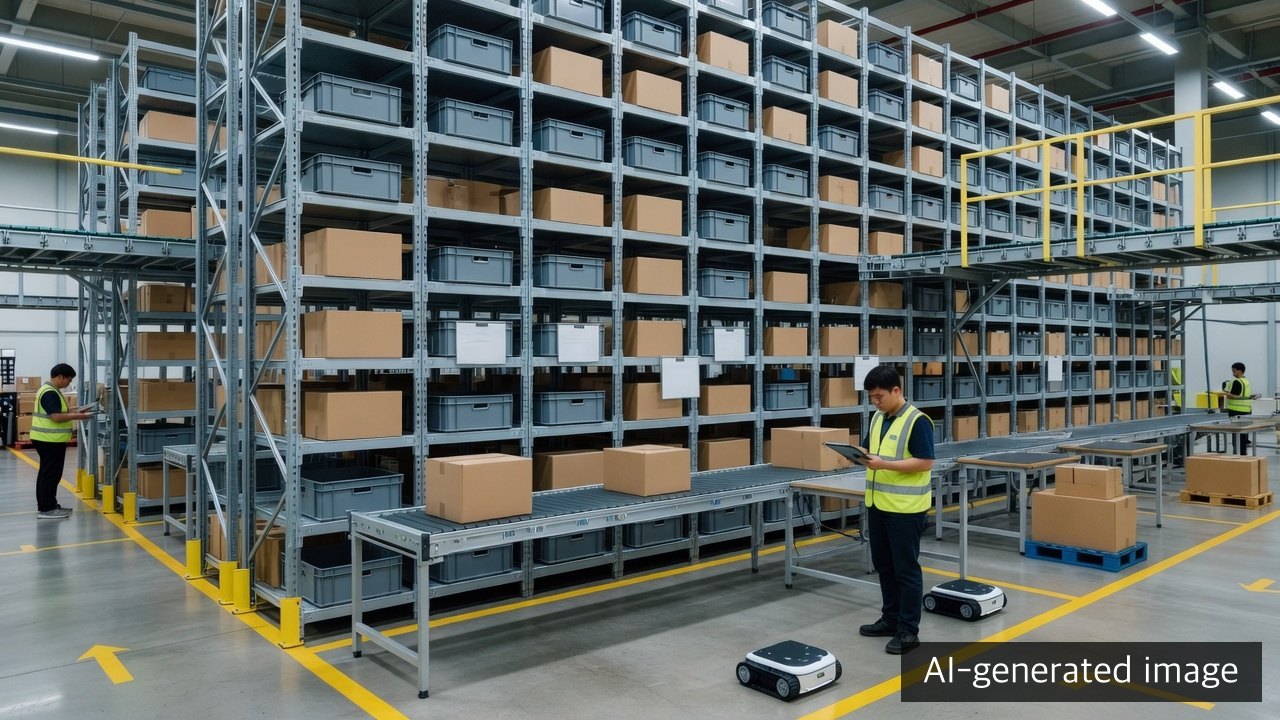
A warehouse-automation project can meet its storage and picking targets while leaving people waiting in the packing area. Picked totes arrive in waves, an operator stops to find the right carton, and a completed parcel returns after a label error. In each case, the bottleneck sits not inside one machine but between processes.
Exotec Korea held Exo-Seminar Seoul 2026 in Seoul on 26 August 2026. The official announcement described it as a forum on the current state and direction of warehouse automation. After the event, Industry News reported that the programme examined an end-to-end design covering inbound through dispatch, rather than treating individual machines as a sequence of isolated purchases.
The same report described Exotec’s Skypod system, in which robots climb storage racks and retrieve containers. This article does not recommend a particular system. It uses the public event record as a starting point for a more basic question: how should a fulfilment centre audit the real bottlenecks between inbound, picking, packing and dispatch before investing in automation?
Separate public facts from site-specific interpretation
| Area | Confirmed in public sources | What the site must still verify |
|---|---|---|
| Event | Held in Seoul on 26 August for Korean logistics and automation practitioners | Whether the examples match the site’s SKU mix, order variability and building constraints |
| Design approach | End-to-end thinking from inbound to dispatch was discussed | Measure handoff time between processes before comparing equipment nameplate rates |
| Storage and picking | A rack-climbing robot retrieves containers in the Skypod concept | Check the wait between pick completion, order consolidation and pack start |
| System architecture | Event presentations described a shift from fixed to more flexible systems | Validate expansion, rerouting and manual fallback under changing volume and SKU mix |
| Manual work | According to the event report, packing and loading retain substantial manual work | Identify causes of waiting, rework and ergonomic load before targeting labour reduction |
| Overseas case | Renault dispatch-time and energy-cost improvements were presented at the event | Treat them as case-specific values, not a transferable return-on-investment promise |
An automation percentage or rated throughput is only the beginning of the investigation. A fast storage system does not reduce customer lead time if orders wait at consolidation, carton selection, labelling, inspection or loading.
Follow one order, not one machine
Begin by selecting representative orders and following their physical and data paths. A single average order hides variability and exceptions. Include at least:
- a small, single-SKU order;
- a multi-SKU order requiring consolidation;
- a bulky or heavy order;
- a fragile, leak-sensitive or deformation-sensitive order requiring extra protection;
- an order requiring lot, serial, shelf-life or temperature checks;
- a non-consolidatable, amended-address or cancelled order; and
- an urgent order close to the carrier cut-off.
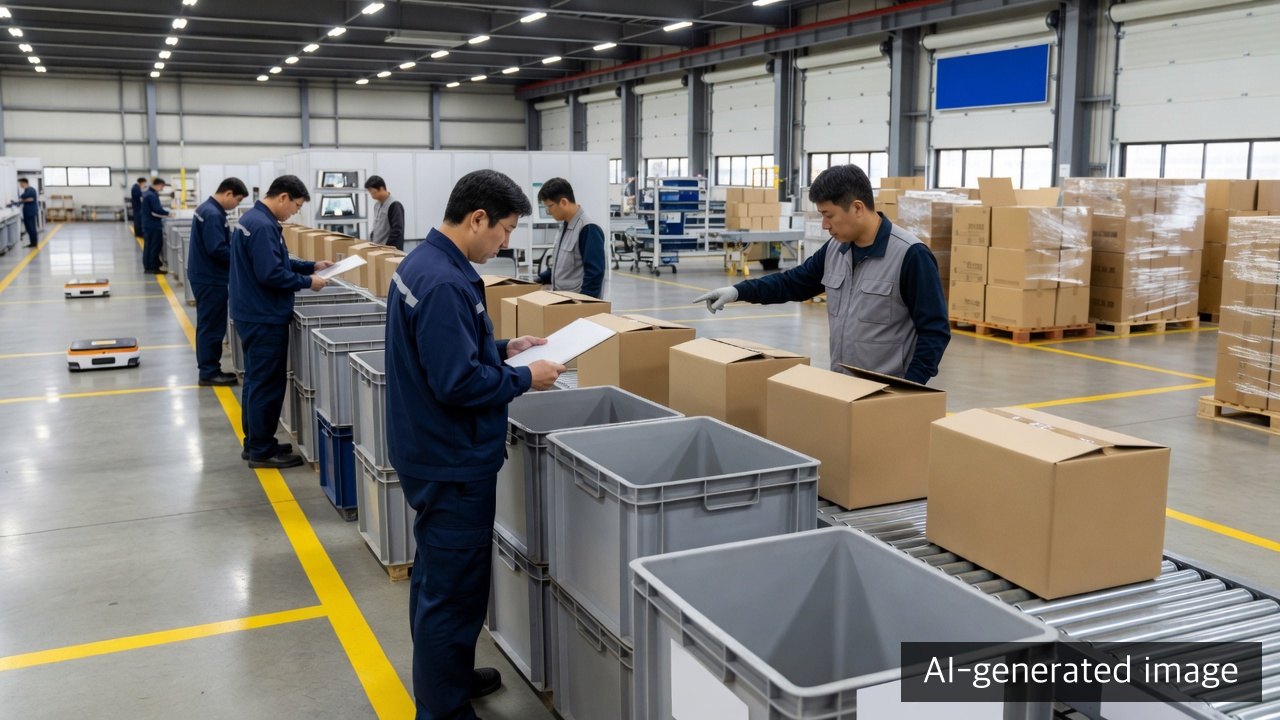
Keep one identity with each order and record timestamps for receipt, storage availability, pick completion, consolidation, pack start and finish, weighing, labelling, sorting and loading. Retain evidence that can be reviewed later: scan logs, equipment events, CCTV timestamps or controlled observation records.
A 60-minute walk: inspect four boundaries
1. Inbound to available storage
Vehicle arrival is not the same as inventory becoming available for picking. Unloading may be followed by inspection, quantity reconciliation, relabelling, lot registration and put-away queues.
- Does the inbound notice match actual item and quantity?
- Is identity controlled at pallet, carton and each level?
- Are damaged, short, excess and unregistered items separated immediately?
- At what event may an order allocate the stock: receipt completion or location confirmation?
- Do empty totes, pallets and discarded packaging obstruct people or equipment?
2. Picking to order consolidation
A picking system may achieve its rated rate while a multi-SKU order waits for its final tote. Pick rate and order-completion time are different measures.
- Do all totes for one order converge at a controlled location?
- Is there a defined buffer and maximum dwell for early-arriving totes?
- Can a shortage, mispick or stock discrepancy be handled without stopping normal orders?
- If priorities change, can the existing tote sequence and location still be traced?
- Does the pick-complete event create a reliable packing instruction?
3. Picking to packing
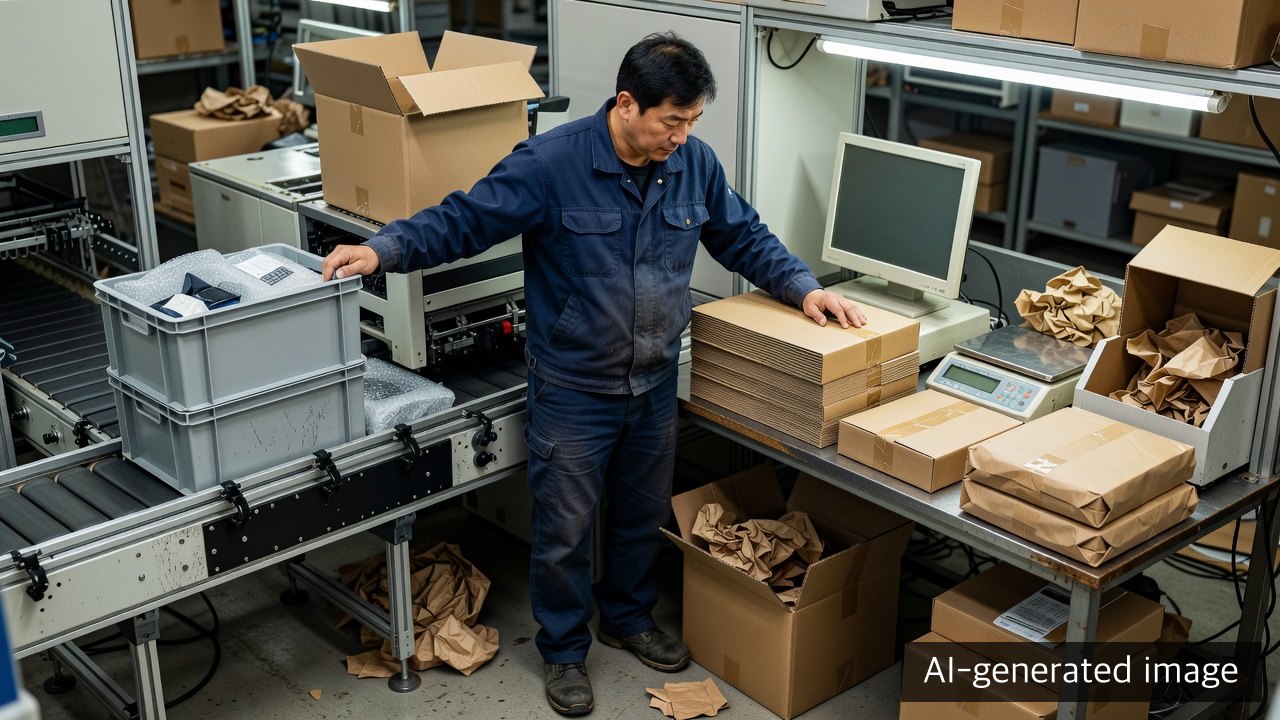
Packing often becomes the grey zone in an automated centre. A tote has arrived, but no carton has been assigned. The operator interprets the packing method again for every order. A printer or scale failure then creates a queue that blocks the next totes.
- Does the order present an approved carton and cushioning or sealing method?
- Where are differences between master-data and actual dimensions or weight corrected?
- Is replenishment triggered before cartons, tape, paper cushioning or labels run out?
- Are carton-erector capacity and manual packing capacity measured separately?
- Are order identity, measured weight and carrier label reconciled in one step?
- Can held parcels be prevented from re-entering the normal outbound conveyor?
- Are operator turns, lifts, reaches and walking steps observed?
Reducing packaging material may lower void ratio while increasing damage or cycle time. Conversely, too many carton sizes complicate selection, replenishment, stock control and carton-erector changeovers. Carton standardisation must balance packing time, damage, transport cube and equipment changeover, not material price alone.
4. Packing to sorting and loading
A sealed carton is not a dispatched carton. Label readability, weight discrepancy, carrier sortation, pallet build, dispatch inspection and vehicle cut-off remain.
- Can label printing and application ever be associated with the wrong order?
- Can curves, guides and conveyor merges damage the label or carton?
- Is there a controlled diversion route for unreadable barcodes, weight errors and address exceptions?
- Is finished-goods queue visible by carrier, route and cut-off time?
- Are pallet pattern, stack height and stretch-wrapping rules linked to the order?
- After a vehicle delay or dock change, can each completed parcel still be located?
A one-page bottleneck audit sheet
| Record | Site entry | Decision question |
|---|---|---|
| Order family and representative SKU | [single/multi/bulky/exception/urgent] | Did the sample cover more than an average order? |
| Observation window | [time/shift/volume] | Were peak and off-peak conditions separated? |
| Process timestamps | [receipt/pick/consolidate/pack/label/sort/load] | At which boundary did the order wait longest? |
| Processing time | [time actively worked] | Is the task itself slow? |
| Waiting time | [time without active work] | Are upstream and downstream processes out of sync? |
| Rework time | [mispick/repack/relabel] | Where did the first error originate? |
| Blocked time | [shortage/downtime/approval] | Is there an owner and bypass route? |
| Packaging supply | [carton/cushion/tape/label] | Did shortage or format selection stop the job? |
| Manual intervention | [count/reason/owner] | Did it safely recover the process or hide a recurring error? |
| Evidence | [log/photo/video/sample] | Can the same event be reviewed? |
Do not keep total lead time as one number. Split it into processing, waiting, rework and blocked time. Hardware is effective at reducing processing time. If the root cause is missing data or exception approval, another machine may leave waiting time untouched.
Release conditions before requesting equipment quotations
Data conditions
- Order, item, tote, carton and pallet identities remain linked across processes.
- Ownership is defined for dimensions, weights, packing constraints and carrier-label rules.
- Exception, hold and cancellation states are separated from normal orders.
- Equipment logs and operator records use an aligned time reference.
Packaging conditions
- Preferred and substitute cartons are approved for representative SKUs.
- Separate maximum rates are known for carton erection, loading, weighing, sealing, labelling and inspection.
- Damage, compression, vibration and moisture validation reflects the actual distribution risk.
- Packaging replenishment and waste removal do not conflict with people, robots or forklift routes.
Recovery conditions
- After downtime, the system can identify exactly how far each order progressed.
- Authority and conditions are defined for manual picking, packing and label issue.
- Restart controls prevent duplicate dispatch and double inventory deduction.
- The queued order sequence is recalculated after recovery.
A pilot must include disrupted days, not only fast days
A pilot run with average volume and normal SKUs does not prove operational control. Select one order family, one picking zone, two packing stations and one outbound route, then deliberately include:
- normal and peak volume;
- single-SKU and multi-SKU consolidation;
- packaging replenishment and carton-format change;
- mispick, shortage and weight discrepancy;
- temporary label-printer or conveyor downtime;
- urgent orders and a changed carrier cut-off; and
- manual fallback followed by return to automatic operation.
Compare more than units per hour. Use consistent definitions for order-completion lead time, pre-pack queue, repack rate, label reissue, manual intervention, damage, packaging consumption and carrier cut-off attainment.
Do not copy a published case into the investment return
Industry News reported that an event presentation described Renault’s warehouse as operating 191 robots and 14 picking stations. The presentation attributed a reduction in average dispatch time from 120 minutes to 15 minutes and a 30% reduction in energy cost to the Skypod deployment. These are case values reported from that presentation.
A Korean site may have different product dimensions, order profile, operating hours, building constraints, electricity contract, labour conditions and legacy systems. Its investment case should therefore state the local baseline, observation period, exclusions, pilot result and scale-up gate, rather than importing an external success rate.
Conclusion
The practical question raised by Exo-Seminar Seoul 2026 is not simply which robot is faster. Viewed from inbound to dispatch, the question is where order identity, state and physical flow break apart—and where people wait or repeat work as a result.
Before requesting equipment quotations, follow representative orders and separate processing, waiting, rework and blocked time at every handoff. Revealing the grey zones after picking and after packing makes it possible to distinguish where hardware is needed from where master data, exception rules or work standards must be corrected first.
About the Author
PackingMaster: Editor of PaperPackLog. Covers market trends, product information, and technology insights in the paper packaging industry.
References
- Exotec, “Exotec to Hold Its First Standalone Korean Seminar, Exo-Seminar Seoul 2026” (31 July 2026)
- Industry News, “In an Era of 6.4 Billion Parcels, Where Did the Workers Go? The Answer Found by Fulfilment Centres” (28 August 2026)
Sources checked on 3 September 2026. Event details and reported case values are limited to the cited sources. The audit sheet and release conditions are an operating guide reconstructed from dependencies across logistics and packaging processes.