
FEFCO Summit 2026 ran May 27 to 29, 2026 at the Meliá Castilla hotel in Madrid. Roughly 225 European corrugated industry leaders and suppliers gathered under the slogan “Circularity in Action.” The sessions and panels pointed in one direction: the claim that corrugated is a sustainable material is no longer a standalone message; it is now a bundle that ties together regulatory compliance, recycling evidence, and plant operating risk.
This post unpacks the FEFCO Summit 2026 agenda for Korean export-packaging readers. It is not a recap. The focus is on how Korean corrugated, box, and finished-packaging companies should absorb three keywords: PPWR, circularity, and plant resilience.
Why the Madrid Agenda Matters for Korea
FEFCO is the European federation of corrugated manufacturers. Korean companies are not direct member participants. There are still three reasons to read its agenda.
First, EU PPWR implementation lands directly inside the specs Korean export packaging must satisfy. Second, when European brand head offices start asking the same recycling-rate and recycled-content standards of their full global supply chain, Korean plants have to prepare documentation to the same standard. Third, the operating risks discussed for corrugated plants (energy, cybersecurity, AI adoption) are the same risks Korean plants face at the same time.
Pulling together comments from FEFCO President Nina Iversen (Glomma Papp), Vice President Saverio Mayer (Smurfit Westrock), and Director General Eleni Despotou, this year’s message lands as one sentence: “The future of the corrugated industry depends on its ability to adapt.”
Keyword 1: PPWR Implementation

The headline session on Day 2 was “PPWR Implementation: What’s next? From Regulation to Reality.” The core theme was the move from regulatory text to plant-floor reality.
PPWR’s EU-level publication concluded in 2025, and member-state implementing legislation accelerates through 2026 and 2027. At this stage, the items the corrugated industry is tracking include:
- Operational application of packaging-minimization (anti-over-packaging) criteria
- Mandatory recycled-content ratios and the methods used to measure them
- Standardization of recyclability-grade documentation (A, B, C)
- EPR reporting data flow per package
- Recycling-impact assessment of coatings, varnishes, and adhesives used on corrugated boxes
Spain’s EPR implementation case was covered in its own session. Because reporting forms and contribution calculations differ by member state, the point was made again that the documentation effort is “per member state,” not “EU as one block.”
The meaning for Korean export-packaging companies is clear. A single line on a purchase order reading “PPWR compatible” is not enough to supply boxes to European brands. The quote needs to go in with documentation that names which member-state EPR form was the basis, and which method was used to measure recycled-content ratios.
Keyword 2: Circularity and Evidence of Recycling Rates
The second keyword behind the event slogan “Circularity in Action” is not the recycling rate itself, but the evidence behind it. That is the reason the FEFCO Communication Committee’s “Recycled for Real” campaign was introduced alongside the agenda.
European corrugated’s average recycling rate has long been published in industry statistics. But as PPWR combines with the EU Green Claims Directive, the requirement is shifting from marketing that cites the average number to per-box recyclability assessment and recycled-content evidence. The shared conclusions of the circular economy session and the recycling-rate session at the Summit were:
- The word “recyclable” can be used only when test data and member-state EPR grading documentation accompany it.
- Recycled-content figures must be traceable through a per-box BOM and supplier certification of the base paper.
- The impact of coatings, liners, and ink changes on recyclability grade must be assessed at the new-product launch stage of the box.
From a Korean export-packaging company’s standpoint, the spec sheet that used to be closed off with one line saying “recyclable corrugated box” is now expanding into per-box recyclability grades, recycled-content figures, and ink-and-coating impact documentation. Companies that organize this material before the purchase order asks for it will have an edge at the quote stage.
Keyword 3: Plant Resilience (AI and Cybersecurity)
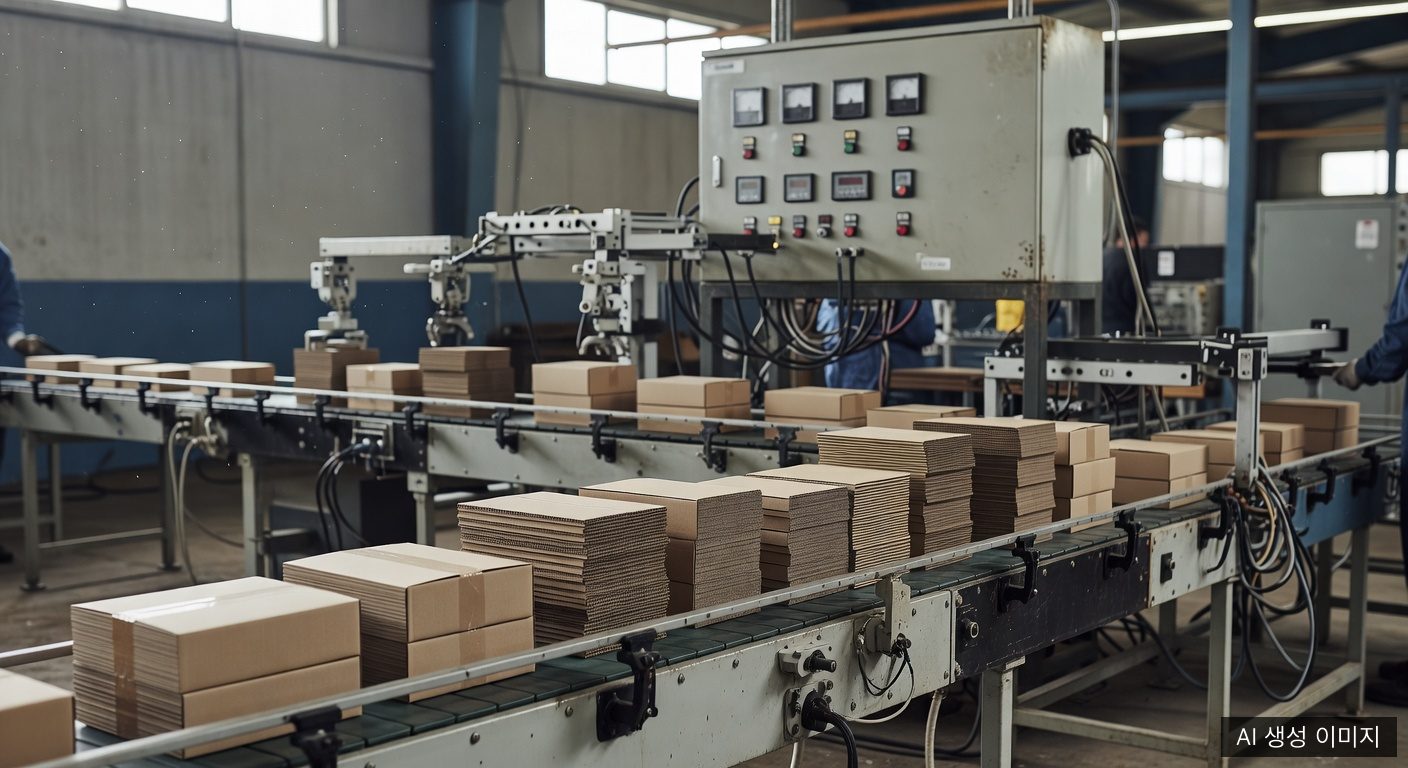
Day 3 sessions ran on two tracks. One was “AI transformation in the corrugated sector.” The other was “The day your plant stops: is your business prepared for a cyberattack?” They look separate, but FEFCO put them together for one reason. As corrugated plants digitize, the risk of downtime is no longer an IT-department problem; it is a company-level problem.
The points the Summit made:
- AI is moving into corrugated processes across box design automation, quality inspection, line scheduling, and waste prediction.
- At the same time, automated and networked processes expand the cyber attack surface.
- The widely quoted line “When production stops, cyber becomes a business issue, not an IT issue” was used because the revenue and delivery impact of a halted line goes well beyond IT’s solo responsibility.
- Plant resilience is now defined as a bundle: backup network paths, operational technology (OT) security, incident response runbooks, and alternate-line capacity in the event of downtime.
Korean corrugated and box plants are inside the same trend. As automated ordering, MES, AI quality inspection, and label-printing line integration expand, operating procedures that limit downtime losses need to evolve in step. The bigger the global brand on the export side, the higher the likelihood that supplier BCP (business continuity plan) documentation will be requested.
Practical Implications for Korean Packaging Companies
Three takeaways for the Korean operating desk.
- European export box quotes need to ship together with PPWR implementation documentation (including member-state-specific EPR references) and recyclability-grade documentation.
- Marketing phrases like “recyclable” or “recycled content XX percent” can be used only when paired with per-box test data and base-paper supplier certifications. Putting those phrases in catalogs, websites, or purchase orders without supporting documentation is a risk under both the EU Green Claims Directive and Korea’s Ministry of Environment rules on environmental claims in labeling and advertising.
- Plant resilience belongs in the customer-acquisition column, not the cost column. The bigger the global brand, the more likely they are to ask for supplier downtime-response documentation. Cybersecurity and AI adoption are two pages of the same file.
Conclusion: Corrugated Sustainability Is Now a Documentation Problem
FEFCO Summit 2026 sent a consistent message. The fact that corrugated is a sustainable material is no longer sufficient as marketing copy. PPWR implementation documentation, recyclability-grade evidence, and plant-downtime response are bundled together at the supplier negotiation table.
The volume of documentation a Korean packaging company has to send with a European export box quote has clearly grown. But the differentiation opportunities at the quote stage have grown alongside it. The Madrid message is not that “corrugated is sustainable.” It is that “who organizes the documentation better” is now an axis of industry competitiveness.
Frequently Asked Questions
Q: Where is FEFCO Summit held each year?
FEFCO holds the Summit every two years. The 2026 event ran May 27 to 29 at the Meliá Castilla hotel in Madrid, Spain, with roughly 225 European corrugated industry leaders and suppliers attending.
Q: How far should a Korean company prepare PPWR implementation documentation?
The base bundle includes per-member-state EPR forms, recycled-content measurement records, and recyclability grading documentation. Check which member-state framework the export-target brand uses, and prepare documentation to that form to reduce repeat document requests during the quote stage.
Q: What should go into plant-resilience documentation?
Operational technology (OT) security policy, alternate-line and outsourcing capacity for downtime events, backup network and data backup policy, incident response runbooks, and recovery-time-objective (RTO) targets are the typical items global brands ask suppliers to include in a BCP.
About the Author
PackingMaster: Editor of PaperPackLog. Curates and organizes market trends, product information, and technical insights for the paper-packaging industry.