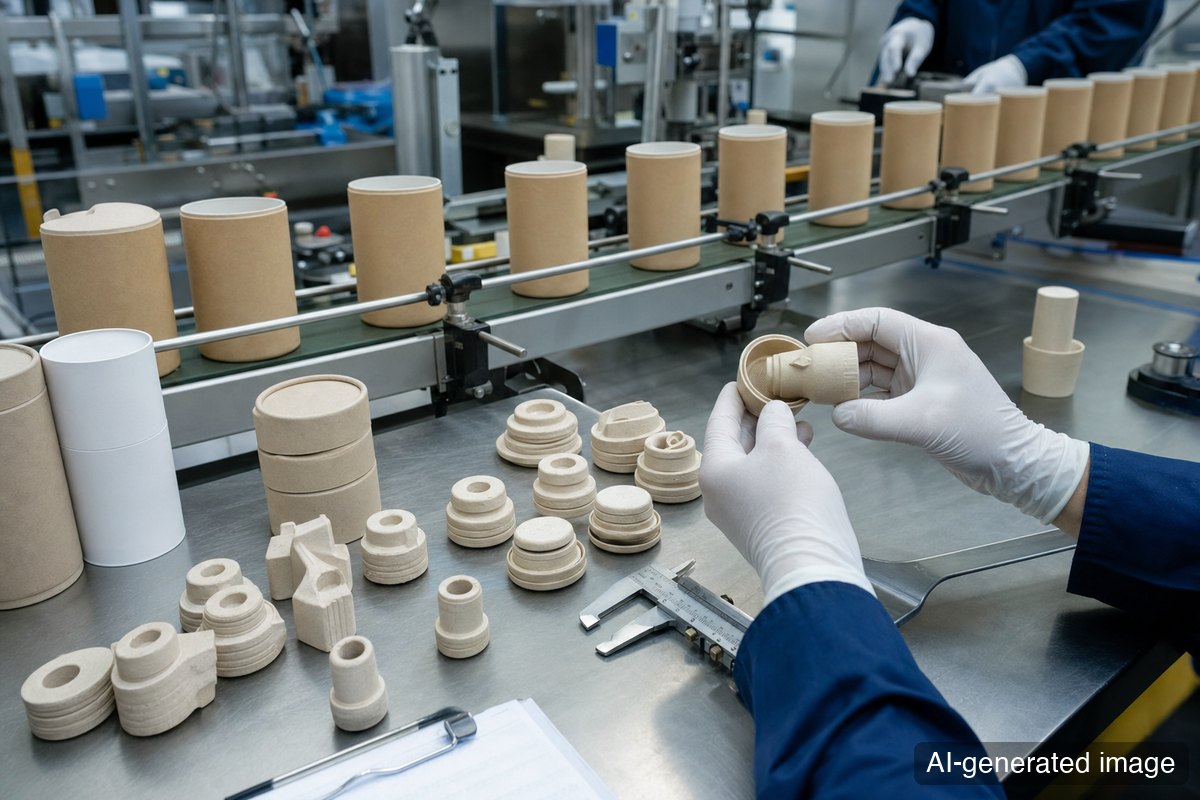
Paper bottles and paper containers are no longer unusual ideas. The harder question often appears at the opening. A package body may shift toward paper, while the cap, plug, pump, dispenser, or sealing component remains plastic. Blue Ocean Closures’ recent introduction of an integrated fiber-based range, including Paper-Plug concepts, points directly to this gap.
In packaging design, a closure may look like a small part. In practice, it controls sealing, opening feel, product protection, recyclability, and user experience. A paper cap or dispenser should therefore be reviewed not as a sustainability symbol, but as a functional component.
1. A closure is closer to a precision part than a sheet material
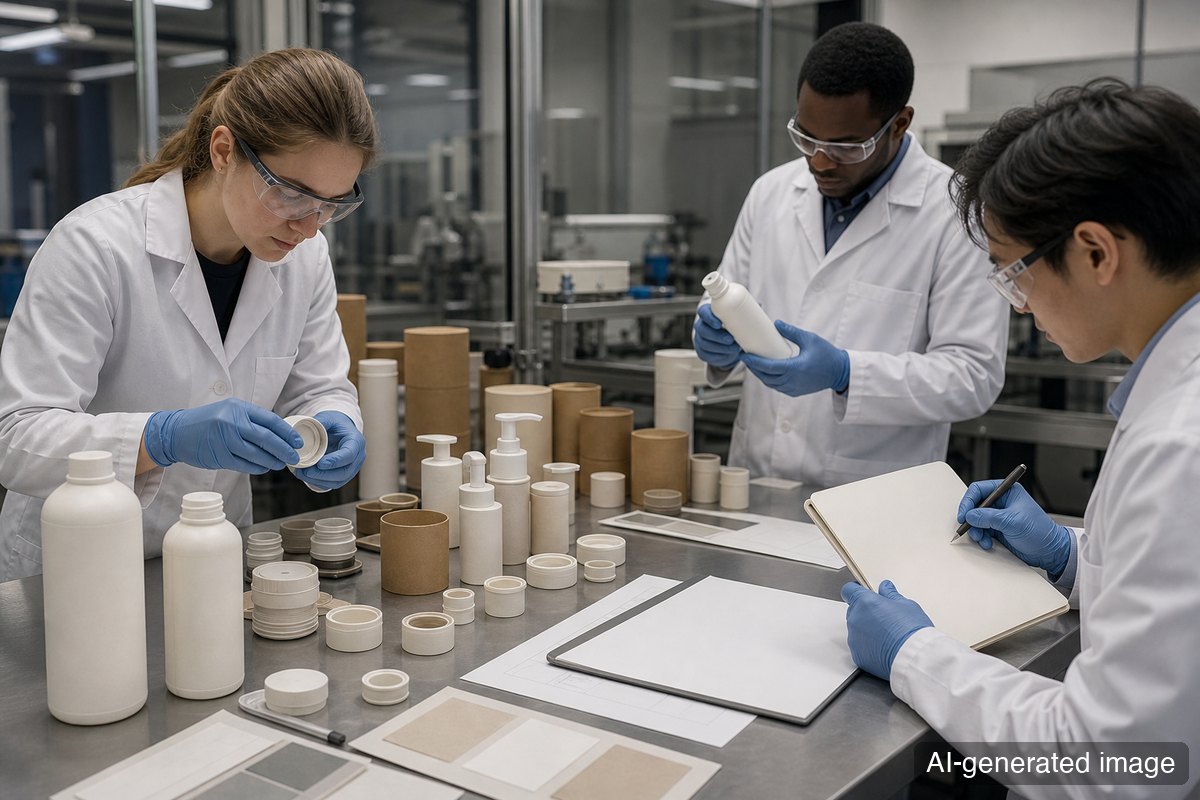
Boxes, sleeves, and cushioning parts can often tolerate some dimensional variation. Caps and dispensers cannot. A small error in a thread, snap-fit, plug, hinge, or dispensing opening can lead to leakage, looseness, poor opening feel, or line stoppage.
Key checks include:
- compatibility with the container neck finish;
- loosening after repeated opening and closing;
- detachment after drops or vibration;
- blockage and remaining-product discharge;
- whether a liner or sealing layer is required;
- stability on automatic filling and capping lines.
Fiber-based parts do not behave like injection-molded plastics. Compression, recovery, moisture uptake, and surface friction are different. Copying the same shape from a plastic cap may not be enough.
2. Moisture and product compatibility define the real application range
Closures sit close to the product. Beverage, cosmetics, detergent, powder, oil, and fragrance applications all impose different demands. If a fiber-based component absorbs the product, swells, transfers odor, or loses sealing force during storage, the material change fails.
Suppliers should be able to discuss:
- contact tests with water, alcohol, oil, surfactants, and fragrance;
- dimensional and sealing-force changes during storage;
- coating or additive information for water and grease resistance;
- food, cosmetic, or household-chemical contact suitability;
- performance under humid logistics conditions;
- leakage, evaporation, and aroma-loss testing.
The practical point is to define where paper closures are suitable now and where they are not. Dry products, short-use applications, secondary plugs, and selected fiber-based container systems may be easier starting points than universal replacement.
3. Recyclability must be judged at the package-system level
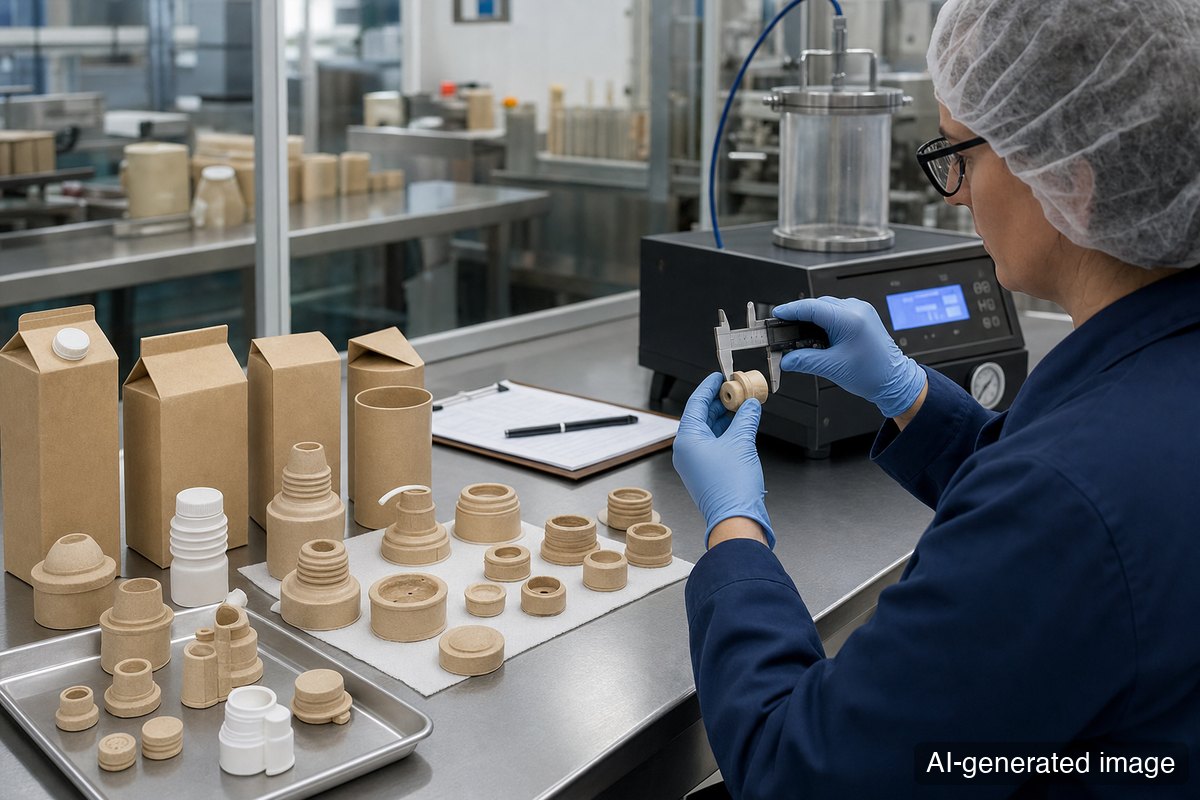
Changing only the cap to paper does not automatically make the whole package easy to recycle. The container body, barrier layer, adhesive, liner, label, ink, and residual contents all enter the recovery pathway together. Conversely, a paper cap on a plastic bottle may create a different sorting challenge.
Practical review should distinguish:
- paper container plus paper closure;
- plastic container plus paper closure;
- closure with separate liner, coating, or seal;
- whether the user can separate the component easily;
- whether the part can disperse and be screened in a paper recycling process.
Fiber-based closures may support paperisation, but the final assessment should be made on the complete packaging system, not on a single part.
4. Mass production depends on line behavior, not only tooling
A fiber-based closure can look promising in a prototype stage and still face challenges in scale-up. Small components are produced in high volume, so forming speed, drying time, post-processing, dimensional control, and automatic feeding all affect cost.
Procurement and development teams should ask:
- Can existing capping equipment be used?
- Do parts stick together, warp, or jam in feeders?
- Does humidity affect dimensional tolerance?
- How much line adjustment is required at the customer site?
- What are the defect criteria and inspection methods?
- How do unit cost, carbon impact, and disposal cost compare with plastic caps?
The competitiveness of a paper closure will depend less on the material story and more on whether it can enter existing filling and packaging operations without creating new risk.
Practical takeaway
Paper caps and dispensers represent the next layer of plastic reduction. The shift is no longer limited to the package body; it reaches the opening and dispensing system.
But these parts are functional components. Fit, sealing, moisture behavior, product compatibility, production-line stability, and end-of-life instructions must all be tested. For export packaging and branded consumer goods, the safest approach is not simply to ask for a paper cap. Ask for a complete package data package.
References
- Packaging Europe, “Blue Ocean Closures introduces new integrated fibre-based range”, 2026.
- Blue Ocean Closures product information on Paper-Plug and fiber-based closure solutions.
- Blue Ocean Closures launches fiber-based plug for reclosable packaging
- Blue Ocean Closures launches Paper-Plug
- Blue Ocean Closures — Launch of Paper-Plug, a new opening concept
About the Author
PackingMaster: Editor of Paper Pack Log. We collect and organize market trends, product information, and technical insights for the paper packaging industry.