
When companies discuss European packaging rules, they often start with the Packaging and Packaging Waste Regulation, or PPWR. But export packaging teams also need to check country-level requirements. France is a good example because packaging sold to consumers may need Triman and Info-tri sorting information.
Triman indicates that a product or packaging component is subject to sorting rules in France. Info-tri gives consumers sorting instructions for the relevant components. For paper boxes, sleeves, inserts, labels, leaflets, and mixed packaging systems, this can affect artwork and production decisions.
Why PPWR Is Not the Whole Answer

PPWR provides an EU-level framework for packaging reduction, recyclability, reuse, and labeling direction. But when a product is actually placed on a national market, local EPR systems, registration requirements, and labeling rules may also apply.
That is why France’s Triman and Info-tri system matters. “Exporting to the EU” is not specific enough. Packaging teams need to know whether the product is sold in France, whether it is consumer-facing, whether packaging EPR obligations apply, and whether a distributor expects French sorting information on the package.
Korean and other Asian exporters should pay attention when:
- Products are sold through French retailers, marketplaces, or local distributors
- The package includes several paper and non-paper components
- A distributor asks for French sorting label artwork
- An existing English package is being reused for the French market
- EU-level rules have been checked but country-level labeling has not
Components to Review in Paper Packaging
Do not treat the package as one single box. Break it down into components first.
Typical components include:
- Outer paper packaging: corrugated shipper, folding carton, sleeve, or paper case
- Inner paper cushioning: corrugated inserts, molded pulp, honeycomb pads, or paper void fill
- Labels and stickers: paper label, film label, removable or non-removable attachment
- Leaflets and manuals: separate paper items placed inside the package
- Non-paper parts: plastic bag, film, metal clip, desiccant, or composite material
If the package is entirely paper-based, the sorting message may be simpler. If film labels, plastic bags, or composite inserts are present, consumer instructions can become more complex. The safest approach is to reserve labeling space during packaging design, not after the artwork is finished.
Where Design Problems Appear
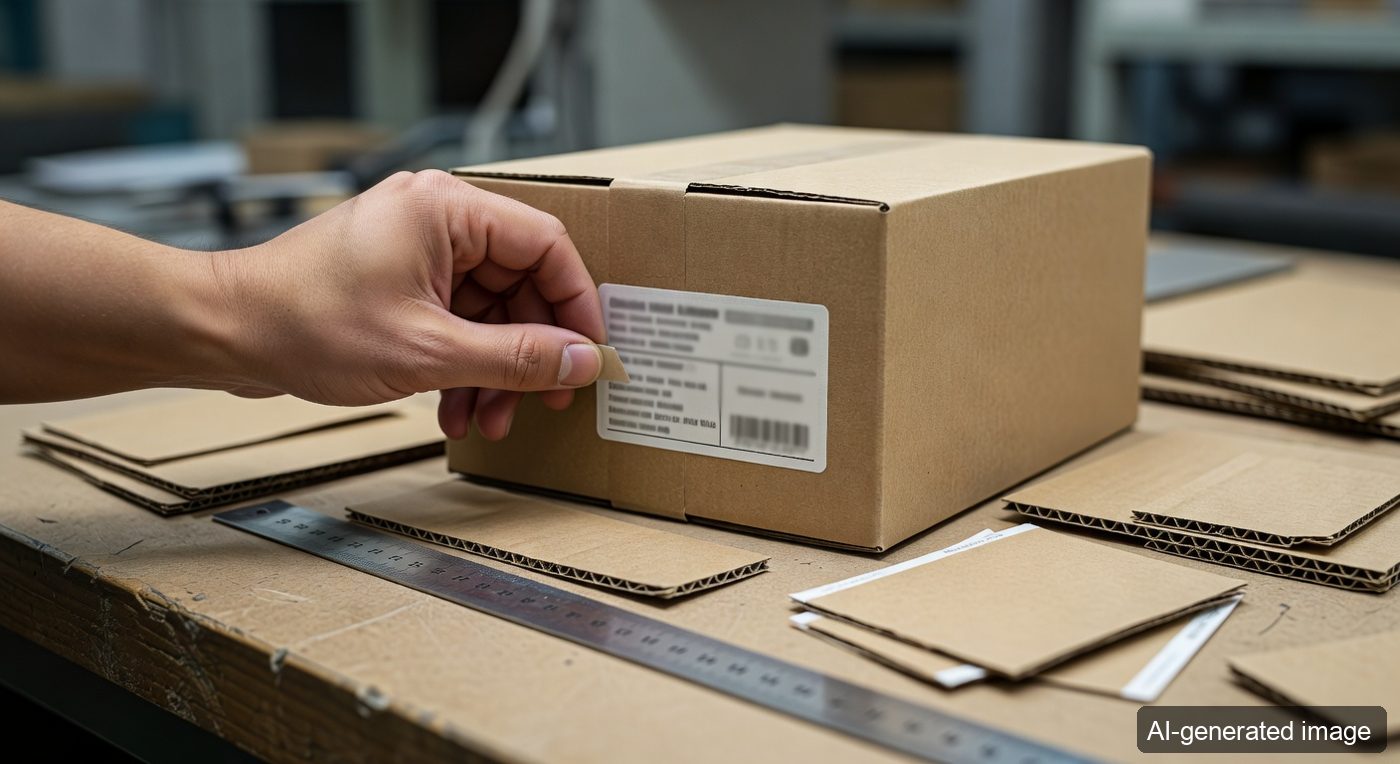
Labeling sounds like a legal or compliance issue, but the practical problems often appear in design and production.
First, space is limited. Small cartons already need branding, barcode, origin marking, warnings, multilingual text, and product information. Sorting instructions can be squeezed into a space that is too small or placed where they are hard to read.
Second, country-level labels may conflict. One common European package may be used for France, Germany, Italy, Spain, and other markets, but each market can have different packaging and sorting expectations. Teams must decide whether to use one common artwork, a country-specific version, or a local sticker.
Third, existing packaging inventory can become a problem. If the labeling requirement is discovered late, already printed cartons may need stickers, rework, or replacement in the next production run.
Fourth, official labels should not be improvised. Do not create similar-looking icons with AI tools or generic graphics. Production artwork should follow official guidance and files from the relevant system.
Checklist for Export Packaging Teams
For paper packaging intended for France, review the following:
- Confirm whether the product is sold to consumers in France.
- Check whether the packaging falls under French EPR and sorting information requirements.
- Review the latest guidance from Citeo or the relevant French sources.
- Break the package into paper, plastic, composite, and other components.
- Reserve actual artwork space for sorting information before print approval.
- Decide whether to use common EU artwork, France-specific artwork, or a local sticker.
- Confirm the file format and wording expected by the distributor or responsible local party.
- Before production, check for missing labels, cropped icons, unreadable size, and wrong placement.
This checklist is not a substitute for legal advice. It is a practical way for packaging, sales, marketing, and compliance teams to discuss the same artwork risks early.
Why It Matters for Exporters
Triman and Info-tri labeling is not just a graphic detail. In export packaging, the question is not only whether the box is strong enough. It is also whether the package can be sold with the correct local consumer information.
For exporters and paper packaging suppliers, three points matter most:
- Labeling space should be considered during packaging design, not after the carton is printed.
- Country-level EPR and sorting label requirements should be checked during quotation and sales discussions.
- Even paper packaging may need different instructions when labels, coatings, bags, or inserts are mixed into the system.
PPWR may shape the future European framework, but a product shipping to France today can still face French national labeling requirements first. Export packaging reviews should therefore combine EU-level rules with local market execution.
Closing
France’s Triman and Info-tri labels are small but important details for paper packaging exports. If the label is discovered late, packaging inventory, artwork schedules, and distributor approval can all be affected.
For products targeting the French market, divide the package into components, check official guidance, and align the labeling approach with the local distributor before printing. Paper packaging performs best when the package also tells consumers how to sort it correctly.
About the Author
PackingMaster: Editor of Paper Pack Log. We collect and explain market trends, product information, and technical insights from the paper packaging industry.
References
- Citeo, Info-tri guide and responsible communication resources, https://www.citeo.com/communication-responsable/info-tri/
- French Ministry for Ecological Transition, FAQ Triman et frises d’information, https://www.ecologie.gouv.fr/sites/default/files/documents/FAQ%20Triman%20et%20frises.pdf
- Background — European Commission, Packaging and packaging waste, https://environment.ec.europa.eu/topics/waste-and-recycling/packaging-waste_en