A purchase order that says only “Indian kraft paper” is not precise enough to determine exposure after a mill flood. When flooding in Gujarat stopped two manufacturing units in the Valsad area’s Salvav industrial zone in July 2026, procurement, quality and logistics teams needed to recheck the mill, grade, PO, lot and shipment status, not just the supplier name. This article separates confirmed facts from outlooks and provides a ready-to-use kraft paper recovery-gate ledger for manufacturers and exporters.
This article does not use flood damage as spectacle. It focuses only on safety, official confirmation and supply continuity.
Separate the Official Disclosure, ICRA’s Outlook and Unresolved Items
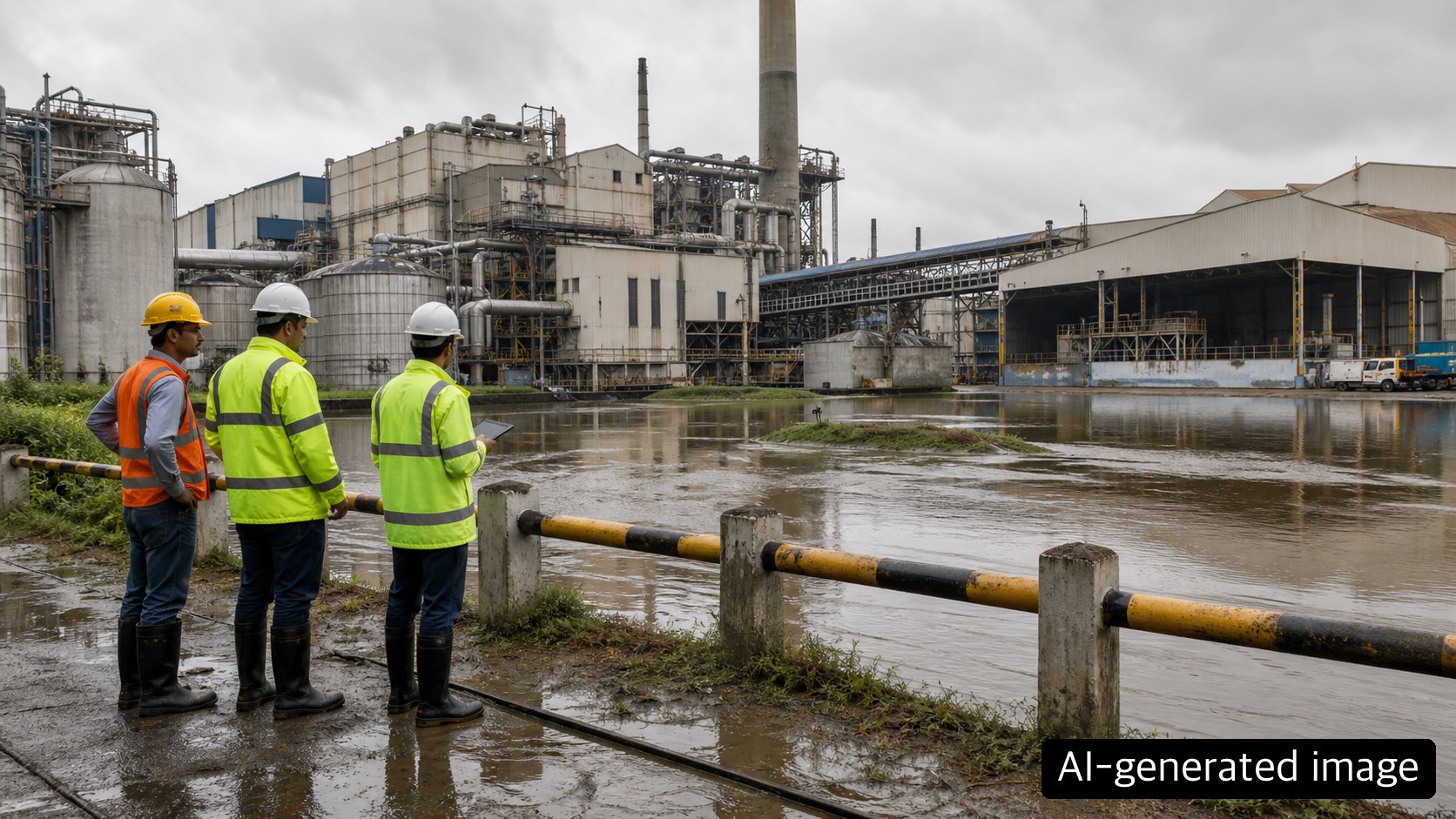
On July 24, the company informed the stock exchange that heavy rainfall and severe waterlogging had flooded its manufacturing facilities in Salvav, Valsad district, Gujarat. Operations at the affected facilities had been temporarily suspended from July 23. The Hindu BusinessLine reported on July 24 that access remained restricted while the company assessed damage to plant, machinery and inventory.
An August 4 ICRA update provided a more specific outlook. According to ICRA, both manufacturing units were affected. Unit I, with installed kraft-paper capacity of 120,000 metric tonnes per annum (MTPA), sustained machinery and inventory damage and was likely to remain disrupted for around two months. Unit II, with installed capacity of 82,500 MTPA, had reported inventory impact and was expected to resume comparatively soon after the insurer’s inspection.
However, “around two months” and “after the insurer’s inspection” are not customer-specific delivery commitments issued by the company. An August 8 trade report repeated the outlook, but the reviewed public material did not provide a confirmed commercial restart date for Unit II or a firm restoration date for Unit I.
| Status | What the Public Material Says | Safe Interpretation | Still to Be Verified |
|---|---|---|---|
| Official disclosure | Salvav manufacturing facilities temporarily suspended from July 23 | The operational stoppage is confirmed | Asset-by-asset recovery and actual shipment restart |
| ICRA assessment | Unit I: 120,000 MTPA, machinery and inventory damage, about two months of disruption expected | Rating agency’s event-impact outlook | Confirmed delivery date for each grade and PO |
| ICRA assessment | Unit II: 82,500 MTPA, inventory affected, restart expected after insurer inspection | Impact assessed as relatively limited | Actual inspection completion and commercial production restart |
| Insurance | Management reported cover for movable and immovable assets | A mechanism for addressing asset losses | Admissibility, amount and timing of settlement |
| Customer impact | No customer-level delivery impact disclosed | Do not generalize this into an India-wide shortage | Supplier’s written PO-by-PO shipment status |
Why This Is Not an “Indian Kraft Paper Shortage”
The two units are described as having combined installed capacity of 202,500 MTPA. That is significant, but one producer’s disruption is not the same as a stoppage of all Indian kraft paper supply. Merchant inventory, rolls made before the flood, cargo already moving to port, and alternate supply from other producers can all have different statuses.
Likewise, insurance coverage does not mean delivery is secure. Insurance addresses asset losses; it does not itself set the timeline for dewatering, inspection, repair, quality verification, commercial production and shipment.
Buyers should narrow exposure to five units of verification.
- Manufacturing unit: Confirm whether the paper came from the affected site and whether it was made at Unit I or Unit II.
- Grade and specification: Confirm grade, basis weight, width, BF or strength, Cobb, moisture, shade, surface treatment and customer-specific requirements.
- Purchase order and lot: Separate open POs, production completion, roll or lot number and mill release status.
- Logistics stage: Distinguish mill stock, inland movement in India, port waiting, shipped cargo and Korean arrival.
- Alternate qualification: Even a similar grade from another mill or producer needs separate printing, bonding, corrugator and customer approval.

Mill–PO–Lot Recovery Gate Ledger
The purpose of these three tables is not to copy a media outlook into an internal commitment. They record the verification stages and next actions required before shipment release. Use gates G0–G4 to fix the decision order, track current material in the first operating table, and link the same PO or lot to alternate approval and the next action in the second. Do not invent stock-day thresholds or acceptance limits from public reporting; enter your own approved specification and customer requirements.
G0–G4 Shipment-Release Criteria
| Gate | Verification Target | Release Criterion | Hold Reason |
|---|---|---|---|
| G0 Official basis | Disclosure, assessment date, verification timestamp | Source and checked-at time recorded | Only a media outlook; no official basis or timestamp |
| G1 Mill-grade mapping | Unit, grade and specification | PO linked to actual manufacturing unit | Manufacturing unit or affected grade unconfirmed |
| G2 PO-lot-logistics | Production, release, shipment and ETA | Location evidence by PO and roll/lot | Pre-flood release or current location unconfirmed |
| G3 Alternate technical validation | TDS, CoA, moisture, Cobb, strength and converting trial | Internal test and first-lot segregation complete | Similar-spec claim without completed testing |
| G4 Customer approval and release | Change approval and shipment decision | Required customer approval completed before release | Customer approval or commercial shipment restart unconfirmed |
1) Track the Current Material
| Supplier/Producer | Actual Mill/Unit | Grade & Specification | PO & Roll/Lot | Production/Release Status | Logistics Status | Inventory/Projected Depletion |
|---|---|---|---|---|---|---|
| [Enter] | Salvav / Unit I or II under review | [Basis weight, width, BF, Cobb, moisture, etc.] | [PO, roll, lot] | [Not produced, in production, complete, released] | [Inland, port, shipped, arrived] | [Quantity, internal calculation] |
| [Enter] | Other producer/mill | [Compare with approved incumbent] | [Alternate lot] | [Available quantity] | [Expected route] | [Keep incumbent and alternate separate] |
| [Enter] | Written reply says no direct mill impact | [Relevant grade] | [PO and lot] | [Evidence of release] | [Vessel and ETA] | [Update receipt plan] |
2) Link Alternate Approval to the Next Action
| PO & Roll/Lot | Alternate Mill/Grade | Test & Customer Approval | Current Assessment | Owner & Next Action |
|---|---|---|---|---|
| [PO, roll, lot] | [Candidate and availability] | [TDS, report, sample, customer reply] | Manufacturing unit being confirmed | Procurement requests written unit identification and firm shipment date for each PO |
| [Alternate lot] | [Candidate confirmed] | Quality test pending | Alternate use on hold | Quality defines test conditions and acceptance basis, then segregates the first lot |
| [PO and lot] | [Contingency candidate] | [Approval status] | Transport schedule being confirmed | Logistics reconfirms shipping evidence and ETA; sales communicates only if the date changes |
Do not put not affected in the Current Assessment column before receiving a written supplier reply. Record the stage itself: manufacturing unit being confirmed, grade impact being confirmed, PO shipment date being confirmed, or alternate test pending.
Nine Questions to Send to the Supplier
- Which manufacturing site and which unit—Unit I or Unit II—made each of our open POs?
- For each PO, what is the status of production completion, mill release, inland transport, port entry and shipment?
- Can rolls made before the flood be segregated by lot from inventory still under flood-impact assessment?
- What is the firm shipment date, and when will the next official update be issued?
- Is any estimated delay based on a production and recovery plan rather than a media outlook?
- What quantity can an alternate mill or grade supply, and what is the earliest shipment date?
- Can you provide the alternate grade’s TDS, test report and differences in furnish, mill and certification scope?
- Which basis-weight, width, BF, Cobb, moisture, shade, printing or bonding conditions differ from the approved grade?
- How do you distinguish insurer inspection, production restart and commercial shipment restart?
Immediate Actions by Role
Procurement
- Obtain replies by
mill, unit, grade and PO, not only by company name. - Do not copy the “around two months” outlook into every PO’s delivery extension.
- Request test documentation and customer-approval requirements together with alternate pricing and lead time.
Quality and Production
- Compare the alternate with the incumbent for the basis weight, caliper, moisture, strength, absorption, shade, printing and bonding conditions relevant to the actual process.
- Do not create pass limits from a news article; use the approved specification, supplier TDS and internal test standard.
- Segregate the first alternate lot from existing stock so receiving, production and complaint traceability remain intact.
Logistics and Sales
- Separate unreleased mill stock from material already shipped when updating ETA.
- Distinguish a possible impact from a confirmed delay in customer communications.
- Record the timestamp, owner and supporting document whenever the supplier’s official reply changes.
Conditions That Require a Hold
- The actual manufacturing unit and Unit I/Unit II status are not confirmed
- It is not known whether the PO was produced and released before the flood
- ICRA’s outlook is being treated as the supplier’s firm delivery commitment
- Alternate TDS, test report, sample trial or customer approval is incomplete
- Insurance coverage is being used as proof of a restoration or shipment date
- Only media coverage is available without a written PO-level supplier reply
- Production restart and commercial shipment restart have not been distinguished
Documents to Check Today
- Open POs for Indian kraft paper and the actual manufacturing site for each supplier
- Production, release and shipment evidence by PO, roll and lot
- Inventory-depletion projection using current stock and confirmed arrivals
- Alternate-grade TDS, test report and sample-approval record
- Customer approval conditions for a paper or mill change
- Timestamp of the supplier’s written reply and the time of its next planned update
What has been confirmed is a disruption at two manufacturing units operated by a specific producer. The practical response is not to declare an “Indian kraft paper shortage,” but to establish which grade and lot from which mill is connected to each PO, then manage logistics and alternate approval in the same record.
About the Author
PackingMaster: Editor of Paper Pack Log. We collect and organize market trends, product information, and technical insights for the paper packaging industry.
References
- Shree Ajit Pulp and Paper Limited, “Temporary disruption of operations following flooding,” stock-exchange disclosure, July 24, 2026, https://www.bseindia.com/xml-data/corpfiling/AttachHis/0e0aae1c-c99a-4b4c-bf55-ba00fe6eba9b.pdf
- ICRA, “Shree Ajit Pulp and Paper Limited: Update on entity,” August 4, 2026, https://www.icra.in/Rating/GetRationalReportFilePdf?id=144807
- The Hindu BusinessLine, “Flood-hit Gujarat sees factory shutdowns, transport disruptions as over 40,500 evacuated,” July 24, 2026, https://www.thehindubusinessline.com/news/national/flood-hit-gujarat-sees-factory-shutdowns-transport-disruptions-as-over-40500-evacuated/article71262921.ece
- The Pulp and Paper Times, “Gujarat Floods Disrupt Shree Ajit Pulp and Paper Operations; Machinery and Inventory Damaged,” August 8, 2026, https://thepulpandpapertimes.com/news/gujarat-floods-disrupt-shree-ajit-pulp-and-paper-operations-machinery-and-inventory-damaged-4557