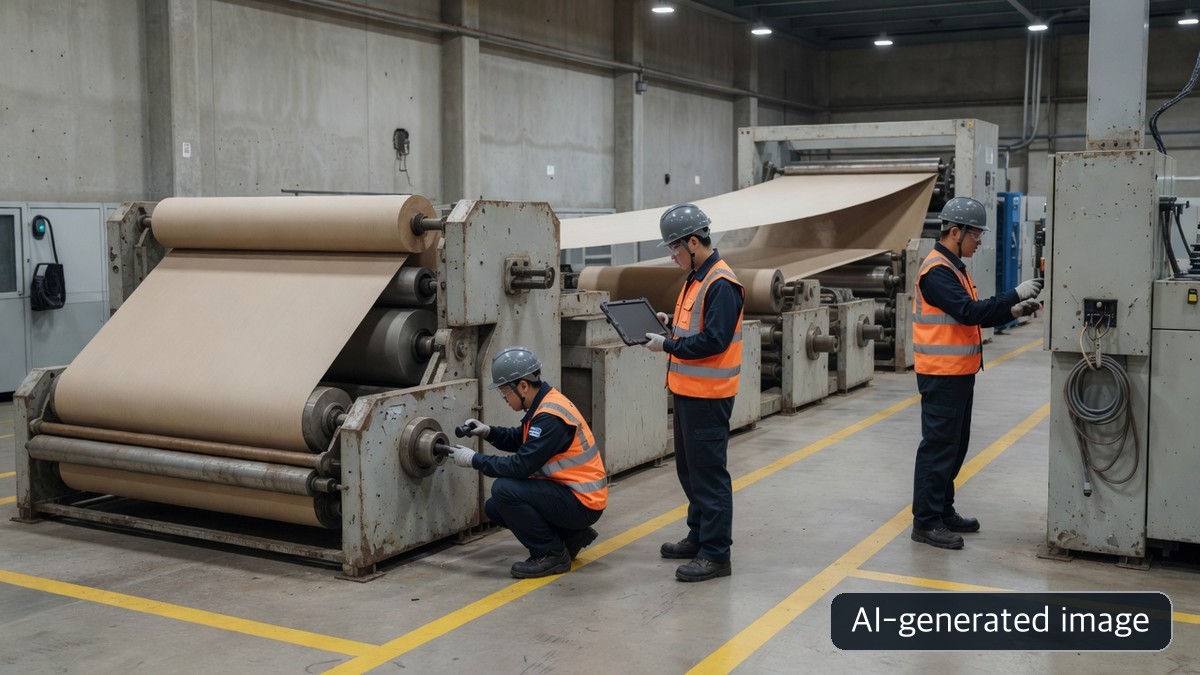
Hankook Export Packaging Industry (한국수출포장공업) disclosed that all containerboard lines at its Osan mill restarted on September 21, 2026. The disclosed production-stop period ran from February 7 through September 20, and the company identified completion of fire-response work and process maintenance as the reason for restarting.
The same disclosure contains a limit that must travel with the headline: current restarted output remains below 100% of pre-fire good-product output. “All lines restarted” should therefore not be rewritten as “pre-fire volume, quality and delivery have all been restored.”
Status checked on September 22, 2026 (KST). The disclosure confirms the restart scope and the current output limitation. The validation record below is a general editorial tool for buyers and production planners. It is not the company’s recovery plan and does not contain internal operating data from the Osan mill.
What the disclosure establishes
On mobile, swipe the table horizontally to view the hidden columns.
| Item | Public wording | Current status | Interpretation limit |
|---|---|---|---|
| Restart scope | All Osan containerboard lines | Production restarted September 21 | No line-by-line speed or utilization rate was disclosed |
| Reason | Fire response and process maintenance completed | Company disclosure wording | Does not prove that every follow-up improvement task is closed |
| Stated effect | Normal operation of containerboard production | Company disclosure wording | Not a metric showing immediate restoration of pre-fire output, yield or delivery |
| Output | Below 100% of pre-fire good-product output | Limitation expressly disclosed | Actual restart percentage and grade-level volume were not disclosed |
| Stop period | February 7–September 20, 2026 | Disclosed | Do not calculate customer backlog from the dates alone |
| Disaster loss | Final amount not yet determined | Corrective disclosure planned after confirmation | Do not manufacture a final loss estimate from current public material |
The disclosure also explains that this containerboard is consumed in corrugated sheet and box production and does not generate separate sales. A blank restart-field sales figure therefore cannot be read as “no sales effect.”
“All lines” and “100%” answer different questions
All lines restarted describes equipment scope. Below 100% of pre-fire good-product output describes a production result. A practical normalization decision needs at least four layers:
- Line availability: Can the intended line operate?
- Process stability: Are speed, stoppage and waste variation under control?
- Released output: How much grade-specific material has passed inspection and quality release?
- Shipment: Are customer allocation, dispatch and ETA connected by evidence?
Confirmation of the first layer does not automatically close the other three. Conversely, the sub-100% statement alone does not prove that a particular customer will be late or that a market-wide shortage exists.

Operating deliverable: four restart-validation gates
1. Fix line status to a name and timestamp
Do not stop at “running.” Record the line connected to the purchased item, the information cut-off time, and whether any planned or unplanned stop remains open. The public material does not identify individual lines, speeds or utilization rates, so do not fill those fields with estimates.
State: restart confirmed / conditional operation / stopped / unresolved
Close with: supplier’s written response, production date and line identifier for the relevant lot, and production-completion notice.
2. Separate gross output from released good output
The buyer needs the quantity that has passed the applicable specification and can ship, not only the gross tonnage made. Verify basis weight, moisture, strength or other applicable fields from the contract specification and item-level certificate. Do not invent acceptance limits absent those records.
State: not tested / under test / quality released / on hold
Close with: lot number, test certificate or CoA, accepted quantity, release date and hold reason.
3. Require both denominator and period for a ramp-up rate
A percentage such as 80% or 90% cannot be compared until its denominator is known. Record whether it measures calendar time, planned operating time, gross output, good output or shipments, and whether the window is a shift, day or week.
State: denominator confirmed / period confirmed / both confirmed / not comparable
Close with: supplier figure carrying its definition and measurement period. The disclosure provides no actual restart percentage; do not present an external estimate as a company metric.
4. Close on customer allocation and dispatch evidence
Production of released material is not the same event as dispatch of the buyer’s order. Under one PO row, connect item code, specification, lot, firm allocated quantity, release date, vehicle or carrier booking and ETA.
State: production complete / quality released / allocated / dispatch confirmed / received
Close with: allocation response, release or loading record, transport document, tracking event and receiving record.
Eight questions to send the supplier
- Which actual line makes each of our items and what is its current operating state?
- What denominator and measurement period are used to compare current output with the pre-fire level?
- How are gross output and quality-released good output separated?
- For every open PO, what are the production lot and inspection or release state?
- Is any held or retest quantity excluded from our allocation?
- What firm quantity is allocated to each PO and when can it be released?
- Which loading, dispatch or transport evidence already exists?
- What are the cut-off time and owner for the next output and delivery update?
Conditions that block closure
Do not close the record as restored to the pre-fire level or delivery normal while any of the following is missing:
- the restarted-line statement is not connected to the buyer’s actual item and lot;
- an output percentage has no denominator, period or good-output definition;
- no test certificate, accepted quantity or release date is available;
- released material exists but no firm customer allocation is shown;
- a dispatch promise has no loading, transport or arrival evidence; or
- the sub-100% wording is being used to claim a market-wide shortage or price increase.
The central fact is that all lines restarted while current good-output volume remained below 100% of the pre-fire level. The useful response is not to delete one side of that statement. It is to connect line–released lot–ramp-up denominator–customer allocation–shipment evidence under the same order record.
About the Author
PackingMaster: Editor of PaperPackLog. Covers market trends, product insights, and technology in the paper packaging industry.
References
- DigitalToday, disclosure table for Hankook Export Packaging Industry’s Osan containerboard restart and the sub-100% statement (September 21, 2026)
- Newsis, production restart after completion of the Osan mill fire-response work (September 21, 2026)
- Korea Exchange KIND, production-suspension disclosure (February 9, 2026)
- Korea Exchange KIND, disaster-occurrence disclosure (February 9, 2026)