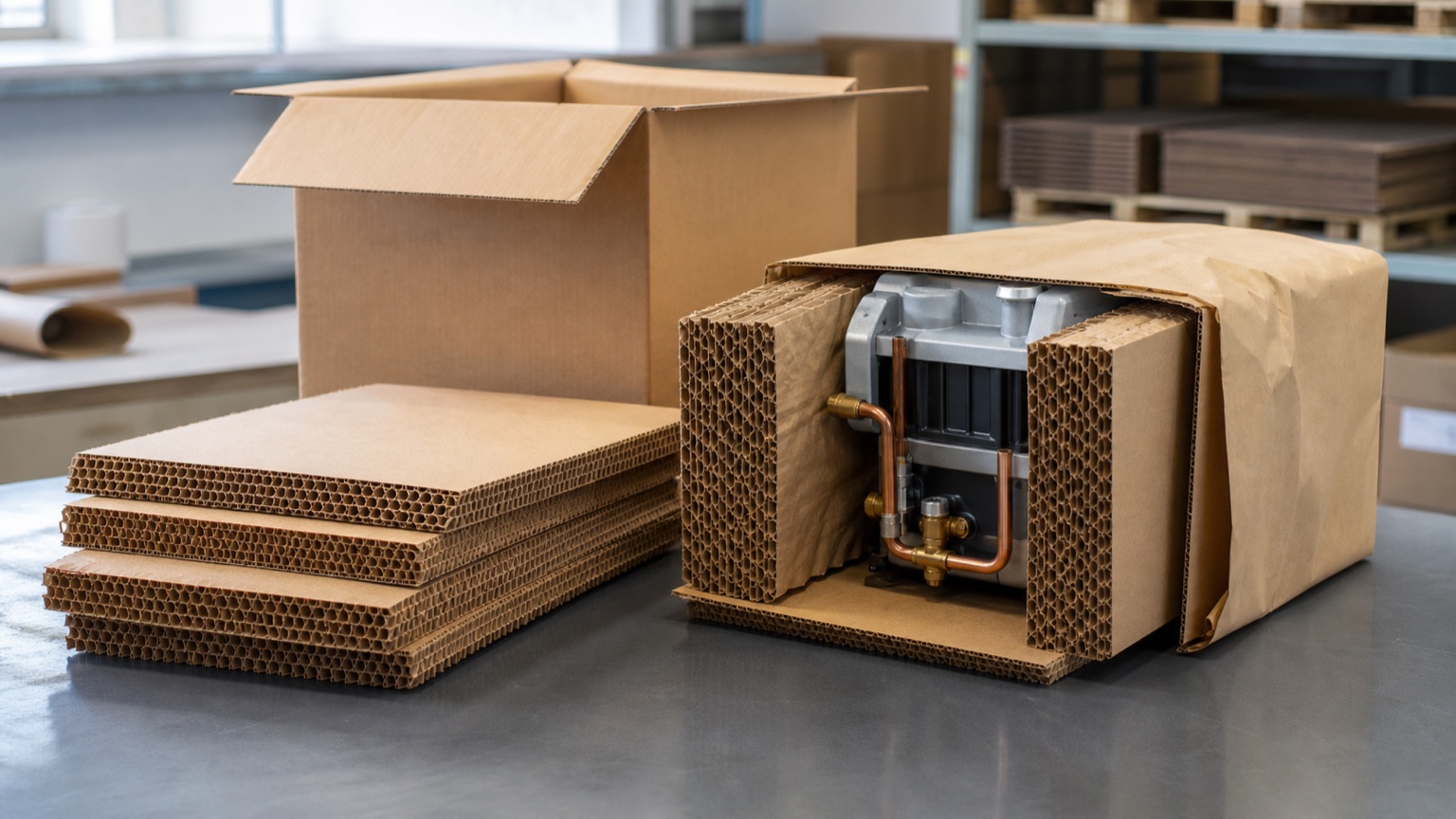
Replacing foam with paper is not a new idea. EPS and PE foams have long been the default for industrial and consumer packaging because they are light, easy to cut, and cheap. But EU PPWR, Korean EPR, and brand-side ESG pressure have pushed packaging teams to look harder at paper-based replacements. Among them, honeycomb paperboard is one of the very few paper structures that can be compared with foam on both planar cushioning and compressive strength.
It does not mean honeycomb can drop into every foam slot. At the same thickness it can be weak under point loads, and its compressive strength drops quickly under sustained humidity or condensation. This guide reviews where honeycomb paperboard is a good foam alternative in 2026, and where another paper-based solution should be chosen instead.
What is honeycomb paperboard
Honeycomb paperboard is a sandwich structure with two paper liners bonded to a hexagonal cell core. The core is typically made by slitting and expanding kraft liner into honeycomb cells, then closing the assembly with face liners. At the same weight, the panel has much higher through-thickness compressive strength than a single paperboard, and it distributes load across its full face.
Its role is different from other paper cushioning options. Molded pulp protects products through shape-matched point contact. Paper pallets and paper blocks carry stacking and forklift loads from below. Honeycomb paperboard sits in between, taking planar load and impact on the sides, top, and corners of a product.
Where honeycomb works well as a foam replacement
The conditions where honeycomb paperboard replaces foam well usually share three traits: load is spread over a surface rather than a point, impact direction is predictable, and the storage and transport environment is reasonably dry.
- White goods and display panels — corner guards and top or bottom face cushions in honeycomb can match EPS in weight while keeping the recycling stream clean.
- Automotive parts and industrial machine parts — door panels, bumpers, and transmission cases with a flat reference face suit planar honeycomb cushioning.
- Furniture and large interior components — corner and side wraps in honeycomb reduce compression damage during stacking and dispose with the corrugated stream.
- Container void fill in export cases — boards used as void fill between cartons and between cargo and container walls reduce vibration and surface impact at the same time.
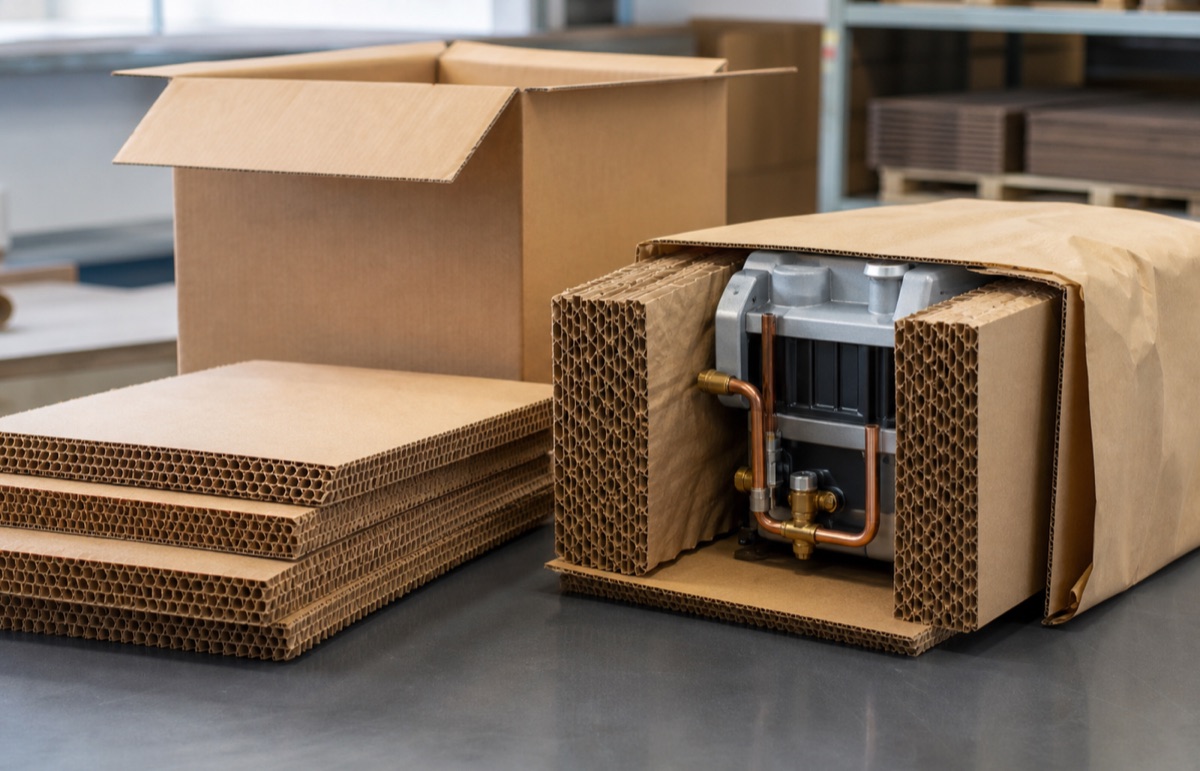
Two benefits are clear in these contexts. First, recovery and recycling become simpler at end of life. Both Korea and the EU treat the material as paper for separate collection, which makes EPR reporting and ESG disclosure cleaner. Second, the print surface is wide enough to carry handling icons, stack counts, and barcodes directly on the cushion.
Where honeycomb gets weak
Foam-to-honeycomb substitution does not always succeed. The structure has known limits.
First, point loads and corner impacts. A concentrated load over a small area can punch through the liner and buckle the cells. A 10 mm board and a 30 mm board at the same density behave very differently here. Where product corners, feet, or legs touch the cushion, the pad should be thicker, or honeycomb should be combined with molded pulp or extra corrugated reinforcement.
Second, humidity and condensation. Standard kraft-linered honeycomb can lose more than half its compressive strength when relative humidity stays above roughly 85 percent or when condensation repeats. Ocean container shipments, destinations in Southeast Asia and the Middle East, and storage near chilled rooms need moisture-resistant liners, polycoat, or edge sealing.
Third, recovery after repeated impact. EPS recovers some of its shape after deformation. A buckled honeycomb cell stays collapsed. Cargo exposed to repeated impacts in the same spot, such as long-haul trucking and multi-level stacking, needs pad placement that spreads impact rather than concentrating it.
Fourth, low volume and frequent design changes. Honeycomb is stable in mass production once cell size, thickness, and liner basis weight are fixed, but die tooling costs and converting waste add up when prototypes change often. Below about 100 prototype units with frequent drawing changes, corrugated cushioning structures or molded pulp tooling can be more efficient.
A practical checklist for comparing foam and honeycomb
When honeycomb paperboard is reviewed as a foam alternative, the quotation and specification meeting should look at more than unit price.
- Load distribution — planar or point load. If point load dominates, increase thickness or combine materials.
- Impact direction — single direction or multi-direction vibration. Multi-direction cargo needs distributed pad placement and corner guards.
- Destination environment — average humidity, condensation risk, storage duration. High humidity routes need barrier coatings, heavier liners, or edge sealing.
- Stacking pattern — tiers, weight per carton, container loading pattern. Combine ECT and BCT with residual compression of the honeycomb pad.
- Return and reuse requirements — foam recovers shape better than honeycomb. Returnable or rental packaging needs a different design.
- Print and labeling needs — honeycomb has more direct print surface.
- Volume and drawing stability — mass production with stable drawings makes die investment pay back faster.
This checklist is not just for a price comparison sheet. It is meant to reduce the damage, claims, and repacking costs that can show up when foam is replaced too quickly. EPR fee per unit, end-of-life cost, and ESG scoring also matter and rarely show up in the raw material price column.
Designing honeycomb together with other paper solutions
Trying to do all the packaging with honeycomb alone is often less efficient than splitting roles across paper-based structures.
- Base structure — paper pallets and paper blocks carry stacking load and forklift entry.
- Product contact face — molded pulp or corrugated inserts handle point contact and shape protection.
- Side and top cushioning — honeycomb paperboard absorbs planar compression and impact.
- Outer box — corrugated box with verified basis weight and ECT rating closes the system, with compression and barcode positions on the spec sheet.
This split lets one material cover the weakness of another. Replacing all foam with paper in a single step is risky. Replacing the segments with the largest environmental gain and the most stable drawings first lowers claim risk.
Items to put on the quotation and spec sheet
When honeycomb paperboard goes into a quotation, recording the following items keeps the file usable for future spec changes, claim handling, and ESG reporting.
- Cell size, thickness, liner basis weight, board basis weight
- Planar compression strength, point load test result, applied standard
- Application location (corner, top, side, insert) and per-part drawings
- Moisture coating and edge sealing, with any added unit cost
- Transport environment assumptions (average RH, storage days, stack height)
- Waste classification, EPR reporting category, recycling stream
- Die cost and lead time if drawings change
These items reveal the real cost structure rather than only the raw material price. The unit price gap with foam can be small, but EPR, disposal, claim risk, and brand value often tilt the decision toward honeycomb in specific segments.
Wrap up
Honeycomb paperboard is the closest paper structure to a planar foam replacement available today. It is a strong candidate for home appliances, automotive parts, industrial machinery, furniture, and export cases that want to reduce EPS and PE foam step by step. It also has clear limits in point load, condensation, and repeated impact, so a direct one-to-one swap is rarely safe.
The shift away from foam is likely to accelerate in 2026 as EU PPWR moves into substantive implementation and Korean EPR is rebalanced. The right question is not whether to remove all foam at once, but which segments should switch first and which structure of paper should be used per segment. Combining honeycomb paperboard with paper pallets, molded pulp, and corrugated boxes can reduce foam without giving up product protection or transport stability.
FAQ
Q: Can honeycomb paperboard replace EPS one to one?
In most cases a one-to-one swap is not recommended. Honeycomb works well in planar cushioning, but cargo with strong point loads or multi-direction vibration usually needs thicker boards or a combination with other paper structures.
Q: What should be checked when using honeycomb for ocean export?
Check average humidity, condensation risk, and shipping duration first. High-humidity routes need moisture-resistant liners, polycoat, or edge sealing, and the container loading pattern should appear on the drawing.
Q: Does switching to honeycomb make EPR reporting easier?
A larger paper share generally simplifies EPR reporting and recycling. Coatings, adhesives, and labels can change the category, so the material spec and end-of-life flow should be reviewed together.
About the author
PackingMaster — editor of PaperPackLog. Curates market trends, product information, and technical insights for the paper packaging industry.
References
- Atlantis Press, Baozhong Wang et al., “Static Compression Test and Analysis of Honeycomb Paperboard”
- BioResources (NC State), “Impact of core cell size on selected properties of honeycomb paperboard”
- Dufaylite, “Paper Honeycomb Packaging: 7 Proven 2026 Specs”
- Background: Coherent Market Insights, “Honeycomb Packaging Market Size & Opportunities, 2026-2033”