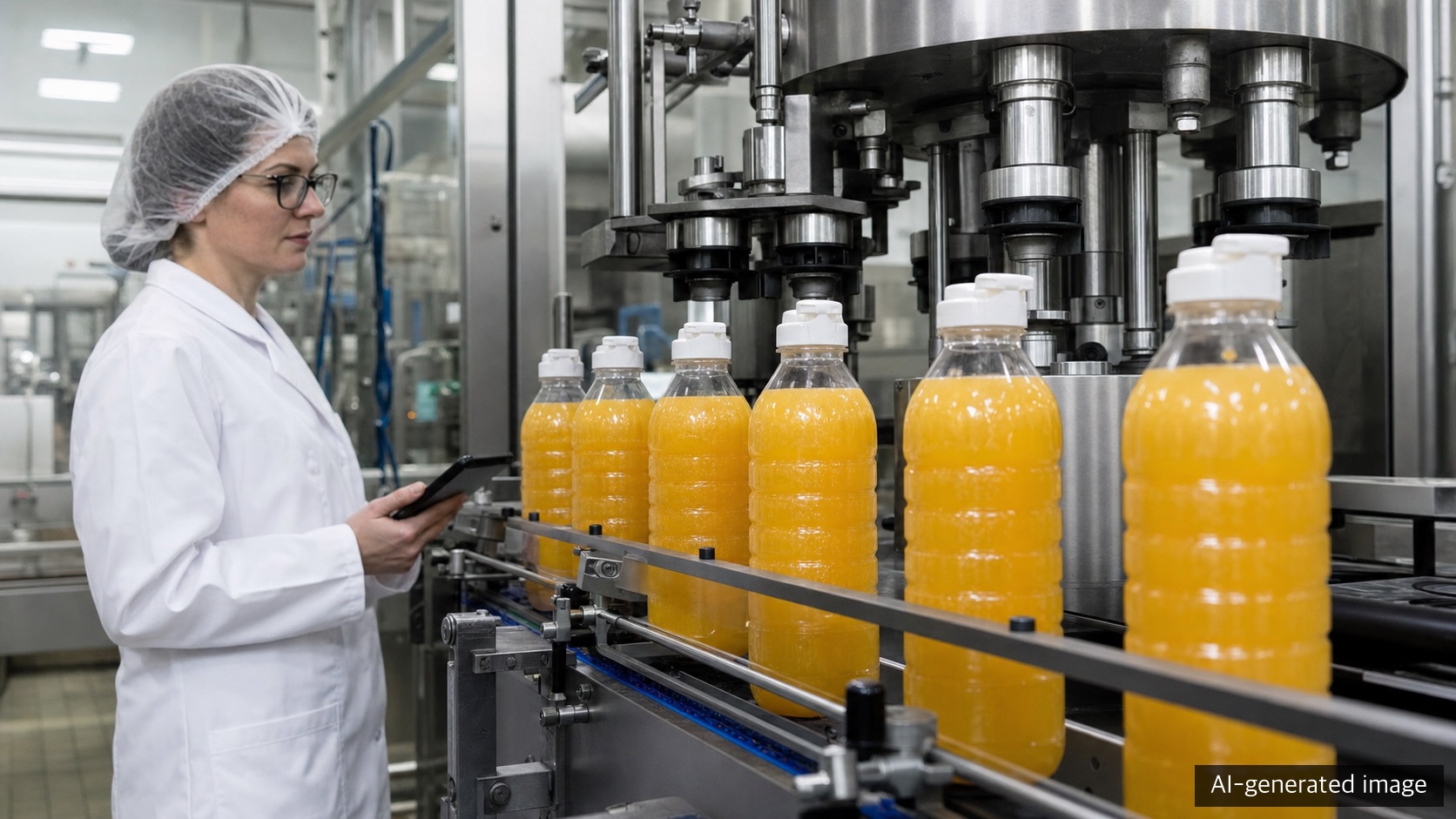
The moment a sport cap is closed on a bottle fresh off a hot-fill line, a thin wisp of steam escapes through the spout seal, and at the next inspection station the line stops on a capping-torque deviation. Quality and production engineering teams are the ones who spend the rest of the day tracing the cause. Before committing to a single cap-spec change, this piece focuses on building one supplier approval checklist you can carry straight into the approval meeting.
What Aptar’s Harmonic Announced on July 23
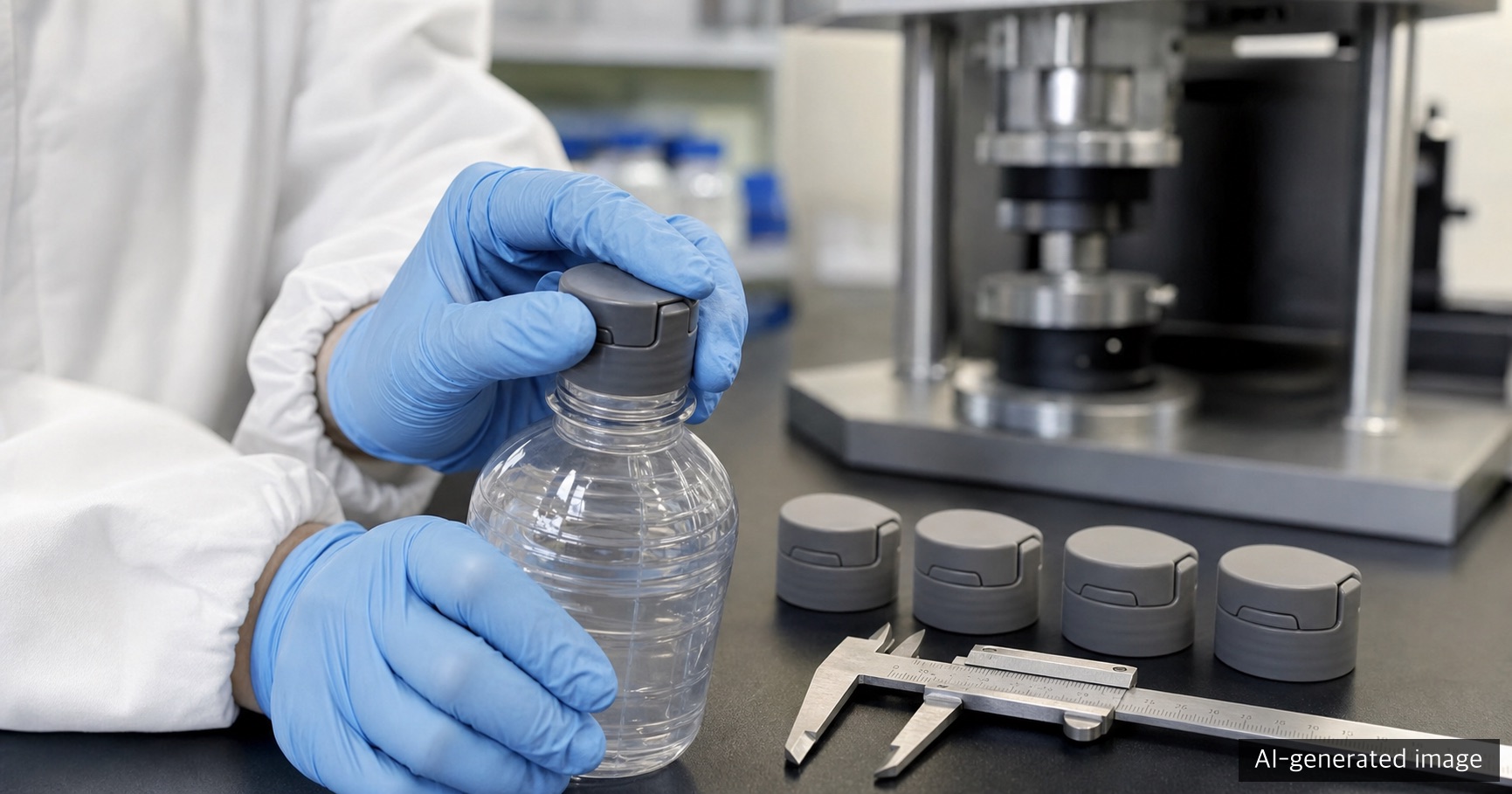
Aptar’s official product page describes Harmonic as a liner-less flip-top sport cap. Its core claim is a sealing system that achieves closure without a foil liner, and the product is positioned for hot-fill bottling applications. Aptar also highlights visual tamper evidence, easy open/close operation, and a comfortable spout. Trade outlet Packaging Europe carried Aptar Closures’ announcement in a July 23, 2026 article, describing it as a “linerless, hot-fill capable sport cap.”
The specifications stated on the official page are:
- Neck finish: 33-400
- Orifice diameter: 6.80mm
- Construction: two-piece, bi-color molding
- Regional availability: Latin America
The Packaging Europe article described this as a “33mm neck finish.” Because the two sources do not use identical notation, do not assume equivalence during approval; compare the supplier’s 33-400 drawing directly with your bottle-neck drawing.
Both sources emphasize three shared performance claims. First, tamper evidence that is visually identifiable. Second, a company explanation (as relayed by Packaging Europe) that secure re-closure helps prevent accidental opening during transport and daily use. Third, a claim of compatibility with high-speed filling lines. All three are Aptar’s own claims and should not be generalized as typical performance for linerless caps as a category.
Check Supply Region First — the “Latin America” Notation
This is where K-beverage OEMs are most likely to stumble first. The official page’s regional availability field lists only Latin America. Supply into Korea or the rest of Asia is not confirmed by this page alone. Since a single cap-spec change can ripple through capper setup, tooling, and inventory policy across an entire bottling line, review should never proceed on the impression that supply “looks available.” The correct order is to confirm supply region, local sourcing feasibility, and mold/neck compatibility first.
The Core Deliverable: A Supplier Approval Checklist for Hot-Fill Linerless Sport Caps
The table below is a judgment sheet meant to be filled in directly during the approval meeting. Actual figures for hot-fill temperature, capping torque, leak tolerance, and line speed are not in this article. Those values are deliberately left as blanks each company must fill in from supplier warranty ranges, filler/capper OEM-approved values, customer specifications, and internal test protocols.
| Input Field | Observation/Evidence | Reference Source | Status | Action (Owner · Verb · Target · Trigger) |
|---|---|---|---|---|
| Supply region / local sourcing | Official page’s regional availability field lists Latin America only | Aptar Harmonic product page | Korea/Asia supply unconfirmed | Before the contract review meeting, Procurement emails Aptar’s Korea distributor or regional sales contact to ask about available supply regions and lead time, and obtains a reply. |
| Bottle neck drawing match / 33-400 | Official spec sheet lists neck finish 33-400 and orifice 6.80mm | Aptar Harmonic product page | Not yet matched against own bottle drawing | Before ordering tooling, a Production Engineering engineer lays the company’s own bottle neck drawing side by side with the 33-400 spec drawing, checks tolerances, and records any mismatches in writing. |
| Filling conditions (hot-fill temperature, etc.) | Hot-fill bottling suitability is claimed, but no specific temperature figure appears in public materials | Official product page (qualitative claim); supplier technical data sheet (TDS) to be requested | Unconfirmed | Quality specifies the company’s measured filling-temperature range in the RFQ and obtains the supplier’s written warranty range (min/max temperature). |
| Capping torque | No torque figure in public materials | Capper OEM-approved values; internal test protocol | Unconfirmed | Production Engineering coordinates with the capper OEM to build a Harmonic-specific torque spec into the setup sheet, then measures it with a torque gauge during trial production. |
| Leak tolerance | No leak figure in public materials | Internal test protocol (leak test SOP) | Unconfirmed | Quality adds a cap-specific item to the leak-test SOP and runs pressure/vacuum leak testing on a pilot batch. |
| Re-closure | “Secure re-closure” claim (Aptar/Packaging Europe) | Packaging Europe article, 2026-07-23 | Only a qualitative claim confirmed; repeat-cycle reproducibility unconfirmed | Quality adds a repeated open/close test (e.g., confirming seal integrity after multiple open/close cycles) to the internal SOP to verify reproducibility. |
| Tamper evidence | Visual/visible tamper evidence claim | Aptar product page; Packaging Europe article | Physical sample unverified | Quality checks, under simulated retail-display lighting, whether tamper evidence is visually identifiable on first opening of a physical sample. |
| Accidental opening in transit | Aptar’s stated explanation (relayed by Packaging Europe) that it helps prevent accidental opening during transport and daily use | Packaging Europe article, 2026-07-23 | No quantitative data | Logistics measures the accidental-opening rate through a transport simulation test replicating actual distribution-route vibration and drop conditions. |
| High-speed filling line compatibility | Claim of high-speed filling line applicability; no specific rpm/BPM figure | Aptar product page | Own line’s approved value unconfirmed | Production Engineering asks its own filler/capper OEM for a line-speed approval value for the Harmonic cap and obtains a written reply. |
| Food-contact/regulatory documentation | No food-contact certification detail in official materials | Documents to be requested from supplier (e.g., food-contact compliance certificate) | Unconfirmed | Quality Assurance requests a food-contact compliance certificate and documentation benchmarked against Korean MFDS standards from the supplier before ordering. |
| Supply continuity | No MOQ, lead time, or alternate production site information in official materials | Supplier quote/contract (to be requested) | Unconfirmed | Before contracting, Procurement confirms minimum order quantity, lead time, and any alternate supply network with the supplier in writing. |
What Each Role Does After Filling In the Table
Procurement owns confirming supply region and securing supply continuity. Don’t simply pass along the “Latin America” regional-availability entry as-is — obtain written confirmation of Korea/Asia supply and lead time. Production Engineering finalizes neck-drawing matching, capping torque, and line-speed approval values together with the capper and filler OEMs. Quality manages filling-condition warranty ranges, leak testing, re-closure reproducibility, tamper evidence, and regulatory documentation in a single approval file. Logistics records transit-opening test results by distribution route, keeping them as claims-response evidence even after the cap switch goes ahead.
Conditions Under Which to Hold Off
Hold off on finalizing the cap switch if any of the following remain true:
- Supply into Korea/Asia has not been confirmed in writing by the supplier
- Your bottle’s neck drawing does not match the 33-400 spec within tolerance
- The supplier has not provided a written warranty range for filling temperature, capping torque, and leak tolerance
- Your filler/capper OEM has not documented a line-speed approval for the Harmonic cap
- A food-contact compliance certificate or domestic regulatory documentation is not in place
To Check Today
- Documents to check today: Aptar Harmonic’s official spec sheet and the reply to your supply-region inquiry email
- Field test: matching your own bottle neck drawing, plus pilot-batch capping and leak testing
- Hold criteria: hold the switch if Korea/Asia supply remains unconfirmed, or if the supplier’s written warranty range (filling temperature, torque, leak) has not been received
About the Author
PackingMaster: Editor of Paper Pack Log. We collect and organize market trends, product information, and technical insights for the paper packaging industry.