IKEA UK’s October 20 announcement says it has launched PackSize technology at its Peterborough customer distribution centre to make cartons to fit orders. The company says that avoiding oversized cartons and filling paper reduces material use by up to 30% and void fill by up to 60%. Its public release does not disclose the baseline carton mix, observation period, order sample or measurement protocol. Those qualified percentages should not be republished as independently verified savings on every shipment.
Total spending, site budget and machine price are different
IKEA’s £31.5 million is the investment across two UK distribution centres: Peterborough and Doncaster. The £30 million Peterborough allocation covers technology upgrades over a two-year period. It is not a published purchase price for a single PackSize machine or the box-making line alone. The other £1.5 million relates to a separate trial of regional fulfilment from Doncaster.
IKEA reports that about 47% of parcels at Peterborough are processed through automation today and expects this to reach 75% in 2027. The latter is a future target, not a throughput already measured. IKEA says orders previously packed by manually measuring an item and making a carton can now be handled with the new technology. Its release does not give a machine’s hourly output, a distribution of carton fit by order, downtime or carton-reject rate.
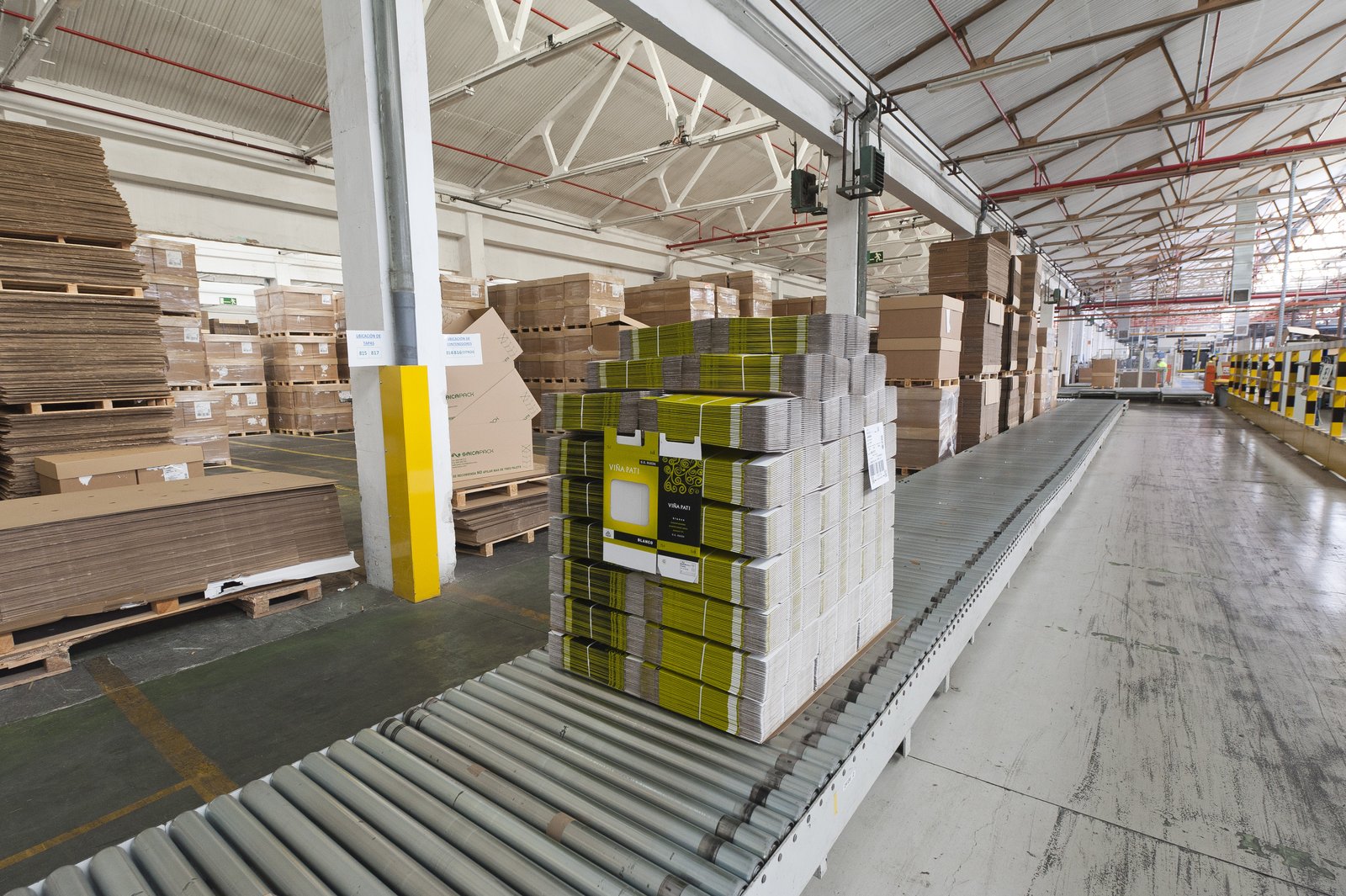 Photo: SimónK / Wikimedia Commons / CC BY-SA 4.0. An unrelated box-stacking example, not evidence of an IKEA or PackSize installation. Resized and converted to JPEG.

What buyers would need before treating a percentage as a specification
- Comparison group: For like-for-like orders, record carton area and weight, filling-paper mass and unfilled volume for fixed-size and right-sized packs. “Up to” is not the mean saving across all shipments.
- Operational throughput: Measure acceptable packed orders per hour alongside dimensioning errors, carton failures, manual rework and equipment stoppages in the same period.
- Pack protection: Compare compression, closure quality, in-transit damage and returns for the same order types. A smaller carton does not automatically maintain every protection requirement.
- Economic scope: Because equipment-only cost is undisclosed, the £30m two-year site budget cannot be treated as the cost of one carton-making machine when calculating a per-box saving. Compare board consumption, operating cost and transport separately.
These are editorial due-diligence questions, not a site test protocol that IKEA has released. A supplier’s generic product demonstration would not establish Peterborough’s actual order sample either.
 Photo: Creativity103 / Wikimedia Commons / CC BY 2.0. A generic shipping-box example, not IKEA equipment or cartons; resized and converted to JPEG.

Doncaster’s route savings are a separate claim
IKEA expects Doncaster to shorten journeys for orders serving northern Britain and Scotland, estimating about 280 tonnes of CO₂ avoided annually. That is a forecast for changed delivery routes, not a measured carbon saving from Peterborough’s right-sized cartons. The 80 additional jobs mentioned in the release also belong to the Doncaster operation. The investment, machine launch, qualified material claim and forecast transport effect should be assessed separately.
About the Author
PackingMaster: Editor of Paper Pack Log. We collect and organize market trends, product information, and technical insights for the paper packaging industry.
References
- IKEA UK, “IKEA invests £31.5 million to make UK fulfilment more efficient and reduce packaging waste”, October 20, 2026 — first-party source for investment scope, launch, company savings claims and Doncaster forecast.
- Packaging News UK, “IKEA invests £30m to automate fulfilment and cut material and void fill”, October 22, 2026 — trade coverage largely following the announcement, not independent measurement.
- Original Commons image links and licences are in the photo captions. None depicts IKEA or PackSize operations.