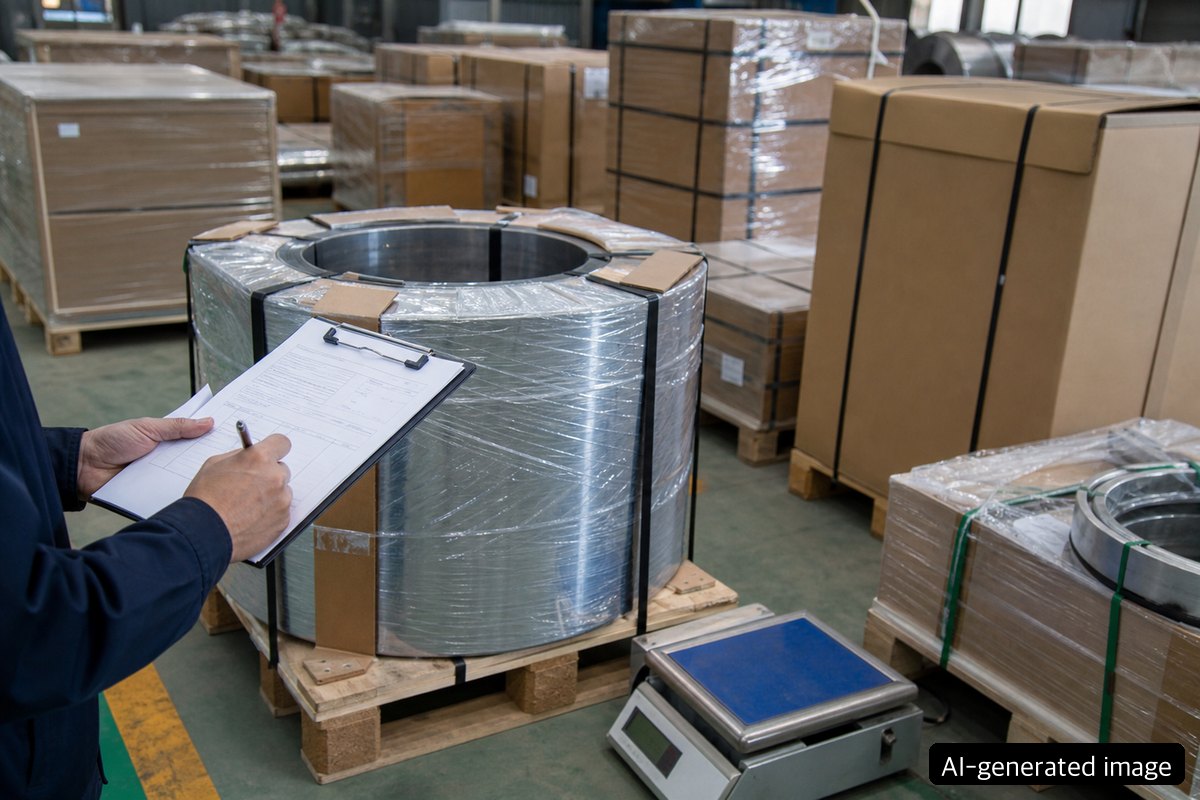
The EU Packaging and Packaging Waste Regulation (PPWR) is not only a food, cosmetics, or consumer-goods packaging issue. Exporters of steel, machinery, automotive parts, electronics, and other industrial goods may also be asked to explain the material composition, weight, recyclability, labeling, and supplier records of the packaging used around their products.
A recent Korean news report on a PPWR briefing for the steel industry is a useful signal. Packaging regulation is moving beyond a narrow compliance topic and becoming a data-management issue across sales, purchasing, quality, and logistics teams.
This article narrows the discussion from “what PPWR is” to a practical question: what packaging data should an industrial exporter request from packaging suppliers before a customer asks for it?
Why industrial packaging is harder
Industrial packaging has more variables than ordinary retail packaging. Product weight, corrosion protection, edge protection, long-distance transport, container loading, and customer-specific delivery conditions all matter. The same product may use different packaging for domestic delivery and EU export, and each customer may request different pallets, dunnage, edge protectors, strapping, labels, and documentation.
Typical industrial export packaging can be divided as follows.
| Area | Examples | Data to request |
|---|---|---|
| Product protection | Paper angle boards, flat boards, cushioning, anti-corrosion packaging | Material, weight, separability |
| Transport packaging | Corrugated boxes, wood-alternative pallets, support blocks | Dimensions, load capacity, recyclability |
| Fixing materials | Strapping, wrap, tape, stretch film | Material, mono-material status, quantity used |
| Marking materials | Labels, printing, stickers | Ink, adhesive, display information |
| Supporting documents | Packaging specification, measurement records, supplier confirmation | Date, person in charge, revision history |
The problem is that this information is rarely stored in one place. Purchasing knows suppliers and costs. Logistics knows loading conditions. Quality knows customer requirements. Sales receives buyer requests. PPWR preparation starts by turning these scattered records into one packaging data sheet.
Six data points to request first
It is difficult to ask a packaging supplier for a complete regulatory dossier at the first step. A better starting point is to ask for basic data that can be collected and improved over time.
Packaging item name and applied product
Connect each packaging item to the product, customer, and shipping method where it is used. Generic terms such as “outer box” are not enough when a customer asks about a specific export product.Material composition
Record paper, corrugated board, plastic, metal, wood, adhesive, coating, and labels as separately as possible. If a supplier cannot disclose detailed formulas, ask for practical material classification and confirmation instead.Unit weight and dimensions
Packaging weight affects reporting, reduction plans, and recyclability assessment. Request width, length, height, thickness, unit weight, quantity used per set, and measurement date.

Recyclability or separability
A simple statement that a material is “recyclable” is not enough. Ask whether the packaging is mono-material, whether paper and plastic parts can be separated, and whether coatings or adhesives may interfere with recycling.Substances, printing, and adhesive records
Not every industrial package needs a test report immediately, but materials such as ink, adhesive, anti-corrosion agents, and coatings should be checked. If no record is available, record it as “not held” so the next action is clear.Supplier and revision history
If a packaging supplier, paper grade, or specification changes, previous data may no longer be valid. Manage supplier name, manufacturing site, effective date, specification changes, and contact person together.
Keep the request short and specific
A vague request such as “please send PPWR documents” can slow down the response. The supplier may feel that it must interpret the regulation before answering. The first request should focus on basic packaging data, not legal interpretation.
A practical request can look like this.
Hello. We are organizing basic data on packaging materials used for EU export customer requests.
Target packaging: product name / packaging item / supplied specification / customer or export region
Requested items: material composition, unit weight, dimensions, quantity used per set, recyclability or separability, printing/adhesive/coating use, supplier information, and specification revision history.
If some records are not currently available, please mark them as “not held.” We would appreciate any available specification sheets, confirmations, or measurement records.
The goal is not to pressure the supplier. The goal is to identify the blanks quickly. Once the blanks are visible, the company can decide whether to request testing, consider alternative materials, consult the customer, or assign an internal owner.
Build the internal sheet by packaging structure
Industrial packaging data should not be managed as one row per product. One exported product may include an outer box, support blocks, edge protection, strapping, labels, and cushioning. It is usually easier to manage the sheet by packaging structure.
| Product/customer | Packaging stage | Packaging item | Material | Weight | Supplier | Record status |
|---|---|---|---|---|---|---|
| Product A / EU customer | Outer packaging | Corrugated box | Corrugated board | 1,200 g | Supplier A | Specification held |
| Product A / EU customer | Edge protection | Paper angle board | Paper | 180 g | Supplier B | Remeasurement needed |
| Product A / EU customer | Fixing | Strapping | Plastic | 60 g | Supplier C | Material check ongoing |
| Product A / EU customer | Marking | Label | Paper + adhesive | 8 g | Supplier D | Adhesive record not held |
This structure helps when a customer asks for total packaging weight, and it also helps when the customer asks which components could affect recyclability.

What the steel-industry briefing signals
The steel-industry PPWR briefing matters because it shows that industrial exporters should treat packaging data as part of customer-request readiness. Steel, machinery, and component manufacturers often focus on product specifications and certifications, but EU buyers may also ask about the packaging surrounding the product.
Three changes are especially important.
- Sales requests are changing: buyers may ask not only about price and lead time but also about packaging material, weight, and recyclability.
- Purchasing criteria are changing: packaging suppliers may be evaluated not only by price but also by data availability, revision control, and recyclability explanation.
- Quality documentation is expanding: companies may need packaging specifications, supplier confirmations, and measurement records in addition to product test reports.
Conclusion
The first step in PPWR preparation is not a long legal report. It is a practical inventory of packaging materials and the data behind them. Industrial exporters must maintain product protection and logistics stability while also being able to explain packaging material, weight, dimensions, recyclability, and supplier records.
The steel-industry briefing sends a clear message to industrial packaging teams. In EU exports, packaging is no longer a back-office logistics consumable. It is a managed data item that can appear in a customer request. The right first move is to send a focused packaging data request, identify the blanks, and improve the record step by step.
About the Author
PackingMaster: Editor of PaperPackLog. We track market trends, product information, and technical insights in the paper packaging industry.
References
- EUR-Lex, Regulation (EU) 2025/40 on packaging and packaging waste, https://eur-lex.europa.eu/eli/reg/2025/40/oj/eng
- European Commission, Packaging waste, https://environment.ec.europa.eu/topics/waste-and-recycling/packaging-waste_en