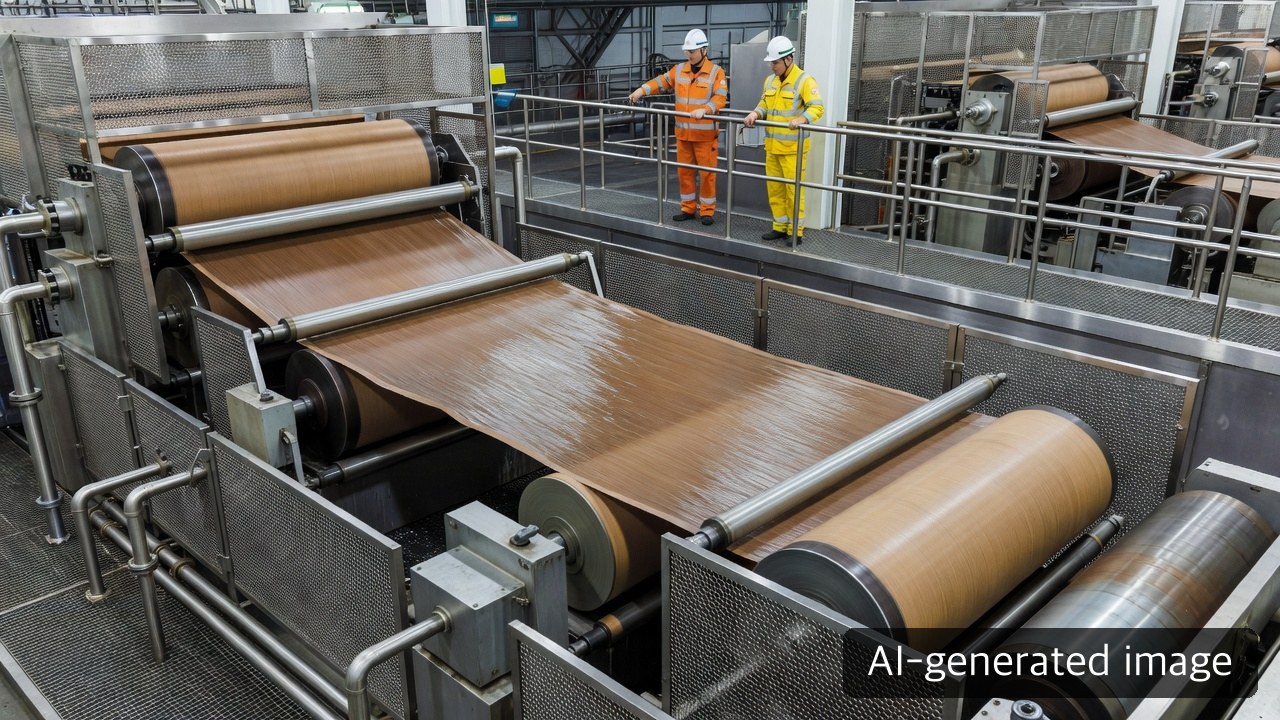
If the press does not remove enough water, the predryer must evaporate more moisture and the steam-saving target can collapse under quality loss and web breaks. On August 26, 2026, Valmet announced an order to rebuild the press and predryer sections of Jeonju Paper’s PM5. Rather than convert supplier expectations into achieved performance, this article turns the project into a copy-ready press-to-predryer site acceptance test (SAT) sheet.
Directly Confirmed Project Scope
The Valmet release supports the following separation between disclosed scope and open verification points.
Target
- Confirmed by the release: PM5 at Jeonju Paper in South Korea.
- Undisclosed or to verify: detailed grades and basis-weight range to be run on PM5.
Rebuild scope
- Confirmed by the release: press section and predryer section.
- Undisclosed or to verify: detailed roll, felt, vacuum, steam and interface design.
Press objective
- Confirmed by the release: lower steam consumption and support energy savings.
- Undisclosed or to verify: baseline, guaranteed saving and guarantee-test conditions.
Predryer objective
- Confirmed by the release: runnability-system upgrade supporting machine efficiency and energy savings.
- Undisclosed or to verify: targets and measurement boundaries for breaks, draw and moisture variation.
Supporting scope
- Confirmed by the release: spare-parts package included.
- Undisclosed or to verify: items, quantities, recommended stock and service response.
Schedule
- Confirmed by the release: start-up scheduled for fall 2027.
- Undisclosed or to verify: shutdown window, commissioning duration, stable production and final acceptance.
Commercial disclosure
- Confirmed by the release: included in Valmet’s second-quarter 2026 orders; value undisclosed.
- Undisclosed or to verify: capital cost, payback and achieved operating-cost saving.
The release says the press rebuild will lower steam consumption and result in significant energy savings, while the predryer runnability upgrade will improve overall efficiency and also support savings. These are the design objectives and expectations reported by Valmet and its customer, not an achieved percentage measured after start-up.
Press-Exit Solids Set the Dryer’s Starting Load
The dependency to verify in the SAT is press-exit solids versus dryer load. Rolls and press fabrics remove water at the press nips, while the dryer uses steam-heated rolls to evaporate the water that remains. Better press dewatering can therefore reduce the evaporation load presented to the dryer.
That relationship sets a test direction; it does not calculate the saving for PM5. Higher press-exit solids can still produce a worse accepted-tonne result if formation, caliper, bulk, strength, surface, moisture profile or runnability deteriorates. The SAT must therefore keep accepted tonnes, quality, breaks and speed inside the same test boundary as steam.
Lock the SAT Measurement Boundary First
A fair before-and-after comparison aligns grade, basis weight, furnish, speed, accepted-product definition and instrument boundary. If identical conditions cannot be recreated, document the differences and pre-approve the correction method.
- Press boundary: press-inlet and press-exit solids, cross-direction moisture profile, nip load, vacuum, felt condition and cleaning
- Predryer boundary: steam flow and pressure, condensate recovery, hood and pocket ventilation, draw, flutter and breaks
- Production boundary: accepted tonnes rather than gross input, including grade change, downtime, defects and broke handling
- Quality boundary: grade-specific basis weight, moisture, caliper, strength, surface and customer or internal approval
- Data boundary: common time axis, instrument calibration, handling of gaps/manual values and abnormal-operation exclusions
Copy-Ready Press-to-Predryer SAT Sheet
Baseline equivalence
- Inputs: grade, basis weight, furnish, speed, accepted-tonne definition and ambient conditions.
- Observe: before/after condition differences and correction history.
- Evidence: pre-approved comparison-condition record.
- Hold/action: if the difference cannot be explained, hold the energy verdict; process and quality owners select a valid test pair.
Press dewatering
- Inputs: nip load, vacuum, felt tension, contamination and cleaning.
- Observe: inlet/exit solids, cross-direction moisture, rewetting, vacuum and drive power.
- Evidence: improved dewatering while all grade-quality boundaries remain satisfied.
- Hold/action: stop optimization after a moisture-profile, surface or strength excursion; the paper-machine owner separates nip, felt and vacuum causes.
Steam and condensate
- Inputs: header pressure, valve state, cylinders, siphons and condensate recovery.
- Observe: steam flow divided by accepted tonnes, condensate recovery and heat balance.
- Evidence: result against the baseline using the same test boundary.
- Hold/action: hold the saving claim if the flowmeter is uncalibrated or condensate behavior is abnormal; utilities owner checks measurement and leakage.
Runnability
- Inputs: draw, tension, hood/pocket ventilation and speed.
- Observe: breaks, flutter, wrinkles, bagging, downtime and stable speed.
- Evidence: pre-approved operating envelope by grade and speed.
- Hold/action: if breaks or downtime increase despite lower steam, hold acceptance; production owner isolates the source zone.
Quality and accepted production
- Inputs: basis weight, moisture, caliper, strength, surface and roll quality.
- Observe: accepted yield, broke and customer/internal test results.
- Evidence: approved specification and test method.
- Hold/action: do not pass on energy alone if accepted yield or a critical property falls outside the boundary; quality owner defines the retest.
Automation and interlocks
- Inputs: sensors, loops, alarms, manual fallback and backup.
- Observe: loop performance, sensor failures, interlock scenarios and history retention.
- Evidence: FAT/SAT results for normal and fault scenarios.
- Hold/action: hold operating acceptance if safety/quality interlocks or manual fallback remain unverified; automation owner repeats the test.
Spares and maintenance
- Inputs: roll, felt, seal, instrumentation and drive spares and service coverage.
- Observe: recommended stock, replacement time, lead time and escalation path.
- Evidence: agreed spares list and maintenance procedure.
- Hold/action: hold final acceptance if critical spares or responsibility boundaries are missing; maintenance and procurement owners lock the service level and stock.
Report Energy Savings in Three Layers
- Process layer: change in press-exit solids and steam consumption
- Operating layer: change in breaks, downtime, speed, draws and moisture profile
- Business layer: actual steam and electricity per accepted tonne, with broke and maintenance cost
A lower steam-flow reading alone can conceal reduced output or quality loss. Conversely, early ramp-up instability should not automatically be treated as final rebuild failure. The contract should connect the baseline, stabilization period, abnormal-operation exclusions and final acceptance date.
Questions to Resolve Before the 2027 Start-Up
- Which PM5 grades and basis weights define the guarantee test?
- Where, how and on what time axis will before/after press solids be compared?
- Which steam-flow boundary will be used, and how will condensate, hood and ventilation effects be separated?
- Which devices, controls and interlocks are included in the runnability-system upgrade?
- Which quality, accepted-yield and break boundaries must be preserved with the energy result?
- What is included in the spares package, and where is the responsibility boundary with existing equipment?
- How are commissioning start, stable production, guarantee testing and final acceptance separately defined?
Public information confirms the PM5 press/predryer rebuild, spares and a planned fall 2027 start-up. It does not disclose the investment value or a quantitative saving. The correct current conclusion is therefore not “savings achieved,” but a project that must verify press dewatering → predryer steam → runnability → quality and accepted tonnes inside one SAT boundary.
About the Author
PackingMaster: Editor of Paper Pack Log. We collect and organize market trends, product information, and technical insights for the paper packaging industry.