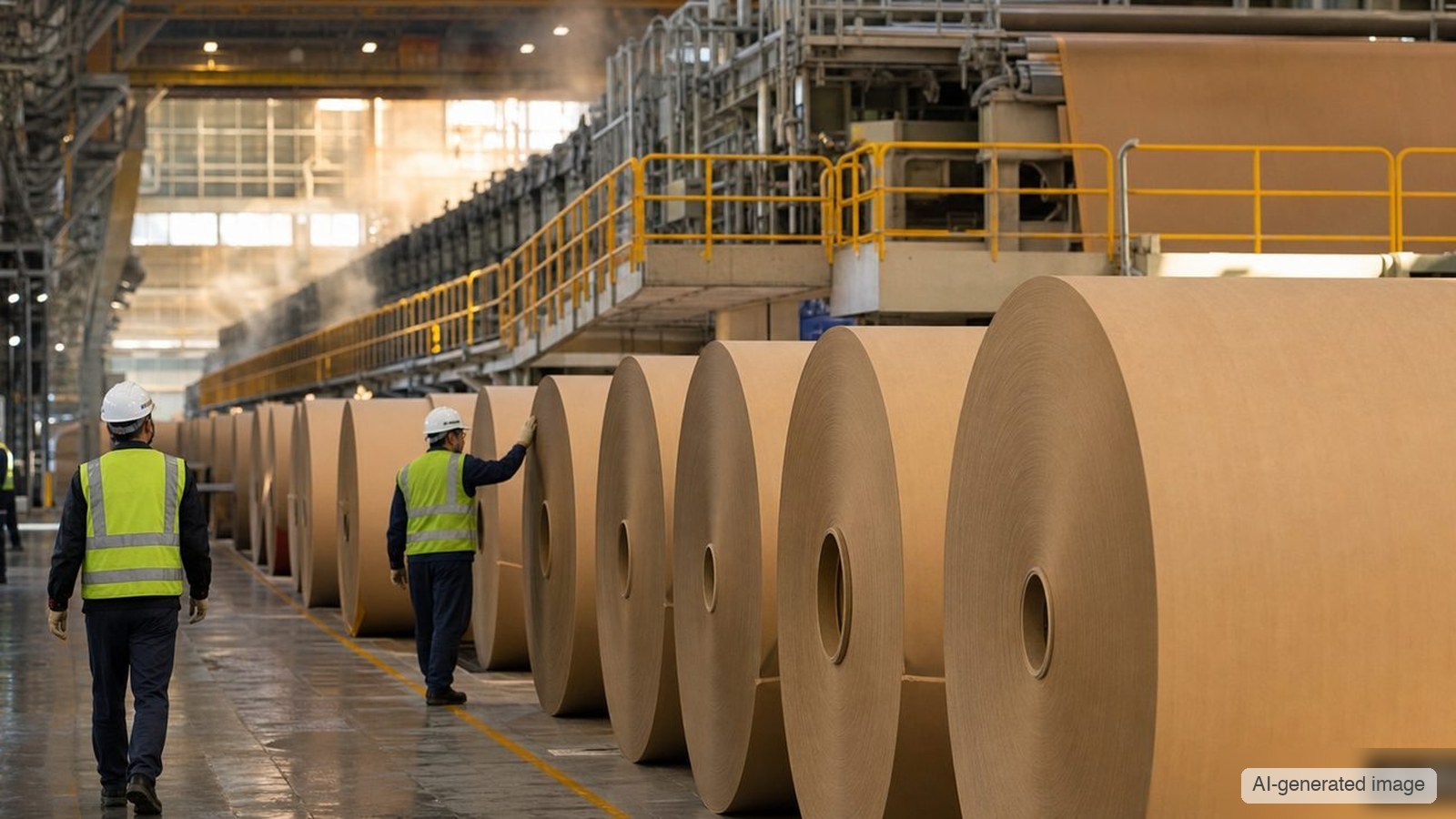
This is the follow-up to our April 26 report on Korea’s corrugated containerboard supply crisis triggered by a fatal accident at Aseahi Paper’s Sejong plant (March 25) and a fire at Korea Export Packaging’s Osan facility (February 7). As of the first week of May 2026 — approximately 40 days after the crisis began — here is where the market stands.
1. Two Plants, Two Recovery Timelines
Aseahi Paper Sejong — Conditional Restart on April 20
Aseahi Paper disclosed on April 20 that it had received conditional approval to resume operations at its Sejong plant from the Daejeon Regional Office of Employment and Labor — 26 days after the fatal accident on March 25. One paper machine restarted on April 20; the machine involved in the accident restarted during the night shift on April 21.
The Sejong plant represents approximately 37.48% of Aseahi Paper’s total revenue (approximately KRW 320.5 billion out of KRW 855.1 billion in FY2025). The company stated it expects “production to normalize quickly” and that “supply disruptions will be resolved.” (Source: Aseahi Paper disclosure / Korea Economic Daily, April 20, 2026)
However, field conditions tell a different story. On April 23, the Maeil Nodong News reported exclusive testimony from plant workers:
“We kept working the same way as before — feeding waste paper directly into the pulper. Only the intensity increased.”
According to the report, the four conditions set by labor authorities (submission of standard operating procedures with worker input, work plans, 80%+ completion of self-diagnosed hazard improvements, and a special safety training plan) were not meaningfully implemented in the field. Workers also reported being pressured to sign consent forms for special overtime work authorization to accelerate production recovery. (Source: Maeil Nodong News, April 23, 2026)
Criminal investigation remains ongoing. The bereaved family and the union filed complaints against management under the Serious Accidents Punishment Act, with police and labor authorities investigating liability.
Actual utilization rate as of May 2026: No official disclosure. Industry estimates suggest 60–80% of pre-accident capacity — requires verification.
Korea Export Packaging Osan — No Recovery Timeline Published
Korea Export Packaging (KRX: 002200) has kept its Osan plant offline since the February 7 fire. In its February 9 DART filing, the company stated the plant is covered by property comprehensive insurance, with loss amounts to be determined through the insurer’s damage assessment process.
The Osan plant accounts for approximately 5% of domestic corrugated medium supply, or roughly 250,000 tonnes per year. Industry observers initially expected recovery to take “several months,” but as of May 2026, no official recovery timeline has been published.
The company’s financial position adds further strain. Korea Export Packaging reported an operating loss of KRW 6.57 billion and a net loss of KRW 3.88 billion in FY2025, reversing to a deficit. Revenue fell 4% year-over-year to KRW 289.6 billion. The fire and production halt add additional burden to FY2026 results. (Source: Newstomato / DART filing, 2026)
Osan plant recovery status as of May 2026: Official completion timeline not disclosed — requires verification.
2. Containerboard Prices in May 2026
As reported in our previous post, domestic containerboard prices rose 12–18% from December 2025 through April 2026. Korea Paper Manufacturers’ Association data showed January 2026 inventory at 152,760 tonnes — down 40% year-over-year vs. the historical average of approximately 240,000 tonnes.
Aseahi Paper’s Sejong restart is a positive signal, but full production recovery from a month-long shutdown at a 620,000-tonne/year facility typically requires 6–8 weeks to rebuild inventory buffers.
KLB/CCC spot prices, first week of May 2026: Official public data not yet available. Based on industry contacts, prices are expected to stabilize modestly from April highs, but meaningful downward movement is limited as long as the Osan plant remains offline and the Sejong restart is not fully confirmed at capacity. (Formal data: Fastmarkets RISI / Korea Paper Manufacturers’ Association — requires verification)
3. Box Manufacturer vs. Buyer Price Negotiations
The Korea Corrugated Packaging Industry Cooperative formally requested “win-win cooperation” from box-buying companies on April 1, citing the dual burden of raw material price increases and supply instability.
Structural barriers remain steep. Most of Korea’s approximately 2,000 corrugated box manufacturers are small and mid-sized enterprises with long-term contracts to large retailers, food companies, and parcel carriers. These contracts make it structurally difficult to pass through cost increases immediately. Parcel and food companies absorb more than 50% of total corrugated production, giving buyers substantial pricing power. (Source: Newstomato, 2026)
As of May 2026: No aggregate data on negotiation outcomes (concluded / failed) has been published. Individual contract negotiations are ongoing. Some price adjustments with parcel/food sector clients are reportedly in progress — specific figures require verification.
4. Downstream Supply Shock Risks: Scheduled Maintenance Season
Korea’s major containerboard producers typically conduct annual planned maintenance concentrated in May–June. With the market already under supply stress, overlapping maintenance shutdowns could delay inventory recovery further.
- ATA: Maintenance schedule not publicly disclosed — requires verification
- Hankuk Paper: Maintenance schedule not publicly disclosed — requires verification
- Hansol Paper: Following fire (September 2025) and fatal accident (July 2025) at its Sintanjin plant, the company has been under heightened safety scrutiny. Additional planned maintenance or inspections in H1 2026 are possible — requires verification
Industry sources suggest that in a tight supply environment, major producers face pressure to avoid postponing planned maintenance given regulatory and safety risks, meaning a May–June overlap with the current recovery timeline is a realistic scenario.
5. Industry Responses: Import Substitution, Recycled Fiber, and Hedging
Amid prolonged supply tightness, some box manufacturers have adopted diversified coping strategies:
Import substitution: Procurement of Chinese-manufactured KLB/CCC containerboard has increased among some buyers. However, full substitution is constrained by freight rate volatility and Korean standard specification requirements (grammage/burst/compression strength).
Recycled fiber ratio adjustment: Some producers are experimenting with higher OCC (old corrugated container) input ratios to reduce costs. Effectiveness is limited by strength degradation concerns and uncertainty in OCC supply.
Inventory build and hedging: Some large buyers (food/retail sector) are building short-term buffer inventories to maintain bargaining leverage in upcoming contract negotiations. This strategy is generally not available to small box manufacturers given cash flow constraints.
6. Recovery Scenarios
| Scenario | Key Assumptions | Inventory Normalization Estimate |
|---|---|---|
| Fast recovery | Sejong at full capacity by June; Osan restart by September; no additional maintenance overlap | Q3 2026 |
| Base case | Sejong gradual ramp; Osan delayed; 1–2 major maintenance events in May–June | Q4 2026 |
| Prolonged | Additional work-stop order from ongoing investigation; Osan recovery exceeds 12 months; multiple maintenance overlaps | H1 2027 |
Disclaimer: These scenarios are analytical estimates based on publicly available information as of May 2026, not official forecasts from any industry body.
Conclusion
The Sejong plant restart is the most significant positive development since the crisis began. But field reports indicate safety conditions have not materially improved, criminal investigation is ongoing, and the Osan recovery timeline remains opaque. With seasonal demand acceleration expected from May through July (parcel volume increases), the market faces a fragile recovery window. Box manufacturers should revisit raw material procurement diversification and contract renegotiation timing before the summer peak.
FAQ
Q1. Has the Aseahi Paper Sejong plant fully normalized?
Not yet. Conditional restart approval was granted on April 20, and the company expects rapid normalization. However, workers reported on April 23 that safety procedures were not being followed in practice. With a criminal investigation still underway, the risk of an additional work-stop order cannot be ruled out.
Q2. Will box prices continue rising through May 2026?
Containerboard cost pressure continues. However, structural buyer-side pricing power means box manufacturers face difficulty converting input cost increases into immediate sales price increases. Market stabilization is tied to inventory recovery — estimated in Q3–Q4 2026 in the base case.
Q3. When will the Osan plant recover?
No official timeline as of May 2026. Initial estimates of “several months” suggest H2 2026 as the working assumption, though financial pressure from the company’s FY2025 deficit and the insurance settlement process may affect timing.
Q4. Can imported containerboard offset the supply shortfall?
Partially. Chinese-origin KLB/CCC is the primary alternative, but lead times of 3–6 weeks and Korean standard specification compliance requirements limit the substitution rate. Fundamental recovery requires domestic plant restarts.
Q5. What are the key milestones to monitor?
① Aseahi Paper criminal investigation outcome (indictment decision under Serious Accidents Punishment Act); ② Korea Export Packaging Osan official recovery disclosure; ③ Korea Paper Manufacturers’ Association Q2 2026 inventory statistics (expected July). We recommend end of June 2026 (D+90) as the next structured review point.
References
- 아세아제지 ‘작업중지’ 세종공장, 한 달 만에 생산 재개 : 네이트 뉴스
- 중동 리스크에 화재·사고까지…골판지 공급망 ‘이중 충격’ < 경제일반 < ECONOMICS < 기사본문 - 더퍼블릭
About the Author
PackingMaster is the editor of Paper Pack Log, curating market trends, product information, and technical insights for the paper packaging industry.