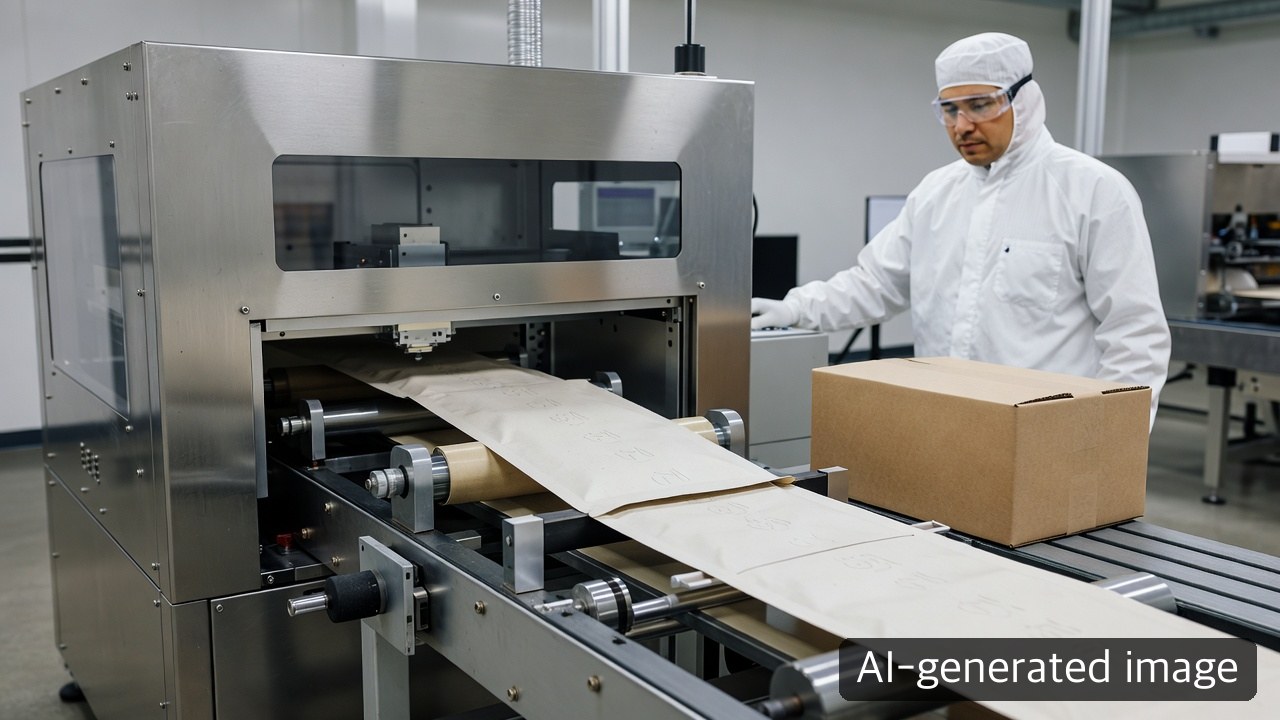
Removing printing plates may accelerate artwork changes, but a multi-SKU conversion still stops if the mark fades after filling and sealing or rubs off in distribution. Flexible-packaging development, quality and production teams must decide whether film structure, sealing, mark durability, line speed and recyclability evidence pass as one controlled package, not merely whether a laser can create an image. This article provides a ready-to-use structure and process compatibility validation tool for bag-in-box (BIB) and eCommerce packaging.
Separate the Public Concept from the Undisclosed Specification
A packaging concept announced on August 5, 2026, combines a corrugated outer pack with a recyclable-oriented, laser-marked flexible format. According to the public materials, artwork is applied directly to the flexible packaging during converting, with the intention of eliminating conventional decorative printing and associated printing plates. The concept targets eCommerce and BIB applications and is described as adaptable from reels to premade pouches and larger bags.
The announcement is not a commercial line approval. The supplier said it was working with customers and partners to explore broader commercial implementation for pet food, home and personal care, and eCommerce formats. Public facts and undisclosed specifications should therefore be separated as follows.
| Item | Publicly Described Scope | Critical Specification Not Disclosed | Operating Assessment |
|---|---|---|---|
| Pack architecture | Corrugated outer pack plus laser-marked flexible pack | Inner-pack layer structure, gauge, tie layers and barrier architecture | Hold specification approval until structure drawing and BOM arrive |
| Marking method | Artwork marked during converting; conventional decorative printing and plates removed | Laser type and wavelength, reactive layer/additive, setting window and resolution | Supplier process window and sample trial required |
| Formats | Reels, premade pouches and larger bags; eCommerce and BIB | Compatibility with each filling, sealing, winding and conveying system | Line trial required on the actual equipment |
| Material options | Bio-based feedstock or post-consumer recycled content may be incorporated by application | Content, source, food-contact status and effect on mechanical performance | Separate specification and compliance file for each option |
| Carbon claim | Internal product-impact assessment reported a significant reduction under one comparison | Result, boundary, emission factors and external verification | Do not convert it into a portfolio-wide reduction percentage |
The internal comparison used a laser-marked, mono-material polyethylene pouch made with bio-based feedstock and a conventional printed and laminated polyethylene stand-up pouch made with fossil-based feedstock. The public material does not provide the numerical result or full methodology. It therefore does not establish that laser marking always reduces carbon or that every laser-marked structure is more recyclable than every conventional printed structure.
“No Printing Plate” Does Not Mean “No Ink or Coating”
The public materials say conventional decorative printing and printing plates are eliminated, but they do not disclose which film layer or additive reacts to the laser. The fact that some other laser-coding systems use responsive pigments or coatings is not evidence that this format uses the same mechanism.
Procurement and quality teams should obtain at least:
- the complete layer structure and the function, gauge and mass of each layer;
- the identity and location of any layer, additive or coating involved in the laser response;
- the available laser-setting window and conditions that prevent thermal film damage;
- declarations of compliance and migration evidence for each food, pet-food or personal-care use;
- the test method, sample structure and assessment body behind each recyclability claim.

Five Gates from Structure to Function, Marking, Line and Launch
Laser marking changes one artwork-production step, but packaging approval still covers the complete package function. Skipping the sequence can produce a mark that passes while the seal or barrier fails.
- G0 Claim boundary: separate publicly confirmed facts, supplier claims and undisclosed specifications.
- G1 Structure compatibility: define substrate, barrier and sealing layers, the laser-response component, and recycled or bio-based BOM options.
- G2 Package function: test barrier, sealing, leakage, flexing and distribution effects with the actual product and storage conditions.
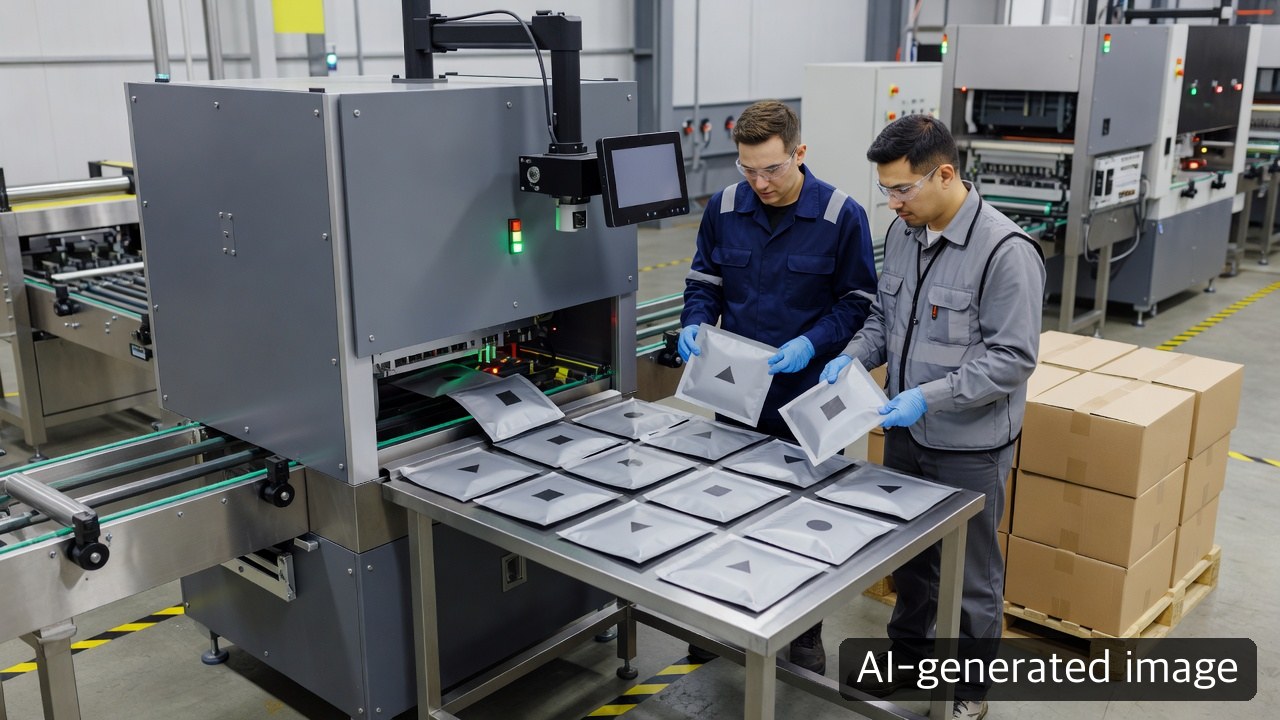
- G3 Marking function: verify focus, energy and speed window, contrast, spread, post-rub and post-flex readability, and version traceability.
- G4 Line and launch: connect converting, filling, sealing, BIB assembly, outer packing, inspection, reject handling and change approval.
1) Structure and Function Evidence Card
| Check | Required Input or Observation | Evidence | Status, Owner and Release Action |
|---|---|---|---|
| Inner-pack architecture | Layer order, gauge/mass, sealing layer, barrier layer, laser-response component | Structure drawing, BOM, TDS and compliance declaration | [Not received, review, approved] — Development requests a drawing for every option; hold samples until received |
| Product protection | Actual product, fill temperature, oxygen/moisture/aroma/light sensitivity and storage period | Application-specific barrier, migration and storage test | [Before test, in progress, pass, fail] — Quality fixes an actual-condition test plan; reselect structure by failure mode |
| Sealing and leakage | Seal temperature/pressure/time, seal strength, hot tack, leak/drop/flex results | Filler and sealer condition sheet, test records | [Process window open, locked] — Process engineering verifies the window at production speed; hold launch if boundary conditions fail |
| Marking compatibility | Laser setting, speed, focus, contrast/spread, readability after rub and flex | Setting history, sample images and readability/rub test | [Window search, locked] — Quality compares every lot with the approved master; define automatic reject on deviation |
| Circularity claim | Mono-material status, recycled/bio-based content and sorting impact | Recyclability assessment, content evidence and market-specific label review | [Insufficient, conditional, approved] — Regulatory checks each sales-market rule and claim; block unsupported reduction or recycling wording |
2) Line Trial and Release Table
| Trial Stage | Variable to Challenge | Result to Record | Release Question | Action and Release Condition |
|---|---|---|---|---|
| Converting | Web lot, tension, speed, laser setting and artwork version | Position, contrast, heat distortion, scrap and stop cause | Are position and readability stable across the production window? | Process engineering locks the stable window and stores version/setting history before filling |
| Filling and sealing | Product, fill quantity/temperature, seal conditions and pouch format | Contaminated seals, wrinkles, leaks and any change in the mark | Does the marking process preserve seal margin and film function? | Quality must pass boundary-condition retest before BIB assembly |
| BIB assembly | Bag size and valve position, folds, box size and insertion method | Hidden mark, bag rub, flex cracks, pinholes and leakage | Is the required mark visible and the inner bag intact after filling, folding and insertion? | Packaging development jointly approves inner/outer drawings and inspection points before distribution test |
| eCommerce distribution | Outer pack, cushioning, handling orientation, temperature/humidity, vibration/drop/rub | Box and bag damage, mark readability, leakage and return reason | Do marking and protection survive the actual route? | Logistics permits a limited launch only after route test passes and failure actions close |
| Change control | SKU, copy, language, web, supplier or laser-setting change | Approved version, old stock, switch time and first lot | Does faster artwork change create an unapproved change? | Marketing, quality and production approve one version and verify old-version segregation before launch |
Do not record only pass. Keep the observed value, source of the criterion, sample lot, owner and release condition together. Acceptance criteria must come from customer specifications, regulations, supplier documents and the internal validation plan—not from a public news article.
BIB and eCommerce Can Use the Same Artwork but Fail Differently
A BIB inner bag expands after filling, folds inside the box and repeatedly contacts valves and corners. A mark that is clear on a flat sample may crack at a fold, or its location may be hidden after outer-pack assembly. Inner-bag leakage and corrugated-box strength require separate tests, but the final launch decision must approve them as one system.
eCommerce packaging has rapid SKU, language and promotion changes, but that speed increases the risk of a version mismatch between the transport label and inner-pack artwork. A shorter laser-marking change lead time creates value only when the WMS/order record, approved copy, web lot and actual marked version remain connected.
Immediate Actions by Role
Packaging Development and Procurement
- Compare the existing printed BOM and proposed laser-marked BOM layer by layer.
- Obtain a quotation that includes the laser module, responsive material, process loss and inspection equipment—not only printing-plate cost.
- Manage recycled and bio-based options as separate SKUs when content, functional or compliance evidence differs.
Quality and Regulatory
- Review product protection, sealing, migration, rub/flex performance and sales-market labelling with mark clarity.
- Do not turn an internal assessment’s “significant reduction” into an invented number or a claim for an entire portfolio.
- Approve recycling, carbon and recycled-content language only when the assessment scope matches the delivered structure.
Production, Logistics and Marketing
- Bind web lot, laser setting, artwork version, filling and sealing results in one first-lot record.
- Recheck mark location, readability and leakage after BIB assembly and eCommerce distribution.
- Do not skip quality/regulatory approval or old-version stock segregation merely because artwork can change faster.
Conditions That Require a Launch Hold
- The location and compliance evidence of the laser-response layer, additive or coating are unknown
- “No conventional decorative printing” is being rewritten as “ink-free” or “coating-free” without evidence
- Barrier and leakage tests are incomplete under actual product, filling and sealing conditions
- Mark position, readability and thermal distortion have not been checked at production speed and web-lot boundaries
- Mark durability and inner-pack damage have not been checked after BIB folding/insertion and eCommerce distribution
- An internal carbon comparison is being applied to a delivered structure with a different calculation boundary
- No approval, traceability and old-version segregation process exists for SKU, language, web or laser-setting changes
Documents to Check Today
- Layer-structure and BOM comparison for the current pack and laser-marking candidate
- Supplier technical file for the laser-response component, setting window and thermal-damage controls
- Product-specific barrier, sealing, migration and storage validation plan
- Record form for mark position, contrast, rub, flex and readability testing
- Actual-route trial covering BIB assembly and eCommerce distribution
- Evidence file for recyclability, recycled content, bio-based content and carbon claims
- Approval, cutover and old-version segregation log for SKU, language, web and setting changes
The operating value of laser marking is not the phrase “no printing plate.” It is the ability to increase change speed while controlling structure, function, marking, line settings and claim evidence under the same approved version. Without those links, faster artwork change can become faster propagation of error.
About the Author
PackingMaster: Editor of Paper Pack Log. We collect and organize market trends, product information, and technical insights for the paper packaging industry.
References
- Mondi, “Mondi unveils award-winning packaging concept that simplifies eCommerce packaging through laser marking,” August 5, 2026, https://www.mondigroup.com/news-and-insight/2026/mondi-unveils-award-winning-packaging-concept-that-simplifies-ecommerce-packaging-through-laser-marking/
- Packaging Europe, “Mondi introduces laser marking concept for e-commerce packaging,” August 5, 2026, https://packagingeurope.com/news/mondi-introduces-laser-marking-concept-for-e-commerce-packaging/14571.article