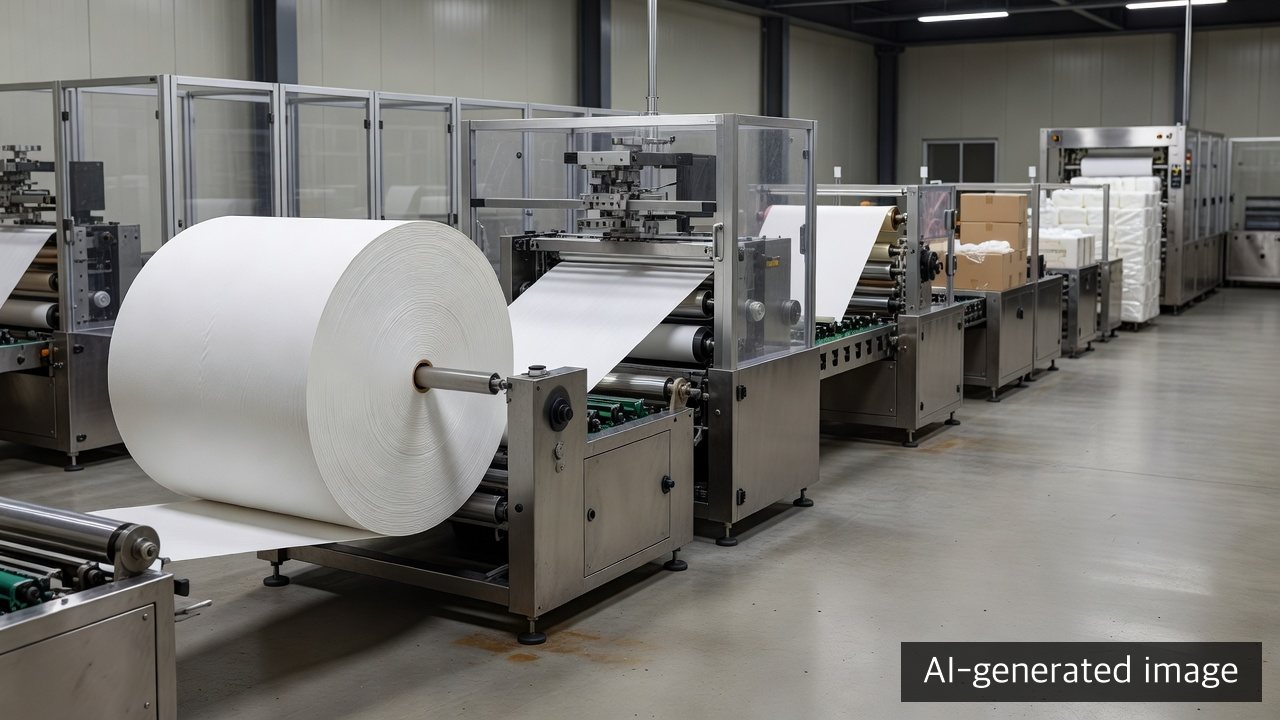
Reports published by Kukmin Ilbo and Seoul Economic Daily on September 17 and 18, 2026 described Paseo production observed during a September 10 visit to Monalisa’s plant in Nonsan, South Korea. According to the two reports, dedicated base tissue is made at the company’s Jeonju plant, while the Nonsan plant performs embossing, four-ply bonding, rewinding, cutting, packaging, and palletizing.
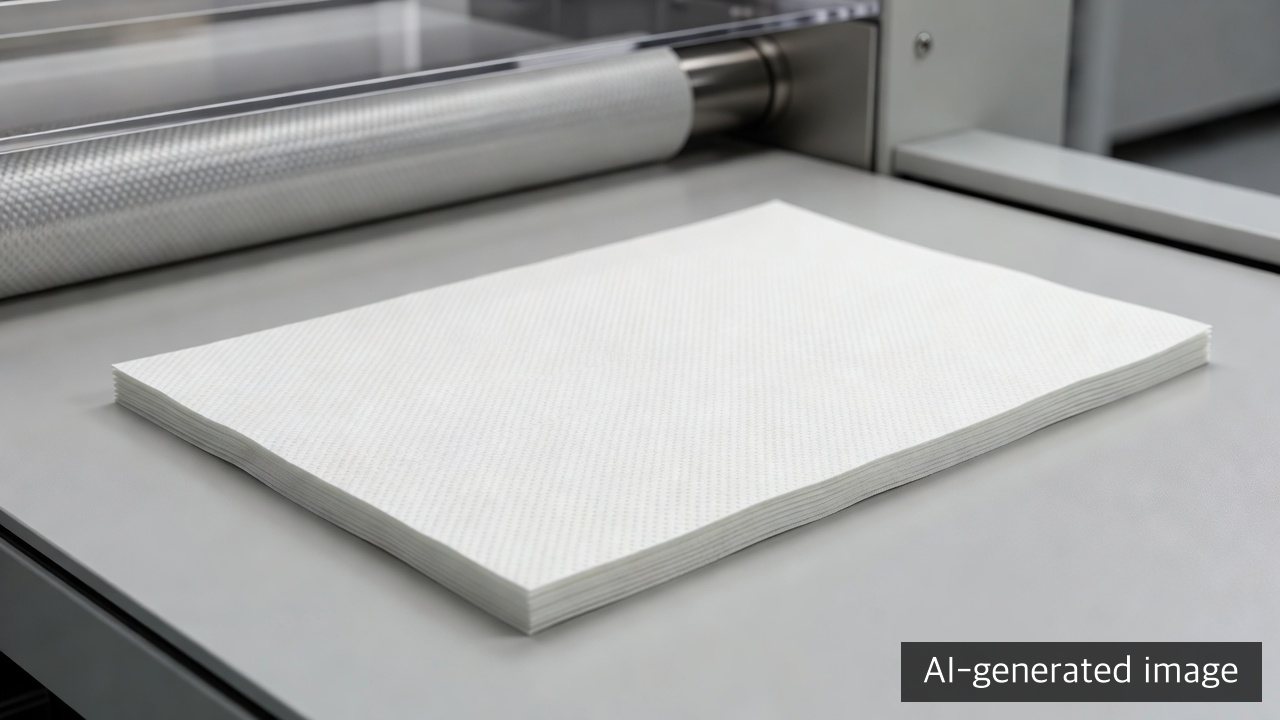
Seoul Economic Daily reported that Paseo was being produced at Nonsan once a month at the time of the visit and that the company was preparing to add production days as demand grew. Kukmin Ilbo reported an investment of approximately KRW 8 billion in converting equipment and a dedicated embossing roll, and described the use of a fine honeycomb-pattern “micro-pillow emboss.”
The two articles should not be treated as two independent quality validations. Both cover the same plant visit and rely substantially on company explanations. This article does not reconstruct Monalisa’s standard operating procedures or claim that its embossing quality or monthly schedule is unstable. It separates the reported facts from an editorial operating checklist for controlling embossing quality and production history in a once-monthly campaign.
What the public reports establish
The reports provide the following overlapping or complementary details.
- Preparation for domestic production took about six months. Kukmin Ilbo reported that the Jeonju plant produced approximately three rounds of base-tissue prototypes and the Nonsan plant produced approximately three rounds of converted prototypes while conditions were adjusted.
- Seoul Economic Daily identified June 1, 2026 as the date of the first Paseo production run at Nonsan.
- The Jeonju plant makes dedicated base tissue from a blend of softwood and hardwood virgin pulp. The specific blend ratio was described as confidential.
- Kukmin Ilbo reported that the base tissue is transported to Nonsan as jumbo rolls approximately 2.73 metres wide, 1.8–2 metres in diameter, and 1.3–1.5 tonnes in weight.
- At Nonsan, the web receives a fine honeycomb-pattern micro-pillow emboss and is bonded into four plies before rewinding, cutting, and packaging.
- In the process observed by Kukmin Ilbo, the web was wound into a 25-metre log, cut into individual rolls, packed in groups of 30, and robotically palletized. These observations should not be generalized into a specification for every Paseo product.
- The converting equipment was introduced in April 2025, and about KRW 8 billion was invested in the converting line and dedicated embossing roll, according to Kukmin Ilbo.
- Four people were reported to be assigned to Line 7 during Paseo production. Their work included loading base tissue, inspecting the product and packaging, and checking the operation of the equipment and robots.
- Seoul Economic Daily reported that Paseo was being produced once a month at the time of reporting and that the company planned to expand production progressively through 2028.
Kukmin Ilbo also quoted a company executive as saying that Monalisa’s internal sensory evaluation found Paseo approximately 50% softer than its own regular three-ply toilet tissue. The article did not disclose the test method, sample size, panel design, statistical treatment, or underlying data. The figure is therefore a reported result from a company-run evaluation, not an independently verified performance value or a production acceptance limit.
What the reports do not disclose
The reviewed reports do not provide:
- the pulp-blend ratio or detailed base-tissue property specification;
- the detailed embossing-roll geometry or actual operating recipe;
- line speed, web tension, loading or nip conditions, adhesive application conditions, or operating tolerances;
- numerical limits for emboss depth, emboss uniformity, ply bonding, or softness;
- Paseo’s actual defect rate, target defect rate, yield, or downtime;
- the SKU schedule, campaign volume, or run length for once-monthly production;
- annual expansion volumes or a confirmed equipment schedule through 2028; or
- independent evidence supporting the reported 50% softness improvement.
Seoul Economic Daily described the Nonsan plant’s overall daily production capacity as 250 tonnes. The reports do not establish that this is the capacity of the Paseo line or the output of a monthly Paseo campaign. A plant-wide capacity figure must not be converted into product-specific output without additional evidence.
Scope of the operating checklist
The checklist below is not presented as a Monalisa procedure, a regulatory requirement, or a reconstruction of actions taken at Nonsan. It is a general editorial template designed to be completed with a site’s approved specifications, test methods, and machine settings without guessing undisclosed target values.
Once-monthly production does not by itself prove that a process is unstable. A campaign separated from the previous run by a long interval can, however, benefit from explicit comparison of like-for-like records and separate identification of startup, steady running, restart after a stop, jumbo-roll changes, and run-end material.
1. Freeze the comparison basis before the run
Confirm the following during production readiness review.
- Campaign identity — Tie the production date, shift, line, item code, and pack format to one run identifier.
- Approved revision status — Confirm that the product specification, base-tissue specification, embossing recipe, inspection method, and packaging specification point to compatible approved revisions.
- Previous accepted reference — Identify the retained sample from the last accepted campaign for the same item and pack format. Do not use a different product’s handfeel or appearance as an informal standard.
- Jumbo-roll genealogy — Link the base-tissue lot, jumbo-roll identifier, receipt and storage status, and the actual property values controlled by the site. The jumbo-roll dimensions reported in the article describe the material flow; they are not quality tolerances.
- Equipment baseline — Record the line, embossing roll, bonding, rewinding, cutting, and packaging equipment identifiers and the approved setting revision.
- Inspection and calibration status — Confirm that required inspection equipment and maintenance checks remain valid for the campaign.
Do not populate the record with guessed line speeds or loading conditions. Record only settings that the site has approved and controls through change management.
2. Evaluate base tissue, emboss pattern, and four-ply integrity together
Kukmin Ilbo quoted a company executive as saying that mechanically similar readings did not always produce the same perceived softness. That statement should not be expanded into an instruction to replace measurement with touch. A more defensible approach is to connect approved instrument measurements and a controlled sensory comparison to the same sample.
- Record the sampling point. Distinguish startup, steady-running, post-restart, post-jumbo-change, and run-end samples.
- Preserve material genealogy. Each converted sample should remain traceable to its jumbo roll and base-tissue lot.
- Inspect the embossed surface. Use the site’s approved method to assess missing, crushed, or uneven pattern areas and other defined appearance conditions.
- Check four-ply integrity. Inspect ply alignment, bonding, winding, and cut edges against the actual product specification.
- Standardize sensory comparison. If handfeel is evaluated, record coded samples, presentation order, the reference sample, assessors, and the approved method. Do not copy the reported “approximately 50%” result into a plant acceptance limit.
- Continue traceability through packaging. Link the accepted sample to its package lot and pallet. Converted-product approval and shipment approval should remain separate states.
Do not release a high volume of material to packaging before first-off approval. After a stop, jumbo-roll change, process adjustment, or equipment event, repeat the site’s approved change-point verification.
3. Control a monthly campaign by run phase, not only by calendar month
A single monthly defect percentage can hide changes in production volume, inspection volume, and the mix of startup and steady-state material. Separate at least the following phases.
- Restart readiness — Verify equipment condition, cleaning, materials, approved settings, and reference samples after the extended interval.
- First-off approval — Before packaging release, verify material genealogy, emboss appearance, four-ply integrity, winding, cutting, and product appearance.
- Steady running — Collect and record samples at the site-approved frequency and at defined change points.
- Post-change verification — Separate samples taken after a jumbo-roll change, restart, process adjustment, equipment abnormality, or quality correction.
- Run closeout — Close production quantity, inspected quantity, nonconforming quantity and category, hold, rework, disposal, and shipment-release quantities under the same run identifier.
- Handover to the next campaign — Record unresolved deviations, maintenance work, the retained accepted sample, and checks required before the next run.
When recording a defect rate, retain the inspected quantity, nonconforming quantity, item, process phase, and counting rule, not only a percentage. The next month’s result can be compared meaningfully only when the denominator and classification rules remain visible.
4. Minimum fields for a campaign run card
One run card or connected electronic record should link:
- campaign ID, production date, shift, and line;
- item code, product format, and pack format;
- base-tissue lot and jumbo-roll identifiers;
- embossing-roll and converting-equipment identifiers and recipe revision;
- approved settings actually used and the time of any change;
- identifiers for startup, steady-running, restart, and post-change samples;
- the approved instrument method and actual measurements;
- the sensory method, reference sample, and result when sensory evaluation is used;
- nonconformance category, quantity, inspected quantity, and detection phase;
- the connection between finished-product samples, package lots, and pallets;
- hold, rework, disposal, and shipment-release status and approver; and
- deviation actions, preconditions for the next run, and the handover owner.
The purpose is not to invent values the site does not control. It is to connect approved requirements and actual production evidence in one traceable sequence.
5. Conditions that block production or shipment release
Do not close the record as “monthly production complete” while any of the following remains unresolved.
- Product, base-tissue, embossing, and packaging records do not point to compatible approved revisions.
- Traceability is broken between a jumbo roll and its finished-product or package lot.
- Startup material entered high-volume packaging or releasable inventory before first-off approval.
- Instrument and sensory results disagree, but the cause and disposition are unresolved.
- A post-restart, post-jumbo-change, or post-adjustment verification sample is missing.
- A defect percentage is recorded without inspected quantity, nonconforming quantity, and process phase.
- Held and released material is not separated physically or electronically.
- Deviation actions were not transferred into readiness checks for the next monthly campaign.
The public record supports the four-ply construction, micro-pillow embossing, the Jeonju-to-Nonsan material flow, the approximately KRW 8 billion equipment investment, and once-monthly production at the time of the reports. It does not disclose line speed, loading conditions, defect rates, or acceptance values. Rather than inventing those numbers, the operating chain should connect base-tissue lot → approved settings and change points → emboss and four-ply samples → package lot → shipment release. Repeating that chain under the same definitions in the next campaign is the practical basis for stabilizing embossing quality and monthly production together.
About the Author
PackingMaster: Editor of Paper Pack Log. We collect and organize market trends, product information, and technical insights for the paper packaging industry.