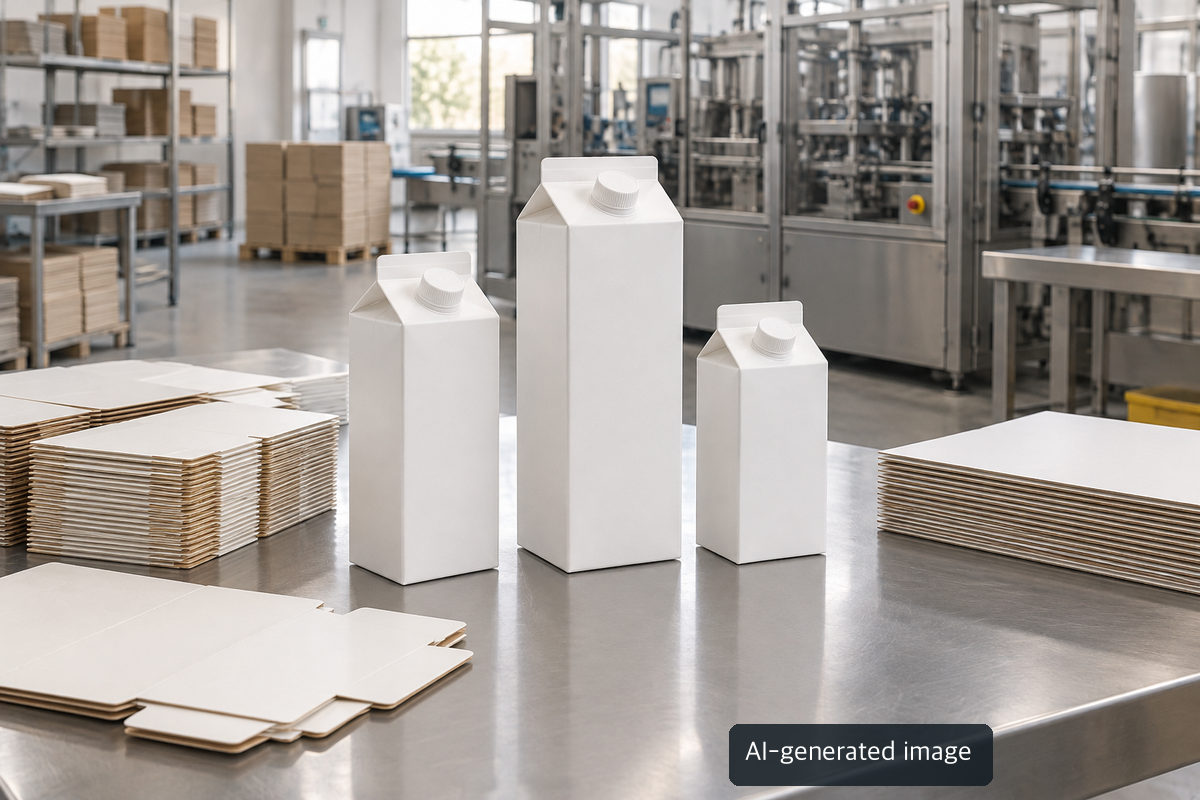
On October 6, 2026, Nippon Paper Industries announced that it had made a prototype for recycling beverage cartons back into beverage-carton raw material, which it calls “Pack to Pack.” The company plans to display the prototype at TOKYO PACK 2026, October 14–16. The relevant development is a proposed chain from recovered cartons to new carton base paper. A prototype, however, is not the same as commercial production, food-contact clearance for every drink, or a confirmed supply contract.
Checked October 10, 2026. The stages and figures below come from Nippon Paper’s October 6 announcement and an October 9 industry report. The exhibition has not yet occurred; this article does not imply an exhibition outcome, production launch or customer approval. The images are conceptual AI-generated illustrations, not photographs of the company, its plant or product.
What was actually announced?
The company’s account says it makes high-quality pulp from separately collected food-use wastepaper in Japan, including beverage cartons, then reuses that pulp as a feedstock for carton base paper. It describes a linked process using its facilities and group company:
| Stage | Scope described by the company | Further evidence to request |
|---|---|---|
| Collection and sorting | Separately collected food-use paper in Japan | Share of beverage cartons; contamination and separation criteria |
| Repulping | Dedicated food-and-beverage paper-container recycling equipment at Fuji Mill | Batch yield and traceability records |
| Base paper | Recovered pulp used to make carton base paper | Recycled-fiber content, grade specification and available volume |
| Conversion | Nippon Paper Liquid Packaging Products converts it into cartons | Product construction, coating and quality approval |
| Filling demonstration | Filling and forming on an NS-FUJI aseptic filling machine at the company’s technical center | Customer-specific commercial approvals and food-contact documentation |
This is a map of the prototype production route, not evidence that each stage has been demonstrated at commercial scale or that all test certificates have been published. Nippon Paper explains that in an NS-FUJI-type aseptic carton the inner surface is fully coated with resin so that the cut paper edges do not contact the beverage directly. That is the company’s description of a contact pathway, not an all-purpose certification of food safety or regulatory conformity for a particular customer product.
Why route recovered cartons back into cartons?
Nippon Paper says its group previously reused high-quality pulp from recovered cartons mainly in tissue and toilet paper. The new proposition is to return that fiber to carton base paper. In the announcement, the company quotes a 38.9% beverage-carton collection rate for fiscal 2024 and an industry group’s 50% target. These are cited Japanese collection figures, not the recycled content of the prototype, a commercial process yield, or a verified emissions saving.
The October 9 Printing Journal DIGITAL report follows the same company announcement. The original release is the primary source for the process and exhibition plan; the trade article is a secondary account of that announcement. Two outlets carrying the same company claim do not establish independent testing or commercial availability.
A buyer’s evidence request
A procurement or quality team considering recycled fiber in beverage packaging should separate feedstock eligibility → base-paper specification → carton construction → filling and storage trials → customer and regulatory approvals.
- Feedstock and traceability: Is the input restricted to beverage cartons or does it include other food-use wastepaper? What are the lot history and contamination criteria?
- Base-paper specification: Is recycled-fiber content declared? Request grammage, strength, converting characteristics and available technical data.
- Carton construction: Ask how inner resin coating and exposed edges are controlled after conversion. Do not substitute a general company description for a specific product approval.
- Product-specific qualification: Request filling conditions, shelf-life and barrier/leakage/odor testing, food-contact regulatory evidence in the destination market, and customer sign-off.
- Commercial status: Record exhibition prototype, trial manufacture, commercial shipment, committed quantity and delivery date as distinct milestones.
The public documents checked here do not establish the exact recovered-fiber blend, product-specific food-contact test results, commercial capacity, price or a Korean supply schedule. A supplier record should therefore say “October 2026 prototype announcement reviewed; product-level paperboard, carton, filling and food-contact evidence requested,” rather than “Pack-to-Pack commercial grade approved.” Update the status if actual post-exhibition tests or deliveries are disclosed.
About the Author
PackingMaster: PaperPackLog editor covering paper-packaging market developments, materials and industrial practice with source-specific qualifications.
References
- Nippon Paper Industries, prototype for horizontal recycling of beverage cartons, October 6, 2026. Company primary source for the process and exhibition plan.
- Printing Journal DIGITAL, beverage-carton recycling prototype coverage, October 9, 2026. Industry follow-up on the company announcement.