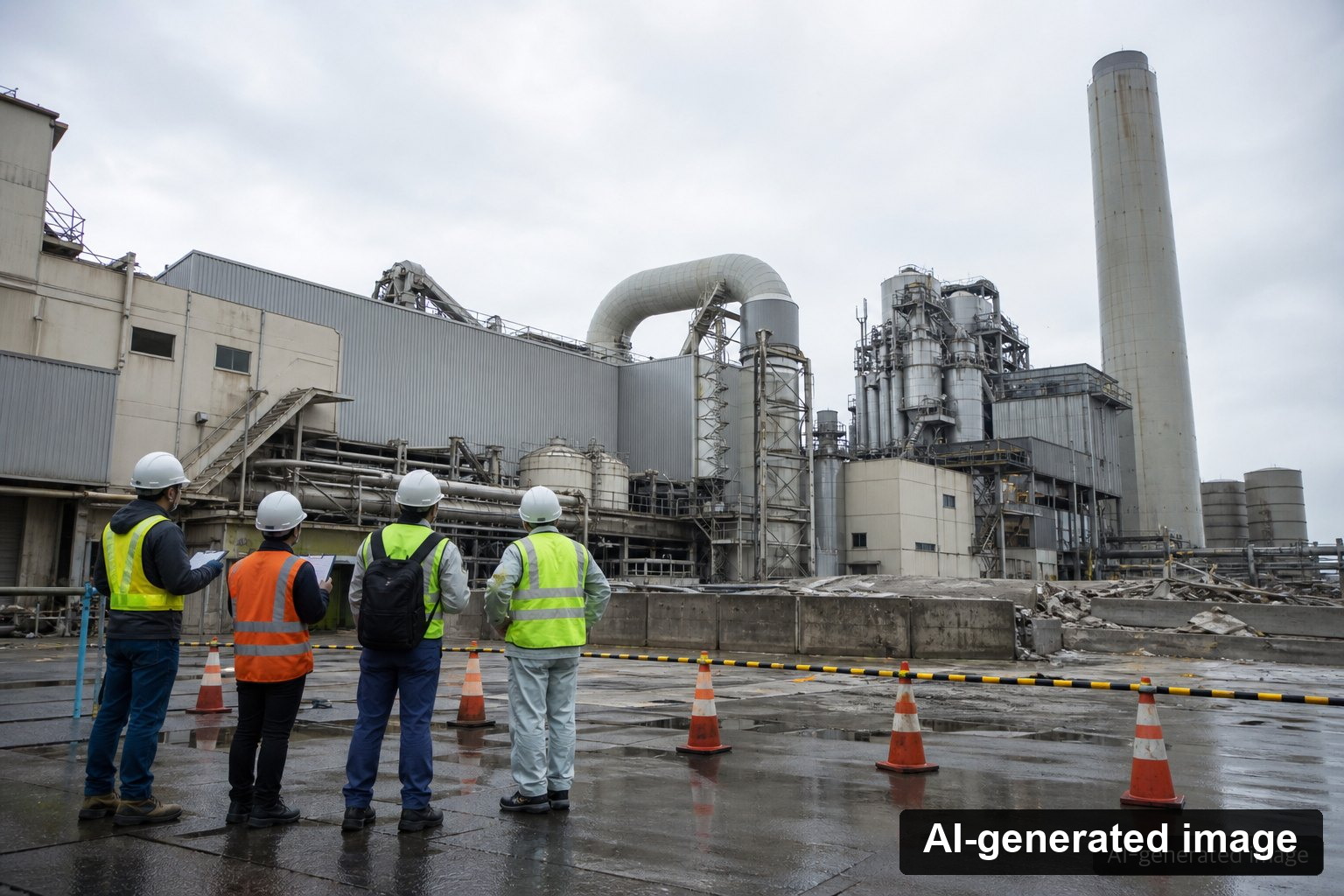
On the evening of September 3, 2026, a fire broke out while an earthquake-damaged chimney was being dismantled at Nippon Paper’s Yatsushiro Mill. A mill employee called emergency services at about 5:55 p.m., and local firefighters responded. NHK’s report, updated at 8:46 p.m., said no injury information had been received and firefighting continued. Sankei and Mainichi reported, citing local fire and police authorities, that no injuries had been confirmed.
We first extend our deepest condolences to those who lost their lives in the July earthquake and to their families. This article avoids sensational descriptions of casualties and focuses only on recovery safety and the official checks needed for supply continuity.
Updated at 9:24 p.m. UTC+9 on September 3, 2026: This existing article, first published on July 31 and expanded on August 5, now includes the chimney-demolition fire and the resulting verification steps. The existing URL was updated instead of creating a duplicate article about the same mill recovery event.
What Changed From the Earlier Article
The earlier version covered a downstream signal from the Yatsushiro shutdown: difficulty securing newsprint and a regional newspaper reducing its page count. This update addresses a secondary incident during recovery and demolition work and presents a release sequence that must come before any conclusion about mill restart: site safety handover → damage boundary → grade and PO impact → alternate approval → commercial shipment release.
Field Problem
The existence of a fire does not by itself prove additional production-equipment damage or a larger supply disruption. Conversely, a later report that the fire was controlled or extinguished would not automatically mean that chimney demolition, mill operations, grade production and customer shipments had returned to normal.
Procurement, production and quality teams should manage these four items as independent verification statuses.
- Fire during chimney demolition: confirmed.
- Completion of firefighting and site safety handover: unresolved.
- Additional effects on demolition, production assets and utilities: unresolved.
- Production and shipment dates for specific grades and POs: unresolved.
Public reporting currently establishes the first statement, the contemporaneous fire response and the reported injury status. The cause, additional equipment damage, changes to the demolition schedule, mill restart and supply effects require separate official confirmation.
Evidence to Check
Scope of the September 3 Fire Reports
- Sankei: At about 5:55 p.m., a mill employee reported that a fire had broken out during chimney demolition. The local fire service said no injuries had been confirmed. Black smoke was visible, and firefighting continued at the time of the report.
- Mainichi: Ten workers were cutting an earthquake-damaged chimney at the site, and no one was injured, according to the police. The fire had not been extinguished as of 7:00 p.m., and firefighting continued.
- The Asahi Shimbun: A mill employee called emergency services shortly after 5:50 p.m., and black smoke rose from one chimney under demolition, according to the local fire service. The report said three of the mill’s five chimneys had been damaged in the July earthquake and demolition had been under way since late August.
- NHK: Its article, published at 6:25 p.m. and updated at 8:46 p.m., reported the fire in a chimney under demolition, no injury information received at that point and continuing firefighting.
Because the outlets reported at different times and cited different authorities, no injury information received and no injuries should retain their source attribution. This article does not combine them into a stronger claim.
Relationship to the Earthquake and Mill Shutdown
Nippon Paper’s official July 29 notice said Yatsushiro Mill had halted following the July 28 Kumamoto earthquake and that detailed damage was under investigation. Later reporting put the total number of deaths at the mill at nine. An August 4 report said Kumamoto Nichinichi Shimbun reduced its usual 20 to 28 pages to 16 because damage at Yatsushiro had made stable newsprint procurement difficult. It also said arrangements to source paper from other mills were continuing.
That reporting establishes a newsprint-procurement effect at Kumamoto Nichinichi Shimbun after the earthquake. It does not yet establish that the September 3 chimney fire extended the shutdown or further reduced supply of any specific grade.
| Check | Current Public Basis | Still Unresolved | Internal Status Wording |
|---|---|---|---|
| Fire and response | Fire during chimney demolition and firefighting reported | Final extinguishment and site handover time | Fire response, safety handover being confirmed |
| Worker status | Fire and police sources reported no injuries or no injury information | Separate company follow-up | Media status checked, official follow-up pending |
| Cause and boundary | Black smoke from a chimney under demolition reported | Cause and additional chimney or adjacent-asset damage | Cause and affected area under investigation |
| Demolition and restart | Post-earthquake demolition work had begun | Schedule change and phased restart | Official schedule being confirmed |
| Supply and delivery | A newsprint-procurement effect at one regional newspaper was previously reported | Additional fire-related grade, PO and delivery effects | PO-level impact being confirmed |

Practical Deliverable
The following is not a reconstruction of the mill’s equipment or damage boundary. It is a general verification sequence for procurement, production, quality and logistics teams connected to Japanese printing paper or newsprint.
Recovery and Supply Release Gates
| Gate | Evidence Required | Owner | Example Current Entry |
|---|---|---|---|
| G0 Official basis | Latest company, fire-service or authority URL and checked time | Safety, Procurement | September 3 reports checked; company follow-up pending |
| G1 Site safety | Final extinguishment, site handover, structural, electrical and demolition approval | Safety, Engineering | Access and demolition restart being confirmed |
| G2 Grade and PO impact | Production mill, grade, specification, PO, roll or lot, production and release location | Procurement, Logistics | Yatsushiro origin and unshipped quantity being confirmed |
| G3 Alternate approval | Alternate mill, TDS, CoA, print or converting trial, customer approval | Quality, Production | Candidate available; technical and customer approval pending |
| G4 Commercial release | Approved grade, allocation, mill release date, shipment date and ETA | Sales, Logistics | Release only POs with a written delivery confirmation |
PO and Lot Trace
| Grade and PO | Production or Inventory Location | Supplier Status | Next Action |
|---|---|---|---|
| [Newsprint or printing paper / PO and roll] | Yatsushiro, another mill, merchant inventory or in transit | Mill, allocation and release date being confirmed | Request a written PO-level reply |
| [Customer-specific grade / PO] | Incumbent or alternate mill | Change-approval condition being confirmed | Check customer specification and mill or grade approval |
| [Alternate grade / sample lot] | Alternate supplier or external warehouse | Technical and commercial review in progress | Approve TDS, CoA, sample and firm shipment date together |
Supplier Confirmation Request
- Please identify the actual production mill, grade and specification, and production, allocation and release status for each open PO.
- Did the September 3 fire change the scope of safety checks for demolition, production assets or utilities?
- Does the fire create any additional review for grades, customer orders, mill inventory or held shipments?
- Can you provide alternate-mill or alternate-grade availability, TDS, CoA, samples and the first firm shipment date?
- Please separate trial operation, limited-grade production, commercial shipment and full normalization dates.
- When is the next official operating update and PO-level reply due?
Hold Conditions
Hold an alternate conversion, firm customer delivery date or normalized status if any of the following remains unresolved.
- Final extinguishment and site safety handover have not been confirmed.
- The cause or damage boundary is being treated as confirmed from media inference alone.
- The chimney-demolition schedule and production-equipment restart are being treated as the same schedule.
- The actual mill, grade, specification and current location of the buyer’s PO are unknown.
- Mill inventory, merchant inventory, shipped stock and unshipped stock have not been separated.
- Alternate TDS, CoA, converting trial and customer approval are incomplete.
- A disruption duration is being communicated without an official delivery reply from Nippon Paper or the supplier.
As of this update, the confirmed facts are the fire during chimney demolition, the emergency response and the source-attributed worker status. The cause, additional production-equipment damage, demolition and restart schedules, and supply effects still require separate confirmation. Buyers should not set a disruption duration from the incident headline. They should record each gate in sequence: safety handover → mill, grade and PO confirmation → alternate approval → commercial shipment release.
About the Author
PackingMaster: Editor of PaperPackLog. Covers market trends, product insights, and technology in the paper packaging industry.
References
- Nippon Paper Industries: Impact of the 2026 Kumamoto Earthquake, July 29, 2026
- The Asahi Shimbun: Newsprint supply support after the Yatsushiro Mill shutdown, July 31, 2026
- Yahoo! News Expert: Kumamoto Nichinichi Shimbun cuts its edition to 16 pages, August 4, 2026
- Sankei: Fire during chimney demolition at Yatsushiro Mill, September 3, 2026
- Mainichi: Fire during chimney demolition and worker status, September 3, 2026
- The Asahi Shimbun: Fire in an earthquake-damaged chimney at Yatsushiro Mill, September 3, 2026
- NHK: Live report on the chimney fire during demolition at Yatsushiro Mill, September 3, 2026