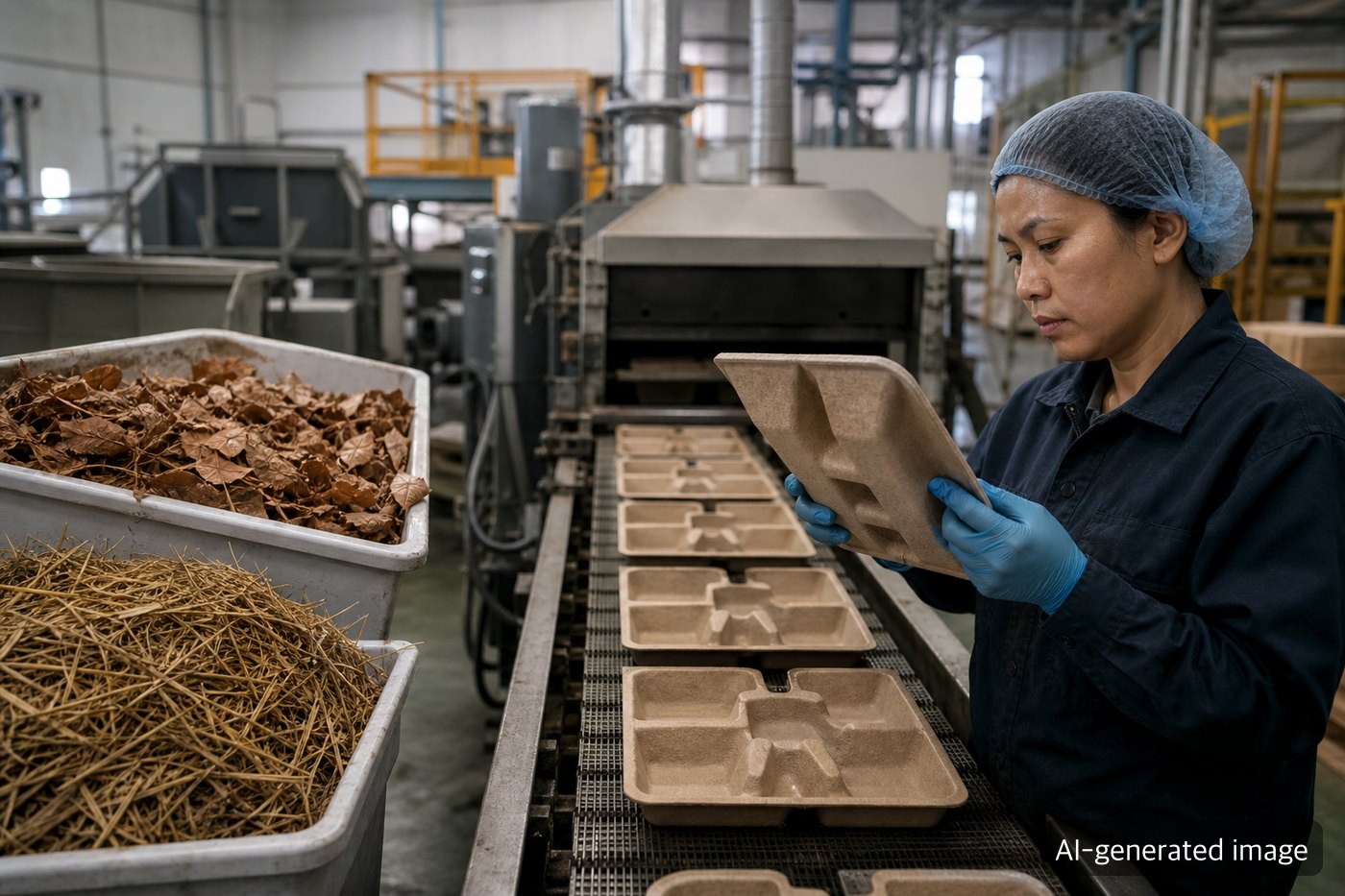
Fallen leaves, agricultural residues, and other non-wood biomass streams are increasingly being discussed as packaging raw materials. The practical question is not only whether they can replace some wood-based input. For molded fiber packaging, the question is whether they can be formed into repeatable cushioning and tray products at industrial quality.
This topic is related to broader work on agricultural byproducts in paper pulp, but molded fiber has its own requirements. A slurry must form on a tool, drain, dry, hold its shape, and survive handling. That makes process behavior just as important as the sustainability story.
In molded fiber, processability appears first
Molded fiber packaging is made by depositing pulp slurry on a mold, removing water, and drying or hot-pressing the formed part. A non-wood material therefore has to work inside the forming process, not only in a lab sheet.
Converters should check whether:
- slurry dispersion is stable;
- fiber pickup on the forming tool is consistent;
- drainage time stays within the production window;
- drying does not create excessive shrinkage or warping;
- edges and ribs resist cracking;
- part weight and thickness remain consistent by lot;
- trimming, stacking, and shipping do not create high breakage rates.
Fallen leaves and non-wood biomass may differ from wood pulp in fiber length, ash content, waxy components, color, and odor. These differences can become visible in molded parts. Corners, ribs, cup holders, and deep-draw areas are especially sensitive to fiber distribution and drainage.
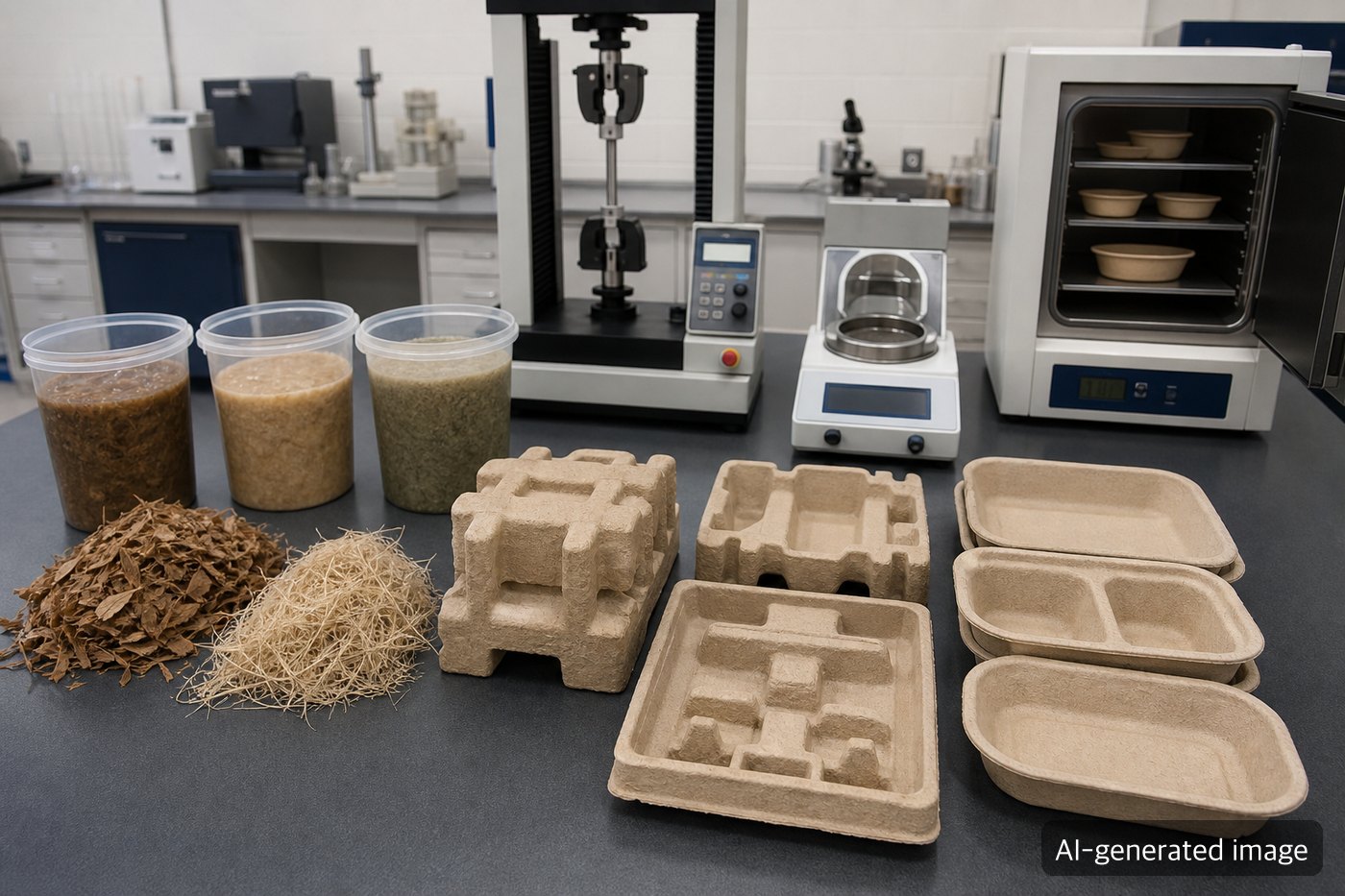
Reducing virgin pulp depends on application, not only blend ratio
Non-wood biomass is unlikely to replace virgin pulp across all molded fiber products. It may, however, reduce virgin pulp input in selected applications if the blend ratio is matched to performance requirements.
The most realistic early applications include:
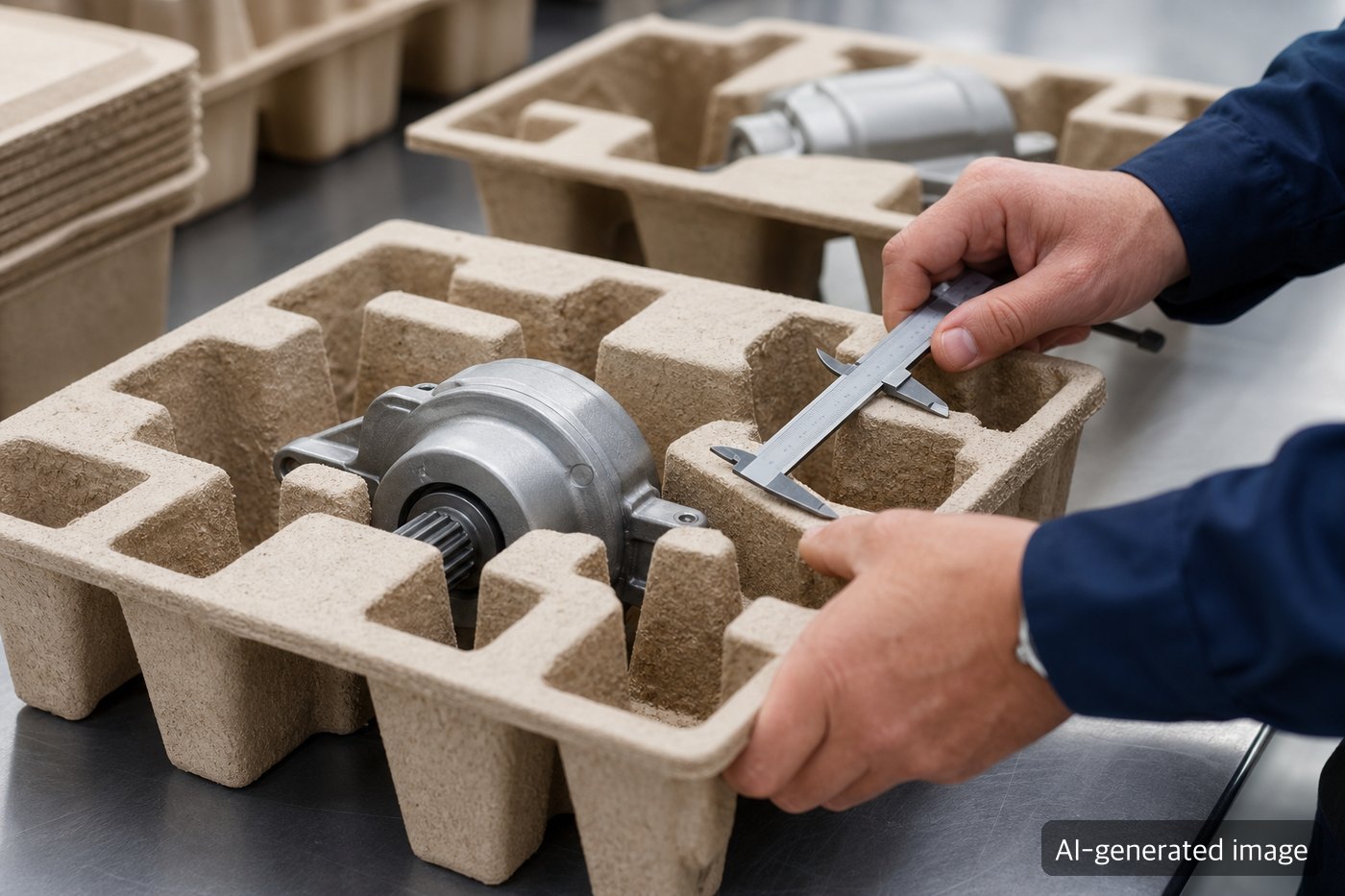
- Cushioning for electronics and consumer goods
Appearance may be less critical than shock absorption and dimensional stability. Drop and vibration tests are still required. - Produce and agricultural trays
Ventilation, moisture behavior, surface cleanliness, and food-contact status must be defined clearly. - Industrial component separation trays
Dust, abrasion, contamination, and part marking risks need to be checked. - Brand support packaging
Texture and color can support a material story, but odor, staining, and shedding must remain controlled.
High-precision electronics, high-humidity distribution, oily food contact, and long cold-chain routes should be approached more cautiously until test data is available.
Residue supply is about collection quality, not only volume
Fallen leaves may be abundant, but abundance is not the same as industrial raw material supply. Collection timing, soil and sand contamination, moisture, decay, storage, and local composition differences can all affect quality. Agricultural residues have similar issues: they may appear in large seasonal volumes but require storage and preprocessing to support year-round production.
Useful questions include:
- Is the biomass seasonal, or can supply be stabilized throughout the year?
- Are washing, screening, grinding, drying, or other preprocessing steps required?
- Could ash or grit damage forming tools, pumps, or pipes?
- Can mold, odor, and moisture variation be controlled during storage?
- Can regional raw material variation be absorbed within the product specification?
- Is there documentation for traceability and material content claims?
A residue stream that looks inexpensive can become costly after sorting, preprocessing, yield loss, and quality control. For molded fiber, the right question is whether the biomass can become a repeatable input, not whether it was once treated as waste.
Food trays require evidence before storytelling
Food tray applications require a stricter review. A natural origin does not automatically make a material safe for food contact. Residual pesticides, heavy metals, microorganisms, odor, color migration, optical brighteners, coatings, and additives all need to be considered.
The required evidence also depends on use conditions. Direct food contact is different from a secondary tray used outside an inner pack. Dry produce, moist food, oily food, chilled logistics, and frozen logistics may require different test plans.
Procurement and development teams should request:
- raw material specifications and collection method documentation;
- physical performance data such as compression, drop, flex, and dimensional stability;
- odor and color-transfer evaluations;
- food-contact test data or clearly stated use restrictions;
- evidence behind recyclability or compostability claims;
- lot-to-lot quality control standards.
Buyer questions for non-wood molded fiber proposals
When a supplier proposes non-wood molded fiber, ask:
- Is there strength and breakage data by blend ratio compared with virgin pulp?
- Can the current part geometry be produced without tool changes?
- Does drainage or drying time increase production cost?
- Are odor, dust, and shedding acceptable in the customer use environment?
- Is there a backup formulation if the alternative biomass supply is interrupted?
- Are food-contact and non-food applications clearly separated?
Closing
Fallen leaves and other non-wood biomass streams may help reduce virgin pulp dependence in molded fiber packaging. But their value will be proven through process data, collection quality, product testing, and clear application boundaries.
Packaging companies do not need to treat this as either a miracle material or a distant idea. The practical path is to test lower-risk cushioning and support tray applications first, while requiring separate safety evidence before direct food-contact use.
About the Author
PackingMaster: Editor of Paper Pack Log. We track paper packaging market trends, product information and technical insights for packaging professionals.