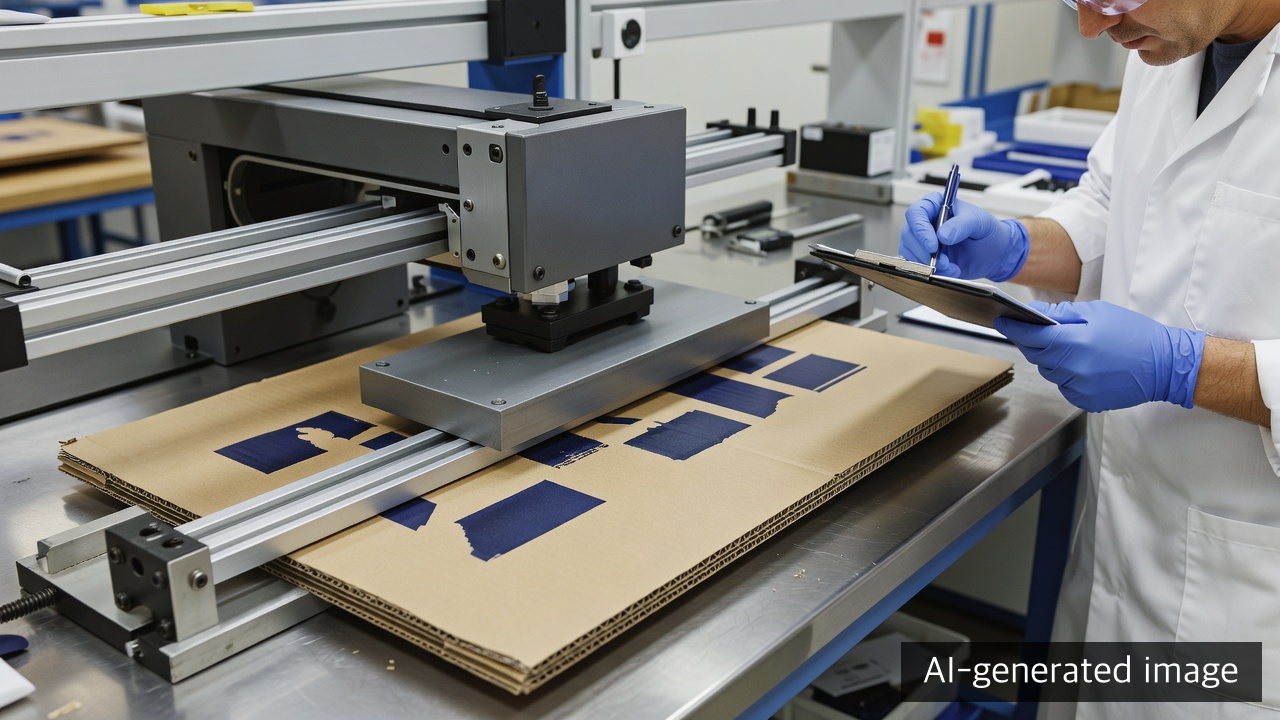
A corrugated carton can leave the press looking clean and still transfer colour to the adjacent case, scuff around a code or lose coating during stacking, conveyor movement and pallet transport. Packaging development, quality and production teams therefore need more than a statement that the ink was dry: they must reproduce which specimen contacted which surface, under what condition, and against which acceptance basis. This article provides a copy-ready ink rub test plan and shipment-hold rules without inventing a universal pass value.
Standards status — checked September 1, 2026: The ASTM catalogue lists
ASTM D5264-98(2019)as the standard practice for abrasion resistance of printed materials by the Sutherland Rub Tester. ASTM also lists revision work itemWK88474, so a test plan should identify the edition and year actually used rather than saying only “to ASTM.” TAPPI’s official catalogue listsTAPPI/ANSI T 830 om-24for the ink rub test of container board and corrugated board. Exact apparatus, load, stroke or cycle settings and specimen preparation must come from the purchased current standard, customer specification and laboratory procedure; this article does not reproduce the copyrighted standards.
Separate Four Failure Modes Before Judging the Result
A single pass/fail cell prevents the failure from being tied to its cause and corrective action. Record at least four distinct modes.
- Printed-surface loss: ink wears away to expose the substrate or changes colour density or gloss
- Colour transfer: ink or coating transfers to the opposing specimen, adjacent carton or witness sheet
- Surface failure: liner fibres, a coating layer or surface paper lifts before the ink film itself fails
- Information-function loss: barcode, 2D code, lot mark or warning information becomes less readable
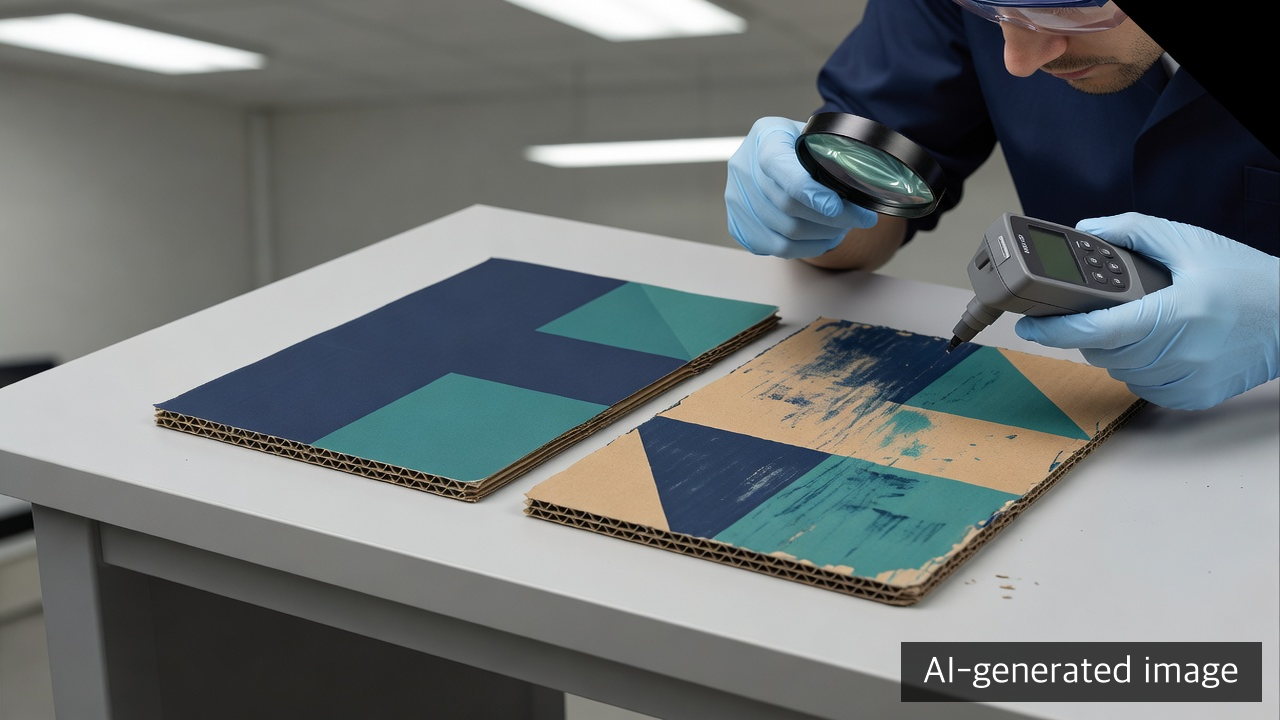
The same pale mark may come from ink wear, fibre lift or coating fracture. Keep magnified photographs and the opposing-surface transfer record together so that the team can decide whether to investigate print settings, ink or varnish, substrate, drying or downstream conversion.
Do Not Use ASTM D5264 and TAPPI T 830 as Interchangeable Labels
| Reference | Scope visible in the public catalogue | What to record in the plan |
|---|---|---|
| ASTM D5264-98(2019) | Standard practice for printed-material abrasion resistance using a Sutherland Rub Tester | Edition and year, equipment, contact material, condition and relationship to the customer specification |
| ASTM WK88474 | ASTM work item for revision of D5264 | Date revision status was checked and alignment between customer-required and internal editions |
| TAPPI/ANSI T 830 om-24 | Ink rub test of container board and corrugated board | Selected dry, wet or other defined mode, actual specimen pairing and acceptance basis |
The documents come from separate standards organisations. Even where their purpose overlaps, do not assume that equipment settings and procedures are automatically identical. A public laboratory-service description is useful secondary context for the dry and wet rub and surface-strength applications of T 830; the official TAPPI catalogue remains the source for the listed edition.
Lock Six Inputs Before Testing
- Use environment: carton-to-carton stacking, contact with film, labels or metal guides, dry storage, or condensation risk
- Specimen identity: board code, basis weight, surface treatment, print process, ink, varnish, print date and lot
- Cure and storage time: whether the specimen represents the real converting and shipment time rather than only a fresh print
- Contact pairing: print-to-unprinted liner, print-to-print, carton-to-label or the actual opposing material
- Acceptance basis: customer specification, approved master, drawing or internal process baseline
- Change scope: ink, varnish, board, anilox, dryer condition, press speed or downstream conversion
Copy-Ready Test Plan
A. Lock the Specimen and Reference
| Input | Value to record | Action if missing |
|---|---|---|
| Item, drawing and customer | [item code / drawing revision / customer] | Hold test start |
| Board | [supplier / grade / basis weight / surface treatment / lot] | Compare with approved material |
| [process / ink / colour / anilox and plate data / print date] | Complete production record | |
| Conversion | [varnish or coating / lamination / adhesive / die-cutting and case making] | Separate changed variables |
| Approved master | [master ID / storage location / approval date] | Hold judgement until reference is available |
| Standard and procedure | [standard number and edition / customer specification / laboratory SOP] | Recheck current and contract-required editions |
B. Lock the Condition and Decision
| Test item | Planned or recorded value | Status and action |
|---|---|---|
| Specimen state | [time since printing / conditioning / surface contamination] | If unknown, condition and resample |
| Contact pairing | [print-unprinted / print-print / actual opposing material] | Treat as supplementary if it does not represent distribution contact |
| Test mode | [dry / wet / customer-defined condition] | Redesign if the mode does not fit the purpose and reference method |
| Equipment and setup | [equipment ID / contact head / applicable load, cycles and speed] | Reconcile with the selected method and specification |
| Observations | [print loss / transfer / fibre lift / dust / gloss change] | Mark location and photograph each failure mode |
| Information function | [barcode, code and text readability before and after] | Hold shipment if required information fails |
| Acceptance basis | [customer limit / approved master / internal process baseline] | Never pass against an invented score |
| Result | [pass / conditional / fail / retest] | Link owner, corrective action and retest date |
The load, cycles and speed field must not remain undefined when testing starts, but it also must not be filled with a number copied from this article. The approver should select and cite values from the applicable standard, customer specification, laboratory equipment and product risk.
Execution Sequence: From Document Control to Shipment Release
G0. Confirm the Applicable Documents
Quality compares the customer specification, approved drawing, standard edition and laboratory SOP. Record the edition, year and check date rather than only D5264 or T 830. If a contract calls out a particular edition, do not replace it automatically merely because a newer edition exists.
G1. Prepare the Master and Test Specimens Under Comparable Conditions
Record board, print and coating structure, cure time and specimen position for the approved master and the new sample. Do not cut only the best-looking section of a sheet; the sampling plan should include positions across the print width and areas near joints or folds where variation can appear.
G2. Select the Real Contact Pair
Determine whether the printed face meets an unprinted liner, another printed face, film, a label or a conveyor guide. A white witness sheet can make transfer easy to see, but it does not replace every real stacking or distribution interface.
G3. Separate Dry, Wet and Boundary Conditions
Do not merge normal storage and condensation or moisture risk into one result. Where permitted by the selected method and customer specification, keep specimens by condition and record their state and elapsed time before testing.
G4. Define Early Stop Conditions
If required information becomes unreadable, the liner suffers severe failure, or the fixture or specimen shifts, do not continue solely to reach the planned cycle count. Record the stop point, failure mode and uncompleted work, then assign a cause-specific action.
G5. Combine Visual, Transfer, Measurement and Readability Results
Do not end with one visual grade. Keep colour or gloss change relative to the master, opposing-surface transfer, fibre lift and dust, required-code readability, and location photographs in one record. Compare measurements only when instrument, geometry and specimen position are consistent.
G6. Tie the Retest Scope to the Change
An ink or varnish change requires renewed rub evaluation; a board change also calls for attention to surface strength; a drying change requires results across the relevant cure times. Do not test only the repaired specimen—compare the pre-change master and post-change sample in the same session.

Actions by Function
Procurement and packaging development
- Put board, print process, ink or varnish, referenced method and required test report scope in the quotation and purchase specification.
- Ask for specimen lot, condition, reference and actual result rather than accepting a supplier certificate that says only
pass.
Production and printing
- Link print date, dryer condition, speed, viscosity, anilox, varnish and conversion changes to the production lot.
- Sample actual production across the web and around changeover regions rather than preparing a separate ideal test sheet.
Quality
- Control the approved master and test edition, and keep failure photographs, measurements and readability results in one record.
- Treat an internal baseline without a customer limit as a process-stability indicator, not as an external performance guarantee.
Logistics and sales
- Feed stacking direction, carton contact, wrapping, conveyor guides, moisture or condensation and the real delivery route into the test conditions.
- Do not expand an ink-rub pass into proof of complete distribution durability; require vibration, compression, drop or storage tests where the risk calls for them.
Conditions That Require an Immediate Shipment Hold
- Passing against an arbitrary cycle count when the standard edition, customer specification or approved master is not fixed
- Specimen board, ink, varnish, cure time or production lot cannot be traced
- Only a convenient opposing material was tested instead of the real carton-contact pairing
- Required barcode, code, lot or warning information is unreadable after testing
- Ink wear and liner-fibre lift were not separated, leading to repeated ink adjustment without substrate review
- Conditions changed after failure but the new specimen was not compared with the pre-change master in the same session
- A rub-test pass is interpreted as automatic approval for vibration, compression, drop and condensation exposure
The purpose of an ink rub test is not to manufacture an impressive cycle count. It is to fix the chain of specimen, opposing surface, condition, observation, acceptance evidence and action so that the same scuff failure is stopped before it reaches the customer. Product limits should come from the customer specification or approved master; when no evidence exists, do not fill the blank with an invented number.
About the Author
PackingMaster: Editor of Paper Pack Log. We collect and organize market trends, product information, and technical insights for the paper packaging industry.
References
- ASTM International, D5264-98(2019): Standard Practice for Abrasion Resistance of Printed Materials by the Sutherland Rub Tester
- ASTM International, WK88474: Revision work item for D5264
- TAPPI, TAPPI/ANSI T 830 om-24: Ink rub test of container board and corrugated board
- Background: SGS-IPS Testing, TAPPI T 830 ink-rub scope summary