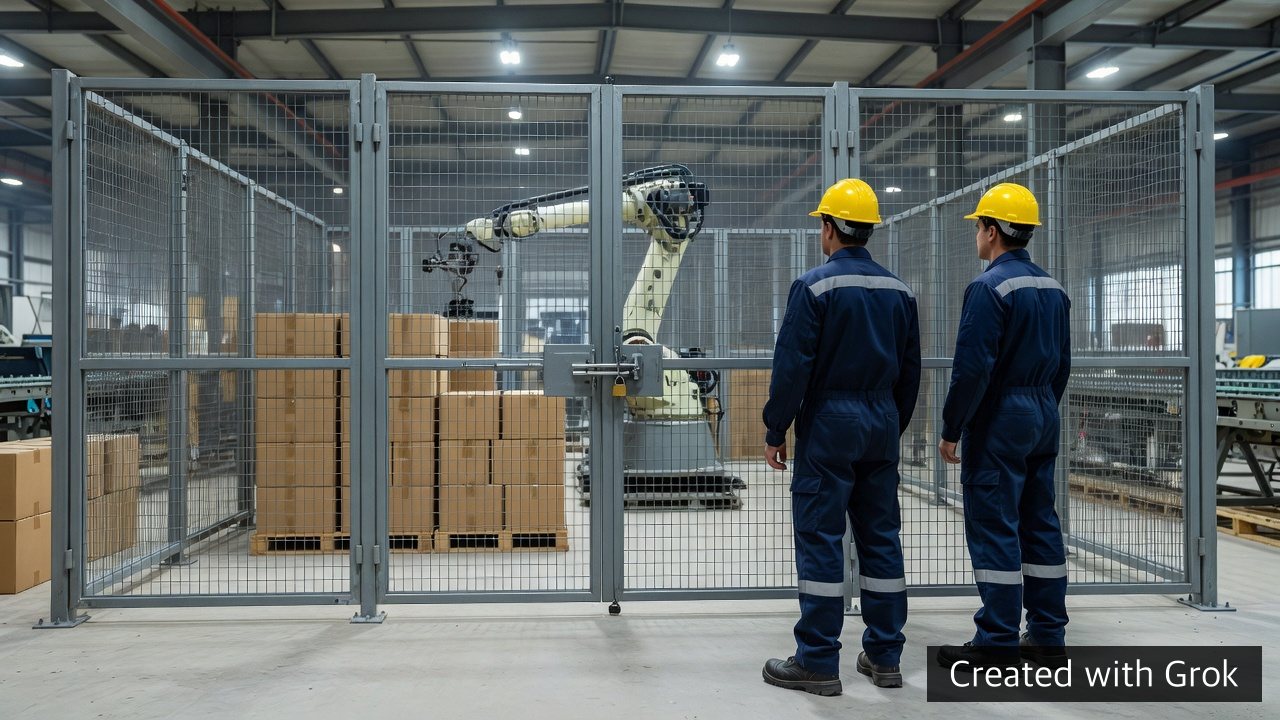
If two people enter a stopped machine for inspection, one person’s exit does not clear the whole work zone for a restart. Stopping motion, isolating hazardous energy, accounting for each entrant, confirming the zone is empty and issuing a restart signal are separate checks. The handoff below is an editorial field proposal for packaging and palletizing operations. It is not a finding that any particular safeguard was missing in a reported accident.
A Goseong report is not a final accident investigation
A September 28, 2026 report by Hyundai Economic News cited police as saying that a worker in his forties was crushed by packaging-related machinery at a food factory in Goseong, South Korea, at about 11:45 a.m. on September 21, and died during hospital treatment on September 25. We extend our condolences. The report says police believe two people had been checking beneath stopped equipment and that the machine was restarted after one of them came out first. Police were investigating where the workers were, how the restart occurred and whether safety devices and procedures were followed.
That account is a reported, preliminary police explanation, not a completed investigation. The cited report does not establish that a lock was absent, an interlock failed, a coworker violated a rule or an employer breached a particular statute. Nor does the reporter’s general description of a “machine robot” identify the exact machine architecture or prove that a robot-specific technical guide applied to this accident. The steps below address analogous work risks, not a reconstruction of the event.
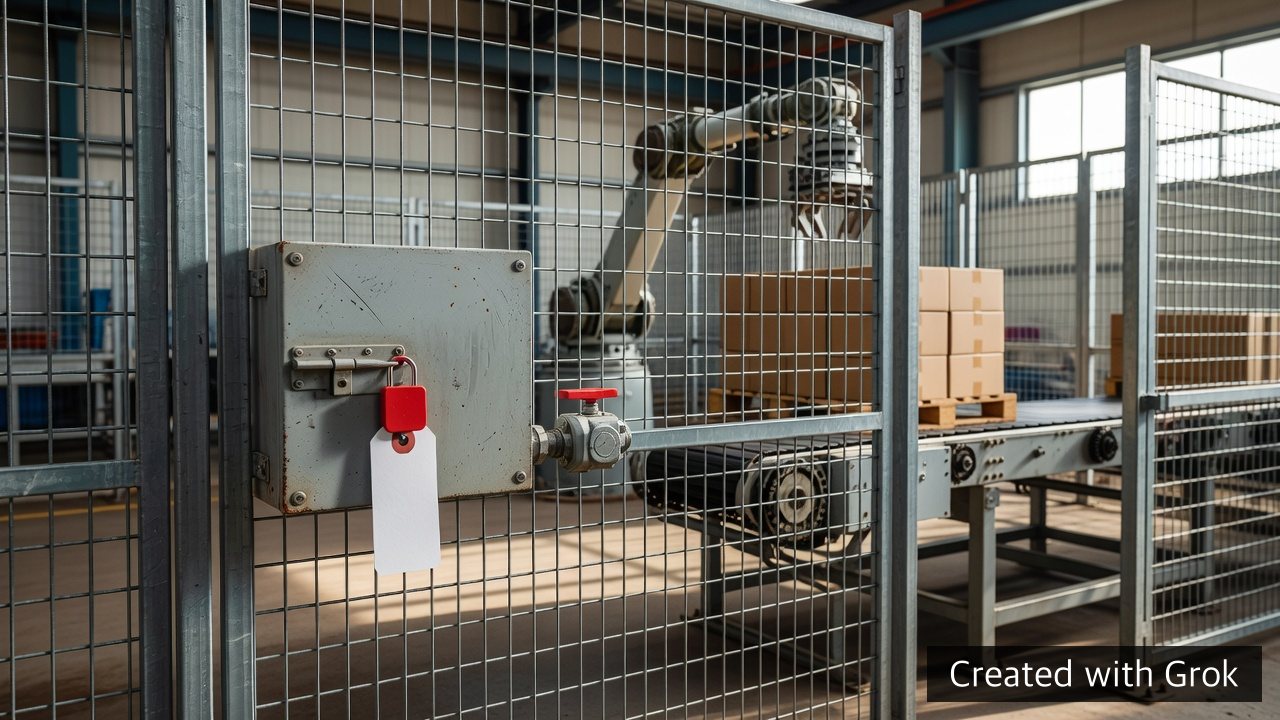
A stop button is not energy isolation
Article 92 of Korea’s Rules on Occupational Safety and Health Standards addresses servicing, cleaning, inspection and repair of powered machinery when hazards may arise: stop the machine and take necessary measures such as locks or signs to prevent another person from starting it. It also addresses releasing hazardous compressed gas or liquid before work. Its application to a particular machine and job must be assessed on the actual facts.
A two-page Korea Occupational Safety and Health Agency (KOSHA) LOTO guide from 2020 sets out a sequence: notify → stop → disconnect and account for residual energy → apply locks/tags and control keys → work → check the equipment and workers’ safety → have the responsible people remove their controls → notify and restart. Its checklist calls for machine-specific procedures, identified energy sources, designated maintenance personnel, confirmation that other workers are safely positioned before removal and notice after release. The guide is procedural background, not a ready-made list of isolation points for every plant.
A packaging cell may involve electrical power, robot axes, conveyors, lifts and grippers, pneumatics or hydraulics, and a suspended load. Identify only the hazards actually present on that machine, using its drawings and the manufacturer’s procedure. An emergency stop, alarm stop or normal stop is not proof of full hazardous-energy isolation. Equally, do not blindly press a start button to “test” isolation: an authorized person must follow the machine’s approved verification procedure from a safe position.
Handoff from entry to restart
This table is our proposed operating handoff, not a statutory KOSHA form. Assign responsibilities according to site authorizations, the manufacturer and the work-permit system. Tie every entry to one record: machine/zone · work ID · time/shift · entrants · isolation points · verifier · restart approver. When multiple people enter, one person’s verbal “done” cannot stand in for the others’ withdrawal or control removal.
On a narrow screen, swipe the table sideways if it overflows.
| Stage and trigger | Required handoff, evidence and hold condition |
|---|---|
| 1. Fault or stop, guarded-zone entry needed | Production identifies the machine, last motion, alarms and every intended entrant; records the work ID and handoff time. Hold if scope or people are unclear. |
| 2. Inspection planning | Authorized maintenance identifies isolation points and stored energy from drawings/procedures; informs affected people. Hold if energy sources, hanging loads, pressure or moving members remain unassessed. |
| 3. Before entry | Authorized personnel stop, disconnect, lock/tag, control residual energy and verify safe isolation using an approved method; record lock/keys and verifier. Hold if isolation or verification fails. |
| 4. Multiple entrants or shift change | The work leader reconciles each person’s entry and task status and applies the site’s approved individual-lock and shift-handoff method; record names and times. Hold if someone is unaccounted for or protection lapses during changeover. |
| 5. Work finished | Maintenance checks tools, temporary repairs, guards and interlocks, then confirms the safe location of each entrant and an empty zone; record the roll call and equipment check. Hold if even one location is unknown. |
| 6. Release and restart | Each responsible person removes his or her protection under the approved procedure and hands off to production. The starter checks the empty zone, portable controls/tools, fault indications and agreed signal; records release, approval and trial outcome. Hold for mismatched personnel records, abnormal indications or an unauthorized start request. |
KOSHA’s Safety Technical Guideline for the Use of Industrial Robots, M-61-2017 describes precautions for industrial robots within its scope. Its sections 6.2.1–6.2.2 cover signaling for multiple workers, checks after an emergency stop and preventing another person’s inadvertent switch operation. Section 6.3.1 requires, before startup, an empty operating range, portable controls and tools in place, no abnormal indication, and the prescribed signal to relevant workers. Section 6.3.2 calls for checking the automatic-operation indication after startup and, before entering the operating range to address an abnormality, stopping the robot and taking measures—such as carrying the safety plug and marking the start switch as work in progress—to prevent anyone else from operating it. This 2017 guide is not an accident finding and does not replace current law; confirm current site and manufacturer requirements before applying it.
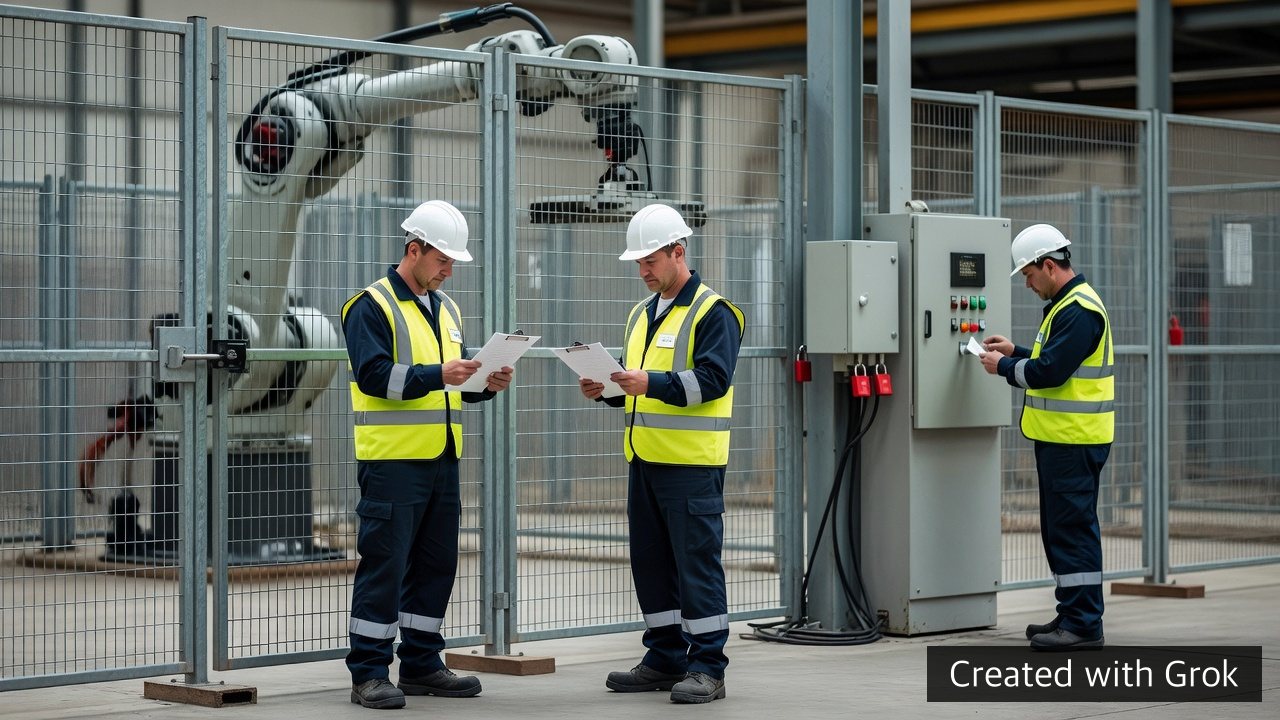
When a diagnostic test briefly needs power
If fault-finding genuinely requires power, do not casually skip the maintenance lockout. Design a separate authorized sequence: stop work → withdraw people and tools from the hazard zone → establish a controlled test mode and boundary → test only as needed → stop, re-isolate and verify before re-entry. This is not a claim that a powered diagnostic test occurred in Goseong. The U.S. 29 CFR §1910.147(f)(1) describes a temporary-energization sequence for testing or positioning; §1910.147(e)(2) addresses checks before removal of energy controls. Those U.S. rules are comparative guidance, not direct Korean legal duties. Match any local test or teaching mode to the manufacturer, the site’s risk assessment and applicable Korean requirements.
The practical deliverable is not a one-word “restart OK.” It is a work-ID-linked record of who entered, where each person is now, who applied and removed isolation, what was checked at the guard and control panel, who gave the signal and who approved restart. If a single field remains unverified, hold the restart and ask the maintenance/work leader and safety lead to reconcile it. That improvement does not require prejudging the cause of any particular accident.
About the Author
PackingMaster: Editor of PaperPackLog, covering paper-packaging industry developments, products and technical decisions.
References
- Hyundai Economic News, “멈춘 포장로봇 점검하다 참변…40대 작업자 압착돼 숨져” — incident reporting based on police statements, September 28, 2026 (Korean).
- Korean National Law Information Center, Rules on Occupational Safety and Health Standards, Article 92 — promulgated September 1, 2025; effective March 2, 2026; accessed September 30, 2026 (Korean).
- KOSHA, “LOTO(잠금장치, 표지판) 작업절차 바로알기” — two-page procedural guide marked 2020 (Korean).
- KOSHA, “산업용 로봇의 사용 등에 관한 안전 기술지침,” M-61-2017 — issued November 27, 2017 (Korean).
- U.S. eCFR, 29 CFR §1910.147, Control of Hazardous Energy — comparative U.S. source, checked against the official September 25, 2026 XML.