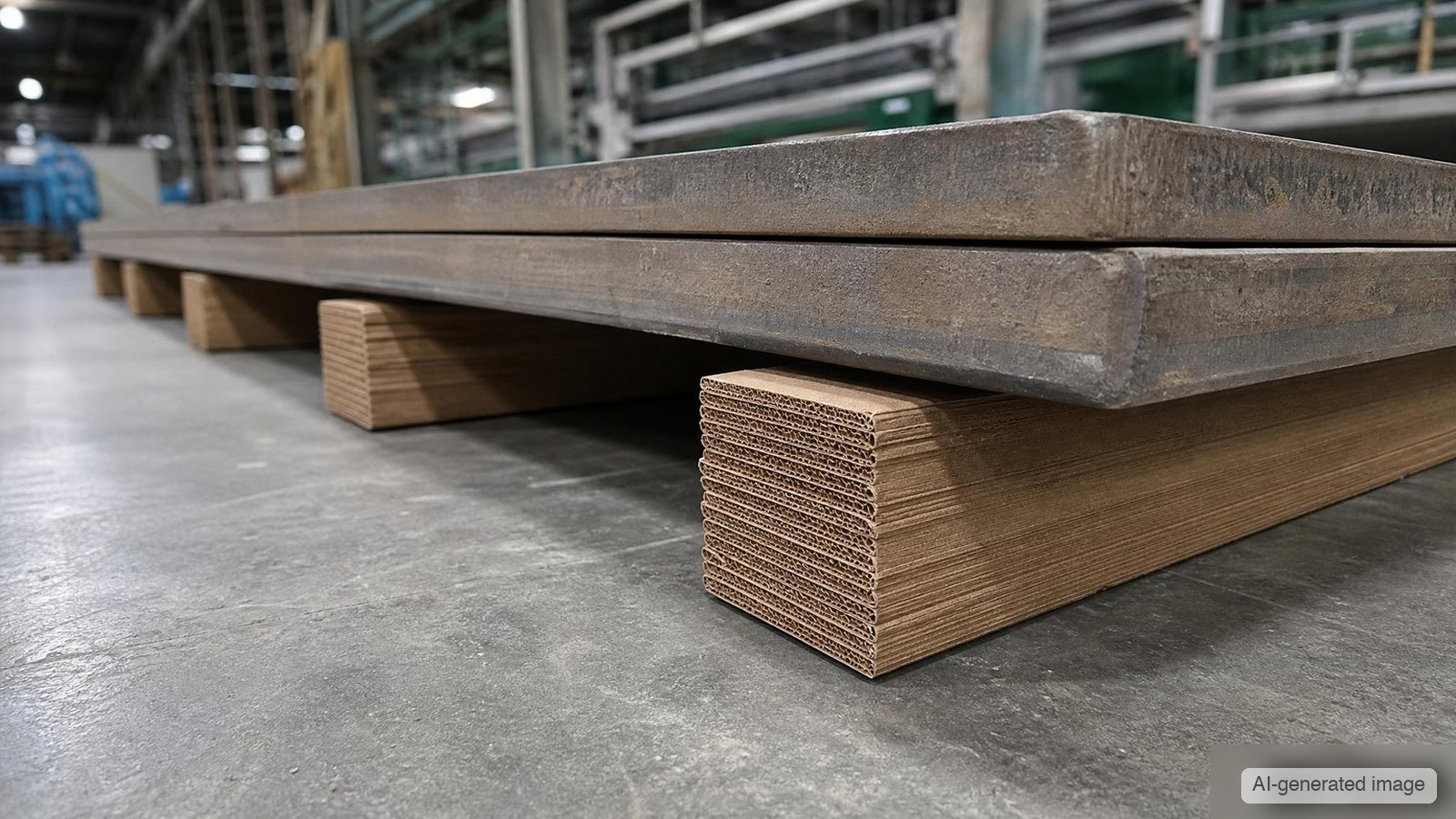
Heavy products often need to be lifted off the floor for storage or moved by forklift. Many sites rely on wood blocks, lumber runners, skids, or pallets, but when export packaging and recycling workflows matter, paper support blocks are also worth evaluating.
This article is not about paper pallets or flat paper boards. It focuses on standalone paper support blocks and explains how to assess load, storage, moisture exposure, placement, and end-of-life conditions when using them as block or skid alternatives.
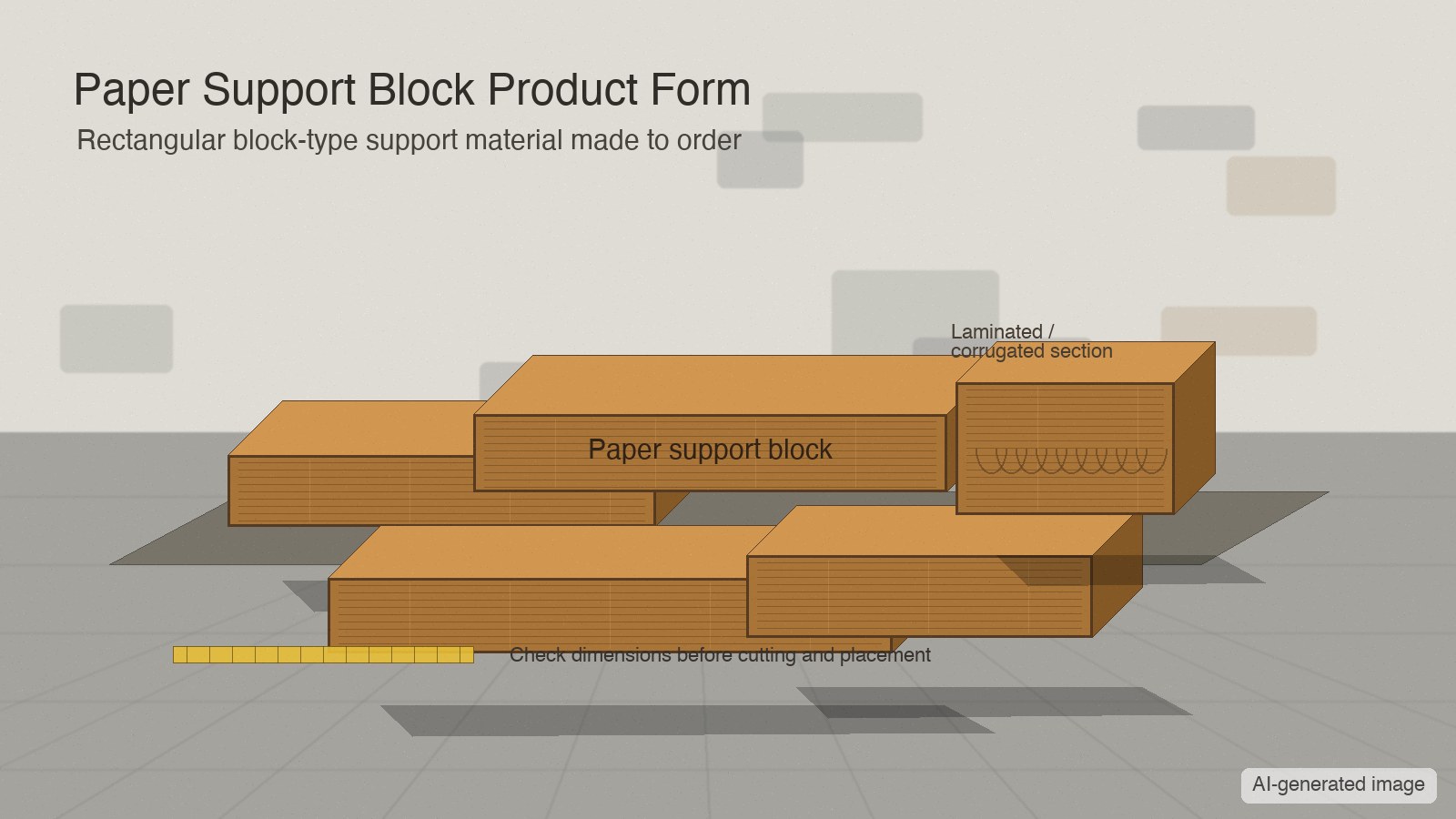
Paper support blocks are paper-based packaging components used to support heavy products. Product specifications commonly highlight custom sizes ranging from 60 mm to 100 mm in width, 20T to 50T in thickness, and 200 mm to 1,000 mm in length, along with high compressive strength.
What Do Paper Support Blocks Do?
The main function of a paper support block is to create clearance between the product and the floor while carrying the product load. It may look like a simple accessory, but in practice it has a direct impact on transport and storage stability.
| Function | On-Site Benefit | What to Check |
|---|---|---|
| Floor clearance | Reduces contact with moisture and contamination | Floor condition, storage duration |
| Forklift access | Easier moving, loading, and unloading | Fork entry direction, spacing between blocks |
| Load support | Helps prevent deformation at the product base | Total weight, contact area |
| Skid replacement | Reduces wood use | Export destination, phytosanitary requirements |
| Easier disposal | Potential compatibility with paper recycling streams | Local disposal rules |
Paper support blocks are not sheet materials that support the full bottom surface. They are closer to structural runners placed at intervals, so support position and spacing are critical.
Sites Where Wood Block Alternatives Make Sense
Wood blocks are strong and familiar, but they are not always the best option. Paper support blocks can be considered under the following conditions:
- Product damage from wood splinters, nails, or fragments is a concern
- The packaging team wants to reduce the burden of wood inspection or fumigation for export packaging
- The package is single-use, so disposal and recycling convenience matter more than return logistics
- The product image calls for paper-based, lower-impact packaging materials
- Width, thickness, and length need to be adjusted to match the product base structure
- Storage is indoors and transport is short-term, with limited moisture exposure
This does not mean paper support blocks can replace wood blocks in every case. High-humidity environments, long-term outdoor storage, or sites with repeated heavy impacts may require additional reinforcement or a different material.
How to Evaluate Load Conditions
Load condition is the most important factor when selecting paper support blocks. Total weight alone is not enough. A 500 kg product can behave very differently depending on whether its weight is distributed across three blocks or concentrated on two, and whether the product base is flat.
Check the following items first.
| Item | Description |
|---|---|
| Total product weight | Actual weight including the product and packaging materials |
| Number of blocks | Load distribution structure, such as two, three, or four rows |
| Contact area | Area where the product base touches the support blocks |
| Concentrated load points | Corners, legs, frames, or the center of a roll |
| Stacking tiers | Whether additional products will be stacked on top |
| Transport impact | Forklift handling, container vibration, loading and unloading shock |
Compressive strength is essential for paper support blocks, but it must be evaluated together with the real contact conditions of the product. If the product does not sit evenly on the blocks, load may concentrate on only a few points.
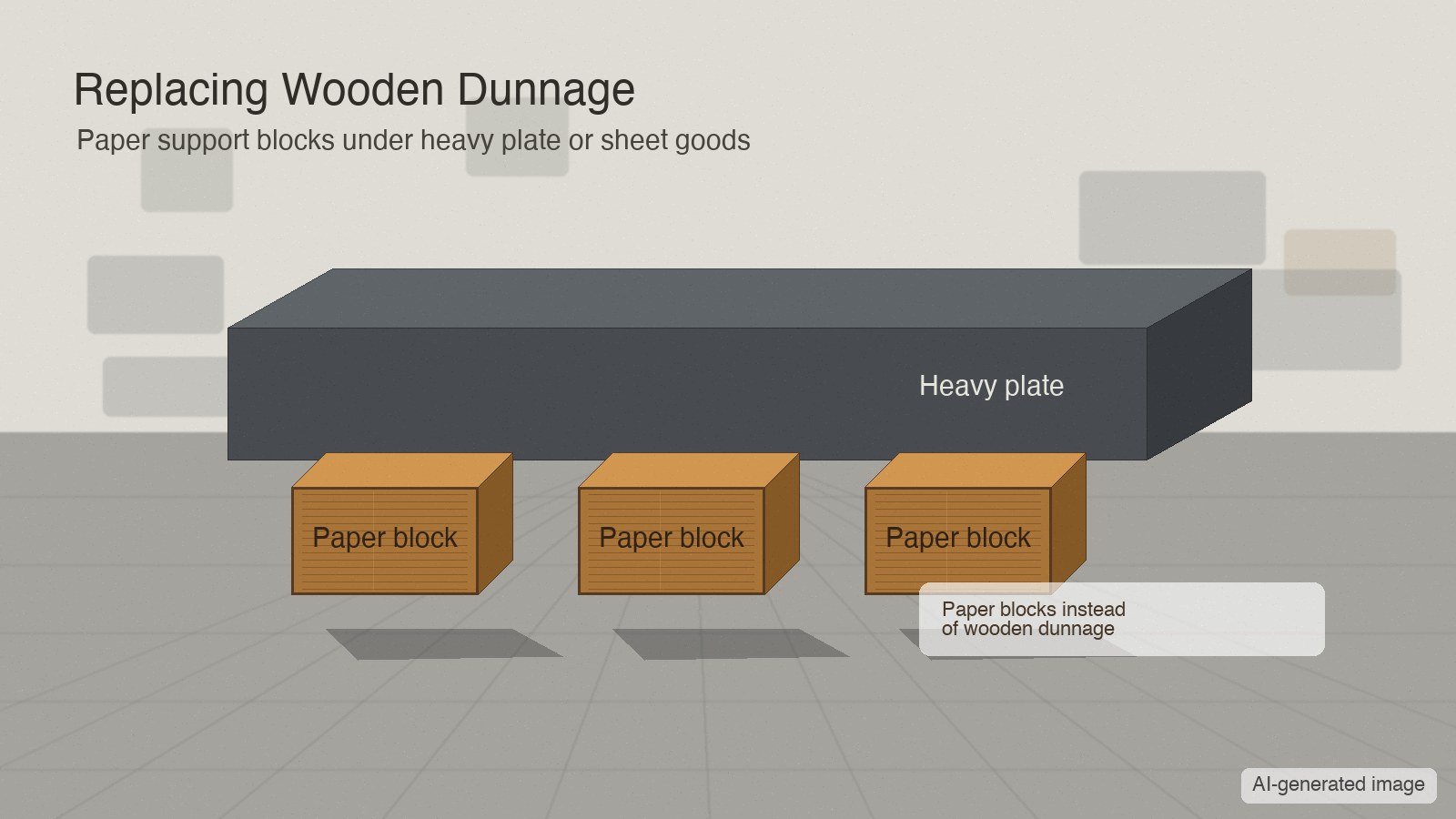
Checkpoints for Skid Packaging
Skid packaging uses a simpler support structure than a pallet to move products. When using paper support blocks like skids, confirm forklift access and product fixation first.
1. Block Spacing
Leave enough clearance for forklift forks to enter. If spacing is too narrow, handling becomes difficult; if it is too wide, the product base may sag.
2. Fixation Method
If the product and support blocks move independently, the load can shift during transport. Review the fixation method together with the block design, such as strapping, wrapping, adhesive, or corrugated reinforcement sheets.
3. Floor Contact Area
If the floor-facing contact area of the block is too small, pressure becomes concentrated. Check indentation and friction based on the condition of the warehouse floor, container floor, or vehicle bed.
4. Product Base Structure
Support positions change depending on whether the product base is flat, frame-based, or has protruding parts. It is best to design the layout using product drawings or actual product photos.
Moisture and Storage Conditions
Moisture conditions must be reviewed carefully for paper-based support materials. Short-term indoor storage and long-term outdoor storage are completely different environments.
| Environment | Review Direction |
|---|---|
| Short-term indoor storage | Standard paper support blocks are often applicable |
| Rainy-season inbound and outbound handling | Check floor moisture and packaging waiting time |
| Refrigerated or frozen storage | Review condensation and possible strength loss |
| Ocean freight | Check container humidity and whether desiccants are needed |
| Outdoor storage | Separate moisture protection is usually needed rather than standalone use |
When using paper support blocks, storage time matters as much as product load. A structure that works during short transport can still lead to compression or deformation during long-term storage.
Comparing Wood, Plastic, and Paper Support Blocks
| Item | Paper Support Block | Wood Block | Plastic Skid |
|---|---|---|---|
| Weight | Relatively light | Generally heavy | Varies widely by product |
| Phytosanitary burden | Lower than wood | Requires export-related inspection management | No wood inspection required |
| Recycling | Can often use paper recycling streams | Requires waste-wood handling or reuse | Needs a return or recovery system |
| Strength | Design and compression conditions must be checked | Strong for heavy loads | Many products are suitable for repeated use |
| Moisture | Requires caution | Mold and moisture-content issues may occur | Relatively resistant |
| Customization | Width, thickness, and length can be customized | Can be cut and processed | Mold and standard-size constraints may apply |
Paper support blocks are advantageous when single-use export packaging, indoor storage, custom dimensions, and recycling convenience are priorities. Wood is strong for heavy loads and rough handling, while plastic is often suitable for reusable logistics systems.
Information to Prepare Before Requesting a Quote
Before requesting a quote for paper support blocks, prepare the following information.
| Item | Details |
|---|---|
| Total product weight | Weight including the product and packaging materials |
| Product base structure | Flat base, frame, legs, or protruding parts |
| Number of blocks | Expected layout, such as two, three, or four rows |
| Dimensions | Width, thickness, and length |
| Use position | Under the product, under a box, or under a machine frame |
| Handling method | Forklift, hand pallet truck, crane, or manual handling |
| Storage conditions | Indoor, outdoor, refrigerated, or ocean freight |
| Fixation method | Strapping, wrapping, adhesive, or reinforcement sheets |
| Packaging volume | Monthly usage, order quantity, and delivery bundle size |
This information allows the supplier to determine the necessary compressive strength and dimensions. Simply asking for a “thicker block” can lead to over-specification or a design that does not match the actual support points.
Field Test Method
Before applying paper support blocks in production, run a small field test.
- Match the support positions using the actual product weight.
- Confirm forklift fork entry and movement.
- After strapping or wrapping, check whether the blocks slide out of position.
- Store the test load for at least 24 hours and inspect compression or deformation.
- If moisture is a concern, run a separate exposure test with samples.
- After shipment, confirm whether the customer site can dispose of and sort the material properly.
Testing should cover product protection, workability, and disposal convenience together. A support block is both a packaging material and a logistics handling component.
Conclusion
Paper support blocks are practical paper-based packaging materials that can replace wood blocks and skid packaging in the right applications. However, the selection criteria are not simply about being paper-based or recyclable. Load, contact area, block spacing, moisture, storage duration, forklift workability, and disposal conditions must be reviewed together.
Before requesting a quote, purchasing teams should organize the product’s total weight, base structure, block layout, storage environment, and handling method. With this information, it becomes much easier to avoid over-specification while choosing a safe paper support block structure.
About the Author
PackingMaster: Editor of PaperPackLog. Covers market trends, product information, and technical insights in the paper packaging industry.
References
- Manufacturer product information: paper support blocks, https://ysung.com/products?lang=ko
- Background — European Commission: Packaging waste, https://environment.ec.europa.eu/topics/waste-and-recycling/packaging-waste_en
- Background — EPA: Paper and Paperboard — Material-Specific Data, https://www.epa.gov/facts-and-figures-about-materials-waste-and-recycling/paper-and-paperboard-material-specific-data
- Background — FEFCO: Easy to recycle, https://www.fefco.org/circular-by-nature/easy-to-recycle