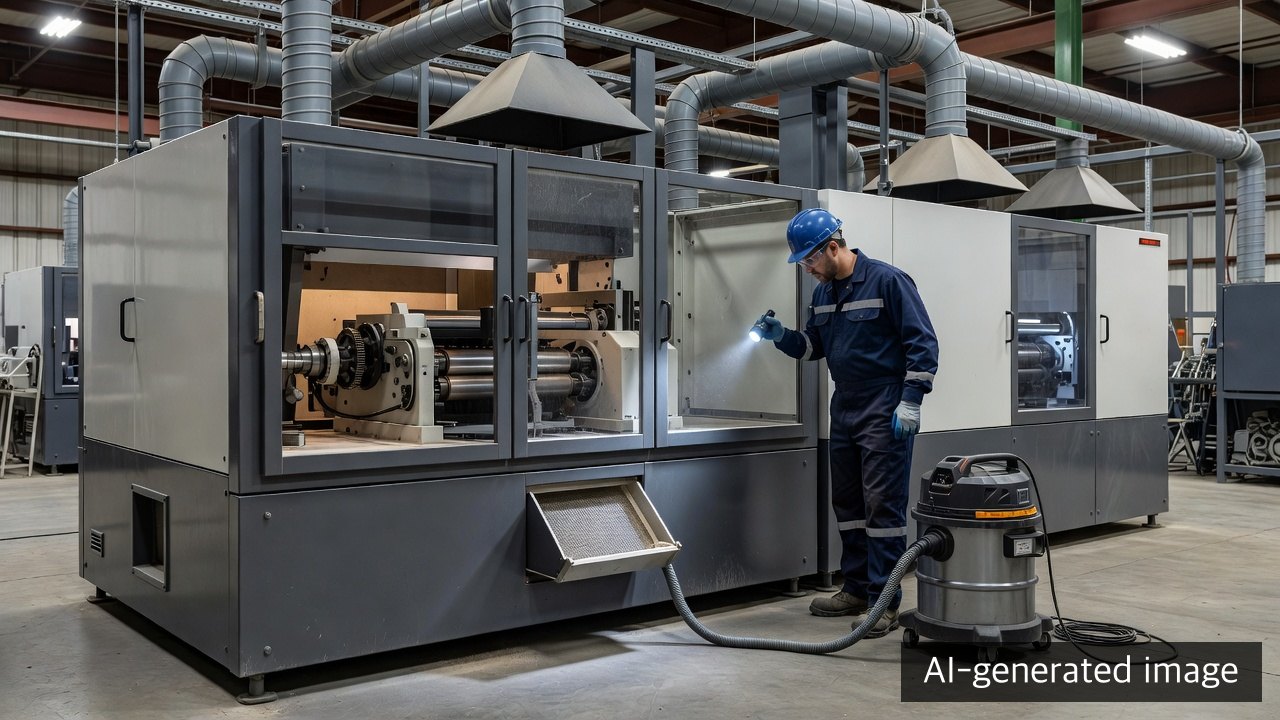
A floor around a slitter or die cutter can look clean while fine paper dust remains inside ducts, on cable trays, above motors, on roof members or in a dust collector. Blowing machine cavities with compressed air may make the visible surface look clean, but it can suspend dust and move it into hidden areas. Where an ignition source exists, that cloud can increase the hazard.
Paper-dust housekeeping is not cosmetic work. It must connect capture at source, accumulation inspection, ignition control, safe recovery and change records. The SOP below does not invent one dust thickness or calendar interval. Each facility should fill the trigger values from its dust characteristics, generation rate, collector performance, equipment geometry and ignition-source risk assessment.
Paper and pulp can form combustible dust
OSHA lists paper and pulp among materials that can be explosible in dust form. A material that burns slowly as a large piece can burn rapidly when finely divided and suspended in air at a suitable concentration under the right conditions.
A severe dust event typically connects:
- combustible fine particles;
- airborne dispersion;
- an ignition source;
- confinement in equipment, ducting, a collector or a room; and
- secondary dust on floors, beams or ducts that can be disturbed.
The assessment therefore cannot stop at the floor. It should include collectors, hoods, ducting, trim conveying, filters and concealed spaces where dust concentrates.
Separate NFPA 660 from local legal requirements
NFPA lists the 2025 edition of NFPA 660, Standard for Combustible Dusts and Particulate Solids, as the current edition. It consolidates NFPA 61, 484, 652, 654, 655 and 664 into one document with common and material-specific requirements.
NFPA 660 and OSHA publications are useful international references, but they are not automatically the statutory acceptance criteria for a Korean facility. Local occupational-safety, fire and electrical rules, KOSHA material, equipment instructions and the site’s risk assessment must be applied together.
Map generation points and hidden deposits first
For slitting, die-cutting and folder-gluing lines, mark at least these points on the equipment layout:
- slitter knives, trim discharge and extraction hoods;
- die-cutting, stripping and waste transfer;
- folder-gluer feed, belts, rollers and brush contacts;
- motors, bearings, brakes and electrical enclosures;
- hoods, flexible hoses, elbows, dampers and duct joints;
- collector filters, hopper, rotary valve and discharge container;
- cable trays, roof members, lights, partitions and pits; and
- areas where dust migrates after cleaning or compressed-air use.
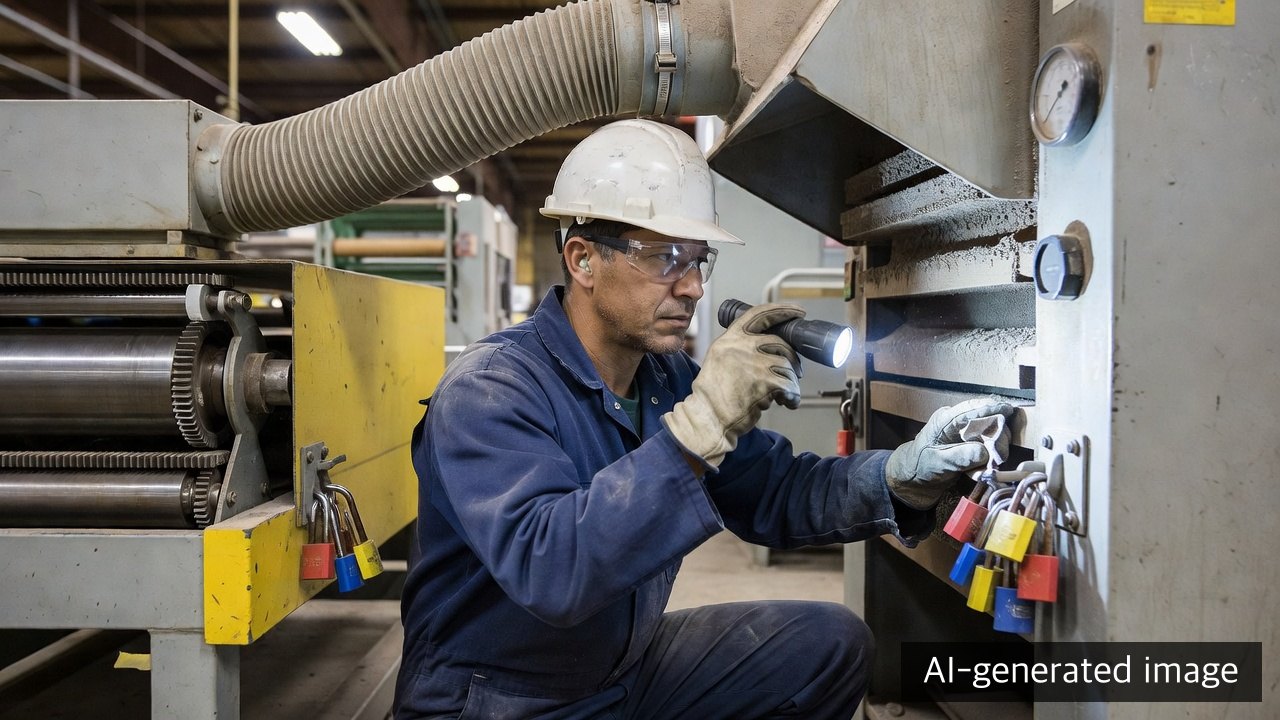
Seven-step housekeeping and dust-collection SOP
Fields marked [site criterion] must be completed from risk assessment and equipment evidence, not copied from an article.
| Step | Trigger | Owner and action | Stop-work condition | Record |
|---|---|---|---|---|
| 1. Pre-job review | Routine inspection, rising dust, collector alarm or grade change | Production hands over equipment state, dust point and recent abnormalities | Fire, smoke, heat or sparks: move to emergency procedure | Line, grade, time and handover owner |
| 2. Safe shutdown | Access inside guards, hoods, ducts or drives | Authorized person stops and isolates energy and prevents restart | Isolation unavailable, residual motion or heat | Isolation points, verifier and recovery conditions |
| 3. Ignition review | Before opening the cleaning area | Check electrical, mechanical, static, hot-surface, welding and smoking sources | Unexplained heat, smell, friction or electrical abnormality | Source list and disposition |
| 4. Source and deposit inspection | Include hood, duct, collector and concealed points | Follow [site inspection route] through visible and hidden areas | Broken filter, blockage, leak or abnormal pressure | Location condition, photos and equipment readings |
| 5. Controlled recovery | After inspection approval | Remove dust slowly with a vacuum approved for the dust and area | Unsuitable equipment, damaged hose or visible dust cloud | Equipment ID, area and recovered quantity |
| 6. Collector and disposal | Hopper, container and filter handling | Follow manufacturer procedure for enclosed discharge and removal | Hot particle, smoke, abnormal heat or unsafe discharge | Hopper, filter and disposal route |
| 7. Restore and record change | Cleaning or repair complete | Restore guards, hoods, dampers, sensors and interlocks; trial run | Leakage, weak extraction, alarm or rapid redeposit | Restart approval, cause, change and follow-up date |
Do not make compressed air or a general-purpose vacuum the default
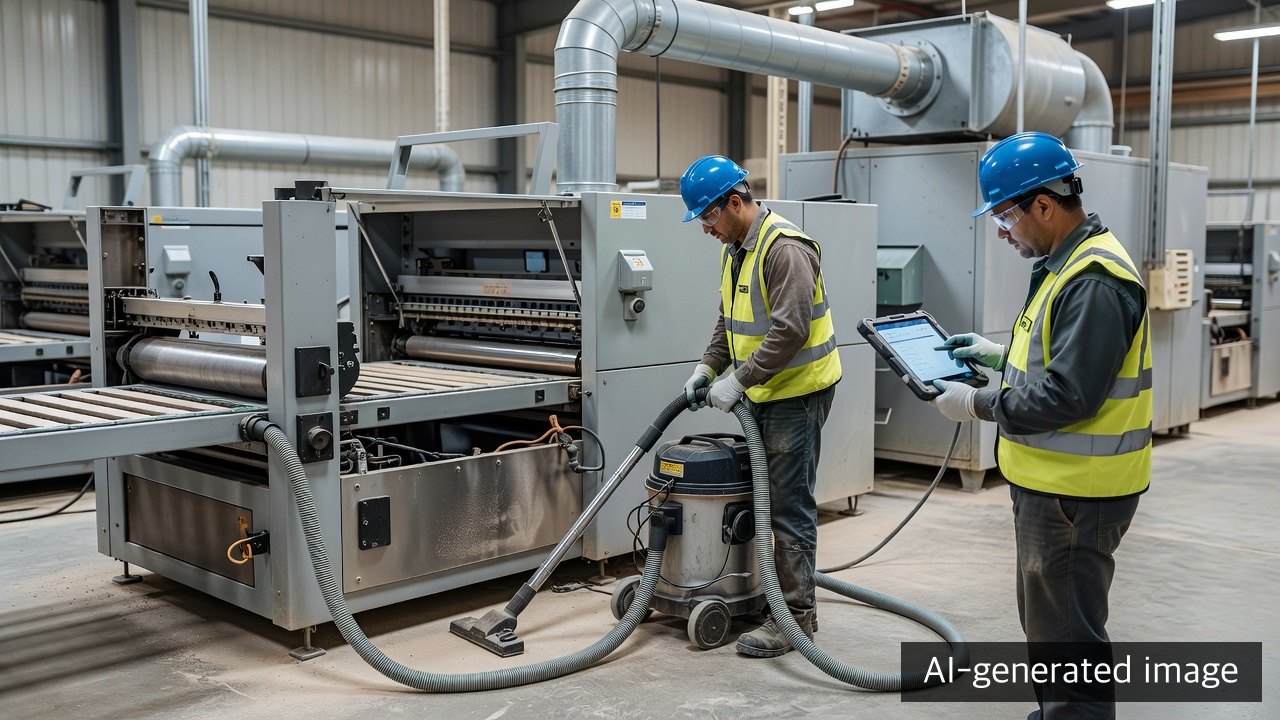
OSHA recommends cleaning methods that do not generate dust clouds when ignition sources are present and says only vacuum cleaners approved for dust collection should be used. A household or general shop vacuum should not be improvised. Electrical construction, static control, filter, container and hose must be suitable for the dust and location.
Compressed-air blowdown should not be the default cleaning method. It can redistribute material rather than collect it. If an exceptional task is proposed, a qualified safety and equipment owner should review applicable requirements, equipment design, ignition-source control, area isolation and extraction, then authorize it in writing. This article does not define an exception permit.
Set intervals from condition, not the calendar alone
“Once per day” can miss a shift with higher throughput or a dustier paper grade. Excessive full cleanouts can also add unnecessary guarded-access work. Use these inputs:
- dust generation by paper grade, flute, print and die-cut pattern;
- line speed and operating hours;
- hood airflow, static pressure or available equipment indicators;
- filter differential pressure and hopper or container condition;
- accumulation trend in open and concealed locations;
- time from cleaning to redeposit;
- knife, bearing, belt and brush wear or abnormal heat; and
- simultaneous changes in leaks, alarms, microstops and quality defects.
Build three layers: routine inspection + condition trigger + post-change reassessment. Reassess after changes to grade, speed, hood, filter, duct, cleaning equipment or method.
Signals that require shutdown and escalation
- Smoke, burning odour, abnormal heat, flame or repeated sparks
- Friction heat or abnormal noise at a bearing, brake or knife
- Abnormal collector differential pressure, airflow or alarm
- Duct blockage, detached hose, broken filter or external leakage
- Visible dust cloud during cleaning
- Unexpected heavy deposit or hot particle in a concealed area
- Unapproved cleaning equipment or damaged power, hose or grounding
- Guard, interlock, emergency stop or explosion-protection abnormality
Do not continue routine cleaning. Move to the site’s emergency response, fire procedure, energy isolation and specialist inspection.
Change-management register
| Change | Expected risk | Performance to confirm | Reapproval owner |
|---|---|---|---|
| Paper, basis weight, flute or coating | Dust quantity, size and stickiness | Generation, hood capture, filter and hopper | Production, quality, safety |
| Higher line speed | More generation and dispersion | Airflow, pressure, leak and redeposit time | Process and maintenance |
| Knife or brush change | Friction and particle-size change | Cut condition, heat and dust form | Maintenance and safety |
| Hood or duct change | Capture imbalance or blockage | Design airflow, damper and leakage | Engineering and specialist |
| Filter or collector change | Fire and explosion protection changes | Manufacturer limits, protection, discharge and interlock | Safety and engineering |
| Cleaning equipment or method | Ignition, dispersion and static risk | Equipment suitability, grounding and dust-cloud observation | Safety manager |
The objective is not a shiny floor. It is to record where dust is generated, where it migrates, why collection performance changed and which ignition sources can coincide with it. A housekeeping SOP should make production, maintenance and safety respond to the same condition-based triggers.
About the Author
PackingMaster: Editor of Paper Pack Log. We collect and organize market trends, product information, and technical insights for the paper packaging industry.
References
- NFPA, NFPA 660 Standard Development — Standard for Combustible Dusts and Particulate Solids, 2025 edition, current-edition and consolidation status verified 11 August 2026.
- OSHA, Combustible Dust: An Explosion Hazard — Overview, accessed 11 August 2026.