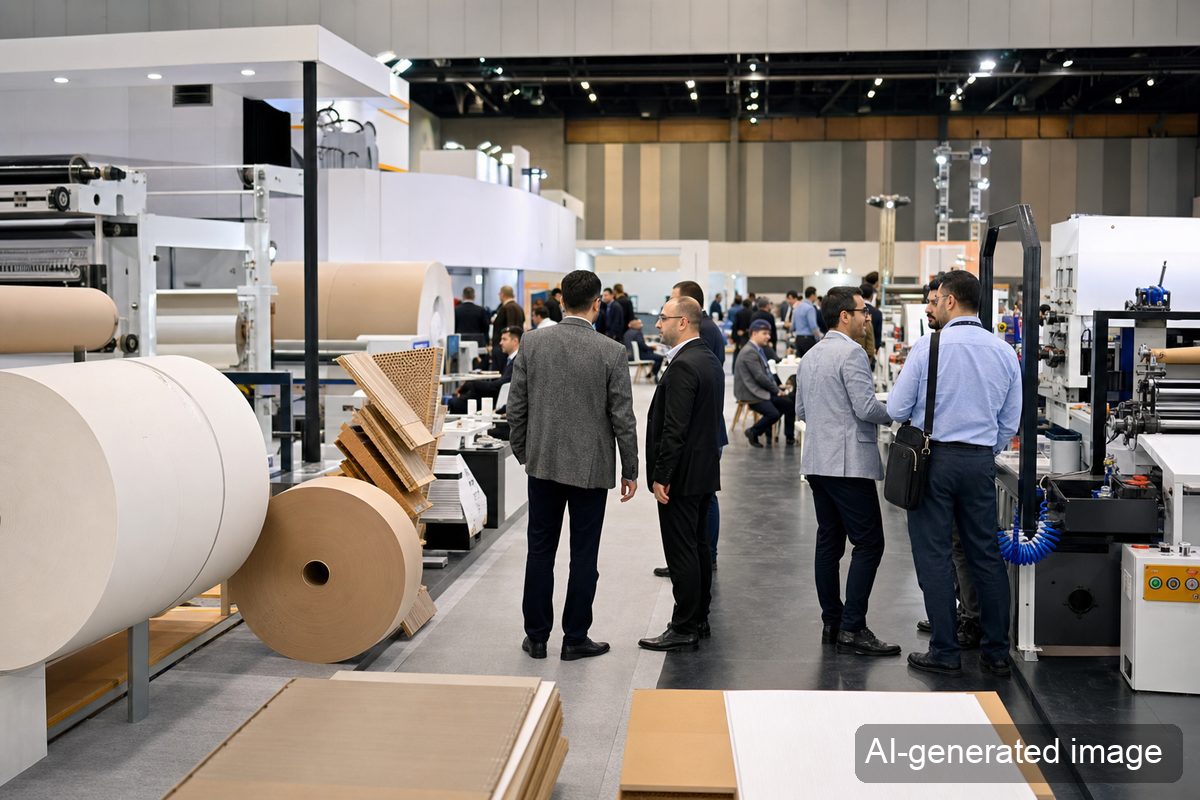
When paper packaging companies monitor global trends, they often look first at China, Japan, the United States, and Western Europe. Turkey and the broader Eurasian region deserve a separate look. Turkey connects Europe, the Middle East, Central Asia, and North Africa, and this geography matters for paper, corrugated board, hygiene paper, packaging products, and equipment.
Paper Eurasia 2026 is one event that helps show this direction. The exhibition description positions it as a Eurasian event for pulp, paper, tissue, corrugated cardboard, paper packaging, chemicals, and machinery for paper production. For packaging companies, this is more than an overseas trade fair listing. It is a window into equipment, material, and export-market signals outside the usual Western European frame.
Why Turkey and Eurasia matter
Turkey sits between Europe and Asia. For paper packaging, that location has three practical implications.
First, the customer geography is wide. Turkish suppliers and converters may serve Europe, the Middle East, Central Asia, and North Africa at the same time. Packaging specifications therefore need to reflect multiple logistics routes and buyer requirements.
Second, equipment investment and cost competition move together. Growth-market demand and European-style quality expectations can coexist. Equipment must deliver productivity, energy efficiency, recycled-fiber handling, and stable quality.
Third, the region can influence export strategy elsewhere. Even if a company does not sell directly into Turkey, its customers may expand into Eurasian markets. That can change packaging specifications, certifications, lead times, and transport requirements.

What the exhibition scope tells us
The notable point in the Paper Eurasia 2026 description is the breadth of the scope. It mentions not only pulp and paper, but also tissue, corrugated cardboard, paper packaging products, chemicals, and production machinery. This suggests a value-chain view rather than a narrow paper trading event.
Packaging companies should watch several areas.
- Corrugated and converting equipment: Box demand often brings demand for printing, gluing, die-cutting, and automated stacking equipment.
- Paper grades and recycled-fiber technology: Cost pressure and supply stability make recycled-fiber quality control and energy-saving systems important.
- The boundary between hygiene paper and packaging: Tissue, packaging paper, and specialty papers share some upstream signals but lead to different investment patterns.
- Chemicals and coating materials: Barrier performance, printability, moisture resistance, and adhesive stability expand the application range of paper packaging.
- Exhibitor and buyer geography: The visitor mix can indicate which export markets and price levels matter most.
Start with market questions, not booth plans
A common mistake in trade-fair planning is to jump directly to the question of whether to exhibit. A better first step is to define the market questions the company wants to answer.
For example:
Which packaging categories are Eurasian buyers asking for?
Food, e-commerce, industrial goods, hygiene products, agricultural packaging, and retail displays may move differently.Should suppliers compete on price or function?
Considering freight and lead times, commodity boxes may be difficult. Functional materials, design support, certification, and stable quality may be more realistic opportunities.How could equipment investment affect packaging prices?
If local corrugated capacity expands, some products may face stronger price competition. At the same time, demand for high-quality paper grades or specialty packaging may increase.Are European rules and emerging-market demand meeting in the same place?
Companies serving Europe may care about PPWR, recyclability, and labeling, while emerging-market buyers may focus more on price and delivery. The intersection of these needs can create practical opportunities.

The impact can arrive indirectly
A company does not need to export packaging directly to Turkey for this market to matter. If equipment investment increases in the region, local corrugated output and quality can improve. That can change pricing benchmarks in nearby markets. Conversely, shortages in certain paper grades or chemicals can create import opportunities.
The influence can also appear through customers. If manufacturers export products to Turkey or nearby markets, their packaging may need to handle longer transport routes, port-to-road logistics, hot and dry environments, and warehouse storage. Box strength, moisture resistance, edge protection, pallet configuration, and label durability may become more important.
This means that Paper Eurasia is not only a place to look for packaging buyers. It can also help companies anticipate how their customers’ export packaging requirements may change.
A practical checklist
To turn exhibition information into usable internal material, summarize the event around these points.
- Main fields: paper grades, corrugated board, tissue, machinery, chemicals, converting equipment
- Key themes: energy saving, recycled fiber, automation, barrier coatings, print quality
- Target regions: domestic Turkey, European export, Middle East, Central Asia, North Africa
- Possible domestic impact: competing products, collaboration opportunities, customer export packaging changes
- Items to verify: exhibitor list, seminar topics, buyer countries, local standards, certifications
This turns an overseas exhibition notice into a shared reference for sales, purchasing, packaging design, and equipment planning.
Closing thoughts
Paper Eurasia 2026 may not be an event that every company feels immediately in its domestic market. But Turkey and Eurasia sit at the intersection of European regulation, emerging-market demand, logistics routes, and equipment investment. Companies that monitor only China, Japan, and Western Europe may miss this axis.
Paper packaging companies should treat Paper Eurasia not just as a trade-fair date, but as a signal for regional paper and corrugated capacity, machinery investment, export possibilities, and changing long-distance packaging requirements.
About the Author
PackingMaster: Editor of Paper Pack Log. We summarize market trends, product information, and technical insights from the paper packaging industry.
References
- Expo in Turkey, Paper Eurasia 2026, https://www.expointurkey.org/paper-eurasia-2026