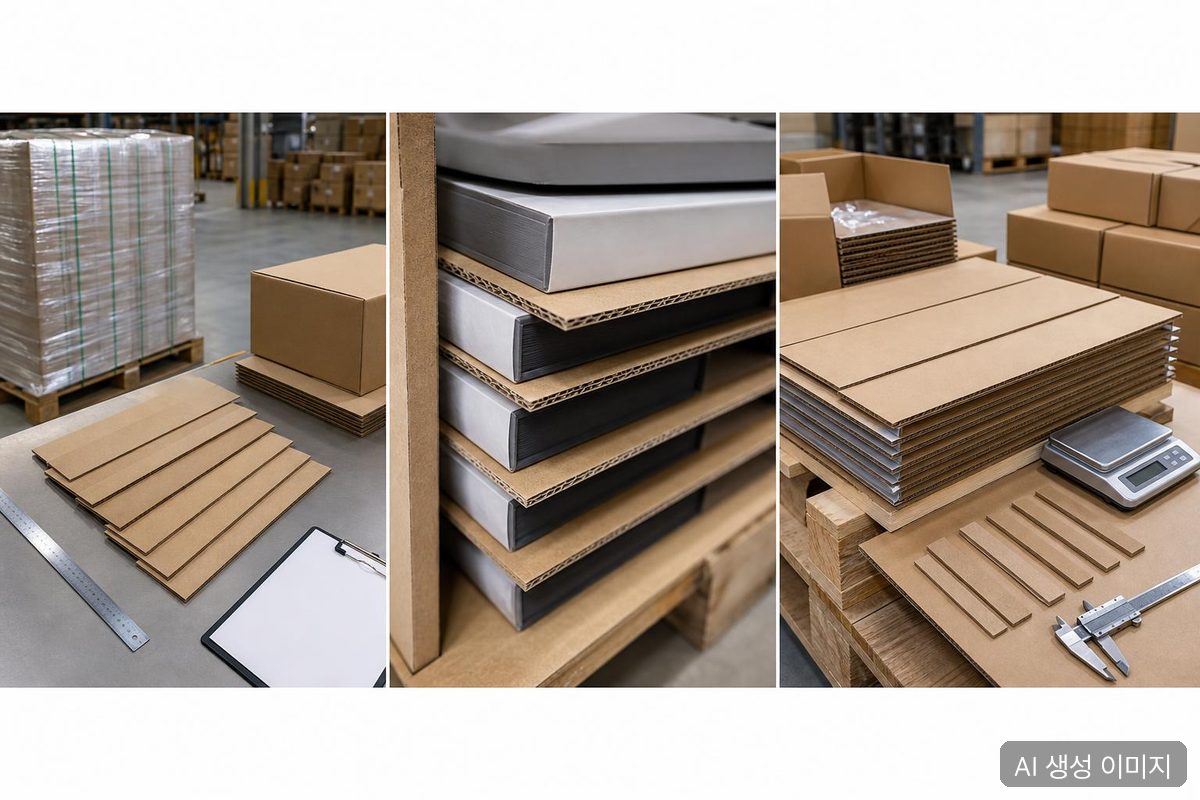
Paper flat board is not as visible as a box, but on production and logistics sites it is often used as a support panel that protects product surfaces and improves stacking stability at the same time. It can be inserted between products to reduce scratches, spread load more evenly on a pallet, and reduce floor friction or shifting during handling.
Based on product information materials, paper flat board is an eco-friendly paper packaging material used between products to protect their surfaces during packing. Available production ranges include widths from 60 mm to 200 mm, thicknesses from 2T to 10T, and lengths from 100 mm to 4,000 mm. Custom widths and lengths can also be produced.
This article does not cover paper board in general. It focuses on the criteria buyers should check when purchasing and applying paper flat board in real operations.
Where paper flat board is used
Because paper flat board is a flat paper panel, its applications may look simple. In actual operations, however, it performs several different roles.
| Position | Role | What to check |
|---|---|---|
| Between products | Surface protection, insertion, spacing | Product surface material, friction, pressure marks |
| On top of a pallet | Load distribution, bottom-surface protection | Pallet size, total product weight, loading pattern |
| Inside a box | Partitioning, reduced movement, auxiliary cushioning | Inner box dimensions, product dimensions, free space |
| Under the product | Floor-friction prevention, contamination prevention | Floor condition, moisture, handling method |
| Between stacking layers | Layer separation, shift prevention | Number of layers, compression load, sliding risk |
The key point is that paper flat board is not a cushioning material that absorbs every impact by itself. It is a panel material that stabilizes contact conditions between products. For that reason, buyers should check not only thickness and strength but also where it will be inserted and in which direction force will be applied.
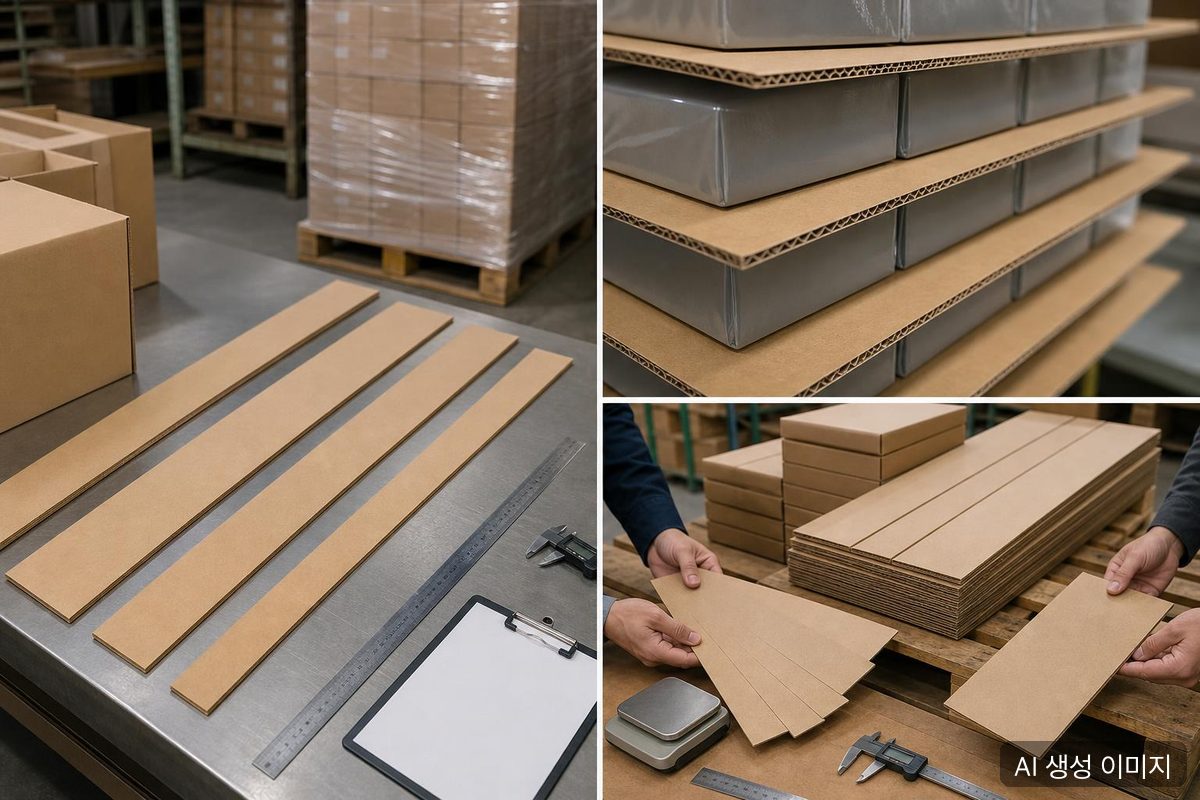
Selection criteria as a support panel for product protection
The first thing to review when choosing paper flat board is the surface of the product being protected. The requirements differ depending on whether the board is used with glossy coated products, metal parts, wound film products, outer cartons for food packaging, or electronic component boxes.
Start with these questions to make specification selection easier.
- Is the product surface sensitive to scratches?
- Will marks remain if products touch each other directly?
- Is the bottom surface narrow, causing load to concentrate in one area?
- After packing, will the product be moved by forklift, conveyor, or manual handling?
- Is there a chance the flat board will slip out or shift when the product moves?
If the purpose is surface protection, a board that is too thin may bend or move easily. On the other hand, using a board thicker than necessary increases packing height, unit cost, and storage space. The sensitivity of the product surface and the available packaging space should be reviewed together.
Pallet-loading stability and load distribution
In pallet loading, paper flat board acts as a support plate under the product. It is especially useful when the bottom of a box is uneven or when product weight is concentrated on certain corners or leg structures. In those cases, paper flat board can help spread pressure over a wider area.
Check the following items for loading stability.
| Item | How to check |
|---|---|
| Pallet size | Actual size such as 1,100 x 1,100 mm or 1,200 x 1,000 mm |
| Product layout | How many units are placed per layer and whether corners protrude |
| Total weight | Total product and packaging weight per pallet |
| Stacking layers | Single-layer, two-layer, or multi-layer stacking |
| Support position | Full-surface support or partial support |
| Handling method | Forklift, hand pallet truck, conveyor, or manual handling |
When the board is used for load distribution, its width and length should sufficiently cover the product’s bottom surface. If it is too narrow, it will not function well as a support. If it is too long, it may catch during work or bend at the edges.
Insertion, cushioning support, and partitioning between products
Paper flat board is also used between products to maintain spacing. It is especially helpful for glass, metal, painted items, film rolls, and sheet materials that can suffer surface damage when they touch each other.
In this use case, paper flat board has three roles.
- It prevents direct contact between products.
- It maintains consistent spacing and stabilizes the packing arrangement.
- It reduces minor movement and friction during transport.
However, paper flat board is not a soft sponge-type cushioning material. If the product must absorb drop impact or strong vibration, it should be designed together with paper cushioning, molded pulp, or corrugated structures. It is safer to view paper flat board as an auxiliary structural material that separates contact surfaces and supports load.
Checkpoints for moisture, floor friction, and shifting during handling
Paper-based panels are affected by moisture and friction conditions. Most problems in the field come not from the material itself but from the environment in which it is used.
1. Moisture
Damp floors, refrigerated or frozen shipping, condensation during ocean transport, and outdoor air during the rainy season can affect the strength and dimensional stability of paper flat board. If moisture exposure is expected, check the following.
- Is indoor storage possible?
- Does moisture rise directly from the floor?
- Does the product itself contain moisture?
- Is moisture-resistant packaging or a separate support material needed?
- Is the board for long-term storage or short-term movement?
2. Floor friction
When paper flat board is placed under a product, friction occurs against the floor surface. If it is too slippery, the product may shift during handling. If it is too rough, it may leave marks on the product surface. It is best to test the side that touches the product surface and the side that touches the pallet floor separately.
3. Shifting during handling
Products can move to one side during forklift travel, sudden stops, conveyor transfers, or wrapping. Buyers should confirm whether the paper flat board reduces layer-to-layer sliding or instead becomes a sliding surface.
Testing should be done using the actual stacking height and actual wrapping conditions. Pressing a single sample by hand is not enough.
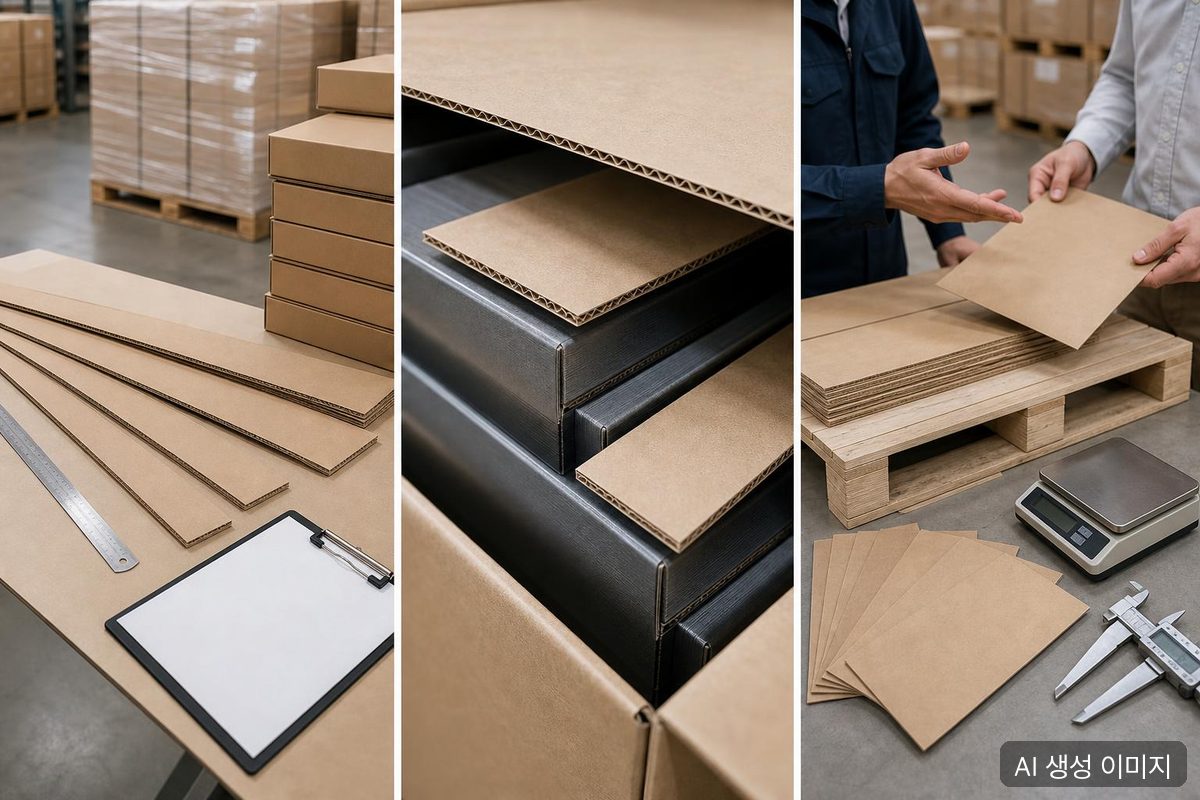
Items to confirm before requesting a quote
Paper flat board is often produced to custom specifications. To receive a quote quickly, prepare the following information in advance.
| Item | Details to confirm |
|---|---|
| Dimensions | Width, length, and tolerance |
| Thickness | Required thickness such as 2T, 3T, 4.5T, or 5T |
| Basis weight and strength | Product weight, compression conditions, required stiffness |
| Use position | Between products, under products, on top of pallets, inside boxes |
| Loading method | Single layer, multi-layer, pallet loading, container loading |
| Packing unit | Quantity per bundle, quantity per pallet, monthly usage |
| Storage conditions | Indoor storage, moisture, refrigeration, long-term storage |
| Product surface | Scratch sensitivity, coating, painting, film surface |
Rather than saying only “make it a certain T,” it is important to explain what product will be supported and where the support will be placed. Even at the same thickness, perceived strength changes depending on length, width, load direction, and stacking method.
When paper flat board is a good fit
Paper flat board is worth reviewing first when the following conditions apply.
- Product surfaces may be scratched or marked when they touch each other.
- Bottom load must be spread across a wider area during pallet loading.
- Products need to be divided simply inside a box.
- The company wants to switch from plastic panels to paper-based material.
- Width and length must be matched to product dimensions.
- The disposal or recycling flow for paper materials can be used after use.
On the other hand, if the board will come into direct contact with water, remain in a high-humidity environment for a long time, or absorb major drop impacts, it is safer to review it together with another cushioning structure rather than use it alone.
Questions buyers should ask suppliers
Before requesting a paper flat board quote, prepare these questions.
- What thickness is recommended for the current product weight and stacking height?
- Should the dimensions differ between insertion use and load-distribution use?
- What range of widths and lengths can be custom produced?
- If moisture exposure is expected, what storage or packaging conditions are recommended?
- Can sample testing confirm whether marks remain on the product surface?
- Based on monthly usage, what are the packing unit and lead-time conditions?
- Can it be designed together with paper angle board, paper blocks, or paper pallets?
Once these questions are answered, buyers can judge practical field applicability more accurately than by comparing unit price alone.
Conclusion
Paper flat board may look like a small panel, but it plays an important role in product protection and stacking stability. It reduces friction between products, distributes pallet-loading weight, and provides simple internal partitioning inside packaging.
Before requesting a quote, buyers should organize dimensions, thickness, strength, use position, loading method, packing unit, and moisture conditions. This allows the supplier to provide the necessary strength, avoid unnecessary overspecification, and propose a paper flat board suited to the actual site.
About the author
PackingMaster: Editor of Paper Pack Log. We organize market trends, product information, and technical insights from the paper packaging materials industry.
About the Author
PackingMaster is the editor of Paper Pack Log, curating market trends, product information, and technical insights for the paper packaging industry.
References
- Yoon Sung, product information: paper flat board, https://ysung.com/products?lang=ko