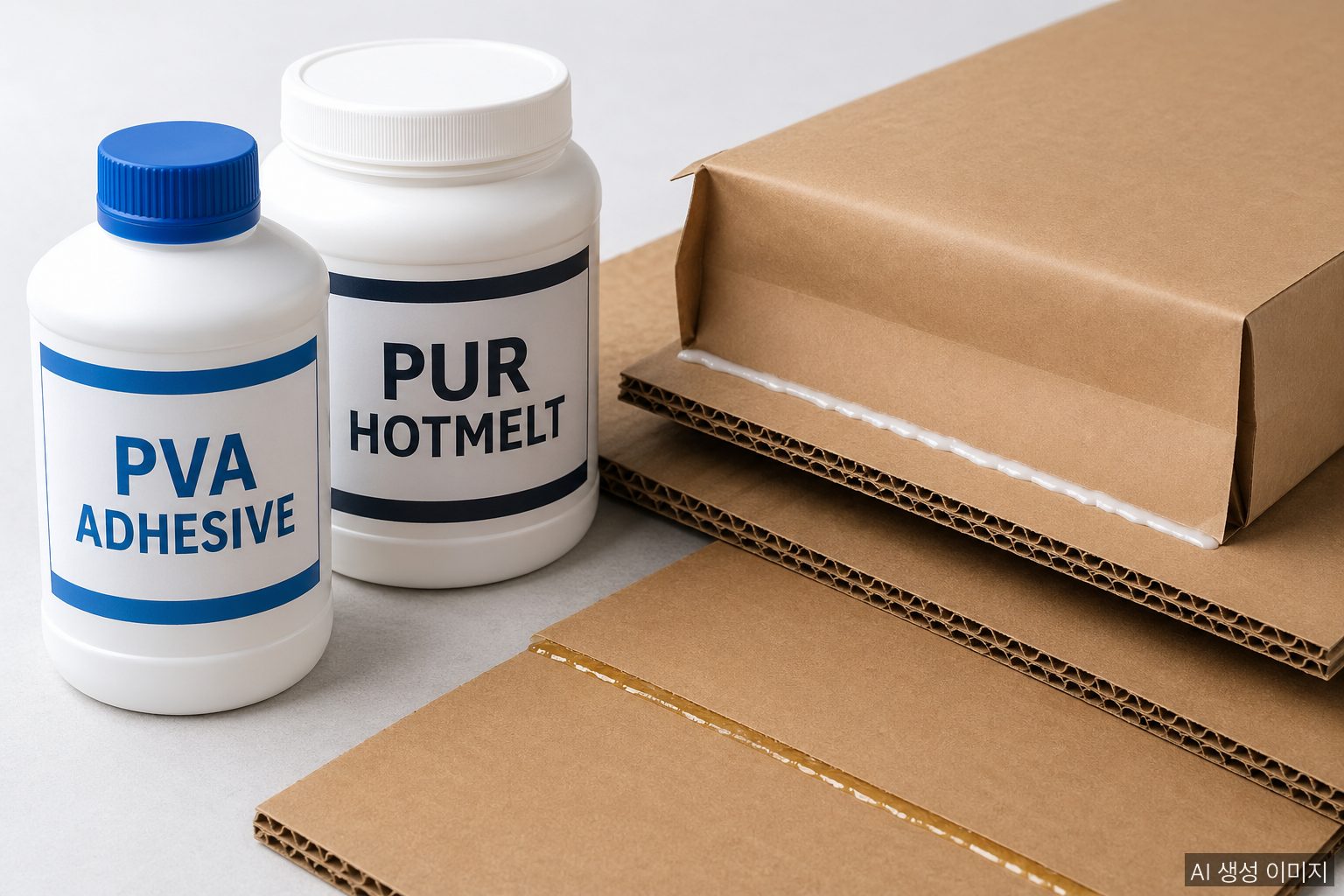
The strength of paper packaging is often determined more by the adhesive than by the paper itself. The lamination of a V-shaped angle board, the bond between corrugated liners and fluting, the multi-layer assembly of a flat board: if the adhesive fails, the paper is irrelevant. In Korea, the dominant adhesive is PoriZol (a PVAc emulsion), but waterproof environments demand something different.
The Korean Standard: PoriZol (PVAc Emulsion)
PoriZol is a brand name for polyvinyl acetate (PVAc) water-based dispersion adhesive that has become a generic term in Korea, similar to how “white glue” works in English-speaking markets.
Strengths:
- Low cost: the standard price point in paper packaging
- Water-based: virtually no VOCs, friendly to the work environment
- Fast initial tack: fixates quickly under compression
- Affinity for paper: penetrates between cellulose fibers for strong bonds
- Recyclability: repulpable along with the paper substrate
Limitations:
- Poor water resistance: bond strength drops sharply on water contact
- Heat limit: softens above 60°C
- EN 204 grade: typically D1–D2 (indoor, dry environments)
PoriZol is sufficient for paper angle boards, corrugated boxes, and flat boards in standard environments. But the limits show up clearly in:
| Environment | PoriZol Limitation |
|---|---|
| Cold-chain condensation | Bond delamination |
| Ocean container shipping | Strength loss from in-transit condensation |
| Food/beverage leakage | Bond loss on liquid contact |
| Outdoor storage | Immediate degradation under humidity or rain |
A Comparison Reference: EN 204
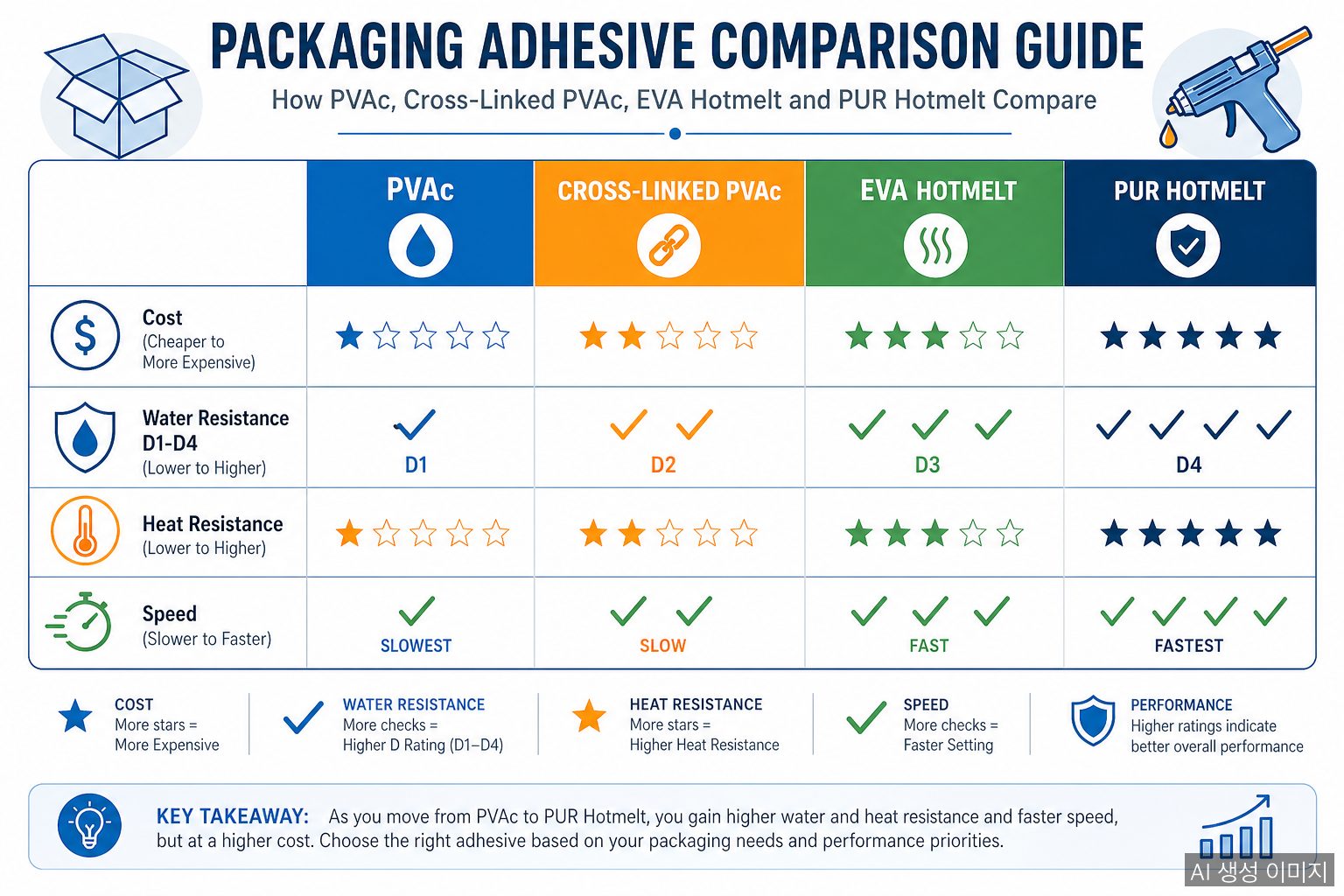
DIN EN 204 classifies the moisture resistance of non-structural thermoplastic adhesives for wood from D1 to D4. It is not a paper-packaging adhesive standard, but suppliers often cite it when describing PVAc water resistance, so it can serve as a comparison reference. Final selection still requires bond-strength testing with the actual paper, coat weight, compression conditions, and wet-exposure cycle.
| Class | Use Environment | Water Resistance |
|---|---|---|
| D1 | Indoor, dry (≤ 50% RH average) | Lowest: typical PVAc |
| D2 | Indoor, short-term high humidity or condensation | Mild water resistance |
| D3 | Indoor, frequent short-term water contact or sustained high humidity | Medium water resistance |
| D4 | Frequent long-term water exposure indoors, or exterior use with surface protection | High moisture resistance, not a permanent-immersion waterproof rating |
For paper angle boards or export-grade corrugated lamination exposed to moisture, D3/D4 claims should be used only for initial screening. Wet bond strength and strength recovery after drying must be tested on the actual packaging construction.
Four Waterproof Adhesive Options
1. Cross-linked PVAc
Adding a cross-linker (e.g., AQUENCE Catalyst R.397, isocyanate-based) at roughly 5% upgrades a D3 PVAc to D4.
- Pros: works with existing PVAc lines, modest cost increase
- Cons: limited pot life after cross-linker addition, residual disposal required
- Use cases: waterproof angle boards, export-grade corrugated lamination
- EN 204: D3 → D4 with cross-linker
2. PUR Hot Melt (Reactive Polyurethane)
The premium choice for water and heat resistance. Reacts with moisture to form a cross-linked structure that does not re-melt.
- Pros: top-tier water/heat/chemical resistance, bonds diverse substrates (paper, film, metal)
- Cons: 3–5× the cost of PVAc; requires dedicated dispensing equipment
- Use cases: premium export packaging, food-direct-contact lamination, furniture/automotive parts packaging
- Performance: D4+ after curing, stable up to 80–100°C
3. EVA Hot Melt (Ethylene-Vinyl Acetate)
Defined by fast curing speed; widely used in automated lines.
- Pros: very fast initial tack, automation-friendly, low cost
- Cons: water resistance similar to PVAc; re-melts at high temperatures
- Use cases: corrugated box sealing, general lamination where waterproofing is not required
4. Polyurethane Dispersion (PUD)
Water-based PU adhesive. Combined with a cross-linker, can achieve D4-level waterproofing plus food safety.
- Pros: water-based for ease of use; products certified for direct food contact exist
- Cons: 2–3× the cost of PVAc
- Use cases: food packaging, medical packaging, lamination requiring eco-certification
Comparison Matrix
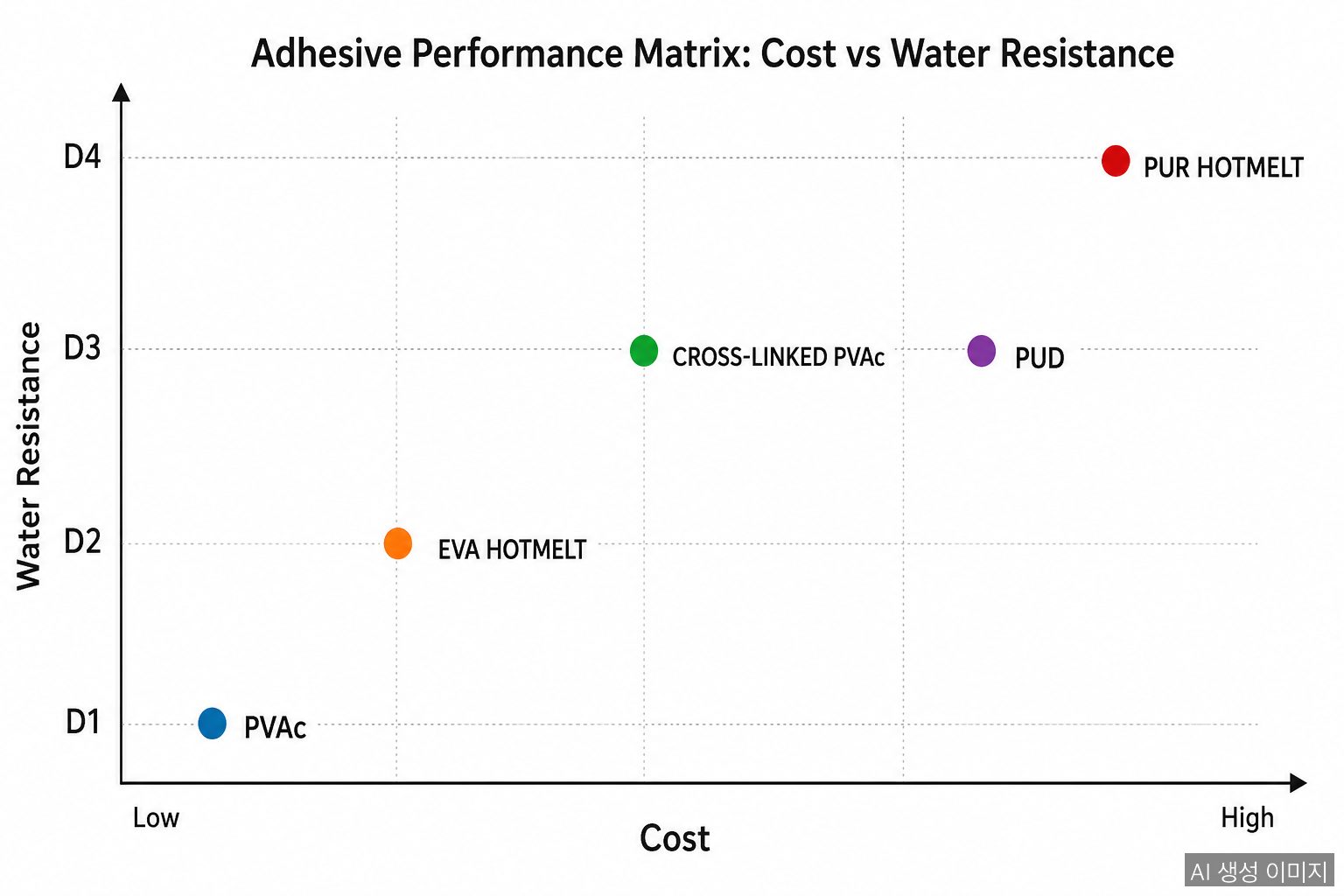
| Property | PoriZol (PVAc) | Cross-linked PVAc | EVA Hot Melt | PUR Hot Melt | PUD |
|---|---|---|---|---|---|
| Cost | ★ (lowest) | ★★ | ★★ | ★★★★ | ★★★ |
| Water resistance (EN 204) | D1–D2 | D3–D4 | D2 | D4+ | D4 |
| Heat resistance | up to 60°C | up to 70°C | up to 80°C | up to 100°C | up to 80°C |
| Application speed | Moderate | Moderate | Fast | Fast | Moderate |
| Automation | △ | △ | ◎ | ◎ | ○ |
| Recyclability | ◎ | ○ | △ | △ | ○ |
| Food contact | Limited | Limited | Limited | Certified products available | Certified products available |
Selection Guide
- Standard boxes/angles, indoor storage → PoriZol (PVAc): perfect fit
- Cold-chain or ocean export → Cross-linked PVAc or PUR hot melt
- Direct food contact → PUD or PUR hot melt (FDA-certified products)
- Single adhesive across an automated line → EVA hot melt (general) or PUR hot melt (waterproof)
- EU PPWR recyclability priority → PVAc or PUD (repulpable)
Implementation Notes
- Existing line compatibility: Plan dispenser and compression-time adjustments before introducing a new adhesive.
- Temperature/humidity management: Hot melts need precise application temperature; water-based products need controlled storage.
- Pilot testing is essential: Even within the same PUR family, bond strength varies by paper grade and basis weight.
- Recyclability certification: For EU export, verify that the adhesive is repulpable.
- Food safety certification: For direct food contact, confirm FDA (US), EU 1935/2004, or KFDA (Korea) certification.
FAQ
Q: Can I keep using PoriZol and just upgrade water resistance?
Yes. Adding an isocyanate-based cross-linker at roughly 5% can lift D2 to D3 or even D4. The trade-off is a shorter pot life that requires adjusting line operation.
Q: If PUR hot melt is so good, why isn’t everyone using it?
It costs 3–5× more than PVAc, and it requires dedicated dispensing equipment (heated nozzles, sealed cartridges). PUR also reacts with moisture during storage, requiring careful handling.
Q: Which adhesive should I use for direct food contact packaging?
Use PVAc, PUR, or PUD products certified by FDA (US), EU 1935/2004 (EU), or KFDA (Korea) as food-grade. Standard PVAc without certification is not approved for direct food contact.
About the Author
PackingMaster: Editor of PaperPackLog. Covers market trends, product insights, and technology in the paper packaging industry.
References
- Ureka, “Differences between D1, D2, D3 and D4 PVA and PU wood glues”
- Background: Kleiberit, “PVAc dispersion adhesives”
- Background: Lux-X, “Waterproof PVAc adhesive for D4 wood bonding”
- PUR Hot Melt, “Water-based adhesives for paper & board converting”
- Hotmelt.com, “Adhesives for Paperboard: Product Recommendations”
- Background: Chemix Guru, “PUR Adhesive vs EVA Hot Melt Adhesive”