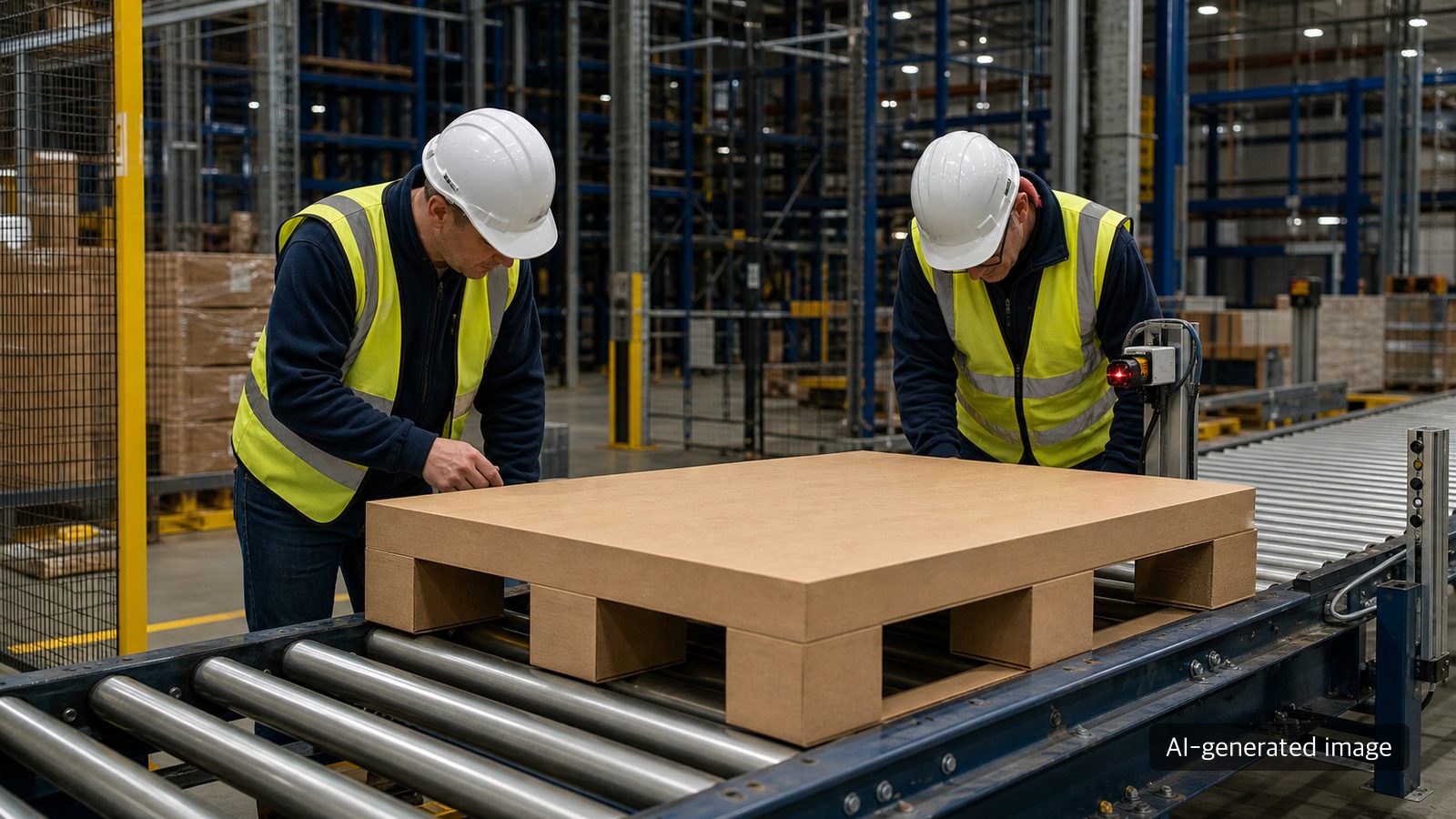
At the infeed of an automated warehouse, a compressed corner on a paper pallet can stop the conveyor, and a sensor can misread pallet orientation while the stacker crane waits. This article is for logistics and equipment teams reviewing paper pallets and paper support blocks to reduce wood-packaging quarantine burden. It provides a copy-ready automated-warehouse intake approval table that suppliers, equipment teams, and quality staff can fill out together.
Paper pallets and paper support blocks have already been covered from the perspective of export packaging, wood replacement, load, humidity, and racking conditions. This article does not repeat that product overview. The practical question is narrower: can this structure pass through the conveyor, sensors, rack supports, and fork equipment in the actual automated warehouse without stopping the system?
Source Check for the Approved Candidate and Direct Evidence
The two URLs attached to the approved topic can only be used as starting signals.
| URL | Verdict | Reason | How it is used |
|---|---|---|---|
| Pallets market forecast page | PARTIAL | It provides pallet market, material, rackable pallet, and automation context, but it does not directly define automated-warehouse approval requirements for paper pallets. | Limited to one background point |
| 2026 packaging legislation outlook page | GENERIC | It covers packaging legislation broadly but does not directly support AS/RS compatibility, ISPM 15 replacement, or paper pallet test conditions. | Excluded as a direct source |
Direct support has to come from elsewhere. The official ISPM 15 page confirms the phytosanitary scope for wood packaging material, while automated-warehouse and rack-safety technical materials show why pallet dimensions, condition, support points, and equipment interaction require a separate test. The conclusion is therefore not “paper is enough” or “ISPM 15 is avoided, so the pallet is approved.” The conclusion is: run a separate intake approval test before using the structure in an automated warehouse.
The direct evidence used for this article is recorded below.
| Source | Verdict | Confirmed point | How it is used |
|---|---|---|---|
| Official ISPM 15 text | MATCH | Confirms the phytosanitary scope for raw-wood packaging material and dunnage. | Separates ISPM 15 replacement from AS/RS approval |
| Automated-warehouse pallet technical material | MATCH | Confirms that pallet size changes, dimension and weight sensing, consistency, and pallet condition can affect AS/RS performance. | Sensor detection, orientation, and recalibration items |
| Automation and rack design recommendation | MATCH | Confirms that automated equipment and racks require product, load, dimension, and storage-medium data, plus precise tolerances for sensor navigation. | Rack support, deflection, and stop conditions |
| Pallet quality material for automated warehouses | MATCH | Confirms that automated warehouses need strict dimensional and structural requirements, flatness, rigidity, bottom condition, and interaction with conveyors and stacker cranes. | Conveyor travel and bottom-contact items |
Automated-Warehouse Intake Approval Table
The table below does not invent pass/fail numbers. Load, deflection, allowed dimensional variation, sensor detection criteria, and recalibration limits have to be agreed by the pallet supplier and equipment owner using the same sample. What the table fixes is the set of inputs, states, actions, and stop conditions.
| Test item | Input fields | Target | Trigger | Status | Owner | Action | Stop or hold condition |
|---|---|---|---|---|---|---|---|
| Fork-entry deformation | Fork width, entry direction, bottom opening height, loaded weight | Fork-entry area | First sample intake or structure change | Approved / Hold / Rejected | Logistics | Insert the actual fork and photograph compression, tearing, or snag points. | Stop if the bottom folds or support blocks shift during fork entry. |
| Conveyor travel | Pallet width and length, bottom contact area, roller or chain pitch, off-center load | Bottom contact area | First line test before AS/RS intake | Approved / Hold / Rejected | Equipment | Run empty and loaded pallets and record stop position and vibration. | Hold if skewing, jamming, abnormal vibration, or stop alarms occur. |
| Sensor detection | Pallet color, bottom voids, load height, film reflection | Detection face | New material or surface treatment change | Approved / Hold / Rejected | Equipment | Record photoeye, scanner, and load-detection results at the same position. | Reject if missed detection, false detection, or orientation error repeats. |
| Rack support | Rack-beam spacing, support direction, deck use, load distribution | Support face | Planned rack storage or AS/RS rack intake | Approved / Hold / Rejected | Warehouse | Compare rack support lines with the pallet bottom reinforcement layout. | Hold if reinforcement lines do not sit on the rack support lines. |
| Deflection observation | Loaded weight, storage time, support method, product base | Center deflection | Before loaded storage | Approved / Hold / Rejected | Quality | After the agreed storage time, record center deflection and compression marks. | Stop if deflection exceeds the agreed equipment-owner value or load concentrates on one line. |
| Humidity exposure | Storage humidity, waiting time, condensation history, moisture treatment | Bottom stiffness | Rainy-season intake, chilled transition, or post-ocean intake | Approved / Hold / Rejected | Quality | Compare fork-entry and bottom-contact deformation before and after exposure. | Quarantine if wet marks, delamination, or stiffness loss appears. |
| Pallet orientation | Two-way or four-way entry, top/bottom direction, barcode location, load pattern | Entry direction | Mixed manual and automated intake | Approved / Hold / Rejected | Logistics | Mark the orientation that keeps fork entry, sensors, and rack support aligned. | Do not approve a one-direction-only pallet without a work standard. |
| AS/RS recalibration | Existing pallet baseline, new dimensions, detection position, allowed recalibration time | Baseline values | Material or size change | Approved / Hold / Rejected | Equipment | Record whether recalibration is needed, how long it takes, and how rollback works. | Stop the change if recalibration causes existing pallets to fail. |
Inputs to Align Before Requesting Samples
The purchasing request should not simply ask whether paper pallets are possible. It should ask for the following data.
| Input | Why it matters | Evidence to request |
|---|---|---|
| Actual pallet width, length, and height | Confirms fit with conveyor width, sensor position, and rack support. | Sample measurement sheet and dimensional tolerance range |
| Bottom contact structure | Broken or discontinuous contact can cause conveyor jams. | Bottom drawing and reinforcement layout |
| Fork-entry direction | Two-way or four-way entry changes the automated intake path. | Fork-entry photos and minimum opening information |
| Loaded weight and product base | Where the load concentrates matters more than total weight alone. | Loaded layout and support-position drawing |
| Humidity and waiting conditions | Paper structures can deform or lose strength after wet exposure. | Storage condition, moisture treatment, and intake quarantine criteria |
| Sensor detection condition | Color, surface, wrap reflection, and bottom voids can cause misreads. | Sensor-by-sensor test result and failure photos |
| Recalibration requirement | A new pallet can disturb existing AS/RS baseline values. | Recalibration time, rollback method, and impact on existing pallets |
Test Sequence
- Empty pallet pass: Check conveyor movement, sensor detection, orientation read, and stop position.
- Loaded pallet pass: Add the real load and inspect fork-entry and bottom-contact deformation.
- Rack support comparison: At the rack or AS/RS storage position, confirm that bottom reinforcement matches the support line.
- Post-storage repeat pass: After the agreed storage time and humidity exposure, repeat intake and inspect deflection, skewing, and detection failures.
- Recalibration impact check: If baseline values are changed for the new pallet, run the existing pallet again.
How to Separate Approval, Hold, and Rejection
Approval does not mean the pallet merely passed once. It means the result is repeatable, operators can control orientation through the work standard, and any equipment recalibration does not damage the existing pallet flow.
Hold means the structure may work after modification. For example, the bottom reinforcement may be slightly misaligned with the rack support line, or the fork-entry area may compress only after humidity exposure. In that case, the supplier should modify the sample and rerun the same table.
Rejection means the team should stop before automated intake. If sensor misreads repeat, the bottom contact area keeps jamming on conveyors, or recalibration makes existing pallets fail, unit cost and quarantine benefits are not enough to justify approval.
Pre-Publication Duplicate-Avoidance Record
Existing articles explain paper pallets and paper support blocks as export packaging alternatives, ISPM 15 options, and load or moisture-sensitive structures. This article is not a product introduction. It is an automated-warehouse intake approval procedure focused on fork-entry deformation, conveyor travel, sensor detection, rack support, deflection, humidity exposure, pallet orientation, and AS/RS recalibration.
Four recent posts were also reviewed. The North America box lead-time post focuses on plant-transition checkpoints, the parcel overpack post on box-size validation, the hot-fill sport-cap post on supplier approval, and the wood-crate conversion post on export-packaging test planning. This article keeps the practical table format but narrows the target to paper pallets and paper blocks entering an automated warehouse, with conveyor, sensor, rack, fork-entry, and AS/RS recalibration failures as the approval gates.
What to Do Today
Purchasing should ask the supplier for test samples and a bottom drawing rather than only a catalog maximum load. Logistics should document the actual fork direction, conveyor route, rack support face, and waiting humidity condition. Equipment should confirm whether the new pallet changes existing AS/RS baseline values, and whether a rollback procedure exists.
Paper pallets and paper support blocks can reduce wood-packaging quarantine burden. But in an automated warehouse, material name matters less than whether the structure passes the system. Do not send a paper pallet into AS/RS just because it helps with ISPM 15. Only a structure that passes the approval table should move into the live line.
About the Author
PackingMaster: Editor of Paper Pack Log. We collect and organize market trends, product information, and technical insights for the paper packaging industry.
References
- IPPC, “Regulation of wood packaging material in international trade”
- Mecalux, “Pallet grades: A guide to recycled pallet quality”
- Swisslog, “Technologies to overcome challenges of pallets in AS/RS warehouses”
- Rack Manufacturers Institute, “Integrating Automation And Pallet Racks? Follow These Design Recommendations For A Successful Implementation”
- Mordor Intelligence, “Pallets Market” — approved-topic URL verdict: PARTIAL
- Pregis, “What’s Ahead for Packaging Legislation in 2026” — approved-topic URL verdict: GENERIC