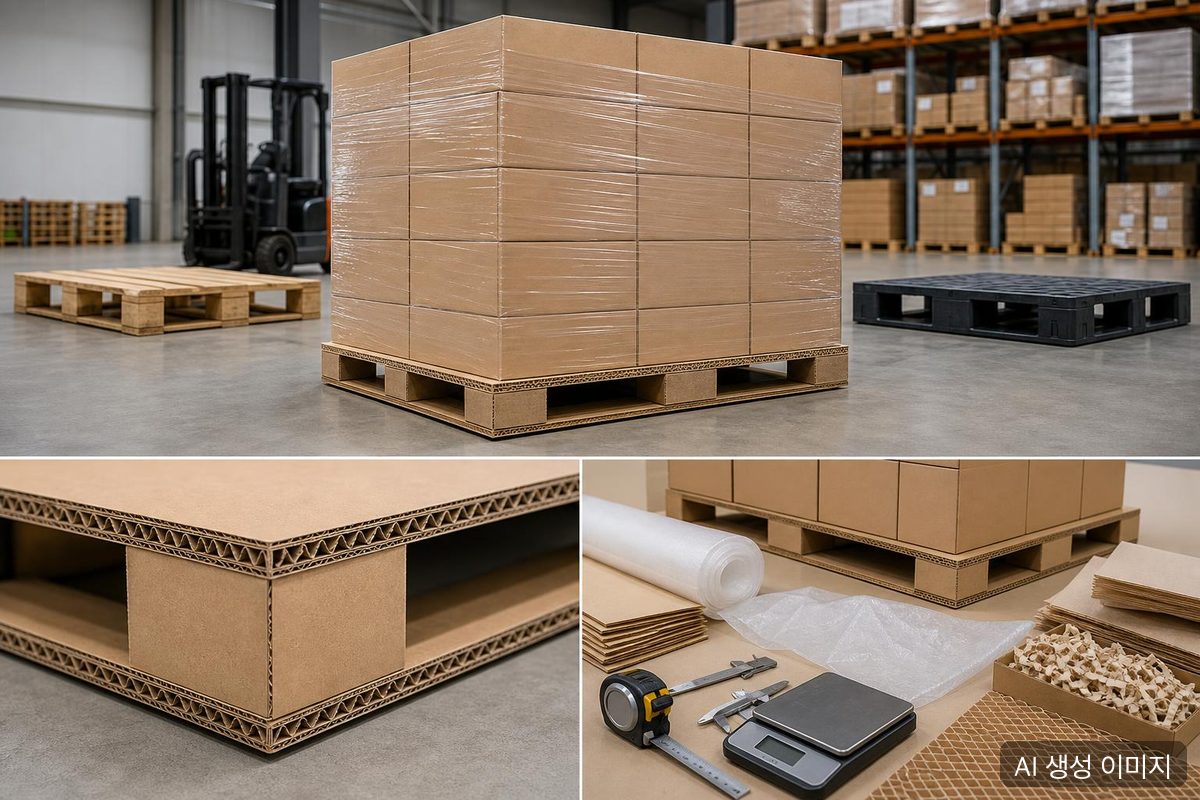
In export packaging, a pallet is not just a base. It becomes the standard by which products are moved by forklift, loaded into containers, stored in warehouses, and inspected during customs clearance. Pallet selection is therefore a purchasing decision that must consider logistics cost, damage rate, quarantine, recycling, and delivery schedules together.
A paper pallet is a pallet made from paper-based materials such as corrugated board, honeycomb board, paper tube structures, and compressed paper. It is lighter than a wood pallet, can reduce the quarantine burden associated with wood packaging during export, and is easier to recycle as paper after use. At the same time, moisture, long-term storage, rack storage, and repeated use under heavy loads require design review.
This article compares paper pallets with wood and plastic pallets and summarizes the criteria buyers should check when selecting pallets for export packaging.
What is a paper pallet?
A paper pallet is a pallet whose top deck, bottom deck, support blocks, or leg structure are made from paper-based materials. Depending on the product and application, it may be manufactured as a laminated corrugated type, honeycomb structure, paper-tube-leg type, or compressed-paper combination type.
Paper pallet suppliers commonly describe paper pallets as environmentally friendly, lighter than wood, and capable of reducing fumigation or treatment burdens when export goods are loaded. Some products present load capacities in the range of 500 kg to 2,000 kg. However, the actual applicable load depends on structure, size, top-deck reinforcement, forklift entry direction, loading method, and storage environment.
For that reason, a paper pallet should not be judged simply as “weak because it is paper” or “always good because it is eco-friendly.” It is a packaging material that often requires custom design depending on what product will be loaded, in what environment, and for how long.
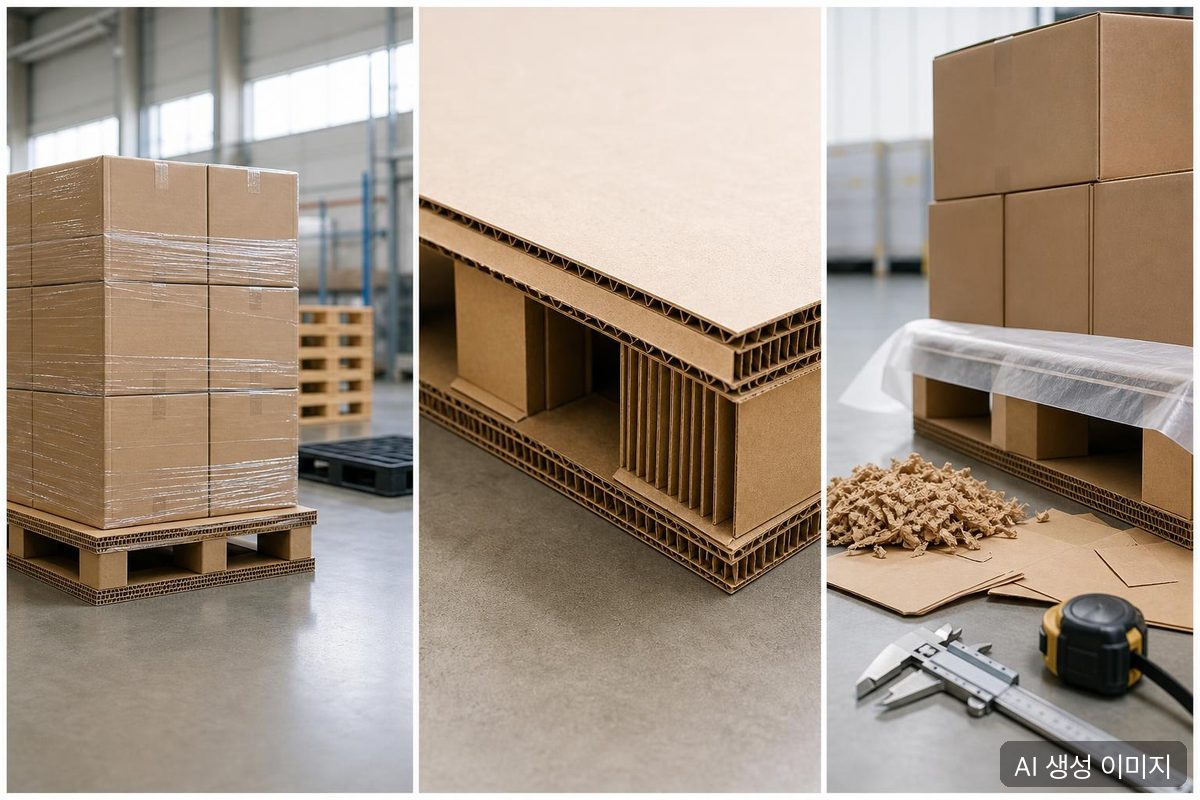
Why paper pallets are attracting attention in export packaging
The biggest reason paper pallets are reviewed for export packaging is wood packaging quarantine. USDA APHIS explains that wood packaging material used to support, protect, or carry cargo must be treated and certified according to ISPM 15. Wood packaging materials require controls such as heat treatment, fumigation, and marking to prevent the spread of pests.
By contrast, alternatives such as plywood, pressboard, plastic pallets, and hardboard are identified as options that do not fall under regulated wood packaging material in some APHIS guidance. In this context, paper-based pallets are also reviewed as an export packaging alternative that can reduce the burden of wood quarantine.
Packaging Revolution, an international packaging media outlet, lists ISPM 15 exemption, light weight, low profile, custom footprint, and reduced reverse-logistics burden as reasons paper and corrugated pallets are considered for export. Smurfit Kappa also describes corrugated pallets as a lightweight and durable alternative to wood pallets, emphasizing recyclability and weight reduction compared with wood.
Comparing wood, plastic, and paper pallets
| Item | Paper pallet | Wood pallet | Plastic pallet |
|---|---|---|---|
| Weight | Light | Generally heavy | Varies widely by product |
| Quarantine | Lower wood-quarantine burden | ISPM 15 treatment and marking required | No wood quarantine |
| Recycling | Recyclable as paper | Reused or treated as waste wood | Reusable; collection depends on material |
| Load capacity | Varies greatly by design | Strong under heavy loads | Many products are strong for repeated use |
| Moisture | May be vulnerable; coating and storage conditions must be checked | Moisture and mold issues possible | Relatively strong |
| Hygiene | Fewer dust, nail, and splinter issues | Wood splinters, insects, and mold possible | Washable products available |
| Cost | Can be favorable for one-way export | Highly general-purpose | Initial unit price can be high |
| Customization | Can be designed to product dimensions | Mostly standard sizes | Mold and size constraints possible |
Paper pallets suit one-way export, air freight, products where weight reduction is important, and shippers that want to reduce wood-quarantine risk. Wood pallets are strong for heavy loads, rough handling, and long-term storage, while plastic pallets are advantageous in returnable logistics and environments where hygiene control is important.
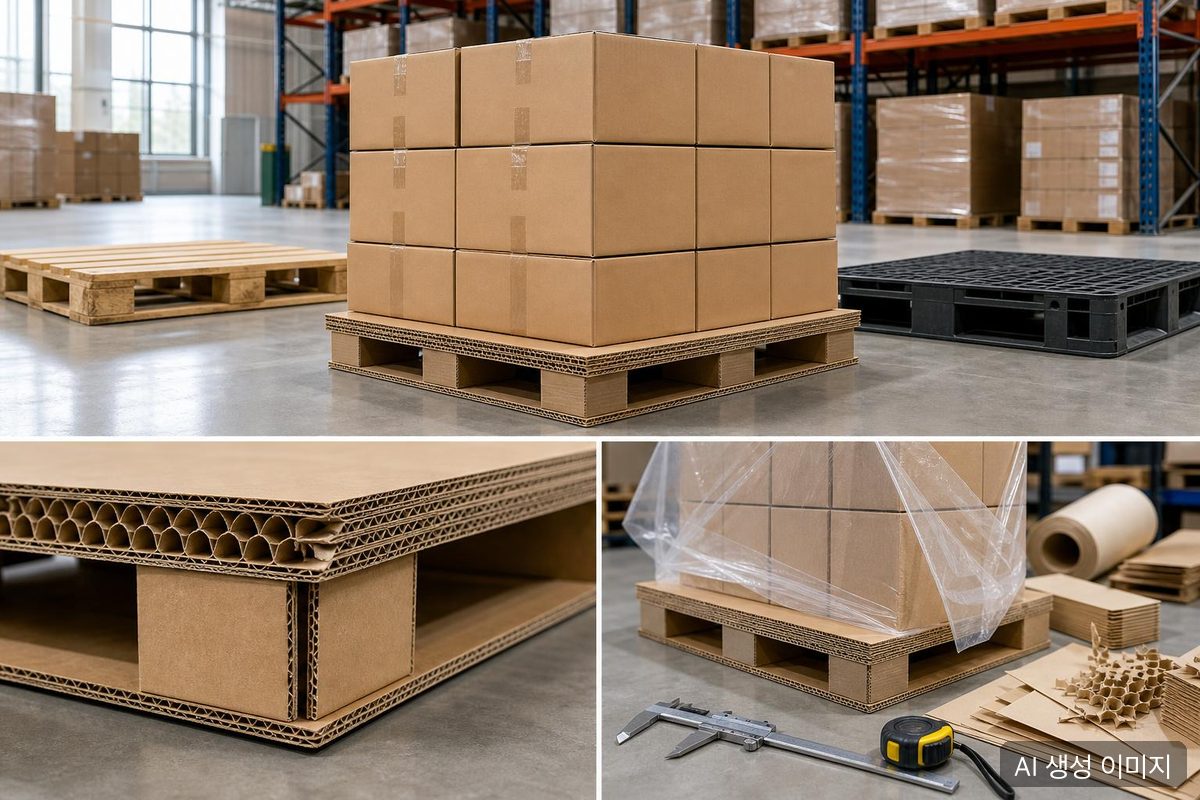
Seven things to check before choosing a paper pallet
1. Actual loaded weight
Looking only at the maximum load shown in a catalog is risky. In practice, static load, dynamic load, and rack-load capability must be separated.
- Static load: the load the pallet withstands when placed on the floor without movement
- Dynamic load: the load the pallet withstands during forklift movement
- Rack load: the load the pallet withstands in rack storage when supported only on two sides
A paper pallet may perform differently when fully supported by the floor and when placed on a rack. Buyers should provide product total weight, number of stacking layers, storage period, and forklift entry direction together so that the design can be accurate.
2. Product bottom surface and load distribution
Even if two products weigh the same 500 kg, a product whose load is spread over a broad surface is different from one whose load is concentrated at four corners. Machine parts, liquid products, drums, and stacked-box products all distribute weight differently.
When reviewing a paper pallet, it is useful to check photos of the product bottom, box loading pattern, banding position, and wrapping method together.
3. Moisture and storage environment
The most important caution for paper pallets is moisture. Refrigerated or frozen logistics, outdoor storage during the rainy season, condensation during ocean transport, and container humidity can reduce strength.
If needed, moisture-resistant coating, top-deck reinforcement, moisture barrier sheets, container desiccants, and indoor storage standards should be reviewed together. However, adding a coating can change recyclability and unit cost, so the purpose should be clear.
4. Forklift and hand pallet truck entry direction
Pallet structure changes depending on the direction from which a forklift enters. Buyers should confirm whether two-way or four-way entry is required, whether hand pallet trucks are used, and whether automated warehouse equipment is involved.
Custom production is one advantage of paper pallets, but if the design does not match the equipment on site, problems occur after delivery. Warehouse equipment and container-loading methods must be checked before ordering.
5. Export destination and quarantine requirements
For wood pallets, ISPM 15 treatment and marking are central. If the export destination is strict about wood packaging, missing treatment, defective marks, or insect traces can delay customs clearance.
A paper pallet can be an alternative that reduces the burden of wood packaging quarantine, but country-specific requirements and buyer standards still need to be confirmed separately. For products where brand management is important, such as food, cosmetics, and electronics, the buyer’s packaging specification should also be matched.
6. Whether reverse logistics exists
If pallets are collected and used repeatedly, plastic or wood may be more suitable. Conversely, if recovery after export is difficult and the pallet is discarded or recycled locally, paper pallets may be advantageous.
Paper pallets fit one-way export and local paper-recycling flows well. Still, local disposal cost, recyclability, and the buyer’s disposal standards should be checked.
7. Product image and ESG requirements
Paper pallets are useful for emphasizing an eco-friendly image. In exports of food, cosmetics, and consumer goods, packaging material and disposal method may be reflected in buyer evaluations.
However, environmental claims need evidence. Buyers should prepare data such as recyclability, certified base paper use, weight-reduction effects, and reduction in wood use.
When paper pallets are a good fit
Paper pallets are worth reviewing when the following conditions apply.
- Export products where wood-quarantine risk should be reduced
- Products for one-way export where pallet recovery is difficult
- Products where weight reduction matters, such as air freight
- Products where a clean packaging image matters, such as food, cosmetics, and electronic parts
- Cases requiring special-size pallets matched to product dimensions
- Cases where local paper-recycling flows can be used
Cases where paper pallets may need extra review
By contrast, additional review is needed in the following conditions.
- Long-term outdoor storage is required
- Products are exposed for a long time to high humidity, freezing, or condensation
- Very heavy loads are applied repeatedly
- Rack storage is essential but lower support is insufficient
- Returnable logistics require dozens of repeated uses
- Site workers handle pallets roughly
These conditions do not necessarily mean that paper pallets are impossible. Suppliers should review whether top-deck reinforcement, moisture-resistant treatment, structural changes, or loading-method adjustments can solve the issue.
Inquiry checklist for buyers
When requesting a quote for a paper pallet, provide the following information to speed up consultation.
| Item | Details to provide |
|---|---|
| Product name | Product or box to be loaded |
| Total product weight | Total weight per pallet |
| Loading pattern | Box quantity, stacking layers, box layout |
| Pallet size | Width, length, and height limits |
| Transport method | Ocean, air, inland, parcel-mixed logistics |
| Storage environment | Indoor, outdoor, refrigerated, frozen, high humidity |
| Equipment | Forklift, hand pallet truck, conveyor, automated warehouse |
| Export destination | For quarantine and buyer-standard review |
| Number of uses | One-way or repeated use |
| Additional requirements | FSC, recyclability, printing, moisture resistance, etc. |
Without this information, suppliers can only quote based on general sizes and approximate load capacity. With sufficient information, excessive reinforcement can be reduced while balancing unit cost and safety.
Conclusion
Paper pallets are not a universal product that completely replaces wood and plastic. However, they can be a strong option in export packaging when weight reduction, lower wood-quarantine burden, recyclability, and custom production matter.
Buyers should first organize product weight, loading method, storage environment, export destination, and recovery plan. Then, comparing wood pallets, plastic pallets, and paper pallets by the same criteria makes it easier to judge packaging cost and logistics risk accurately.
About the author
PackingMaster: Editor of Paper Pack Log. We organize market trends, product information, and technical insights from the paper packaging materials industry.
About the Author
PackingMaster is the editor of Paper Pack Log, curating market trends, product information, and technical insights for the paper packaging industry.
References
- Packaging Revolution, Paper Pallets for Export, https://packagingrevolution.net/paper-pallets-for-export/
- Dae-A Industry, paper pallet product page, https://www.dae-a.com/daeawp/?page_id=50
- Smurfit Kappa, Corrugated Cardboard Pallets, https://www.smurfitkappa.com/us/products-and-services/packaging/corrugated-pallets
Meta description candidate
A practical export packaging guide comparing paper pallets with wood and plastic pallets, including advantages, limits, load capacity, quarantine, recycling, and storage conditions.
Tag candidates
paper pallet, export packaging, pallet, wood pallet, plastic pallet, eco-friendly packaging, B2B packaging materials, logistics cost reduction
Duplicate-avoidance note
Existing articles on paper angle board focus on protective angle-board materials, while the paper tube industry restructuring article covers changes in the paper tube market. Even if paper pallets are mentioned in existing articles, no standalone product article was identified. This draft avoids duplication by explaining paper pallets as a standalone export packaging material and focusing on purchasing criteria compared with wood and plastic pallets.