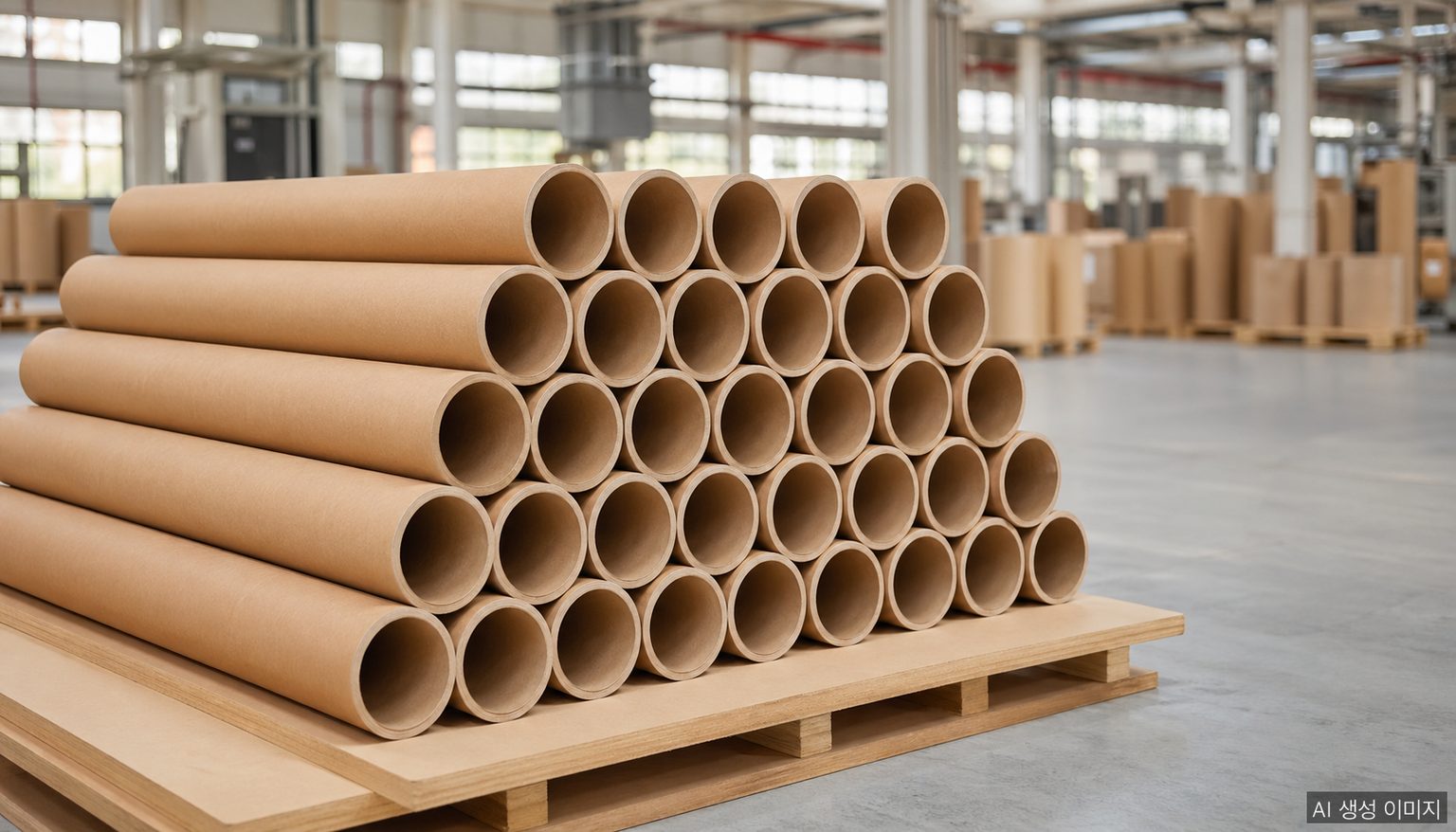
In spring 2026, the news coming from Korea’s paper tube and paper core industry has been consistently heavy: “Several more companies closed this year.” That is the message people bring back from industry gatherings. Yet downstream users such as film, textile, and paper-roll printing businesses are rarely crying out that supply has been cut off. Closures are clearly increasing, so why does the market still look stable? This article explains the structure behind that apparent contradiction.
The 2026 macro environment in data
The difficulties facing paper tube suppliers are not isolated events. They are part of a macro environment weighing on the entire paper packaging materials industry.
| Item | As of April 2026 |
|---|---|
| Softwood and hardwood bleached chemical pulp price | USD 780 per ton, up about 20% year on year |
| KRW-USD exchange rate | Remaining in the 1,500 won range |
| Shanghai Containerized Freight Index | More than 30% above the pre-Middle East-risk level |
| Brent / WTI crude oil | Above USD 100 / high USD 90 range |
In addition, from December 2025 to January 2026, major base-paper manufacturers raised corrugated base-paper prices by 10% to 25% in a coordinated market move. During the same period, auxiliary materials such as adhesives, printing ink, and packaging wrap rose by another 20% to 55%.
In April 2026, Korea’s competition authority also imposed a total of KRW 338.3 billion in fines on six paper companies over alleged printing-paper price collusion. Some companies were referred for prosecution. The major paper manufacturers were already under pressure, with low margins or operating losses, and the large fines added another shock.
When base-paper suppliers shake, downstream converters shake even more. At a regular general meeting of a packaging industry cooperative in January 2026, members adopted a resolution condemning unilateral price increases by major corrugated and white-board manufacturers. The fact that the converting industry formally pushed back is a sign that downstream resilience is approaching its limit.
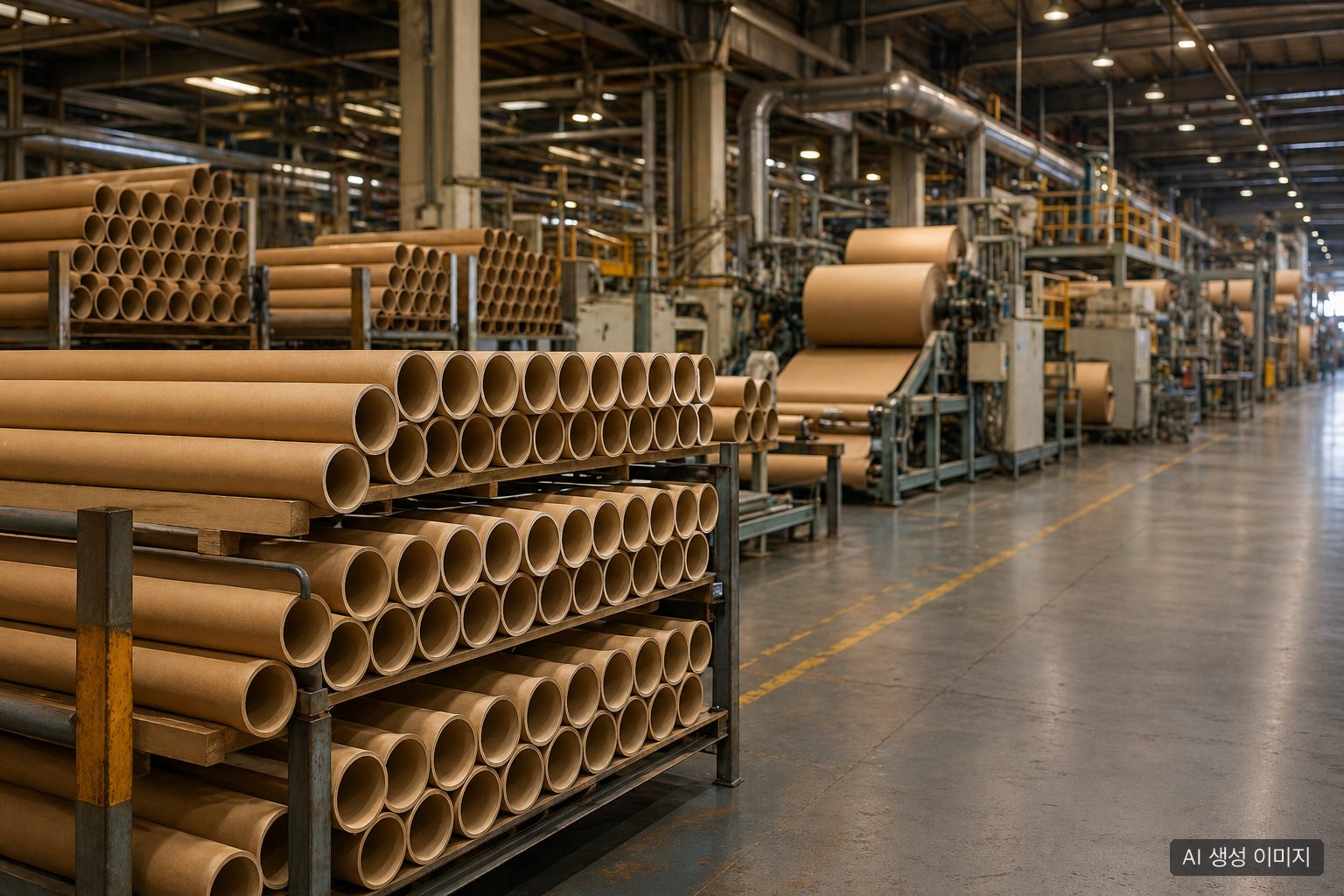
The three main causes of closures
Combining industry interviews with macro data, the causes of paper tube supplier closures converge into three factors.
1. Continued profitability erosion
Paper tubes have traditionally been a high-volume, low-margin business. Operating margins commonly remain in the low single digits, and pricing power is weak. Now pulp, electricity, and logistics costs have risen at the same time, while labor costs have also accumulated over the years. This is not a temporary one- or two-year loss. Profitability has been eroded for more than five years, and that has accelerated decisions at marginal plants.
2. Recent base-paper price increases
The base-paper price increases that became serious at the end of 2025 were the final blow. When base paper rises by 12% to 25% and auxiliary materials rise by 20% to 55%, paper tube prices cannot rise by the same amount. Downstream customers in film, textiles, printing, and paper-roll converting also have limited ability to pass on costs. As a result, converters must absorb a significant portion of the increase, and suppliers without the financial strength to absorb it are the first to exit.
3. Lack of successors
This is the most structural and most serious cause. Many first-generation founders in Korea’s small manufacturing sector are now at an age where retirement is becoming a real issue, yet there is no successor. Their children often avoid manufacturing, while external hiring is difficult in both cost and cultural terms. When profitability erosion and succession gaps overlap, it becomes hard even to sell a small plant, and closure becomes the natural path.
This is not only a paper tube issue. It is connected to the broader succession cliff facing Korean manufacturing. However, the shock appears earlier and more strongly in the paper tube sector, where low margins, labor-intensive work, and family management are closely combined.
Why downstream industries still look fine
The reason closures are increasing while film, textile, and printing plants are not stopping because of paper tube shortages is simple: the volume from companies that disappear is being absorbed by surviving suppliers.
Larger suppliers tend to share the following characteristics.
- Automated and standardized production lines that create unit-cost advantages
- Stable utilization through multi-product production, including paper tubes, flat board, paper angle board, and paper pallets
- Better purchasing power through bulk procurement of pulp and base paper
- Continuity in decision-making through second- or third-generation management systems
Demand gaps created by the closure of small operators are absorbed through higher utilization at these larger suppliers. In the short term, supply stability for downstream industries is maintained. In the long term, the market becomes more concentrated.
The real change: what customers are losing
The market may look fine on the surface, but something is quietly disappearing from the perspective of B2B purchasing teams.
- Supplier-diversification options are shrinking. The number of suppliers available for quote comparison is falling. More buyers now say that where they once received quotes from five companies, they can now receive them from only two.
- Price negotiation power is weakening. Surviving suppliers have little reason to cut prices aggressively. As price competition from small operators disappears, prices naturally stabilize at a higher level.
- Lead-time and quality risks are becoming concentrated. When the supplier base shrinks, a fire, labor dispute, or equipment accident at one supplier can directly lead to a line stop for the buyer.
In other words, supply remains stable, but negotiation power and risk diversification deteriorate. Buyers should not feel safe just because the surface-level supply situation looks stable.

Four conditions of suppliers that survive
At this point, B2B purchasing teams should evaluate suppliers against four conditions.
1. Business diversification
Suppliers that produce multiple paper packaging materials–such as paper angle board, flat board, paper blocks, paper pallets, and paper tubes–are more resilient to external shocks than companies dependent on paper tubes alone. If demand for one item falls, other items support utilization, reducing volatility.
2. Scale and automation
Suppliers with a certain level of annual sales and automated lines outperform small operators in unit cost. Even when base-paper prices rise, they have more room to absorb the increase and can set a more reasonable line in price negotiations.
3. Succession system
Family management dependent on a single owner may look stable, but the entire plant can disappear when there is no successor. Suppliers with a clear second- or third-generation management structure or a professional management system are more reliable for purchasing contracts with five- to ten-year horizons.
4. Financial resilience
A company with dried-up operating profit can be shaken by a single base-paper price increase. For unlisted small and medium-sized companies with no public filings, buyers can indirectly verify resilience through delivery history, credit ratings, and tax-payment records.
Suppliers that satisfy all four conditions are becoming less common. That is why the ability to secure long-term supply contracts is becoming a new performance indicator for purchasing teams.
FAQ
Q. Is there a chance paper tubes will become scarce?
In the short term, the risk is low. Larger suppliers are absorbing the volume from operators that close, so total market supply remains stable. However, procurement lead times may increase in cases of regional concentration or specific specifications such as heavy-duty or large-diameter paper tubes.
Q. How far will paper tube prices rise?
Additional upward pressure is likely to continue throughout 2026. If pulp prices remain around USD 780 per ton and the exchange rate stays in the 1,500 won range, another round of base-paper increases may occur. However, downstream industries have limits on price pass-through, so the increase is unlikely to expand indefinitely. A reasonable scenario is an additional annual rise of about 5% to 12%.
Q. What kind of supplier should buyers choose?
A safer supplier is one that satisfies the four conditions of business diversification, scale, succession system, and financial resilience. Rather than simply choosing the lowest quote, buyers need to ask whether the supplier can deliver the same quality at a stable price five years from now.
Q. Are industry cooperatives or associations responding?
A packaging industry cooperative adopted a resolution at its 2026 regular general meeting condemning price increases by major corrugated and white-board manufacturers. Industry-wide price negotiations and joint responses are becoming more active. However, official data releases from a paper-tube-only association remain limited.
Q. What is the market position of multi-product paper packaging manufacturers?
Integrated manufacturers that produce paper tubes, paper angle board, flat board, paper blocks, paper pallets, and other products are positioned as consolidators during this restructuring phase. They can steadily absorb demand gaps created when small single-item operators exit.
About the author
PackingMaster: Editor of Paper Pack Log. We organize market trends, product information, and technical insights from the paper packaging materials industry.
About the Author
PackingMaster is the editor of Paper Pack Log, curating market trends, product information, and technical insights for the paper packaging industry.
References
- Logistics costs, pulp prices, and energy costs plus collusion fines: paper companies face a gloomy 2026
- Logistics costs, raw materials, and fines: paper companies face likely losses this year
- Background: Box industry adopts resolution condemning price increases by major corrugated and white-board manufacturers
- Background: Box industry condemns price increases in corrugated and white board
- Middle East risks, fires, and accidents create a double shock for the corrugated supply chain
- Competition authority imposes large fines for paper-industry collusion
- Paper industry performance weakens amid global slowdown
- Background: Rising pulp and corrugated-board costs raise concerns over paper price hikes
- Background: Pulp prices surge from the start of the year, raising the possibility of domino price hikes for paper cups and delivery boxes
- Background: Corrugated industry sees domino price increases from base paper to sheets and boxes