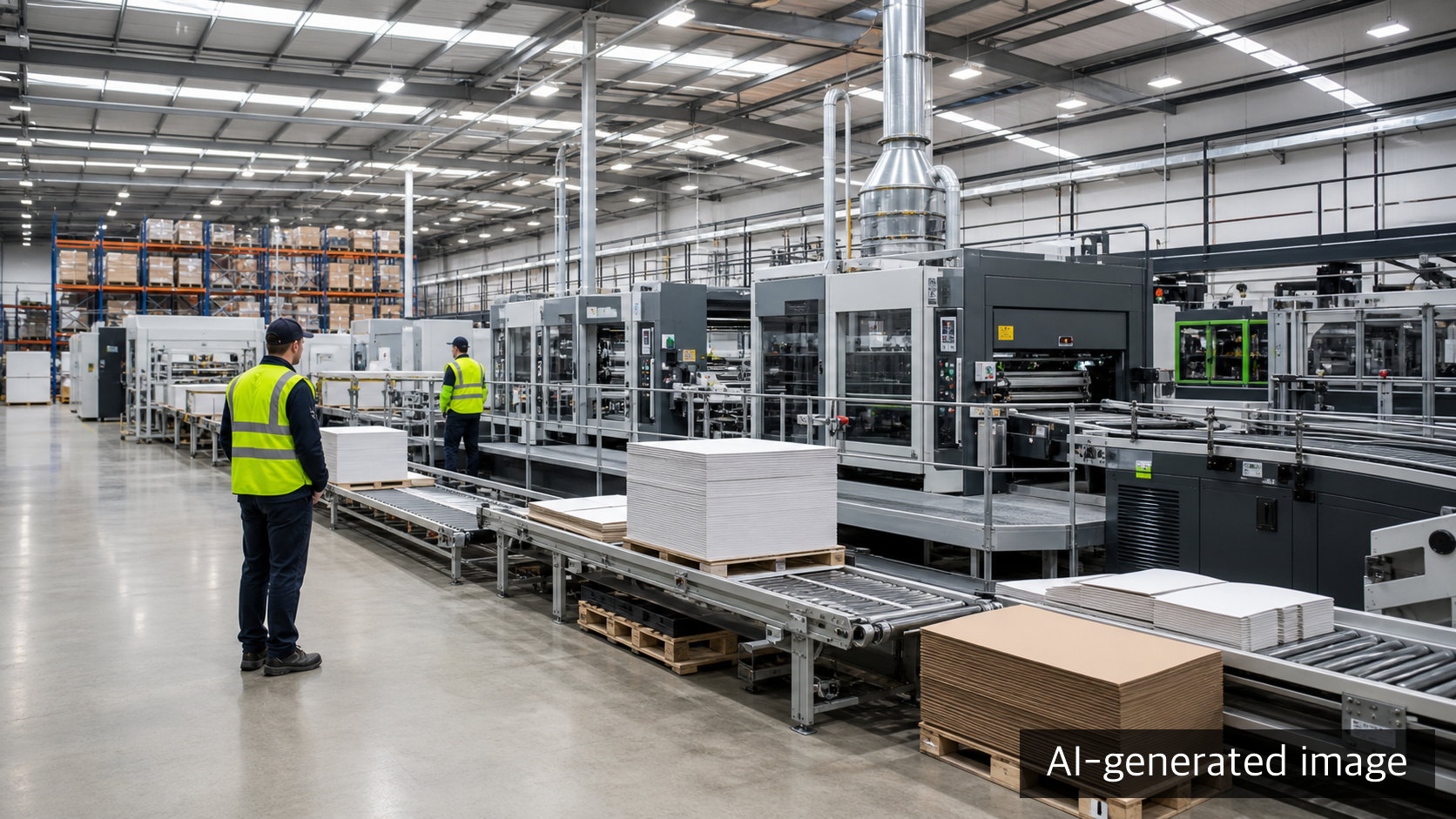
In July 2026, Paranova Print and Packaging announced a £20 million, five-year investment programme for its fibre-based packaging operations. The centrepiece is a new 98,000-square-foot plant in Godmanchester, Cambridgeshire. The announcement is best read not merely as a capacity expansion, but as an attempt to combine printing, finishing, warehousing and R&D into one operating system designed for shorter lead times and variable demand.
The announcement at a glance
- Paranova announced £20 million of investment over five years.
- The first stage is a £6 million purpose-built plant in Godmanchester, planned at the time of the announcement to open in November 2026.
- The building covers 98,000 square feet, with about one-third of its operational footprint planned for warehousing.
- The site is planned to combine manufacturing, warehousing, office space and R&D functions.
- Paranova said the following stage would commit another £14 million to additional printing and finishing equipment and a fully automated logistics system.
- The site is expected to support about 150 employees once fully operational.
These figures are planned values reported around 28 July 2026. The final opening date, equipment configuration, output and employment level may change during installation, commissioning and ramp-up.
What the published sources confirm
Paranova described Godmanchester as its fourth and largest fibre-based packaging facility in the United Kingdom. The target markets include fresh produce, convenience and food-to-go, while the product scope includes cartons and sleeves.
| Item | Published plan | Operations implication |
|---|---|---|
| Total programme | £20 million over five years | A staged programme rather than one isolated machine purchase |
| Stage one | £6 million new facility | Building and initial production system |
| Later investment | £14 million | Additional print, finishing and automated logistics |
| Floor area | 98,000 square feet | Space to scale manufacturing and warehousing together |
| Warehouse allocation | About one-third of operational footprint | Buffering seasonal demand and forecast variation |
| Functions | Manufacturing, warehouse, office and R&D | Linking product development with industrialisation |
| Employment | About 150 at full operation | Automation and workforce planning must be developed together |
The company said the plant was designed with equipment partner Koenig & Bauer to maximise speed, workflow efficiency and shop-floor automation. The planned press and finishing suite is intended to support shorter runs, faster turnaround, lower stockholding and more complex customer requirements. Those are expected benefits, not verified operating results. Actual performance will depend on product mix, changeover time, quality losses, maintenance and workforce capability.
The real subject is flow, not a single press
A modern press attracts attention, but the operational question is whether material can move without interruption from paperboard receipt through printing, finishing, packing, warehouse receipt and dispatch. A fast press cannot shorten the total lead time if die-cutting, gluing, inspection or packing becomes the constraint.
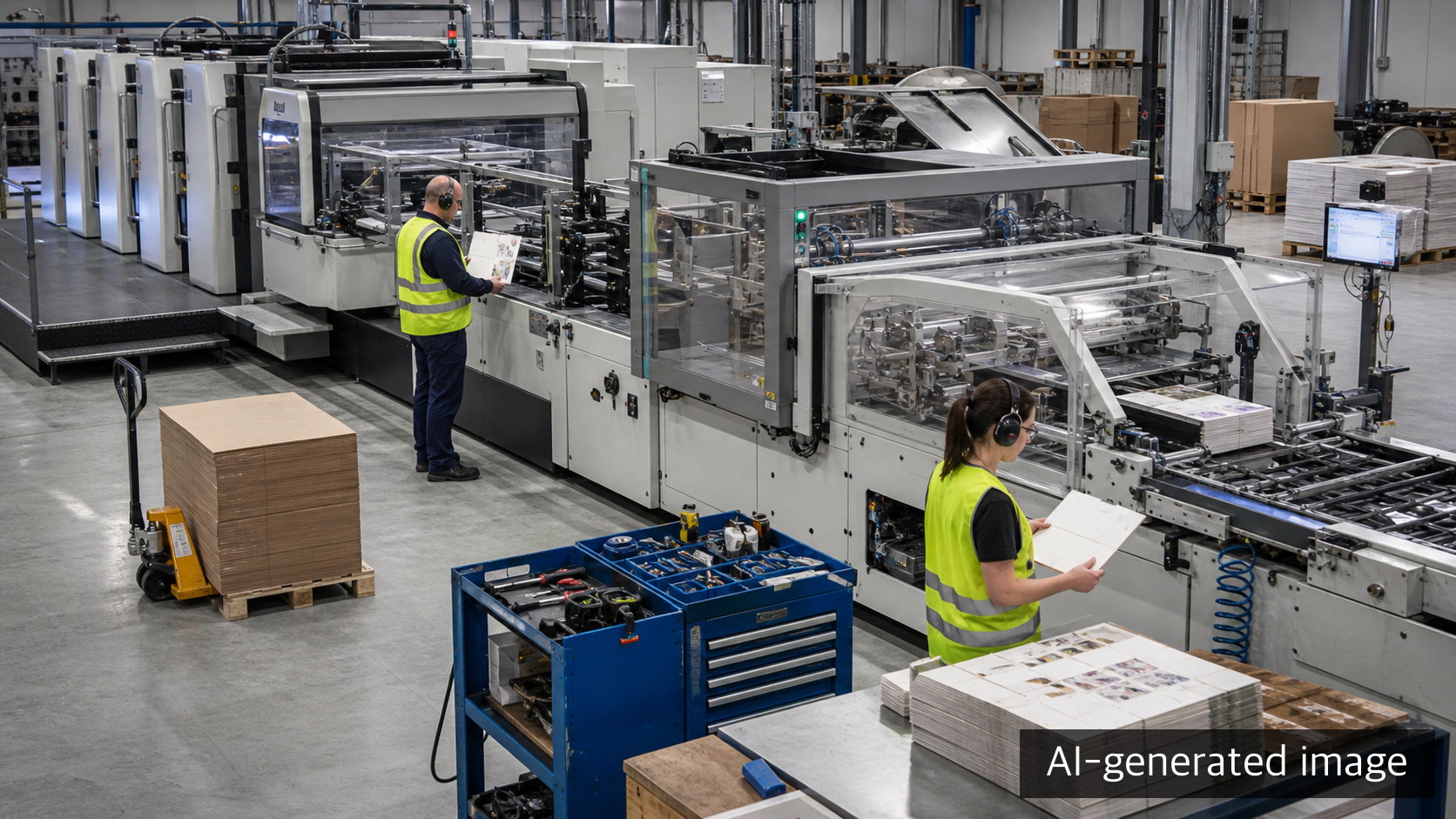
Before approving a similar investment, manufacturers should connect the following measures in one value-stream model:
- Average and maximum run length by product family
- Actual changeover time for plates, cutting tools, glue settings and inspection recipes
- Good-output rate per hour at every process
- Planned stops, cleaning time and drying or conditioning requirements
- Capacity of die-cutting, stripping, gluing, inspection and final packing
- Time required for palletising, warehouse receipt and order picking
- Physical routes for rework and nonconforming material that prevent accidental release
Capacity should be balanced using good output, not catalogue speed. Otherwise, the investment can create larger queues between processes rather than shorter customer lead times.
Why allocating one-third of the footprint to warehousing matters
Paranova said about one-third of the operational footprint would be used for warehousing. This should not automatically be interpreted as a plan to hold excessive inventory. Fresh-produce and food-to-go packaging can be affected by promotions, seasons, weather and changes in retailers’ plans. The operation therefore needs space and dispatch flexibility to absorb forecast error.
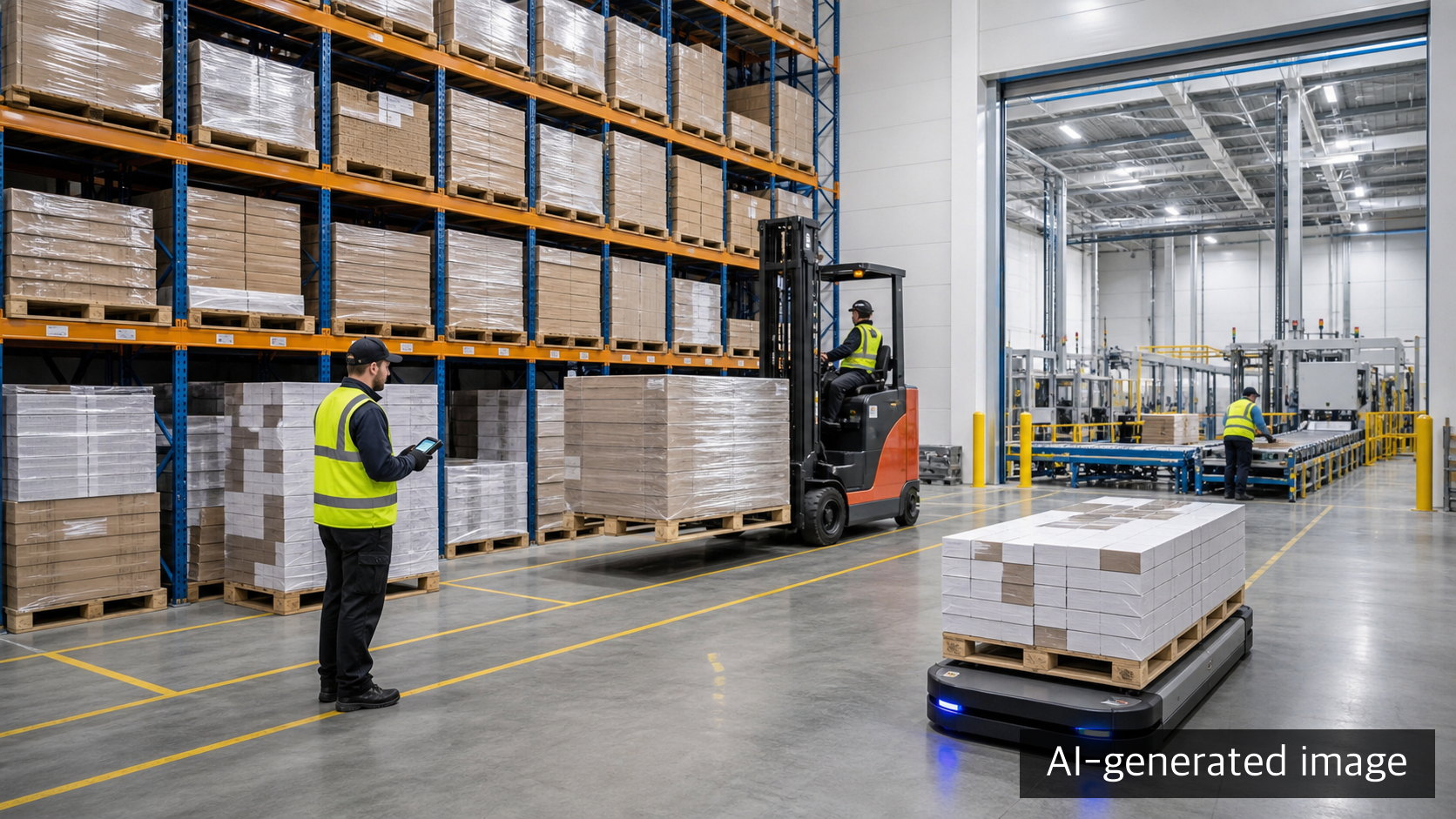
A large warehouse does not, by itself, create flexibility. Raw materials, work in progress, finished goods and blocked stock need controlled locations. WMS data must also agree with production planning and quality-release status. A comparable expansion should define:
- Minimum and maximum inventory by material and finished product
- Ownership and obsolescence responsibility for customer-specific safety stock
- Treatment of printed stock remaining after a campaign or design change
- Lot traceability and stock-rotation rules
- Pallet dimensions, stack height and rack loads
- Physical separation of AGVs, forklifts and pedestrians
- Replanning rules when dispatch priorities change
Warehousing is part of the lead-time system, not merely a room after production. Without clear inventory rules, more space can increase obsolescence and write-offs.
The advantage of putting R&D near production
Locating R&D at the production site can reduce the travel time between sample development, print trials, finishing tests, customer approval and industrial production. This is particularly relevant to fibre-based transitions. Replacing a plastic format with paper is rarely a simple material substitution. Stiffness, coating, moisture and grease resistance, printability, die-cutting, adhesive performance and filling-line compatibility have to work together.
The development recipe must also transfer into production without loss of information. At minimum, material code and lot, print settings, cutting-die revision, adhesive and application conditions, inspection criteria and the approved customer master should share one controlled change history. Physical proximity helps, but it cannot replace disciplined product and process data.
Eight checks before a similar investment
1. Has demand been modelled by mix, not only by annual tonnes?
The same annual volume can require very different equipment when one plant runs a few stable products and another runs many short orders. SKU count, average run length, seasonal variation and urgent-order share should be included.
2. Have the processes after printing been measured?
Compare die-cutting, stripping, gluing, inspection and packing using good output. Do not balance the line by comparing maximum catalogue speeds.
3. Is changeover time standardised?
Short-run performance depends more on transition loss than on peak speed. Measure from the last good item of one order to the first good item of the next, separating external preparation from internal downtime.
4. Are automated-logistics interfaces defined?
An AGV or automated warehouse is not an isolated asset. Define how ERP, MES and WMS exchange pallet identity, location confirmation, hold status and release instructions before buying hardware.
5. Can quality data keep up with line speed?
Specify how colour, contamination, missing print, adhesive defects and dimensions will be checked and recorded. High speed without adequate inspection capacity can accelerate the production of defects.
6. Is the boundary between people and automation clear?
The planned workforce illustrates that automation does not mean an unmanned plant. Operator, maintenance, quality, logistics and development roles need shift and training plans.
7. Is ramp-up loss included in the business case?
Installation completion is not the same as stable production. FAT, SAT, trial runs, customer qualification and yield stabilisation need time and cash allowances.
8. Is the environmental case tested at product level?
Terms such as “fibre-based” and “paperisation” do not establish environmental superiority on their own. Material composition, coatings, adhesives, recyclability in the target collection system, package weight, logistics and food-protection performance should be assessed for each application.
What should not be overstated
Shorter lead times, reduced stockholding and improved responsiveness are the stated aims of the investment. The public articles do not provide verified OEE, defect rates, delivery performance or payback. The November 2026 opening was also a plan at the date of announcement and should be checked against later project updates.
The full £20 million is not described as immediate spending. It is a five-year programme, beginning with the £6 million site and followed by £14 million of additional equipment and logistics investment. A manufacturer evaluating a comparable project should split the case into building, utilities, printing, finishing, inspection, logistics, IT, training and ramp-up loss, with a clear approval gate for every stage.
Conclusion
The important feature of the Godmanchester project is not one large press. It is the attempt to design manufacturing, finishing, warehousing, automated logistics and R&D as one lead-time system, while linking an initial £6 million site investment to a later £14 million equipment and logistics programme.
Before selecting machinery for a paperboard-packaging expansion, define the product mix, target lead time and inventory policy. Only then can press speed, warehouse area and automation scope be aligned with the same operating goal.
About the Author
PackingMaster: Editor of PaperPackLog, covering market developments, products and manufacturing technology across the paper-packaging industry.
References
- Paranova Print and Packaging, Paranova to spend £20m over five years on new fibre-based packaging facility in Godmanchester, 28 July 2026.
- Packaging Scotland, Paranova to invest £20 million in new UK fibre-based packaging facility, 28 July 2026.
Sources checked on 6 August 2026. This article interprets publicly announced plans from an operations perspective and does not guarantee actual equipment performance or commissioning results.