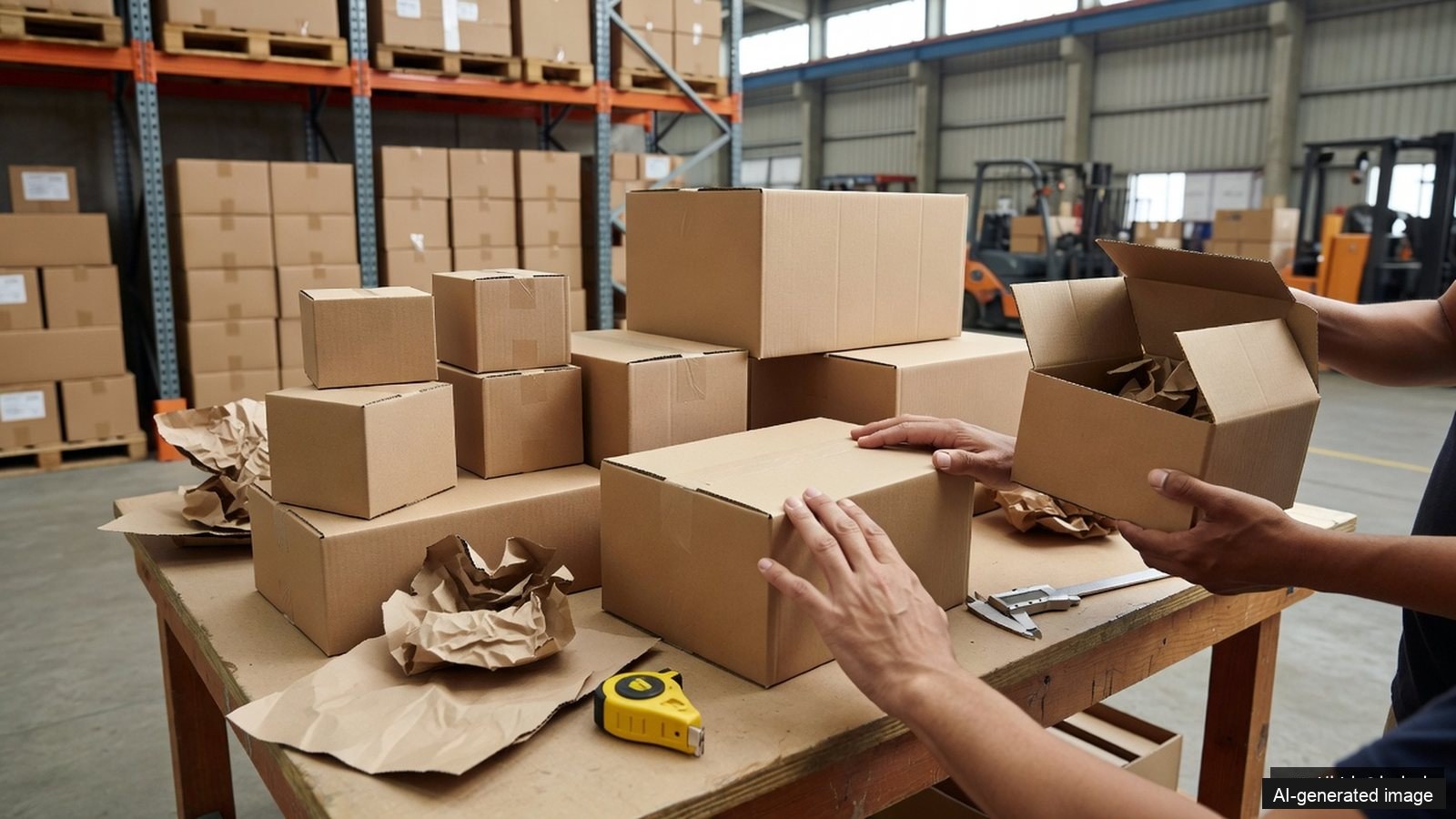
Just before dispatch cutoff, a picker chooses a box that is much larger than the product, adds paper cushioning, and the line stops because the void-ratio decision is unclear. The responsible readers are fulfillment operators, packaging engineers, and customer-side inbound teams. The table below can be copied into a site checklist so product volume, inner box dimensions, cushioning, exceptions, and actions are recorded in one place.

What the latest field signal confirms
A logistics technology case disclosed on July 9, 2026 is useful because it lays out the operational variables behind parcel overpack compliance. The public article explains that the core rule limits the number of packaging layers for one product to one and keeps the packaging void ratio at 50% or lower. It also states that the rule applies across paper boxes, plastic pouches, and Styrofoam packaging.
The difficult part is not only the 50% number. The same source lists exceptions such as multi-item bundled packing, reused packaging, fragile goods such as glass or ceramics, and long or flat irregular products. It also states that cushioning material is not included in product volume, while paper cushioning can relax the void-ratio limit to 70%. That means a site needs more than a smaller-box recommendation. It needs a record of why a box was chosen, which exception was applied, and whether cushioning was treated correctly in the calculation.
The table separates calculation from responsibility
The void ratio looks like a simple calculation, but four decisions are usually mixed together.
First, product measurement. If the item is not a clean rectangular solid or includes accessories, the team must know who approved the base dimensions.
Second, inner box dimensions. Supplier catalogue dimensions are not always the same as the actual inner size of inbound boxes.
Third, cushioning purpose. Paper cushioning, air cushioning, and fragile-goods protection should not be treated as the same packaging decision.
Fourth, exception evidence. A checkbox for bundling, reuse, fragile goods, or irregular shape is not enough unless the site keeps photos, order data, or customer specifications.

Box Size Validation Table
The table below is written for a fulfillment center to copy by SKU. It does not create new thresholds beyond the public 50% and 70% figures. If an exception is unclear, do not approve the packout. Put it on hold and assign the evidence owner.
| Input field | Site record | Decision basis | Status | Action |
|---|---|---|---|---|
| SKU and shipping channel | SKU, set status, parcel, same-day, or B2B delivery | Manage separate rows when the same SKU uses different boxes by channel | Pending / Review / Confirmed | Operations separates the representative SKUs by channel. |
| Product measured dimensions | Length, width, height, protrusions, accessories | Base value for void-ratio calculation | Review / Remeasure | Quality records photos and measured dimensions before approving the base value. |
| Product volume method | Rectangular conversion or irregular-shape memo | Irregular products require exception review | Apply / Hold | Packaging engineering records the shape reason and volume method in the same row. |
| Inner box dimensions | Inner length, width, height, flap interference, measurement tool | Use actual inner dimensions, not catalogue outer dimensions | Pass / Remeasure | Inbound staff measure at least three samples with a caliper or measuring tape. |
| Void ratio | Product volume, box inner volume, formula version | General limit of 50% or lower | Pass / Hold / Change box | Operations checks a smaller box or exception reason when the value exceeds 50%. |
| Paper cushioning use | Paper cushioning type, position, amount | Review 70% limit only when the paper cushioning condition is met | Apply / Not apply | Packing staff attach photos and the reason for paper cushioning use. |
| Cushioning volume treatment | Whether cushioning was counted as product volume | Cushioning is not product volume | Correct / Approve | Data owner fixes the formula and retires the previous decision. |
| Exception reason | Bundling, reuse, fragile goods, or irregular product | Exception needs reason plus evidence | Accept / Hold | Customer-side owner attaches evidence photos or order-configuration data. |
| Alternate box candidate | Current box, smaller box, pouch option | Must protect the item while satisfying the rule | Change / Keep / Test | Packaging engineering assigns samples and routes fragile SKUs to testing. |
| Final action | Approve, change box, revise method, hold shipment | Keep decision owner, effective date, and review date | Approve / Revise / Hold | Site manager updates the pack instruction and WMS rule. |
Role-Based Actions
Fulfillment operations should start with the highest-volume SKUs and put product dimensions and current inner box dimensions in the same file. Only confirmed SKUs should appear on the packer screen.
Packaging engineering should not treat every value above 50% as the same problem. Paper cushioning, fragile products, irregular shapes, reuse, and bundling need separate evidence. When an exception is applied, the row should include photos, the formula version, and the approver.
Customer-side inbound owners should document protection requirements for fragile goods, flat products, and bundled sets. A verbal request to “protect it well” leaves the warehouse responsible for both overpack and damage risk.
Data owners should lock the formula so cushioning volume is not counted as product volume. Paper cushioning can affect the applicable limit, but it should not be used to inflate the measured product size.
Hold Conditions
Put the box-size change on hold if any of the following applies:
- Product measured dimensions or inner box dimensions are missing.
- Existing files counted cushioning as product volume.
- The site cannot prove whether the cushioning is paper or another material.
- The exception reason exists only as a verbal instruction.
- A smaller box is available but damage risk, closure condition, and label surface were not checked.
- The customer delivery specification requires a separate pack size or cushioning method.

A Practical Starting Sequence
Start with the top 20 SKUs by shipment volume. Put the current box and the next smaller candidate box on the same bench. Then record product dimensions, inner box dimensions, void ratio, paper cushioning, exception reason, and final action in one table. Finish each row with one of four outcomes: approve, change box, revise the packing method, or hold shipment.
The goal is not to make every box smaller. The goal is to make product protection and compliance visible in the same workflow. A packout that only chases the number can create damage claims. A packout that only relies on exceptions can be weak in an audit. The site needs to update both the calculation table and the work instruction.
FAQ
Q: If paper cushioning is used, can the 70% limit always be applied?
No. The public source says the limit can be relaxed to 70% when paper cushioning is used, but the site still has to verify the actual pack configuration and evidence.
Q: Should plastic pouches and Styrofoam packs be checked separately?
The public source says the rule applies to paper boxes, plastic pouches, and Styrofoam packaging. Do not exclude a packout simply because the material is different.
Q: What is the most common calculation error?
Counting cushioning volume as product volume. Cushioning can support a protection decision, but it should not be used to increase the product volume in the formula.
About the Author
PackingMaster: Editor of Paper Pack Log. We collect and organize market trends, product information, and technical insights for the paper packaging industry.