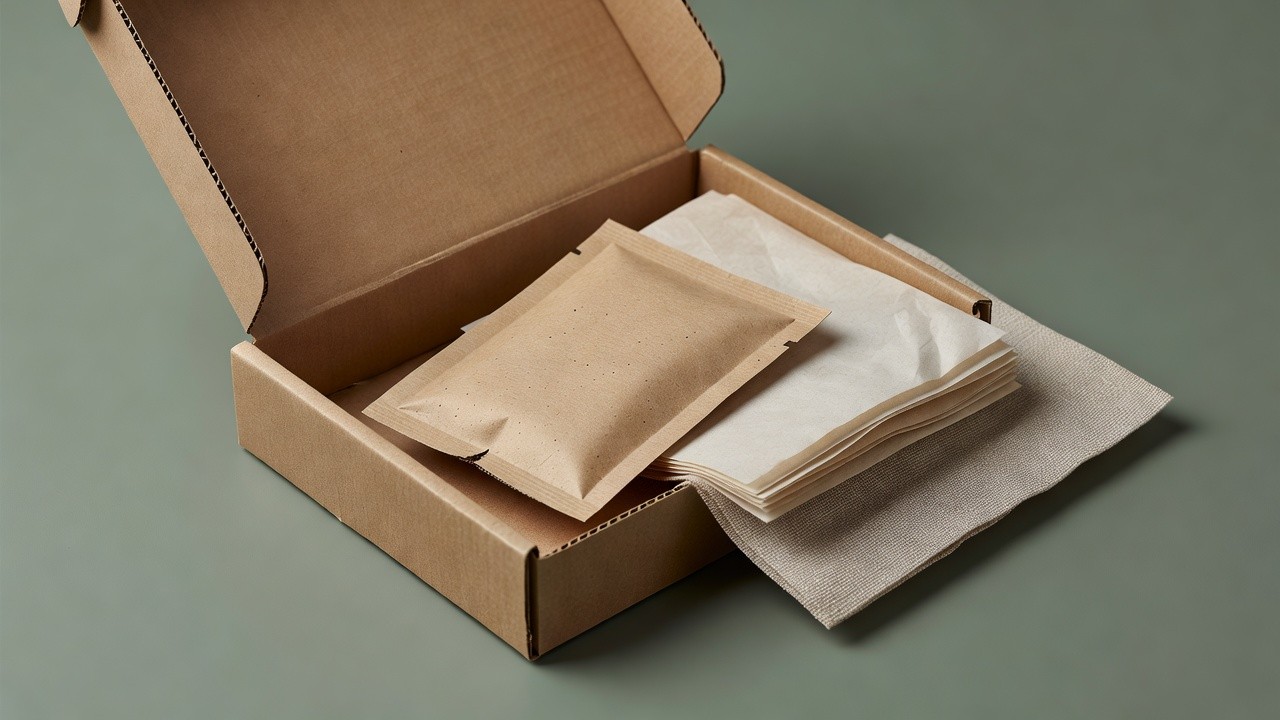
Korean supplier de:hum says that its manufacturing method for desiccant packaging paper using a PLA-laminated structure was granted a Korean patent in June 2026. The development is relevant to brands evaluating a switch from a conventional vinyl or PE coating to a PLA laminate. Because PLA is itself a plastic, this should not be described as a reduction in plastic without a component-level mass comparison. A supplier announcement and promotional performance material are not enough to authorize an immediate switch from a conventional silica-gel packet.
The publicly described patent concerns the packaging-paper manufacturing method and the resulting packaging paper, not the desiccant fill. The reviewed material does not identify the candidate’s active chemistry, grade or fill mass. Validation should therefore separate a wrapper-only change using the incumbent fill from a complete-sachet change involving both the fill and the wrapper.
Approval has four gates: absorption under comparable conditions, permeability/seal/line performance, product-specific preservation, and certification plus the actual end-of-life route. If one remains unresolved, the accurate status is “under evaluation,” not “sustainable replacement completed.”

Separate Confirmed Facts from Claim Scope
Public material supports the following boundaries.
- Patent
- Public statement: the supplier reports Korean Patent No. 10-2981293, “Manufacturing Method for Desiccant Packaging Paper and Desiccant Packaging Paper Manufactured Thereby,” registered June 18, 2026.
- Practical interpretation: the reviewed evidence is the supplier’s patent announcement. Registration, claim scope and current legal status should not be treated as independently verified until the official patent publication or register is checked. Patent status is also separate from performance equivalence.
- Structure
- Public statement: the supplier describes a biodegradable PLA-laminated paper structure replacing a conventional vinyl-coated structure.
- Practical interpretation: exact paper/PLA weight share, layer construction, adhesive and sealant still need documentation.
- Absorption
- Public statement: Packnet reports that de:hum’s Max Dry achieved approximately three to four times the moisture uptake of silica gel in what the article describes as a KTR test under the same conditions.
- Practical interpretation: no original KTR test report or separate certificate was available in the reviewed material. Do not reuse the ratio or describe it as “KTR-verified” until the specimens, temperature, RH, duration, replicates, reference grade and calculation basis are confirmed.
- Biodegradation or composting
- Public statement: Packnet also reports claims of more than 93% biodegradation and compliance with BS EN 13432.
- Practical interpretation: no underlying certificate or test report was reviewed. Do not present this as certified finished-product performance until the exact standard edition, certificate holder, tested object, passed criteria and validity are verified.
- Paper-stream disposal
- Public statement: the product is described as paper-based.
- Practical interpretation: coated or mixed paper may follow a different route, depending on the local collection and reprocessing system.
A patent addresses novelty and rights. A test report describes performance under stated conditions. Certification evaluates a named object against defined criteria. Actual recycling still depends on collection, sortation and reprocessing infrastructure. These are not one interchangeable “eco certificate.”
1. Absorption: Read the Test Conditions Before the Ratio
A common comparison error is to use only moisture uptake per packet or percentage mass gain. Product protection depends on several interacting variables:
- dry mass of the active material and the sachet;
- test temperature, relative humidity and exposure time;
- open exposure versus a sealed chamber;
- sachet area, perforation/permeability and seal width;
- package headspace and initial moisture load;
- moisture released by the product, cushioning and corrugated board;
- the target RH window and the risk of over-drying.
When requesting a supplier report, ask for the test method, sample ID, conditioning, replicates, and the grade and mass of the reference silica gel—not only the result table. Use two separate comparisons: (1) material performance, measuring uptake over time at equal active-material mass; and (2) replacement performance, comparing internal RH and product quality in the same sales pack at the permitted sachet footprint and count. If the active chemistries differ, equal-mass results do not establish drop-in equivalence. State explicitly whether headspace, sachet dimensions or sachet count is being held constant.
2. Permeability, Seals and Line Performance
Even when the internal desiccant can hold more moisture, a slow outer wrap can miss an early humidity spike. Excessive permeability or weak seals can create dust leakage, tears or contact risk.
Check:
- water-vapor transmission with the test method, temperature, RH on both sides, test direction, units and effective permeable area;
- air permeability as a separate structural property rather than a substitute for water-vapor transmission;
- heat-seal or pressure-seal window and seal strength;
- sachet rupture and dust after drop, vibration and compression;
- change in permeability after printing or ink application;
- friction, static, double feeds and jams in automatic dispensers;
- delamination and seal stability after hot/humid storage; and
- application-specific contact and safety documents for food, cosmetics or pharmaceuticals.
“PLA-laminated” does not define one performance level. Film thickness, adhesive and thermal history can change the result. A test on the supplier’s standard sample cannot automatically cover a custom printed size and seal specification.
3. Product-Specific Preservation: More Uptake Is Not the Pass Criterion
The purpose of a desiccant is not to capture the most water. It is to keep the packaged product inside an acceptable window throughout distribution and shelf life. Apparel and footwear may require mold, odor and metal-corrosion checks. Food applications may require water activity, sensory and packaging-compatibility review. Capsules and some sensitive goods can also be harmed by over-drying.
Final approval should therefore use the actual sales pack.
- Freeze the specification: lock product moisture, inner pack, headspace, corrugated board, sachet position and count so the incumbent and candidate conditions match.
- Laboratory comparison: run replicated testing at real distribution conditions and justified stress conditions, recording predefined RH limits, peak RH, time outside specification, time to target RH, product-quality endpoints and replicate variability.
- Packaging-line pilot: run dispensing, sealing, inspection and case packing against jam, double-feed, omission, rupture and dust limits.
- Transport and storage: repeat preservation testing after vibration, drop and compression, with both the sachet and product inside acceptance limits.
- Limited release: trace one SKU, one region and a defined period, keeping complaints, returns and quality metrics within baseline.
A candidate can have higher eventual uptake and still fail because its initial response is slow or its dispensing loss rate is high.
4. Certification and End of Life: PLA Does Not Automatically Mean Paper Recycling
The European Commission notes that biobased plastics are not necessarily biodegradable or compostable. Compostable plastics typically decompose in industrial composting facilities and first need a collection route. A standard for industrially compostable packaging should not be expanded into a claim that a product freely biodegrades in the environment or is home-compostable.
In Korea, the Korea Consumer Agency’s sorting guidance directs coated paper and paper with other materials attached or mixed in to residual waste rather than the ordinary paper stream. A repulpability result alone does not establish acceptance in a consumer paper-collection stream. Disposal wording for the complete sachet should be based on explicit acceptance by the relevant municipality or waste operator. A documented commercial take-back contract may define a separate route for covered business waste, but it should not be generalized into consumer paper-recycling guidance.
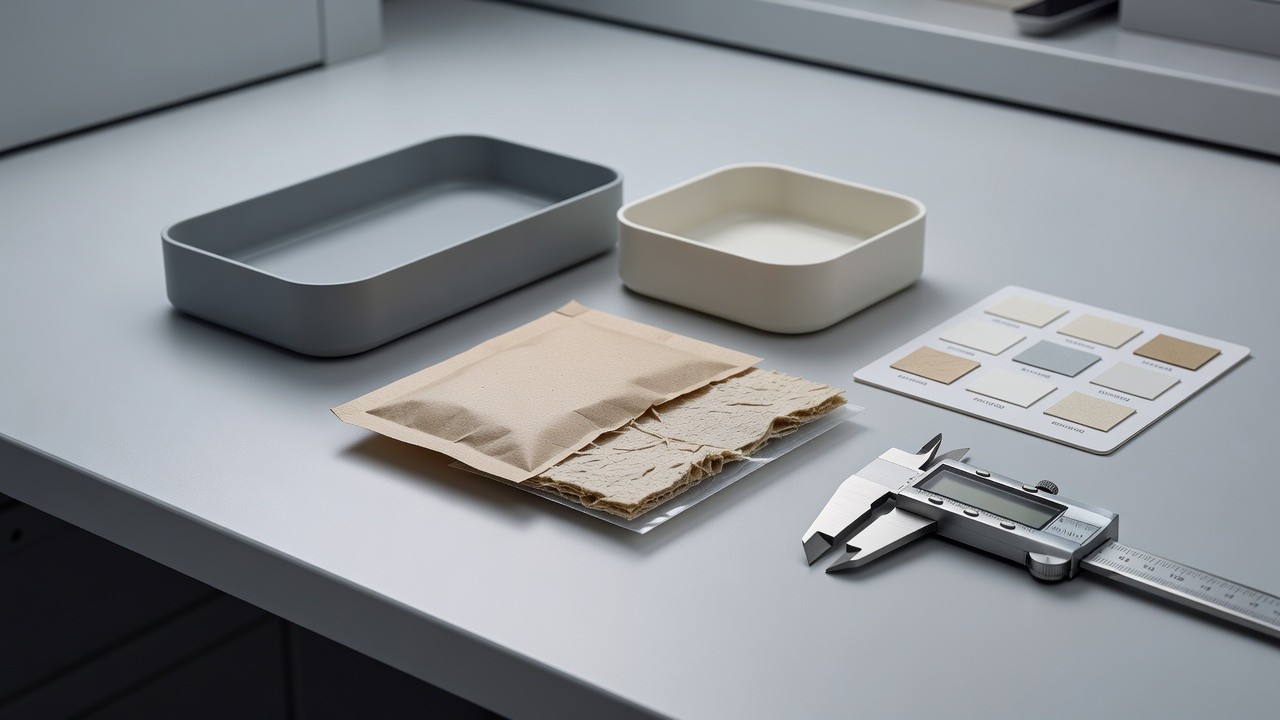
Request these documents from the supplier:
- the current test report showing the exact product code;
- where such a claim is made, the certificate or report identifying the exact standard designation and edition—including BS EN 13432 as reported by Packnet—the certificate holder, tested object and passed criteria;
- a weight and composition table for paper, PLA, adhesive, ink and desiccant material;
- the method and reject rate for any repulpability or recyclability test; and
- supported disposal wording plus evidence of actual acceptance by the relevant municipality, collection operator or contracted recovery system in each market.
The fact that one packaging layer is made from a biodegradable material does not support claims that the complete sachet is home-compostable or recyclable in every paper stream.
Manage Approval in Three States
- Hold: a core test condition, structure or disposal route is unresolved. Make no environmental or equivalence claim.
- Conditional approval: a one-SKU pilot and limited distribution have passed. Lock the scope and operating conditions in the specification.
- Full approval: performance, line, preservation, certification and disposal evidence connect to the product code. Apply market-specific disposal wording and change control.
Conclusion
PLA-laminated packaging paper may be evaluated as an alternative to a conventional PE- or vinyl-coated structure. The reviewed material does not establish a reduction in plastic mass or life-cycle environmental impact. The supplier-reported patent may mark a development milestone, but this review did not independently verify the official patent record. Patent status, absorption testing, compostability certification and local sorting instructions answer different questions.
Replacing silica gel is not a copy-and-paste exercise based on a supplier headline. It requires connecting comparable absorption, wrap durability, finished-product preservation and market-specific end-of-life evidence in one controlled specification. Until all four gates close, “candidate under validation” is more accurate than “drop-in replacement.”
About the Author
PackingMaster: Editor of PaperPackLog. We collect and organize market trends, product information, and technical insights for the paper-packaging industry.