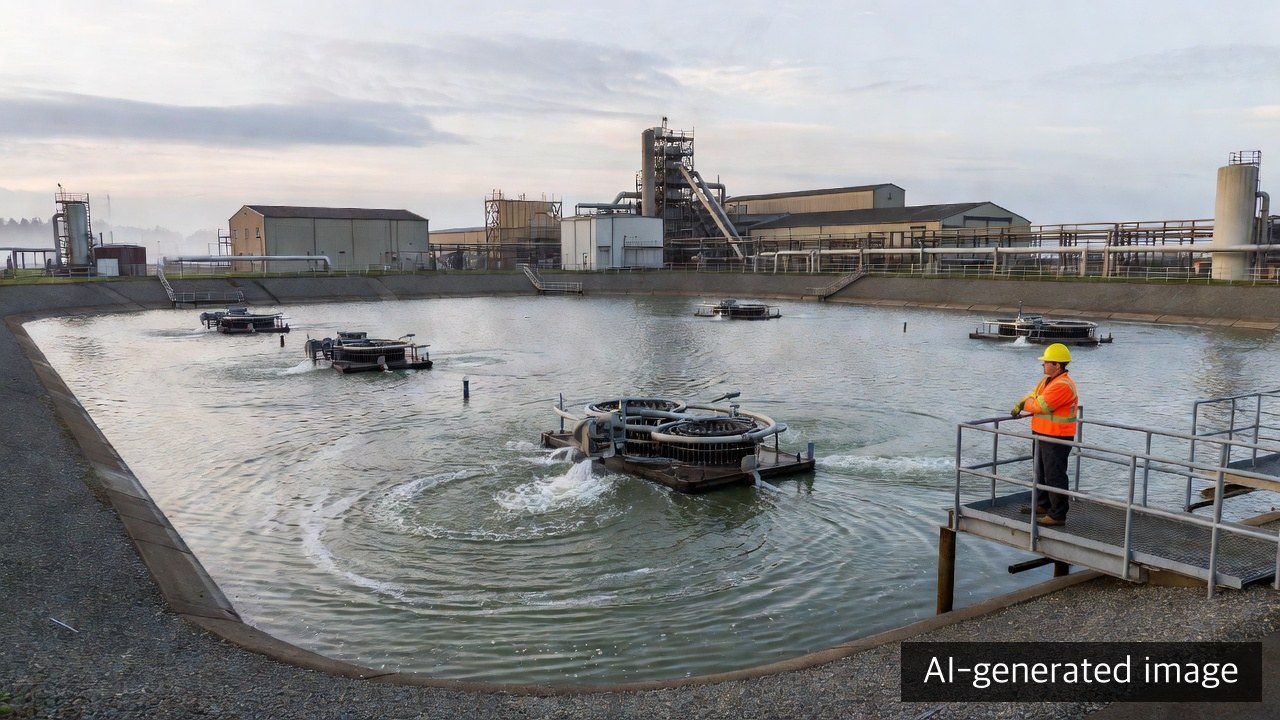
If sludge accumulates in an aeration basin while part of the aeration system is unavailable, reacting only after an effluent problem appears is too late. Paper-mill environmental and maintenance teams need one timeline connecting basin condition, dissolved oxygen, equipment availability, process upsets, and discharge results. This article uses the Port Townsend paper-mill penalty as a case study and provides a copy-ready aeration-basin operating-log checklist.
What happened
On September 16, 2026, the Washington State Department of Ecology announced a $734,000 penalty against Port Townsend Paper Corporation. Ecology said the mill had improperly operated its onsite wastewater treatment system since fall 2025 and violated other water-quality requirements, resulting in increased pollution entering Port Townsend Bay.
Ecology described the following sequence.
| Date | What Ecology reported | Operational meaning |
|---|---|---|
| October 2025 | An unannounced inspection warned that the treatment system was not being properly operated and maintained | Inspection findings need work orders and closure evidence |
| February 2026 | The associated inspection report documented sludge accumulation, bank vegetation, and aeration equipment that was malfunctioning or had been removed | Usable basin volume and equipment availability need trend control |
| April 2026 | Two process upsets sent a reported total of 9,000 gallons of black liquor to the wastewater lagoon | Normal-load and shock-load procedures need to be separate |
| April 2026 | Ecology said the mill violated its permit discharge limits six times after the releases | Influent events, treatment capacity, and effluent results need one incident ID |
| September 16, 2026 | Ecology announced the $734,000 penalty | Long-running operation and maintenance records can become enforcement evidence |
KUOW, quoting an Ecology spokesperson, reported that the agency identified 170 days of noncompliance. Its report said sludge and weeds had reduced the volume and performance of the roughly 30-acre aeration pond, while disconnected or malfunctioning equipment contributed to water with low dissolved oxygen being discharged to the bay, according to the agency.
This is an administrative Notice of Penalty issued by Ecology. Ecology’s release said the company had 30 days from the announcement to pay or appeal to the Washington Pollution Control Hearings Board, and the company announced its intent to appeal. This article does not assume the outcome or decide liability; it examines only the operating-control links in the public enforcement record.

An aeration basin is a connected control system
In an aerated stabilization basin, oxygen supports aerobic microorganisms that break down organic material. Keeping an aerator running is not enough by itself. Treatment performance can change when sludge reduces usable volume, aeration equipment is unavailable, an analyzer reports unreliable data, or a process upset sends black liquor or another high-strength load into the system.
The publicly available Port Townsend Paper wastewater permit includes controls such as:
- continuous dissolved-oxygen monitoring in aeration-basin effluent, with daily averages, the minimum daily average in the reporting period, and monthly averages reported;
- calibration and maintenance of continuous monitoring instruments;
- a daily paper or electronic operations logbook;
- aerated stabilization basin sludge-depth surveys under the operations and maintenance manual, followed by submission of results; and
- proper operation and maintenance of treatment facilities and related equipment.
The useful control chain is therefore not one instrument reading. It is basin condition → equipment availability → influent load → instrument reliability → effluent result → verified closure on the same timeline.
Copy-ready aeration-basin operating-log checklist
The fields and actions below are an editorial operating template, not permit requirements in themselves. Legal duties follow the express wording of the permit applicable to each facility and its approved operations and maintenance (O&M) manual. Use date, time, shift, author, instrument ID, incident ID, action owner, and due date as common header fields. Populate limits and trigger values from the site’s permit, approved O&M manual, design criteria, and internally approved operating envelope; do not copy a value from a news report or another facility.
| Control axis | Record and inspection fields (frequency per permit and O&M manual) | Trigger | Immediate action | Closure evidence |
|---|---|---|---|---|
| Usable basin volume | Sludge depth, survey date and point, bank and vegetation condition | Changed accumulation rate, missed survey, concern about lost volume | Repeat measurement, plan removal, assess treatment-capacity effect | Survey map, before-and-after photos, removed quantity, completion date |
| Aeration equipment | Units running and unavailable, current, vibration, sound, alarm code | Unit trip, equipment removed or taken out of service, repeated alarm, standby unavailable | Start standby unit, issue work order, assess load and effluent effect | Closed work order, commissioning readings, restoration time |
| Dissolved oxygen | Continuous trend, daily average, minimum daily average for the reporting period, analyzer status | Failure to meet permit monitoring or reporting requirements, data gap, excursion from an O&M or internally approved alert value, or rapid decline | Cross-check analyzer, verify calibration, adjust aeration and load | Calibration record, before-and-after trend, approver |
| Influent load | Flow, pH, process upset, black-liquor or chemical entry | Abnormal flow or pH, process release, abrupt color or foam change | Identify source, evaluate approved process-stream isolation or storage procedure, notify production | Incident ID, volume estimate, valve and process restoration evidence |
| Effluent | Permit parameters, sample time, laboratory and analyzer status | Internal warning level, permit exceedance, recurring adverse trend | Determine reporting need immediately and notify in parallel; take an additional sample and conduct environmental review when required | Laboratory result, report ID, corrective action |
| Record completeness | Shift log, alarms, work orders, calibration, sampling history | Missing period, no owner, unresolved action | Complete before handover and assign unresolved action | Electronic approval and linked work order or test result |
The most important column is “closure evidence.” Entries such as “checked,” “no issue,” or “action planned” do not show that equipment was restored, capacity recovered, or effluent performance stabilized.
Permit reporting decisions and notifications must proceed in parallel with the technical investigation and must not be delayed by an internal approval step. In particular, Section S4.C of Port Townsend Paper’s NPDES Permit WA0000922 generally prohibits treatment-facility bypasses. A bypass is not an operator-discretion response unless S4.C expressly allows it, such as essential maintenance that causes no permit violation, or Ecology has approved an anticipated bypass.
Read dissolved oxygen together with equipment condition
When dissolved oxygen declines, turning on one additional aerator and closing the event can miss the real cause. Use the sequence below to investigate the technical cause, but make any permit-reporting decision and notification in parallel rather than waiting for the sequence to finish.
- Measurement confidence: check sensor fouling, calibration status, data gaps, and the difference from a field measurement.
- Aeration availability: confirm actual units running, electrical load, vibration, airflow or surface mixing.
- Influent change: overlay flow, pH, temperature, process upset, and high-strength-load timing.
- Basin condition: review sludge depth, vegetation, potential short-circuiting, and lost usable volume.
- Effluent response: connect permit-parameter trends with the actions taken, and record the time and outcome of the parallel reporting decision and notification.
Port Townsend Paper’s NPDES Permit WA0000922 addresses not only continuous dissolved-oxygen monitoring but also instrument calibration and daily operations records. Saving a trend line without the sensor condition, equipment fault, process event, and linked work order makes later incident reconstruction difficult.
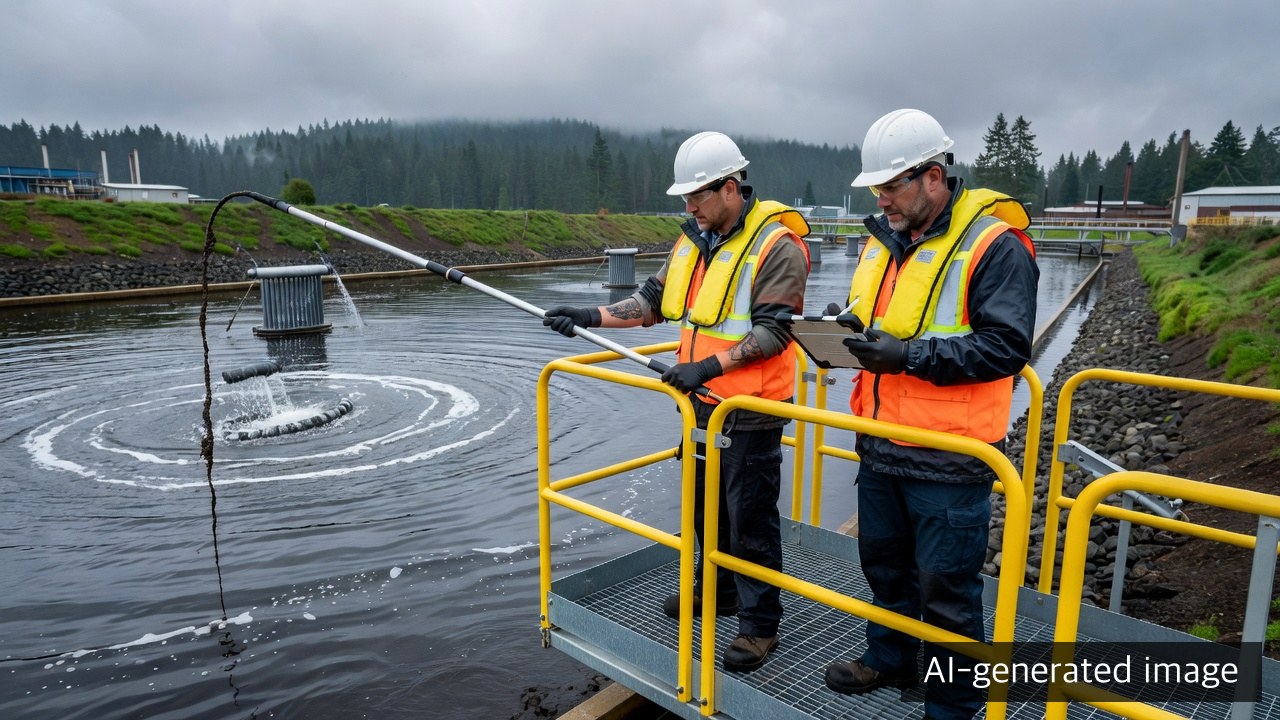
Handover fields when a process upset reaches wastewater treatment
Black liquor or another high-strength process stream entering wastewater treatment is not solely an environmental-department issue. Production, maintenance, and environmental staff need one incident record.
| Handover field | Production records | Wastewater operator records | Decision and action |
|---|---|---|---|
| Start and stop time | Process upset, isolation, and restoration times | Time the influent change was detected | Reconcile the two timelines |
| Material and estimated amount | Material, concentration or estimation basis, release path | Influent flow, pH, color, and foam change | Assess shock-load size and duration |
| Isolation and storage status | Valve, tank, and recovery-line status | Whether entry to the lagoon continues | Decide an approved process-stream isolation or storage action; treatment bypass is governed separately by the permit |
| Treatment capacity | Ability to reduce or stop production load | Aeration availability, basin condition, instrument confidence | Adjust production load or increase monitoring |
| External reporting | Internal contact and contact time | Permit notice and reporting requirements | Record who reported what and when in parallel with the technical investigation |
Do not invent thresholds for this table. Reporting triggers, sampling frequency, bypass conditions, and discharge limits must come from the applicable permit and approved procedures. Internal contact or approval must not be treated as a prerequisite that delays a statutory reporting clock.
Audit questions raised by the case
- Were sludge-depth surveys completed at the required frequency, and did rising accumulation lead to verified removal?
- When aeration equipment was removed, failed, or stopped, was standby capacity and effluent impact documented?
- Can reviewers see continuous dissolved-oxygen data gaps, calibration, and field cross-checks in the same record?
- Does production notify wastewater and environmental staff before an upset reaches the treatment system?
- Do inspection findings close through work order, repair, commissioning, and stable effluent confirmation?
- Are the reporting owner and timing clear for permit violations or credible risk conditions?
Four documents can be checked today: the latest sludge-depth survey, aeration-equipment operating and maintenance history, continuous dissolved-oxygen trend with calibration record, and the most recent process-upset handover. Put them on one timeline. Any blank period should receive an owner and a defined piece of closure evidence.
About the Author
PackingMaster: Editor of Paper Pack Log. We collect and organize market trends, product information, and technical insights for the paper packaging industry.
References
- Washington State Department of Ecology, $734,000 fine issued to Port Townsend paper mill
- Washington State Department of Ecology, Port Townsend Paper permits and documents
- Washington State Department of Ecology, Port Townsend Paper Corporation NPDES Permit WA0000922
- KUOW, Port Townsend paper mill hit with $734,000 pollution penalty
- Peninsula Daily News, Ecology fines Port Townsend paper mill $734,000