
EU PPWR (Packaging and Packaging Waste Regulation) has hit the D-70 mark ahead of its 2026-08-12 application date. At this stage, two questions dominate the inbox of Korean export-packaging suppliers: (1) “does our packaging meet PPWR?” and (2) “how do we prove it?” The first can be answered at the grade, material, and label level. The second cannot be answered without a documentation package.
This post does not repeat the general PPWR explainer (see “EU PPWR August 2026 Countdown” and “PPWR/ESPR Summary”). Instead, in line with the way PPWR has settled toward proof, not promises, it walks through the six documentation packages a Korean export-packaging supplier should keep at the SKU level.
The ‘proof not promises’ Direction
Reading the PPWR text, EU Commission guidance, and member-state transposition drafts together, the direction is increasingly clear.
- “It is recyclable” -> needs to be paired with test reports and recycling-line assessment data
- “X% recycled content” -> needs traceability evidence for recycled material (supplier records, claim wording)
- “Reusable packaging” -> needs reuse-system operating evidence plus rotation data
- “Compostable” -> needs conformity test reports against standards such as EN 13432
- “Environmental claims” -> the claim wording must be checked across labels, quote sheets, product pages, and advertising
The exact form of evidence each item requires varies slightly across member states, the EU Commission, and CEN standards, but the requirement for a documented evidence package is shared across all of them. The point in time when Korean export-packaging suppliers should be organizing this at the SKU level is now.
Six Documentation Packages for Export Packaging
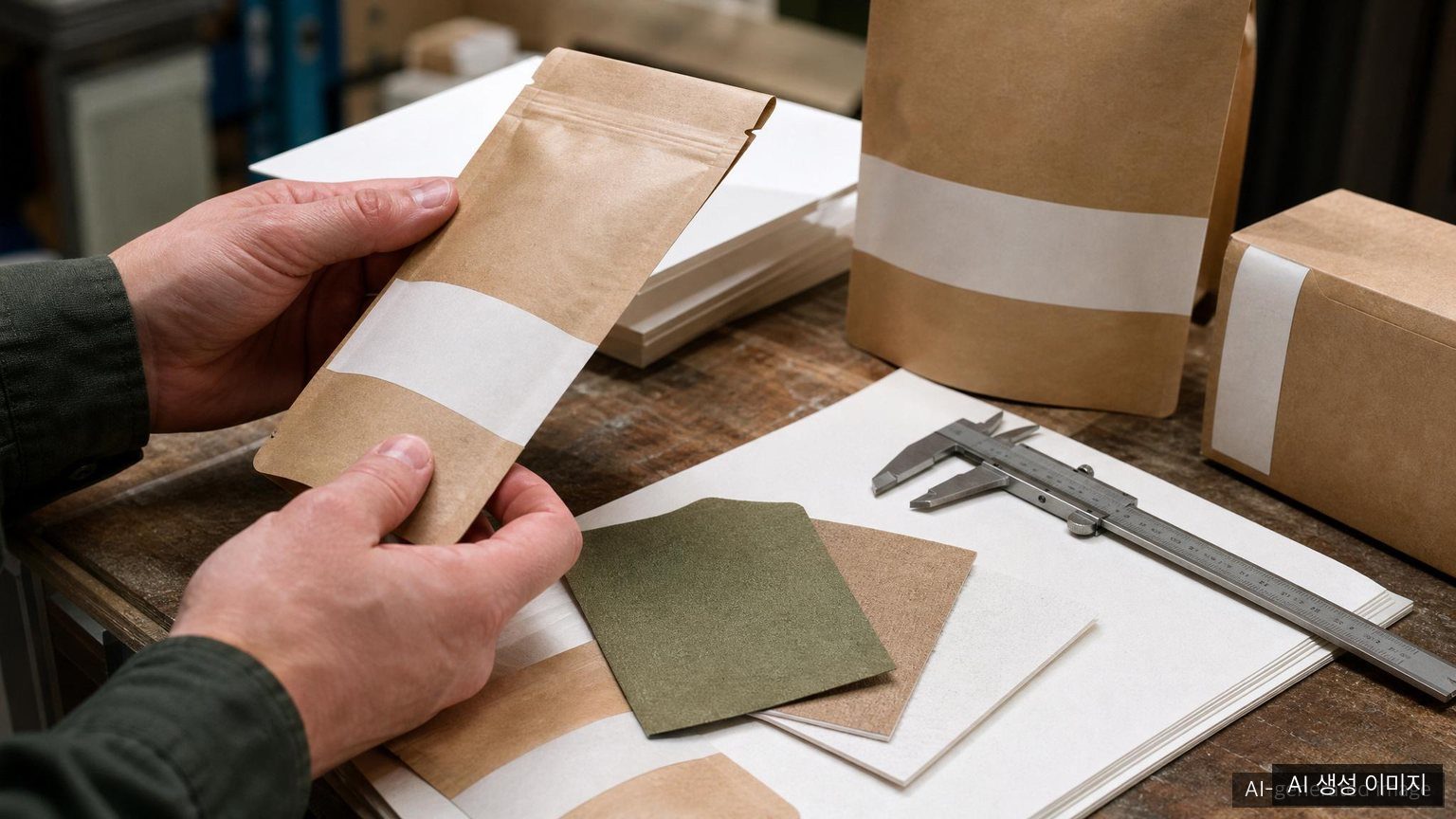
Package 1: DoC (Declaration of Conformity)
A statement of conformity prepared by the manufacturer or importer for packaging covered by PPWR. It typically includes:
- Manufacturer/importer information plus responsible-person signature
- Applicable regulations (PPWR articles and standards)
- Packaging identification (SKU, material, grade)
- References to test and assessment reports
- Issue date and validity
This is the first document requested at the EU market-entry stage. Korean head offices working with EU converters and importers should decide upfront who issues it.
Package 2: Test and Assessment Reports
- Recycling-line conformity assessment (4evergreen guideline, CEPI Recyclability Lab Test Method, etc.)
- ECT/BCT/Compression (see “ECT/BCT/McKee Overview”)
- EN 13432 and equivalents for compostable items
- Material-level separability testing
Test reports are typically treated as valid for one year, but they need to be refreshed whenever material or structure changes. Maintain an “SKU to test report” mapping sheet next to the report files.
Package 3: Supplier Documentation Package
- Recycled-content, FSC/PEFC, and basis-weight records from base-paper suppliers (liner, fluting, white top)
- Records from film, coating, adhesive, and ink suppliers
- Mass balance or other traceability documentation where recycled materials are used
- A standard supplier-document request form (see “Supplier Document Request Package”)
The harder PPWR gets, the more supplier-document consistency drives head-office documentation consistency. Standardize form, language, and claim wording when receiving supplier records.
Package 4: Label and Claim Documentation
- Label design files (including EU separate-collection pictograms and material codes)
- A list of environmental claims used in quote sheets, product pages, and advertising
- A mapping of each claim to its supporting evidence (test reports, supplier records, certificates)
- Label change history
Claims should not be written as a generic “eco-friendly.” They should read as concrete, evidence-backed phrases such as “recyclable (EU line basis),” “FSC-certified base paper,” or “30% recycled content.”
Package 5: Recycled-Content Reporting Records
- Calculation basis for recycled-material share (supplier records, mass balance)
- Calculation method (weight-based, volume-based, or mass balance)
- Verification or certification (third-party verification where possible)
- Reporting timing (PPWR member-state reporting cycles)
PPWR ramps the recycled-content obligation in stages. We are just before application now, but once the reporting cycle starts, the records have to be ready for immediate submission.
Package 6: Reuse/Refill Operating Records (applicable SKUs only)
For SKUs that operate as reuse or refill packaging, prepare:
- Operating model of the reuse system (closed loop or open loop)
- Return, cleaning, and re-supply data
- Safety and hygiene test records
- Rotation-rate (reuse cycle) data
If reuse does not apply, this package can stay empty. State “not applicable” explicitly on the SKU mapping sheet.
Four Things Often Missed in Practice

1. Treating a ‘certificate’ as ’evidence’
Holding an FSC/PEFC certificate or an ISO certificate does not automatically convert into PPWR evidence. The scope of the certificate, which SKUs it links to, and whether the claim wording sits inside that scope all need to be documented together (see “FSC/PEFC Quote Guide”).
2. Mismatched wording between the label and the quote sheet or website
We see cases where the label reads “recyclable” while the company website says “100% biodegradable.” Claim wording has to be bundled into one standard. Sales, marketing, and legal should all read from the same claim-wording standard.
3. Inconsistent language and format in supplier documents
The base-paper supplier sends an English PDF, the film supplier sends a Korean Excel file, and the adhesive supplier sends a Japanese sample. Re-request supplier documents in a standard English form, or have the Korean head office attach an English translated copy.
4. Stacking files without an SKU mapping sheet
The problem is rarely missing documents; it is more often not knowing where they are. Without an SKU mapping sheet, a request like “send the PPWR DoC copy for product A” cannot be answered immediately. A single sheet is the starting point for the six packages.
What to Actually Do from June Through September
- June: Standardize the SKU mapping sheet plus the folder structure for the six packages (top 20 SKUs first).
- July: Finalize the DoC template; issue the standard English supplier-document request form.
- Late July: Joint review of labels and claim wording (sales, marketing, and legal in one meeting).
- Early August: Refresh the test and assessment reports; issue the first DoC batch (limited to in-scope SKUs).
- Mid to late August: Right after PPWR application, track which documents EU buyers and converters actually request.
- September: First operating review. Update the six-package standard.
Conclusion
PPWR is not a regulation that ends with adding an “eco-friendly” line to the label. Every line of claim wording must be linked to test reports, supplier records, certificate scope, and label design history. For Korean export-packaging suppliers, standardizing the six packages (DoC, tests/assessments, supplier records, label/claims, recycled content, reuse/refill) at the SKU level is the fastest way to cut response costs in the EU market right after PPWR applies.
A single K-food export checklist that handles PPWR and California SB 54 together is covered in “EU PPWR x California SB 54 Dual Regulation”. Reading both posts shows how the same documentation can be reused across the two regimes.
About the Author
PackingMaster: Editor of PaperPackLog. Curates and organizes market trends, product information, and technical insights for the paper-packaging industry.
References
- EUR-Lex, Regulation (EU) 2025/40 (PPWR) — https://eur-lex.europa.eu/eli/reg/2025/40/oj
- Background — European Commission, Packaging and Packaging Waste — https://environment.ec.europa.eu/topics/waste-and-recycling/packaging-waste_en